You juggle a lot. Child care is expensive, spots are scarce, and a single sick day can undo a carefully planned week. That pressure shapes household budgets and career decisions, not just your calendar.
This guide is about the parts you can actually control. You will find home routines that cut daily friction, benefits that lower your child care bill in 2026, and ways to be judged at work on results instead of hours at a desk.
The goal is not a perfect schedule. It is fewer frantic scrambles and systems that survive a bad week.
For broader systems that sit around all of this, see our work-life balance resources.
Key Takeaways
- Child care averaged $13,184 a year in 2025, so benefits and subsidies are worth the paperwork.
- Two federal changes take effect in 2026: a $7,500 dependent care FSA limit and a bigger child care tax credit.
- Repeatable anchor routines beat willpower for mornings, after school and bedtime.
- Written outcomes protect you against face-time bias when office policies tighten.
- Measure success by calmer mornings and steadier family time, not by hours logged.
Why Balance Matters Now for Working Parents
Child care is now one of the largest line items in a family budget, and it quietly shapes which jobs parents can take.
Child Care Aware of America put the national average price of child care at $13,184 per year in 2025. That is about 10% of median income for a two-parent household and roughly a third of median income for a single parent. For families with two children in care, the bill beats median rent in every state with available data.
Supply has not caught up either. Between 2024 and 2025 the number of licensed child care centers fell by about 1%, while smaller family child care homes grew by 1.4%. Help exists, but it reaches few people: only 15% of children eligible for federal child care assistance actually receive it.
The career effect is measurable. Research from the Center for American Progress, based on the National Survey of Children’s Health, found that more than two million parents of children aged five and under (about one in ten) had to quit a job, turn one down, or change it substantially because of child care problems.
“Child care is not a side issue for your career. It decides which shifts, roles and promotions are realistically open to you.”
- Cost is the main constraint, and it competes directly with rent and savings.
- Scarcity turns small disruptions, like one closure, into lost workdays.
- Public programs such as CCDBG and Head Start exist, but most eligible families never reach them.
Time-Smart Home Systems That Save Your Day
Repeatable rituals protect the minutes that matter most. A routine you do not have to think about removes dozens of small decisions, which is exactly what tired parents run out of first.
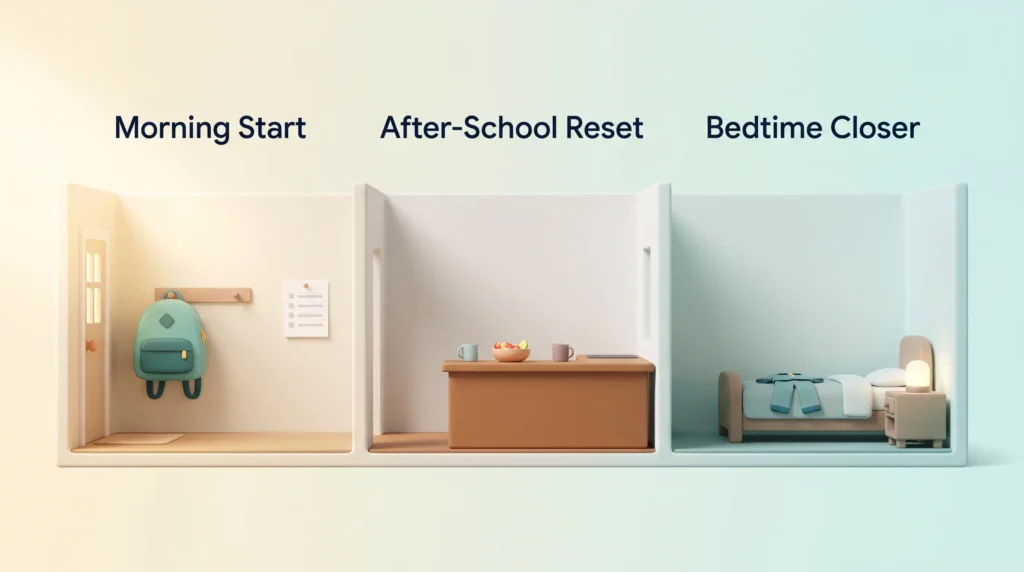
Anchor routines: morning starts, after-school resets, bedtime closers
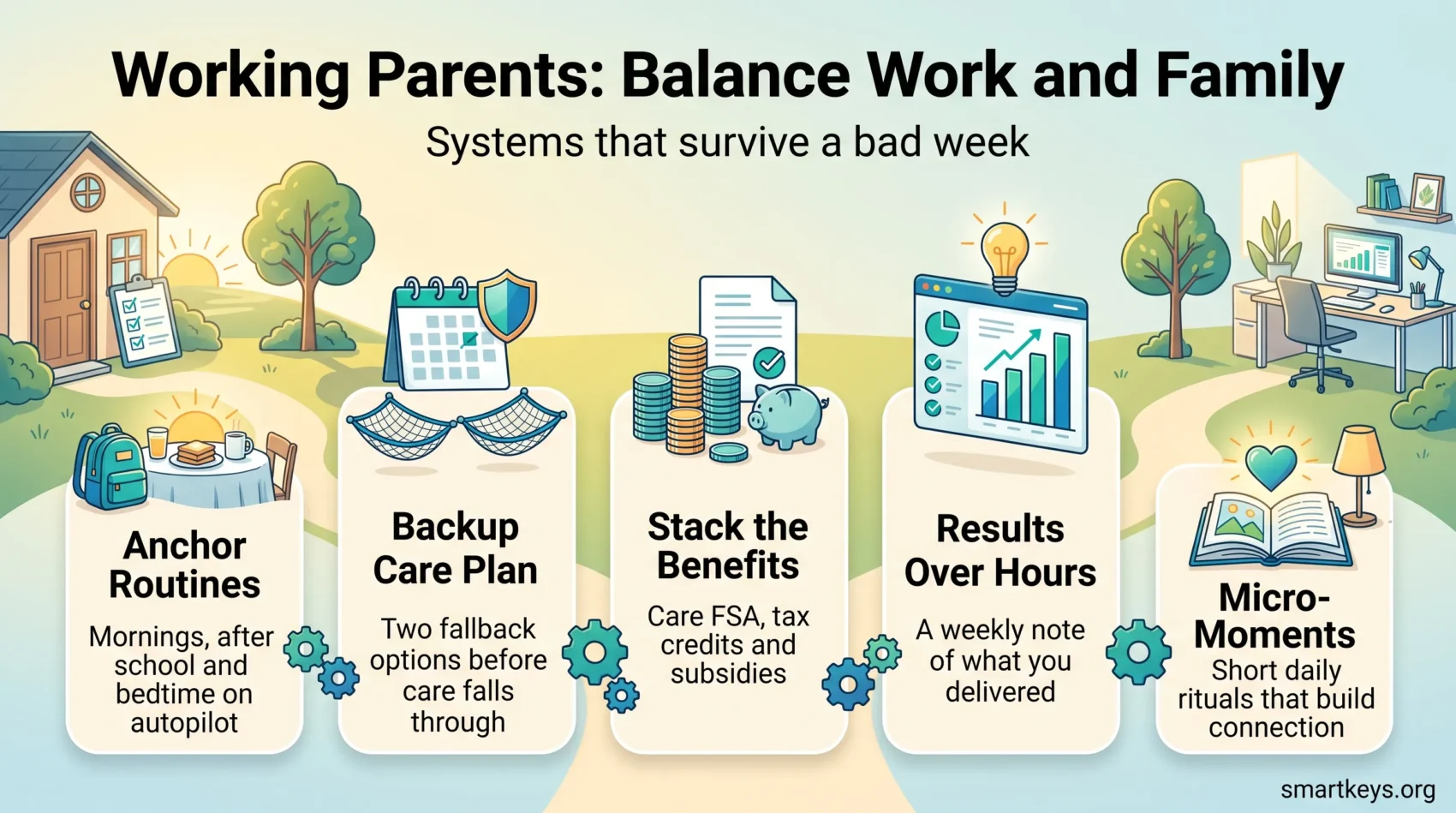
Prep the night before: bags packed, outfits picked, one shared departure checklist by the door. On days when you can, wake 15 minutes earlier so breakfast includes actual conversation rather than a countdown.
After school, use a short reset instead of jumping straight to homework. A five-minute snack and chat, a walk around the block, or one song of dancing gives everyone a clean break between school mode and home mode. A predictable bath and bedtime sequence then cuts most evening negotiation.
Switching gears: end-of-work rituals
The hardest transition for many parents is the one between work and home, especially when both happen in the same room. Build a two-minute closer: shut the laptop, silence notifications, write tomorrow’s first task on paper, then walk into family time on purpose. Our guide to setting boundaries at work covers how to make that stick when colleagues expect instant replies.
- Make routines visible on a whiteboard or shared app so nobody is the sole keeper of the schedule.
- Batch similar chores (meals, laundry, school forms) into set slots. Our guide to email batching applies the same logic to your inbox.
- Use micro-moments: one good question in the car line, or co-cooking a side dish during dinner prep.
- Protect one uninterrupted work block a day with a focus time policy or simple time blocking, so the hours you do have at your desk count.
Child Care, Access and Money: Your Options in 2026
Knowing your options is what turns an unaffordable bill into a manageable one. Start by mapping local care, then stack every form of financial help you qualify for.
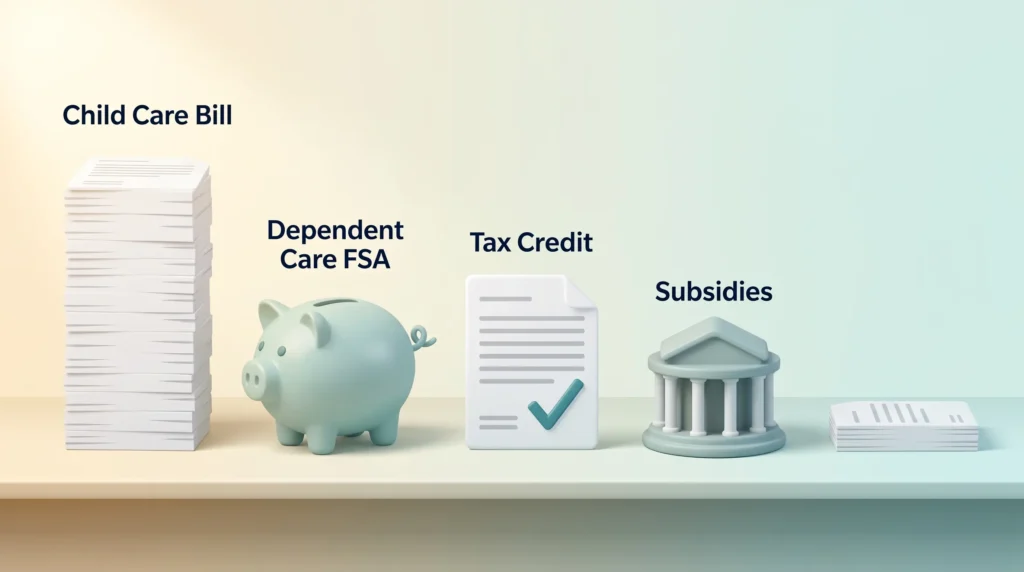
Care settings and backup plans
Center-based daycare, licensed in-home care, nanny shares, parent co-ops and employer-backed backup care each trade cost against flexibility. Centers offer reliable hours and oversight. Home-based care is often cheaper, but one provider falling ill closes your care for the day.
So the backup plan matters more than the primary choice. Line up two options in advance: someone who can cover a morning, plus a drop-in center or backup care benefit. Without one, every closure becomes a last-minute negotiation with your manager.
What changes in 2026: two federal money levers
Two changes from the One Big Beautiful Bill Act take effect in 2026.
The dependent care FSA limit rises to $7,500. A dependent care FSA lets you set aside pre-tax salary for child care. The cap had been stuck at $5,000 since 1986, apart from a temporary pandemic increase. From 1 January 2026 it is $7,500 for single filers and joint filers, and $3,750 for married filing separately. If your employer offers one, it is the largest single lever most families have.
The child and dependent care tax credit gets bigger. Starting with the 2026 tax year, the maximum credit rate rises from 35% to 50% of qualifying expenses. The full 50% applies at the lowest incomes and steps down as income rises, with higher earners still receiving 20%. You cannot claim the same dollars through both an FSA and the credit, so it is worth running both numbers before you enroll.
Public programs worth checking
CCDBG (the Child Care and Development Block Grant) funds state subsidies for lower-income families with children under 13. Congress funded it at $8.831 billion for fiscal year 2026, an $85 million increase that does not keep pace with inflation. Eligibility and waitlists are set state by state, so check your state agency rather than assuming you do not qualify.
Head Start and Early Head Start provide free early learning, health and nutrition services for children from birth to age five in low-income families, with funded enrollment of about 716,000 places in fiscal year 2024. MIECHV funds voluntary home visiting by a nurse or trained educator during pregnancy and early childhood.
What to ask your employer
Ask HR three questions: is there a dependent care FSA, is there a backup care benefit or child care stipend, and what flexibility is formally allowed rather than informally tolerated. Written flexibility survives a change of manager. A clear hybrid work policy beats a vague promise, and our overview of how employee benefits are changing shows what is realistic to request.
“A backup plan and a written flexibility agreement turn unpredictable days into manageable ones.”
Make Every Moment Count with Your Children
Short, reliable touchpoints do more for connection than rare big events. They also fit into a workday, which is why they actually happen.
Micro-moments that matter
Start with a one-question breakfast check-in: what is the main thing happening today. It takes a minute and lets your child head out feeling noticed. When the morning is already rushed, ten slow breaths together works better than another instruction.
- Add a five-minute dance break when energy dips and let your child pick the song, so it feels like theirs.
- Treat bath time as a low-pressure talking slot rather than a task to finish.
- Close the day with the same three steps: read for ten minutes, share one good thing and one worry, then preview tomorrow so bedtime is not the first time your child hears about it.
Keep a family wish list of small activities and cross them off together. Open questions and real listening turn two minutes into something your child remembers. If evenings keep getting eaten by chores, our guide to delegating effectively works at home as well as at work, and a repeatable evening routine gives the day a proper end.
For more ways to protect family time, see our work-life balance resources.
Workplace Realities: Bias, Return to Office and Belonging
Bias at work is rarely announced. It shows up as who gets remembered when a project is assigned.

Closing the perception gap
Face-time bias is the tendency to reward visible presence over actual results, and it penalizes anyone whose schedule is shaped by care duties. The countermeasure is documentation. Send your manager a short weekly note of what you shipped, what moved and what is next. That shifts the conversation from hours to outcomes. Our article on proximity bias covers how this plays out in hybrid teams, and outcome-based work explains the alternative model.
Return-to-office transitions
Office attendance rules have tightened in many companies, so it helps to negotiate with numbers rather than feelings. Working from home saves an average of 72 minutes of commuting a day, according to a 27-country study by Aksoy, Barrero, Bloom, Davis, Dolls and Zarate published in the AEA Papers and Proceedings. For a parent, that is roughly the length of the whole after-school window.
Propose a pattern rather than an exception: core collaboration days in the office, focused work at home, and pickup blocks marked in a shared calendar. Our guide to return-to-office mandates covers what is negotiable in practice.
Inclusive support at work
Employer support is moving, though unevenly. In SHRM’s 2026 Employee Benefits Survey, 46% of employers offered paid parental leave, up 7 percentage points from 2025, and 36% offered paid family leave, up 5 points. At the same time, flextime during core hours fell by 6 points and hybrid work by 3 points. Leave is improving while day-to-day flexibility is being squeezed, which is exactly the trade-off parents feel.
- Join or start a caregiver employee resource group so requests come from a group rather than one person.
- Ask for lactation rooms, backup care and a vetted provider list. These are cheap for employers and valuable for parents.
- Include families of children with disabilities by linking to specialist resources and allowing appointment-heavy weeks. See our guide to accessible remote work and to neurodiversity at work.
Protecting Your Own Energy
A calm parent makes a calmer home, and self-care here means maintenance, not indulgence.
Small habits that hold up on bad days
Pick recovery habits short enough to survive a difficult week: a ten-minute walk, a few minutes of structured breathing, or a two-line journal entry at the end of the day. Consistency beats duration. Our guides to preventing burnout and to movement breaks cover what to do when the week goes sideways anyway.
Where to find support
Many employers run an Employee Assistance Program (EAP) offering short-term counseling, parenting consultations and referrals, usually free and confidential. Schools have counselors, and in the US a 504 plan or IEP can formalize support for a child who needs it.
Share the load deliberately. Trade rides, meals or an hour of care with other families. Reciprocal arrangements last longer than one-sided favors, and they build the network you need the next time care falls through.
Conclusion
Small systems compound. Anchor routines at home, one protected work block a day, and written outcomes at work beat any single productivity trick.
On money, 2026 gives working parents two levers: the dependent care FSA limit rising to $7,500 and the child and dependent care credit rising to a maximum of 50%. Check both, plus your state CCDBG program and Head Start eligibility, before deciding that quality care is out of reach.
At work, ask for flexibility in writing and document your results. Then measure progress by how the week feels: fewer frantic mornings, a backup plan you have not had to improvise, and predictable time with your children.
Found this useful?
Make SmartKeys a preferred source on Google, and our articles will surface more often in your Top Stories, AI Overviews, and AI Mode.
Add as Preferred Source