You want a workforce that keeps operating when someone is off sick, resigns, or the workload suddenly doubles.
Cross-training means teaching an employee to do parts of a colleague’s job while keeping their own. The bookkeeper learns to run payroll. The support agent learns to process refunds. Nobody changes role, but the team stops depending on one person for any critical task.
That matters more in 2026 than it did a few years ago. The World Economic Forum’s Future of Jobs Report 2025 estimates that nearly 40% of the skills a job requires will change by 2030, and that 59 out of every 100 workers will need reskilling or upskilling in that window. Roles are not just being replaced. They are quietly changing shape underneath the people doing them.
The cost side also favours training. SHRM puts the average cost per hire at nearly $4,700, and notes many employers estimate the full cost of a new hire at three to four times the salary of the role. Training someone you already employ is usually cheaper.
Key Takeaways
- Remove single points of failure: Train the tasks that stop the business when one person is unavailable.
- Tie learning to outcomes: Every training hour should map to a coverage gap.
- Keep it hands-on: Shadowing plus supervised practice beats a slide deck.
- Protect the day job: Short blocks and time-limited rotations prevent overload.
- Prove it: Track coverage readiness and error rates, not attendance.
Why Cross-Training Matters Right Now
When people can cover each other’s work, absences cost you delay instead of chaos.
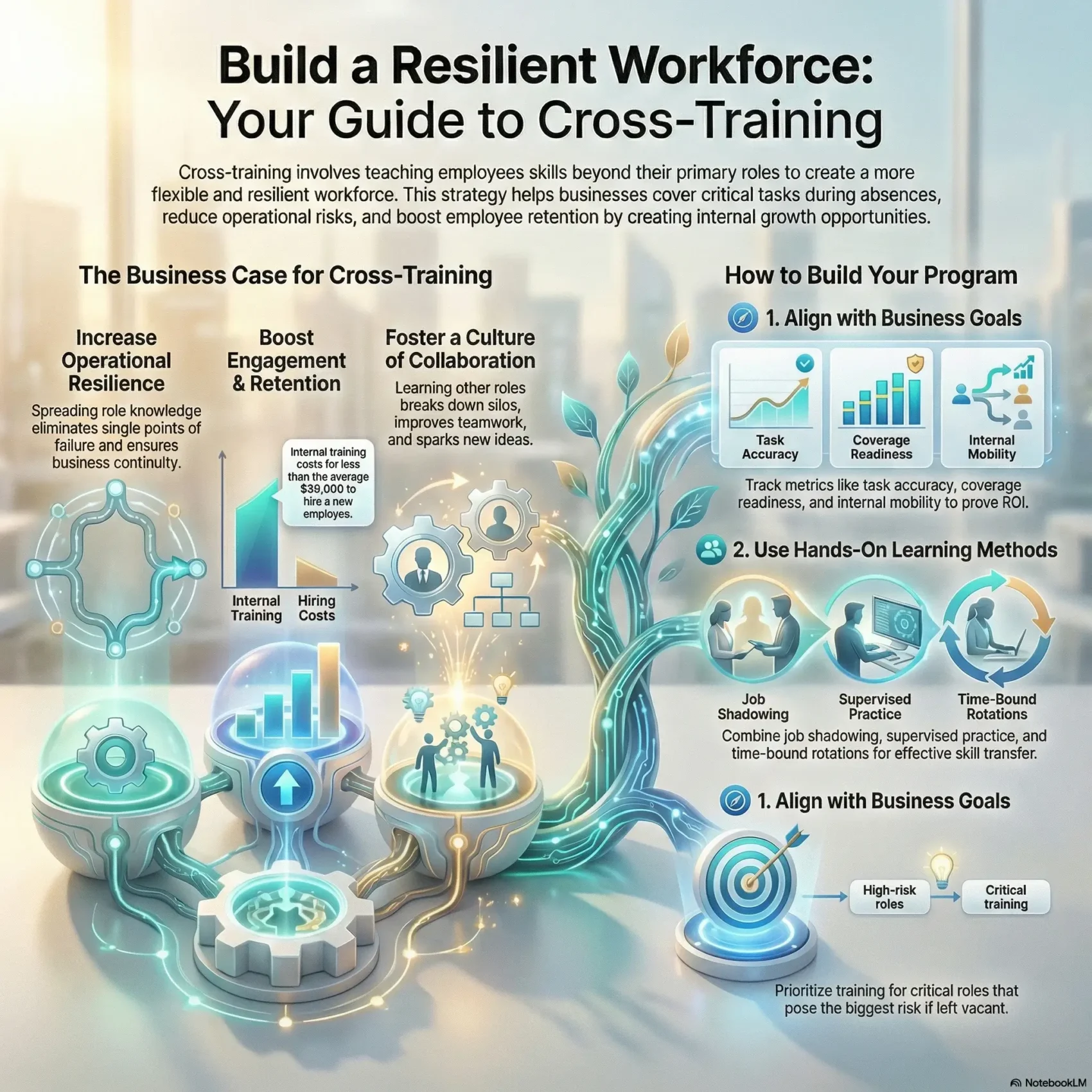
Spread role knowledge so the work continues when someone is out. If only one person knows how to close the month-end books, that person’s holiday is a business risk. Two trained people turn it into a scheduling detail.
The second benefit is less obvious. People who have seen an adjacent job spot the friction between the two. A support agent who has watched the billing process stops raising tickets that billing cannot act on. That fix comes from someone who has sat in both seats, not from a process review.
There is a retention angle too. LinkedIn’s 2025 Workplace Learning Report found that only 36% of organizations have fully embraced career-driven learning, and that 45% of employees say they do not get enough career guidance. Cross-training is a cheap way to show someone a path that does not require leaving; see our guide to talent retention strategies.
Keep the learning tied to real tasks. Formats that fit around a working day, such as microlearning built into the workflow, hold up better than a day-long workshop nobody can attend, and VR employee training covers the more immersive end.
What Cross-Training Is and What It Is Not
Cross-training adds a second competence. It does not hand someone a second job.
Definition: cross-training teaches an employee to perform specific tasks from another role while their own role stays the same. The goal is coverage of defined tasks, not a full role swap.
The shape you are aiming for has a name. A T-shaped person has deep expertise in one area, the vertical stroke of the T, plus enough working knowledge of neighbouring areas to collaborate with them. Design firm IDEO popularised the idea; its former CEO Tim Brown described hiring for exactly that profile. In practice your best analyst still does analysis, but can brief a designer without a translator in the room.
Where it pays off
Cross-training earns its cost when a task is critical, done by few people, and hard to hand over at short notice: month-end close, payroll, incident response, key-account handover, regulatory reporting. It also feeds internal mobility, the practice of filling open roles from existing staff rather than the external market. An internal talent marketplace works better when people already have adjacent experience.
Common drawbacks and how to fix them
Three things go wrong most often. People get overloaded because training was added on top of a full workload. Learners lose depth in their own specialism because rotations ran too long. And staff read the whole thing as preparation for redundancies. The fixes: cut other work during the training period, time-limit every rotation, and state the purpose in writing before the program starts.
How to Build a Cross-Training Strategy From the Ground Up
Start with the risk map, not the training catalogue.
Find the single points of failure. List the tasks that would stall if one named person were unavailable for two weeks. That list, not a generic skills framework, is your training backlog. A structured skills gap analysis makes the exercise repeatable across departments.
Rank by operational impact. A delayed marketing report is inconvenient. A missed payroll run is not.
Match willing people to real gaps. Someone who wants the exposure learns faster than someone assigned to it. Where career conversations already happen, such as in continuous performance management, is the natural place to raise it.
Prepare the trainers. Your best performer is not automatically a good teacher. Pick people with patience and the willingness to let a learner make a recoverable mistake, then give them a template covering scope, milestones, and what the learner should do unsupervised at the end. Mentorship matching platforms help at scale, but a spreadsheet is enough to start.
Two rules keep it sane: use short, regular blocks, and define what “trained” means per task.
Designing the Program for Real-World Performance
Turn learning goals into steps someone can follow on a Tuesday morning.
Write the SOPs first. A standard operating procedure is a written, step-by-step description of how a task gets done. Without one, every trainer teaches a slightly different version and quality drifts. Good SOPs are also the backbone of wider knowledge management, so the work pays off twice.
Use job rotation without losing specialization
Job rotation means moving someone into a different role for a fixed period, then moving them back. Keep it time-bound, with a defined return date. Open-ended rotations are how people lose their edge. Mapping the moves onto a career lattice, where sideways steps count as progress, makes the logic clear to everyone involved.
Blend shadowing with supervised practice
Start with shadowing so the learner sees the task done properly. Then have them do it with the trainer watching. Then alone, with the trainer available. Checklists carry them through the middle stage. This is the same sequence that makes remote onboarding work, and it fails for the same reason when skipped.
Build in the collaboration touchpoints
Schedule short check-ins where learner and trainer compare notes. This is where process improvements surface, and it matters most in multigenerational teams, where knowledge flows in both directions at once.
Using a Cross-Training Plan Template to Scale It
A light, repeatable plan lets you run this across teams without adding an administrative layer.
A spreadsheet is enough. Build a row per learner covering the tasks being learned, the assigned trainer, start and target dates, scheduled practice, the definition of “independent” for each task, and the learner’s stated interests. That last column predicts completion better than any other.
For each task, pick one to three metrics that already exist: time to resolve a ticket, error rate on a form, on-time completion of a run. Do not invent new measurement work. Workforce analytics tools can pull most of it automatically once the program grows.
Worked example. You need a payroll backup. The tasks are time-entry validation, the payroll run, and exception handling. The learner shadows one cycle, runs the next with supervision, and runs the third alone with the trainer on call. Success is one full cycle on time with zero corrections. Total cost: roughly six hours across three months. A written hybrid work policy follows the same principle: write the rule down, then let people work.
Measuring Outcomes and Keeping the Program Alive
Track whether the coverage is real, not whether the training happened.
Pick metrics that describe capability
Attendance is not a result. The useful measures are task accuracy, time to complete, and coverage readiness: can this person do the critical steps alone, today, without asking? Test it while the usual owner is genuinely unavailable. Measure at two levels: individual mastery says one person is ready, coverage depth across the team says the business risk has dropped.
Use reviews, feedback, and recognition
Fold progress into conversations you already have. Performance reviews are the obvious place to record new capability and ask what the person wants next. Recognition matters more than managers expect: an employee who takes on extra learning and hears nothing will not volunteer twice. The evidence on what moves employee engagement points the same way.
Iterate on what you learn
Compare results across cohorts. Participation rates, learner feedback, and trainer notes show where the SOPs were unclear; update them while the detail is fresh. Watch which tasks are changing shape too. As automation absorbs routine work, some tasks stop being worth training while others gain value, so the question of augmentation versus replacement should shape next year’s list.
Conclusion
Small, measured steps that keep the work running while skills grow.
Start with one critical task and one willing learner. Write the SOP, book the shadowing, run the supervised practice, then test the coverage for real. That single loop is the whole method. Everything else is scaling it.
Keep the plan lightweight, protect the learner’s workload, and measure readiness rather than hours. You get fewer single points of failure and a visible growth path for staff who would otherwise look elsewhere. For the wider skills picture, see our overview of upskilling and reskilling, and for leadership and future-ready skills, see future leadership skills.
Start small, measure results, repeat.
Found this useful?
Make SmartKeys a preferred source on Google, and our articles will surface more often in your Top Stories, AI Overviews, and AI Mode.
Add as Preferred Source