Virtual reality training has moved past the demo stage. The case studies are older and better documented, and the hard question has changed. It is no longer “does VR work?” but “for which roles, at what scale, and at what cost?”
The 2026 picture is more sober than the hype cycle of a few years ago. Immersive training clearly outperforms slide decks for procedural and hands-on skills. It also demands content budgets, headset logistics and a rollout plan that many employee development teams underestimate. Here is what a realistic virtual reality training programme looks like now.
Key Takeaways
- VR training pays off mainly for procedural, physical and high-stakes skills, not for every course in your catalogue.
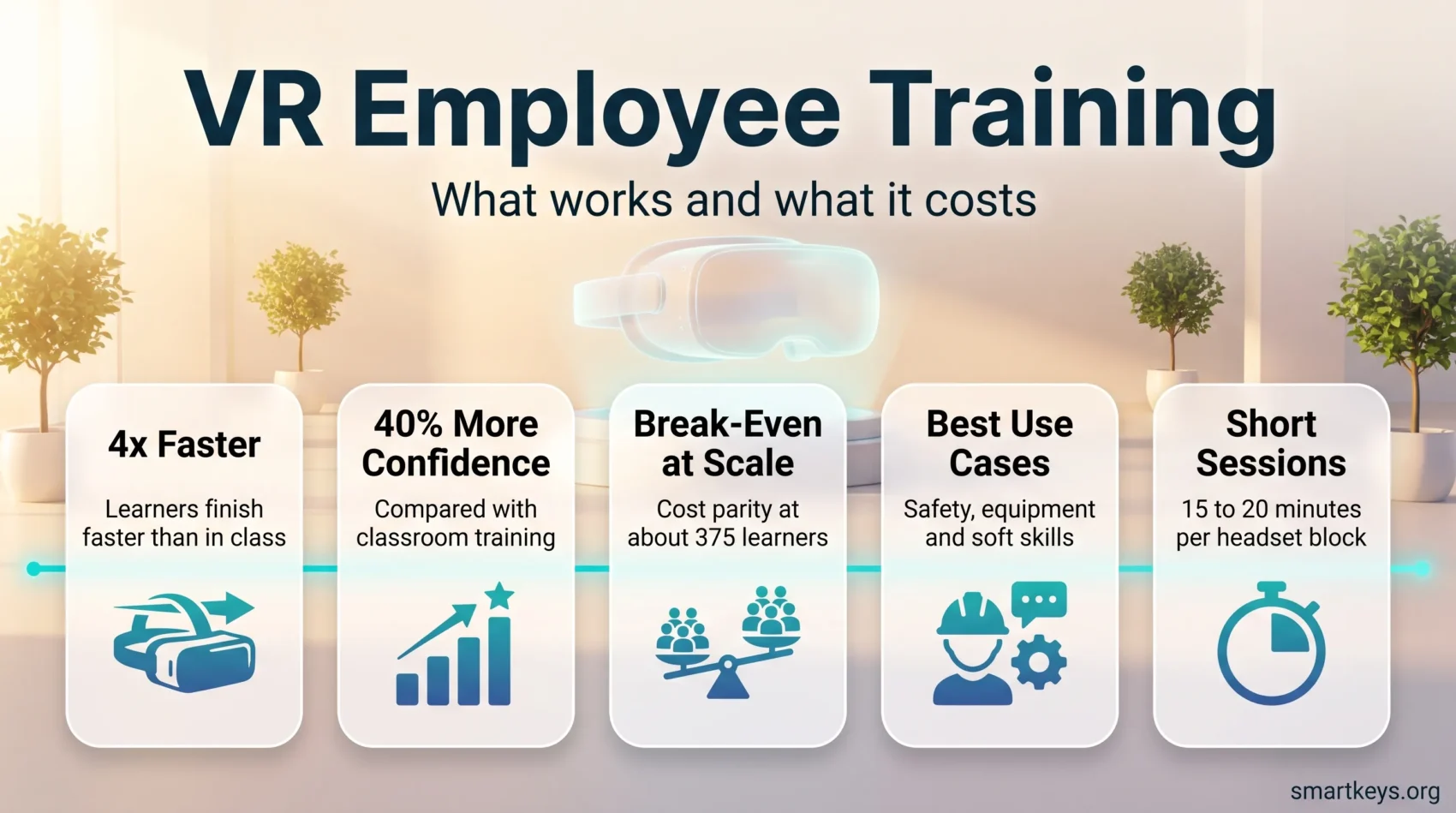
- PwC found VR learners completed training four times faster than in a classroom and felt markedly more confident applying what they learned.
- Walmart cut one training programme from eight hours to fifteen minutes with VR, a 96% reduction.
- Cost advantages appear at scale. PwC put the break-even against classroom training at roughly 375 learners.
- Headset prices rose in 2026, so hardware budgets need rechecking rather than assuming a steady decline.
- Content creation, not hardware, is usually the largest and most underestimated line item.
Where VR Employee Training Stands in 2026
Adoption has broadened and narrowed at the same time. Companies that once tried VR Employee Training in every department have pulled back to the cases where immersion does something a video cannot: practising a physical sequence, rehearsing a difficult conversation, or walking into a hazardous situation without any actual hazard.
What the Evidence Actually Supports
The most rigorous public study remains PwC’s research into VR for soft skills training. Its findings are worth quoting precisely, because they are frequently garbled online. PwC reported that learners trained in VR finished up to four times faster than classroom learners, felt 3.75 times more emotionally connected to the material than classroom learners, and were four times more focused than e-learning participants. Confidence to act on what they had learned improved by 40% over classroom training and 35% over e-learning.
Those are strong results, but they are specific to one type of content, delivered under study conditions with professionally produced material. Treat them as evidence that immersive learning can work very well, not as a guarantee for whatever a vendor demos next week.
What the Hype Usually Gets Wrong
Many statistics circulating about VR simulations trace back to press releases rather than published research, repeated so often that the original source is untraceable. Before building a business case on a number, check whether anyone published the methodology behind it. If nobody did, leave it out of your board deck.
It also helps to separate two claims. “VR training improves learning outcomes” has reasonable support. “VR training is cheaper” is conditional and depends entirely on how many people you put through it.
Benefits of VR Employee Training
Immersive training earns its place when it does something other formats cannot. That usually means bodies, hands, pressure or risk are involved.
Engagement and Knowledge Retention
The mechanism is straightforward: learners do something rather than watch something. Practice under realistic conditions produces stronger recall than passive viewing, which is why VR compares well with video and slide-based courses for procedural content. Pair it with short bursts of learning and spaced repetition and the effect compounds, because each headset session becomes rehearsal rather than a one-off event.
Cost Effectiveness Depends on Scale
This is where most business cases fall apart. PwC’s cost modelling found VR reached parity with classroom training at around 375 learners, parity with e-learning at roughly 1,950 learners, and became about 52% cheaper than classroom instruction at 3,000 learners. Below those thresholds, the content production cost dominates and VR is simply the expensive option.
The implication is clear: VR suits large, repeated, standardised training. If you need to certify two hundred people once, build something simpler. If you onboard thousands of frontline workers every year, the maths changes completely. Check the numbers against your existing upskilling return on investment before committing.
Closing Gaps in Hands-On Roles
Hiring managers consistently report difficulty finding candidates with practical, job-ready skills, and immersive practice is one credible response. VR lets people repeat a procedure dozens of times without consuming materials, occupying equipment or exposing anyone to risk. That makes it a natural fit alongside a structured cross-training strategy and broader upskilling and reskilling programmes.
Discover more about the wider role of virtual reality at work and how immersive tools are reshaping day-to-day operations.
How VR Training Works
The underlying idea is simple. Put the learner inside a 3D environment, give them something to do, and let the consequences of their actions play out.
The Mechanism of Immersive Learning
A headset removes competing visual input, which is a large part of why focus improves. The learner interacts with objects using controllers or hand tracking, receives immediate feedback, and repeats the sequence until it becomes automatic. Because the environment is synthetic, the system logs every action: where the learner looked, what they touched, how long they hesitated. That behavioural data is often more useful than a quiz score, and classroom training cannot produce it.
Sessions work best when they are short. Most practitioners cap headset time at roughly 15 to 20 minutes per block to limit fatigue and eye strain, then reinforce with conventional follow-up material.
Types of Training Scenarios Available
VR training scenarios cluster around a few proven categories:
- Safety and hazard recognition, where employees rehearse dangerous situations before facing a real one.
- Clinical and healthcare simulations, letting practitioners repeat procedures and practise patient communication.
- Equipment and maintenance training, including work with machinery that is expensive to take offline. Manufacturers increasingly combine this with digital twins in manufacturing so the virtual model matches the real asset.
- Soft skills rehearsal: difficult conversations, customer escalation, interviewing and feedback.
- Retail and logistics process training, particularly for seasonal surges and new store or warehouse formats.
Implementing a VR Learning Platform
Rolling out a VR learning platform is a change management project with a technology component, not the other way around. The sequence matters.
Steps to Get Executive Buy-In
Leadership will fund a solved problem, not a technology. Build the case accordingly:
- Name the specific problem: a safety incident rate, a long ramp-up time, a certification bottleneck.
- Model the cost honestly, including content production, headset management and IT support, and show where the break-even sits.
- Connect the programme to a business goal that already has attention, such as retention or compliance.
- Bring a comparable case study from your own industry rather than a generic vendor reel.
- Propose a bounded pilot with a defined success threshold and an agreed stopping point.
Identifying Training Needs and Objectives
Work out what belongs in a headset before you buy one:
- Audit current training and find where outcomes are weakest, not where the format is oldest.
- Ask department leads which tasks new hires get wrong most often in their first ninety days.
- Filter ruthlessly. If a task can be taught by a two-minute video, teach it with a two-minute video. Approaches like microlearning and modern edtech platforms handle a lot of content more cheaply.
- Define measurable objectives for what survives the filter, and agree how you will measure them before the first build.
Best Practices for VR Corporate Training
The organisations that succeed with VR treat the first year as an experiment with a budget, not a deployment.
Pilot Programs and Rollout Strategies
Launching pilot programs is the essential first step in any VR training rollout. A well-run pilot answers questions a vendor demo cannot:
- Define clear learning objectives and a success threshold before you start.
- Select a representative group, including people who are sceptical about the technology.
- Test the logistics as seriously as the content: charging, hygiene, device management, scheduling and floor space.
- Gather structured feedback on comfort, clarity and perceived usefulness.
- Decide in advance what result would justify a wider rollout, and what result would end the project.
Key Metrics for Measuring Success
Tracking key metrics is what separates a programme from a pilot that never ends. Alongside your existing VR-based assessment and interview practice, measure:
- On-the-job performance after training, not just in-headset scores.
- Time to competency compared with the previous method.
- Error and incident rates in the weeks following training.
- Completion and repeat-use rates, which reveal whether people find the experience worthwhile.
- Total cost per trained employee, recalculated as volume grows.
To connect these outcomes to broader people metrics, see how organisations approach employee engagement in distributed teams.
Safety and Compliance Training in VR
Safety is the clearest win. Employees rehearse exactly the situations you cannot ethically stage: a confined space entry, an energised panel, a fall from height, a chemical spill.
Realistic Simulations for Hazardous Situations
The value is repetition without consequence. A learner can make the wrong call, see what happens, and try again. That is impossible in a live environment and unconvincing in a slide deck. Immersive content also standardises safety training across sites, which matters when the same procedure is taught three different ways in three countries. Common applications include:
- Pre-use inspections and correct selection of personal protective equipment.
- Lockout and tagout procedures practised end to end.
- Work at height, confined space entry and emergency evacuation.
- Hazard recognition, where learners scan an environment and flag risks under time pressure.
- Interaction with automated equipment, increasingly relevant as robotics enter more workplaces.
Most enterprise platforms record gaze and interaction data, giving safety teams evidence of who actually engaged with a procedure rather than who clicked through a module.
Soft Skills and Inclusive Training
The second strong use case is uncomfortable conversations. Role play works, but it needs a skilled facilitator and willing colleagues. VR provides an infinitely patient scene partner.
Using VR for Soft Skills Development
Employees can rehearse giving critical feedback, de-escalating an angry customer, or responding to a comment that crossed a line. Because the scenario is private, people take risks they would avoid in front of peers. PwC’s study found that a large majority of participants had a moment of realisation about their own behaviour during an inclusion course, which is precisely the effect a slide deck rarely achieves.
This complements rather than replaces other approaches. AI-driven soft skills practice and AI performance coaching cover more ground at lower cost, while VR handles scenarios where physical presence and body language matter. Designing sessions with neurodiversity and inclusion in mind is essential: headsets are not comfortable for everyone, so an alternative path must always exist.
Where VR Training Is Heading
Two forces are shaping the next few years: hardware economics and the blurring line between virtual and augmented reality.
Hardware Costs Went Up, Not Down
The assumption that headsets get cheaper every year broke in 2026. Meta raised prices across its Quest range effective 19 April 2026, citing a global surge in memory chip costs: the Quest 3S now starts at $349.99 for the 128 GB model and $449.99 for 256 GB, with the 512 GB Quest 3 at $599.99. High-end enterprise and mixed reality devices sit far above that.
Budget hardware at current rates rather than projected declines, and plan for replacement cycles, breakage and accessories. Even so, headsets are rarely the biggest cost. Custom content production usually is, which is why many organisations start with off-the-shelf libraries and commission bespoke scenarios only where generic content clearly falls short.
The Role of AR and Mixed Reality
Fully virtual environments are giving ground to mixed reality, where digital instructions overlay the real workplace. That suits maintenance, assembly and field service, because the learner keeps their hands on the actual equipment. The distinction between formats is covered in more depth in our look at AR in on-the-job training and at AR and VR in the workspace.
Related techniques are maturing alongside it. Teams designing products increasingly use AR and VR for prototyping, and adaptive content that adjusts difficulty to the individual learner, now common in AI-powered learning platforms, is arriving in immersive training too.

Challenges in Adopting VR for Training
Most failed VR programmes fail for unglamorous reasons: nobody owned the devices, the content aged badly, or the pilot never had a definition of success.
Overcoming Resistance to Change
Some people dislike headsets, a minority experience genuine discomfort, and others feel self-conscious wearing one in an open office. Practical responses work better than enthusiasm:
- Provide a private or semi-private space for sessions.
- Keep first sessions very short and low stakes.
- Offer an equivalent non-VR path for anyone who cannot or will not use a headset.
- Let early participants introduce the technology to their own teams.
Framing matters too. Training that lands in the same week as automation or restructuring news will be read through that lens, so plan the communication alongside the rollout.
Setting Up Infrastructure and Content
Building a workable VR training infrastructure means solving several unglamorous problems at once:
- Device management: charging, updates, hygiene, storage and a named owner for the fleet.
- Performance: consistently high frame rates, since dropped frames are the main cause of discomfort.
- Content maintenance: procedures change, and a simulation that teaches an outdated process is worse than no simulation.
- Integration with your existing learning system so completion data lands where the rest of your HR reporting already lives.
- Network and IT support, particularly for multi-site deployments.
None of it is exotic, but all of it needs an owner. Programmes that treat headsets as an L&D side project tend to stall within a year.
Conclusion
VR employee training has earned a permanent place in corporate learning, but a narrower one than early forecasts suggested. It excels at procedural, physical and emotionally charged practice, and it produces behavioural data no classroom can match. It struggles to justify itself for small cohorts, simple content, or organisations with no clear owner for the programme.
Walmart’s results illustrate the upside at scale: working with Strivr, it reduced one training programme from eight hours to fifteen minutes and put more than two million associates through immersive training across thousands of locations. That kind of return is available to organisations with similar volume and similar repetition, and rarely to anyone else.
Start with one high-value problem, run a pilot with a real success threshold, and measure on-the-job outcomes rather than in-headset scores. Do that and VR becomes a tool your corporate learning programme uses deliberately, not a headset gathering dust in a cupboard.
Found this useful?
Make SmartKeys a preferred source on Google, and our articles will surface more often in your Top Stories, AI Overviews, and AI Mode.
Add as Preferred Source