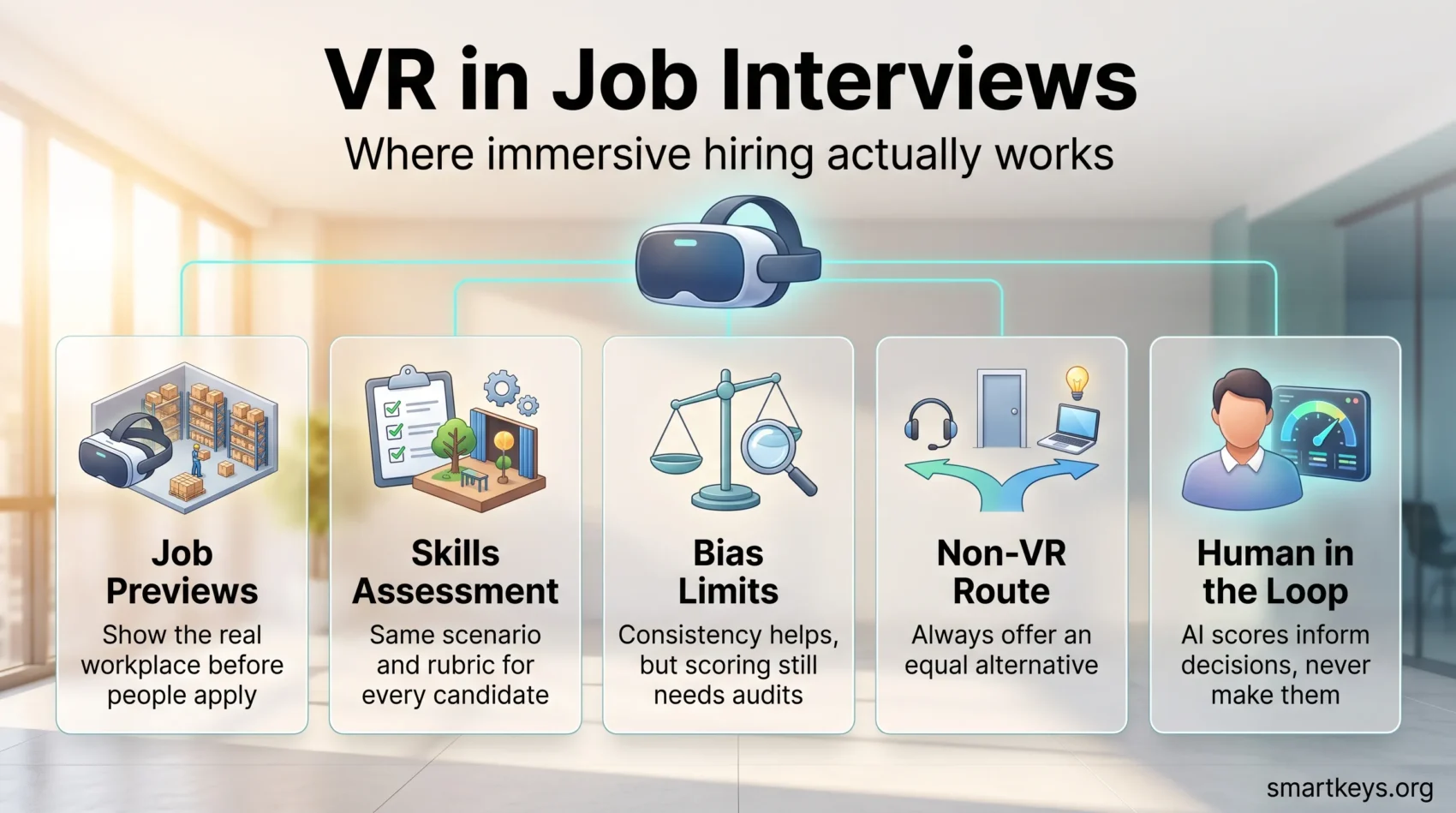
Virtual reality in job interviews has been described as the next stage of hiring for close to a decade. The honest position in 2026 is more modest: full VR interviews remain rare, while VR has found solid ground in adjacent parts of recruitment such as skills assessment, realistic job previews, employer branding and interview practice. That gap between the promise and the practice is worth understanding before you buy a headset or accept an invitation to a virtual assessment.
This guide covers what a VR job interview actually involves, where employers are genuinely using immersive technology, what the evidence supports about bias and candidate experience, and which rules now apply when artificial intelligence scores what happens inside the headset.
Key Takeaways
- Full VR job interviews are still uncommon. Immersive technology is used far more often for assessment, training and job previews than for the interview itself.
- Walmart’s VR assessments, run with Strivr, are the best documented enterprise example: they informed promotion decisions for store management roles.
- VR can standardize a scenario for every candidate, which helps consistency. It does not remove bias on its own.
- Once AI scores behaviour inside a VR session, hiring rules apply. Illinois, New York City, Colorado and California all impose duties in 2026.
- The EU AI Act’s high-risk obligations for recruitment systems have been deferred to December 2027 under the Digital Omnibus agreement.
- Accessibility remains the weakest point: motion sickness, vision differences and headset cost exclude candidates who should not be excluded.
Where VR Actually Sits in Hiring Right Now
Start with what is real. The strongest documented enterprise use of immersive assessment is Walmart, which worked with Strivr to put candidates for store management roles through VR scenarios and used the results as one input into promotion decisions. It was reported widely in 2019 and it remains the clearest example of a large employer scoring people inside a headset rather than simply training them there.
Most other immersive recruitment activity sits one step away from the interview. Employers use 360 degree walkthroughs to show a factory floor, a hospital ward or an office before a candidate applies. Universities and colleges use platforms such as Bodyswaps and VirtualSpeech so students can rehearse interviews and receive structured feedback. Manufacturing and healthcare employers use VR employee training for onboarding, then reuse the same scenarios to test whether a new hire can perform the task.
The hardware picture explains part of the caution. Standalone headsets are cheaper and lighter than they were, but the enterprise segment consolidated after Microsoft retired HoloLens, and memory chip costs pushed consumer prices up again in 2026. Our review of AR and VR in the workplace covers where that market landed. An employer who cannot assume a candidate owns a headset has to ship one, run the session on site, or fall back to a browser based simulation.
What a VR Job Interview Involves
A VR job interview places the candidate inside a simulated environment rather than in front of a camera. Depending on the design, the candidate may speak with an avatar interviewer, work through a job scenario, or do both. The session is recorded, and what gets recorded goes well beyond the answers: gaze direction, hesitation, movement, tone and the sequence of decisions made under time pressure.
Two formats dominate. The first is a conversational simulation, closer to a traditional interview, where an avatar asks questions and the candidate responds. Avatar quality has improved sharply as synthetic video tools matured; our HeyGen review shows how realistic a generated presenter can now look. The second format is a work sample delivered immersively: handle a difficult customer, triage a queue, run a safety check. That is the version employers tend to find defensible, because work sample tests have a long track record as predictors of job performance, a point covered in our Workello review of skills testing platforms.
The distinction matters for candidates too. A conversational VR interview is a familiar task in an unfamiliar wrapper. A scenario assessment is a genuinely different exercise, and preparing for it means practising the work, not polishing your answers.
How Recruiting Technology Got Here
Hiring moved from newspaper ads to job boards, then to applicant tracking systems, and after 2020 to video interviews as the default. Immersive assessment is the next step on that path, alongside the AI screening covered in our guide to AI hiring tools. The pattern repeats: a technology promises speed and objectivity, employers adopt it faster than they validate it, and regulators catch up later. VR is simply earlier in that cycle than resume parsing or scored video interviews.
What VR Adds to an Interview
Realistic Job Previews
The clearest benefit has nothing to do with assessment. Showing candidates the actual environment before they commit reduces the mismatch that drives early attrition. A warehouse night shift, a busy emergency department or an open plan trading floor is difficult to convey in a job advertisement and immediately obvious in a headset. For distributed roles the equivalent is showing how the team actually works, which our guide to remote work addresses. The same immersive tooling underpins virtual reality in remote work.
Consistent, Observable Skills Assessment
A well designed VR scenario gives every candidate the same situation, the same interruptions and the same time pressure. That consistency is hard to achieve with human interviewers, who vary in mood, style and follow up questions. It also surfaces behaviour that interviews only ask about: how someone prioritizes when three things need attention at once, or whether they check the safety step when nobody is watching. Those are soft skills that self reported answers rarely capture, and the same logic drives augmented reality training programmes.
Reach and Employer Branding
Immersive previews let candidates evaluate an employer without travelling, which widens the pool geographically and signals technical seriousness. That signal has limits. Candidates notice quickly when a polished VR experience sits on top of an otherwise slow, opaque process, and a strong first impression does not survive a three week silence afterwards. The wider hiring context is covered in our overview of HR trends.
The Bias Question: What VR Can and Cannot Fix
The common claim is that VR reduces hiring bias because avatars hide appearance and assessment focuses on demonstrated skill. Part of that holds. Standardizing the scenario removes some of the variance that lets unstructured interviews drift into rapport judgments, and structured assessment has long been the more defensible approach.
The rest does not hold. Voice, accent, vocabulary and reaction speed all survive into the headset. Avatar choice introduces its own signalling. Most importantly, whatever model scores the session was trained on data from somewhere, and a scoring model can reproduce the pattern it learned just as readily inside VR as outside it. Our article on AI hiring bias works through how that happens.
There is also a group the technology can quietly exclude. Candidates prone to motion sickness, those with vestibular conditions, low vision, limited stereoscopic vision or reduced hand mobility may perform worse for reasons that have nothing to do with the job. An immersive assessment without a genuine non VR alternative is an accessibility problem before it is a fairness problem, a theme our guide to remote work accessibility explores. Treat the alternative route as mandatory, not as an accommodation granted on request.
Where AI Fits, and What the Law Requires in 2026
AI is what turns an immersive experience into an assessment. Speech recognition transcribes answers, models score decision sequences against a rubric, and dashboards rank candidates. Everything that makes this useful also makes it regulated, because a scored VR session is an automated employment decision tool by any reasonable reading.
Four sets of rules matter for employers hiring in 2026.
- New York City Local Law 144: automated employment decision tools used for candidates in the city require an annual independent bias audit, published results and advance notice to candidates.
- Illinois HB 3773: in force since 1 January 2026, this amendment to the Illinois Human Rights Act requires notice when AI is used in recruitment, hiring or promotion decisions, and bars using zip code as a proxy for a protected class.
- California FEHA automated decision system regulations: effective 1 October 2025, these require four year record retention and make the presence or absence of bias testing relevant evidence in a discrimination claim.
- Colorado AI Act: after a postponement, implementation now begins on 30 June 2026, bringing impact assessments and disclosure duties for high-risk AI systems used in employment.
In the European Union the picture changed late in the process. Recruitment systems sit in Annex III of the EU AI Act, and their high-risk obligations were originally due to apply from 2 August 2026. The Digital Omnibus agreement defers those obligations to 2 December 2027, subject to formal adoption and publication in the Official Journal. Transparency duties under Article 50 are a separate track and should not be assumed to move with them. Our EU AI Act compliance guide tracks the detail, and the wider debate is covered in AI ethics at work.
Practical consequence: if you score candidates with a model, document the rubric, keep the records, run the audit and tell people. That is now the baseline in several jurisdictions rather than good practice.
Running a VR Interview Well
Most failures are logistical rather than technological. A short checklist prevents the common ones.
- Offer a non VR route by default: publish it in the invitation rather than waiting for candidates to ask, and make sure it is scored the same way.
- Send a hardware and setup guide early: headset model, required space, controller basics and a test link, at least several days ahead.
- Run a short calibration session: five minutes of free movement before assessment starts lets candidates settle and reduces nausea reports.
- Standardize the scenario and the rubric: the same situation, the same interruptions and the same scoring criteria for everyone.
- Check the physical space: lighting affects tracking quality on inside out headsets, and a cluttered room limits safe movement.
- Say what is recorded and why: gaze and movement data is personal data, and our guide to data privacy at work covers the duties that follow.
- Keep a human in the loop: a model score should inform a decision, not make it. The risks of the alternative are set out in algorithmic management.
- Close the loop afterwards: feedback within a week is the difference between an impressive process and a gimmick.
How Candidates Can Prepare
Preparation splits into two parts: making the technology a non event, and getting good at the actual task.
On the technical side, confirm the headset model and software before the day, charge everything, clear a space of the size the employer specifies, and run the platform’s tutorial at least once. Use a wired or strong wireless connection if the session streams. If you have never worn a headset, borrow one for an hour first; the goal is that nothing about the hardware is novel when the assessment starts.
On the substance, find out which format you are facing. For a conversational simulation, prepare as you would for a structured interview and practise speaking to an avatar, which feels stranger than it sounds. For a scenario assessment, rehearse the work: the prioritization call, the safety step, the awkward customer. Free interview practice tools built on immersive platforms exist through many universities and employment services, and the skills employers are actually testing for are a better guide to preparation than any script. If the employer has published its onboarding approach, our piece on remote onboarding and training gives a sense of what comes next.
One more thing: ask for the alternative if VR is a problem for you. A serious employer will have one, and how they respond tells you something useful about the job.
The Honest Outlook
Immersive hiring will keep growing where it already works: high volume roles with a physical component, safety critical work, and any job where showing the environment prevents bad matches. Those cases justify the cost because the scenario is expensive to stage any other way.
The generic VR interview for a desk job is a harder sell. It costs more than a video call, adds friction for candidates, produces data that raises legal duties, and answers questions a well structured conversation already answers. Smart glasses and lighter headsets may change that calculation, and our piece on smart glasses at work tracks where the hardware is heading. Until the equipment is as unremarkable as a laptop camera, expect immersive assessment rather than immersive interviews.
For candidates, the practical takeaway is unchanged. Employers still hire for demonstrated capability. VR simply changes the room in which you demonstrate it.
Found this useful?
Make SmartKeys a preferred source on Google, and our articles will surface more often in your Top Stories, AI Overviews, and AI Mode.
Add as Preferred Source