Soft skills are the human abilities that decide how you work with other people. Listening properly. Explaining a decision so others can act on it. Staying steady when a plan collapses. Handling disagreement without turning it into a fight. They sit alongside hard skills, which are the technical abilities you can certify, such as writing SQL or closing a set of accounts.
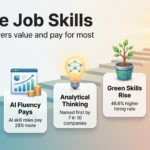
For years these were treated as pleasant extras. That has changed, and the change is measurable. The World Economic Forum’s Future of Jobs Report 2025 asked over a thousand large employers which skills matter most today. Analytical thinking came first, with about seven in ten companies calling it essential. The next four were resilience and flexibility, leadership and social influence, creative thinking, and motivation and self-awareness. Four of the top five are human skills rather than technical ones.
This guide explains what soft skills are, why employers are paying closer attention as software absorbs routine work, which skills come up most often, and how to build them without waiting for a training budget. It stays on the human side of the picture; for the full range of skills the future job market rewards, from AI fluency to green skills, start with our overview.
Key Takeaways
- Soft skills describe how you work with people: communication, adaptability, judgment and self-management.
- Four of the five skills employers rank highest are human skills, according to the WEF’s 2025 employer survey.
- Automation absorbs routine tasks first, which raises the value of work that needs judgment and coordination.
- Soft skills are learnable through deliberate practice and feedback. They are not fixed personality traits.
- Structured interview questions about real situations test them far better than gut feeling.
What Soft Skills Actually Are
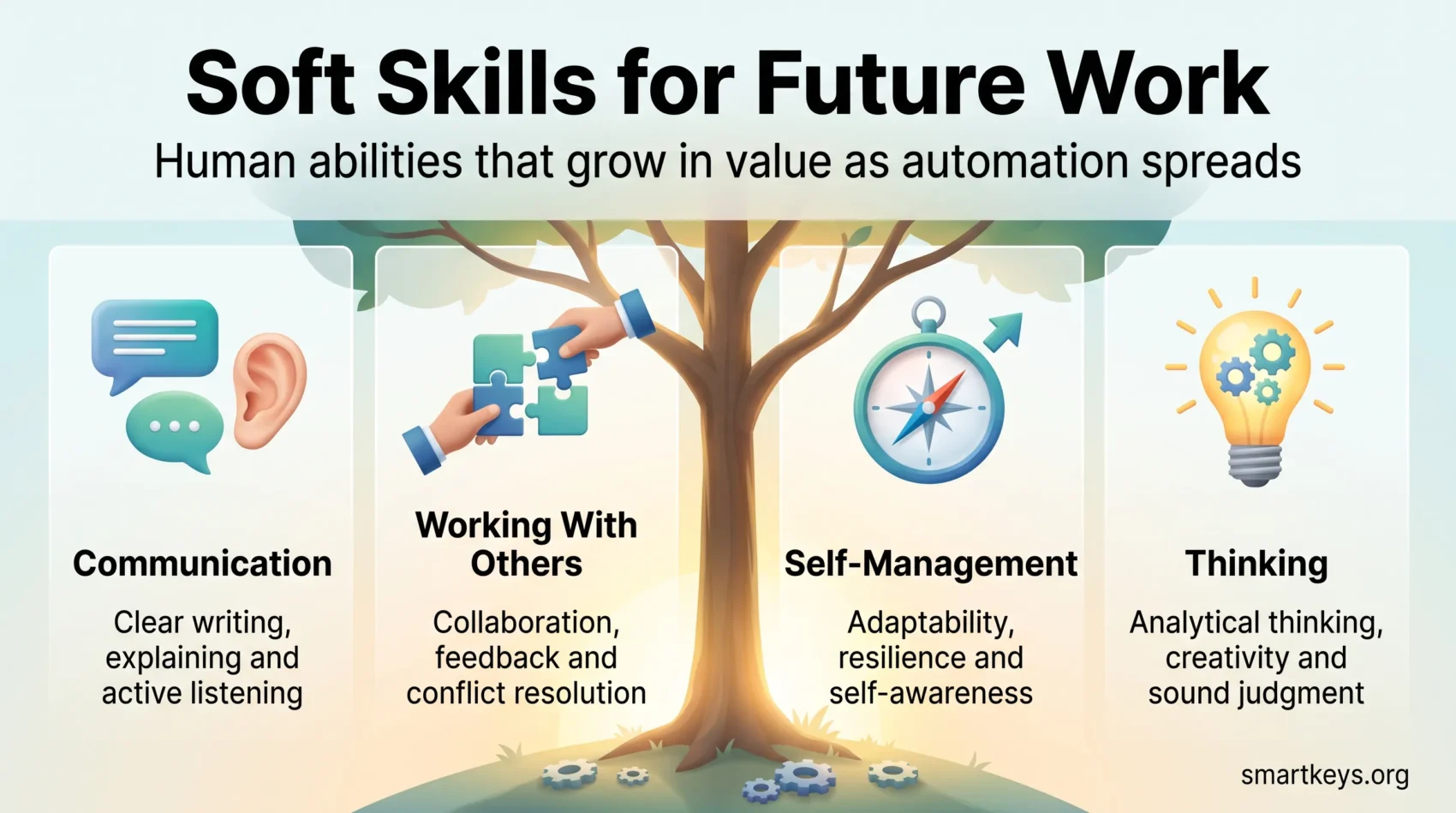
The term is vague, which is part of why it gets dismissed. It helps to split it into four groups.
Communication. Writing a message people understand the first time. Explaining technical work to someone outside your field. Listening well enough that the other person feels heard.
Working with others. Collaboration, giving and taking feedback, resolving conflict, and influencing people who do not report to you.
Self-management. Adaptability, resilience after setbacks, time management and self-awareness about your own strengths and blind spots.
Thinking. Analytical thinking, creative problem solving and judgment under uncertainty. These overlap with technical ability, but the deciding factor is usually how you frame the problem, not which tool you use.
One example makes the difference concrete. Two analysts produce the same forecast. One sends a spreadsheet. The other sends three sentences saying what changed, what it means for next quarter and what decision is now needed. The second analyst gets asked back into the room. That gap is a soft skill, and it is trainable.
Why Employers Are Paying Closer Attention
Three shifts explain the change, and none of them are about work becoming softer.
Automation eats routine work first. Research published by Harvard Business School, covering US job postings from 2019 to March 2025, found that openings for routine, automation-prone roles fell by 13% after ChatGPT launched, while demand for analytical, technical and creative roles grew by 20%. Software is absorbing predictable tasks, so a larger share of what remains involves judgment, persuasion and coordination. Our overview of AI and automation at work covers what the evidence does and does not support, and a companion piece looks at how workers are actually adapting.
Distributed teams remove the informal repair layer. In an office, a misread message gets fixed in the corridor. In a hybrid or remote team it becomes a two-day misunderstanding. Written clarity, explicit expectations and disciplined meeting habits stop being nice-to-have. That is why remote leadership and hybrid meeting etiquette now get treated as skills to train rather than manners to assume.
Management itself is under strain. Gallup’s State of the Global Workplace 2026 report puts global employee engagement at 20% for 2025, the lowest since 2020. Manager engagement fell further, from 31% in 2022 to 22% in 2025. Managers are the layer that turns strategy into daily work, and when that layer is depleted the skills that hold teams together matter more, not less. The same pressure shows up in engagement across remote teams and in rising burnout.
There is a longer-run signal too. McKinsey’s 2018 Skill shift analysis projected that demand for social and emotional skills in the United States would grow by about 26% by 2030, while demand for basic data entry and processing would fall sharply. That projection is now eight years old, so treat it as direction rather than precision. The direction has held up.
The Soft Skills Employers Ask For Most
Rather than a wish list, here is what actually appears at the top of employer surveys, with a note on what each one looks like in practice.
- Analytical thinking. Breaking a messy question into parts you can test. The WEF’s 2025 survey found roughly seven in ten employers treat it as essential.
- Resilience, flexibility and agility. Recovering from a lost deal or a cancelled project quickly enough to be useful the following week.
- Leadership and social influence. Getting a group to commit to a direction when you have no authority to order it.
- Creative thinking. Producing a second and third option when the obvious one is blocked.
- Motivation and self-awareness. Knowing where you are weak and asking for help before it costs the team.
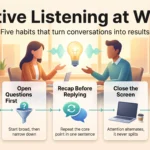
- Empathy and active listening. Understanding what a colleague or customer actually needs, which is often not what they first ask for.
- Curiosity and lifelong learning. Treating a new tool as something to try rather than something to resent.
- Conflict resolution. Naming a disagreement early and keeping it about the work.
LinkedIn’s Skills on the Rise ranking points the same way. Its 2025 US list put AI literacy first, then conflict mitigation and adaptability, with public speaking and stakeholder management also inside the top ten. Technical and human skills are climbing together, not competing. If you are an employer deciding where to invest first, a digital skills gap analysis shows which of these gaps actually exist on your team.

How to Develop Soft Skills
Soft skills improve the same way technical ones do: repeated practice on real tasks, with feedback from someone who will tell you the truth. Reading about active listening changes nothing on its own.
Practise on real work, not exercises
Pick one skill and one recurring situation. If the skill is written clarity, rewrite the summary line of every report you send for a month. If it is conflict, commit to raising one disagreement per week in the meeting rather than afterwards. Small, repeated, specific. A one-day workshop with no follow-up rarely changes behaviour.
Get feedback you can act on
Ask two colleagues a narrow question: “In yesterday’s meeting, was my point clear the first time?” Narrow questions get useful answers. Broad ones (“any feedback for me?”) get politeness. Some companies formalise this through continuous performance management, which replaces the annual review with short, regular check-ins.
Use structured training where it fits
Courses help most when they give you a model to apply and a group to practise with. Communication, negotiation and conflict handling all suit that format. Options range from internal programmes to online course platforms, and increasingly to AI-supported soft skills training that lets you rehearse a difficult conversation before you have it. For teams, shared practice sessions spread capability rather than concentrating it in one person.
Build self-awareness before technique
Most communication problems are not vocabulary problems. They come from not noticing your own effect on a conversation. Deliberate attention helps here: pausing before replying, noting when you are reacting rather than thinking, asking one clarifying question before you argue. Emotional intelligence, meaning the ability to read and manage emotions in yourself and others, grows out of that habit rather than out of a personality test.
Plan the longer arc
Skills decay when unused, and roles change faster than they used to. The WEF estimates that 39% of workers’ core skills will be transformed or outdated between 2025 and 2030, and that 63% of employers already name skills gaps as the main barrier to transformation. That is the case for treating learning as routine maintenance. Our guide to upskilling and reskilling goes deeper, and education for future jobs covers the credential side.
Hiring and Assessing for Soft Skills
Employers say soft skills matter, then assess them by instinct. That is where most hiring processes leak.
Structured behavioural questions work better. Ask candidates to describe a specific past situation rather than a hypothetical one: a disagreement with a colleague, a project that failed, a time they had to change plan quickly. Ask what they did, not what they believe. Score answers against the same criteria for every candidate, because consistency is what makes the comparison meaningful.
Work samples add a second signal. A short written brief shows communication. A collaborative exercise shows how someone handles being challenged. Both are harder to rehearse than an interview answer.
Two cautions are worth naming. First, “culture fit” is where bias hides most easily. Define the behaviours you need and score those instead. The same risk applies to automated screening, which we cover in AI hiring tools and bias in AI hiring. Second, a strong soft skills interview does not replace checking whether someone can do the job. Credentials and practical tests still carry the technical weight.
Once someone joins, the first weeks decide how quickly they find their footing. Deliberate remote onboarding matters more when new colleagues never share a room.
Where the Soft Skills Argument Gets Overstated
Two corrections are worth making, because the topic attracts inflated claims.
The headline statistics are often older and narrower than they appear. The widely repeated line that soft-skill intensive jobs will make up two-thirds of all jobs by 2030 comes from a 2017 Deloitte Access Economics study commissioned for the Australian market. It may still be roughly right. It is not a fresh global finding, and it is usually quoted as one.
Soft skills also do not substitute for competence. In technical roles they change how far your work travels, not whether it is correct. The pattern in current job data is that human and technical skills rise together: employers want people who can build the model and explain what it means. Tools now carry part of the coordination load, as our look at AI collaboration tools shows, but they do not decide what is worth doing.
Conclusion
The case for soft skills is no longer a matter of taste. Employers rank human abilities at the top of their own surveys, routine work is being automated first, and distributed teams punish unclear communication daily.
The practical response is narrow rather than grand. Choose one skill. Practise it in real work. Ask for specific feedback. Repeat. That routine compounds faster than any course, and it travels with you when the job description changes. For the wider context, our overview of future work trends and our guide to future leadership skills pick up where this article stops.
Found this useful?
Make SmartKeys a preferred source on Google, and our articles will surface more often in your Top Stories, AI Overviews, and AI Mode.
Add as Preferred Source