The future of work is being reshaped by three forces at once: job automation, the growth of the gig economy, and a settled but permanent shift to remote work. Five years out from 2030, the picture is clearer than it was, and less dramatic than the early forecasts suggested.
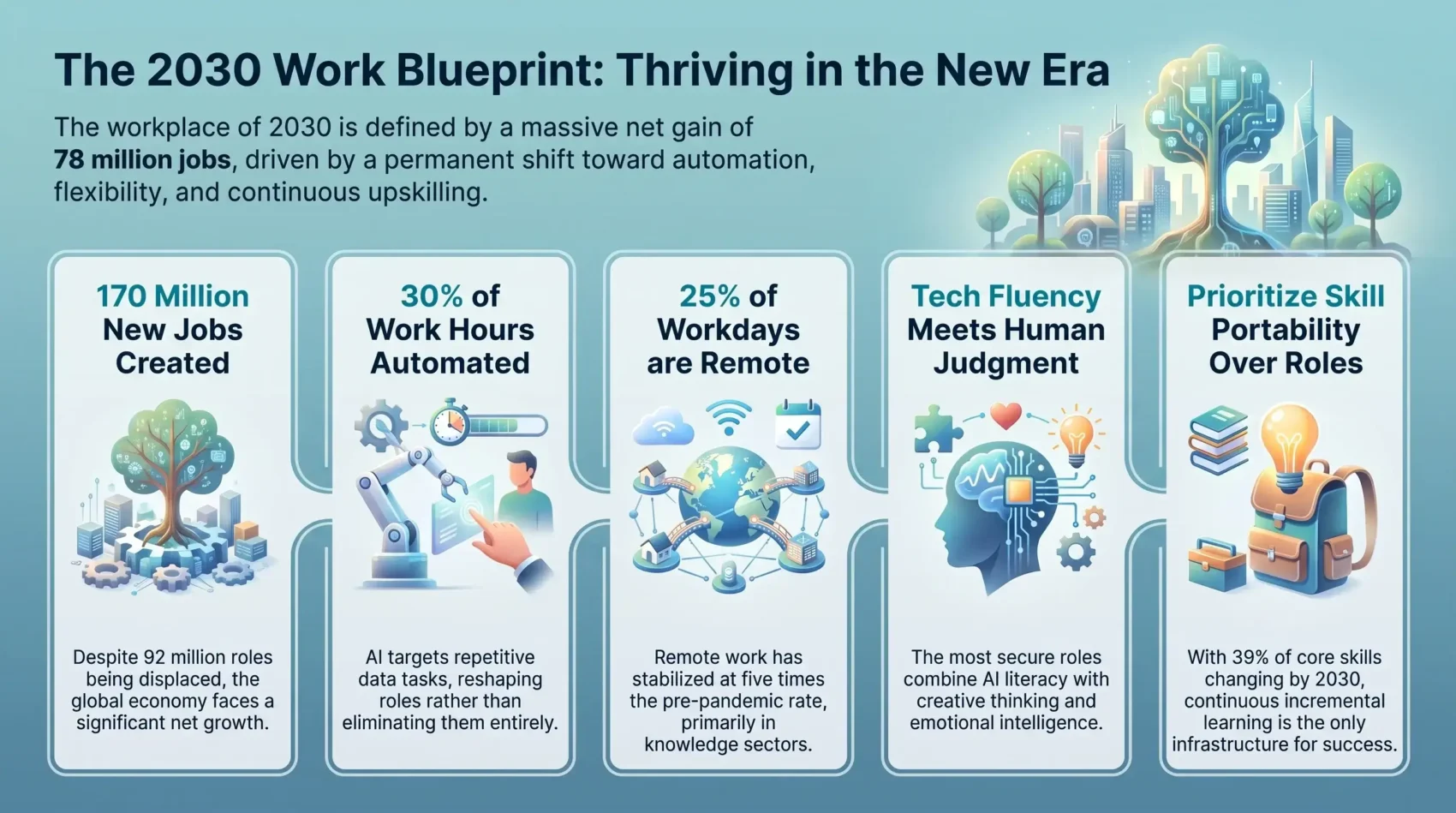
The World Economic Forum’s Future of Jobs Report 2025 puts numbers on it. Employers surveyed expect technology and structural change to create 170 million jobs and displace 92 million by 2030 – a net gain of 78 million, but with roughly 22% of all jobs churning in the process. The same employers expect 39% of workers’ core skills to change over that period, down from the 44% they predicted in 2023.
That single revision is the story of the last two years. Disruption is real, broad, and slower than the headlines implied. What follows is what the evidence currently supports about automation, remote work, independent work, artificial intelligence and skills – and what it means for the way you plan a career or a workforce.
Key Insights
- The WEF expects a net gain of 78 million jobs by 2030, with about 22% of all roles disrupted along the way.
- Remote work has stabilised at roughly a quarter of US paid working days, not the near-total shift once predicted.
- The gig economy keeps expanding, and regulation is catching up with it.
- AI adoption is near-universal, but measurable financial return remains the exception.
- Upskilling is the single most decisive variable for career longevity.
What Automation Will Actually Change by 2030
The most cited estimate remains McKinsey Global Institute’s: with accelerated adoption of generative AI, up to 29.5% of the hours worked in the US economy could be automated by 2030, driving an additional 12 million occupational transitions. Note the unit. It is hours and tasks, not whole jobs. Most occupations lose parts of themselves rather than disappearing.
That distinction matters when you plan. A role built almost entirely on routine data handling is exposed. A role that mixes judgement, physical presence and client relationships is not, even if half its administrative load evaporates.
Which Jobs Grow and Which Shrink
The WEF’s 2025 survey points in a consistent direction. The fastest-declining roles are cashiers and ticket clerks, administrative assistants, and – newly – graphic designers, where generative tools have moved fastest. The fastest-growing roles split into two groups: specialist technology jobs (AI and machine learning specialists, big data specialists, fintech engineers) and high-volume frontline jobs that resist automation (delivery drivers, nursing professionals, care workers, construction workers, teachers).
The US Bureau of Labor Statistics reaches a similar conclusion by a different route. Its 2024–2034 projections have total employment rising from 170.0 million to 175.2 million, an increase of 5.2 million or 3.1% – markedly slower than the 13.0% growth of the previous decade. Healthcare and social assistance is the fastest-growing industry at 8.4%. Office and administrative support is among the clearest losers, with the BLS attributing the decline directly to automation and AI in business processes.
If you want the practical version of this, our guide to adapting your role as automation advances works through it step by step, and our overview of robotics in the workplace covers the physical side of the same trend.
Where AI Delivers, and Where It Does Not Yet
Adoption is no longer the bottleneck. McKinsey’s 2025 global AI survey found 88% of organisations reporting regular AI use in at least one business function, up from 78% a year earlier. Value capture is another matter: only 39% reported any EBIT impact at the enterprise level, and most of those attributed less than 5% of company earnings to AI.
The gap between those two numbers is the real story of AI at work right now. Tools are everywhere; redesigned workflows are rare. Organisations that report meaningful returns are disproportionately the ones that rebuilt processes around the technology rather than bolting it onto existing ones. Our analysis of AI in business operations looks at what separates those two groups.
Automation also carries costs that do not appear in a productivity dashboard: displacement for people whose skills are suddenly mispriced, new cybersecurity exposure, and decisions made by systems nobody in the room can fully explain.
Remote Work Has Settled, Not Vanished
Remote work neither took over the economy nor collapsed back to 2019 levels. It settled. According to the Survey of Working Arrangements and Attitudes (SWAA) run by WFH Research, about 25% of paid full days in the United States were worked from home as of May 2026 – roughly five times the pre-pandemic rate and broadly flat for three years.
What the Remote Work Data Shows
Among US full-time employees surveyed between June 2025 and May 2026, SWAA found 62% fully on-site, 26% hybrid, and 12% fully remote. Employer plans have been stable at around 1.3 to 1.5 remote days per week since mid-2022, which is why return-to-office announcements keep making news without moving the aggregate much.
Knowledge-intensive sectors remain furthest ahead, and the range of roles that are now routinely remote extends well beyond software. Our look at how remote work changed the workplace covers the longer arc, and the shift has knock-on effects on office footprints and on how companies approach business travel.
Why Flexibility Still Pays
The steady state is hybrid, and the argument for it is no longer purely about employee preference. Randomised evidence published in Nature in 2024, from a trial at Trip.com, found that a two-day-a-week hybrid schedule left performance and promotion rates unchanged while cutting quit rates by about a third. That is a retention result, not a productivity claim, and it is the strongest single piece of causal evidence available.
For employers, the practical questions are scheduling and fairness rather than whether to allow remote work at all. Our guide to flexible work schedules covers how to set a policy that survives contact with a real calendar.
The Gig Economy and the Growth of Independent Work
Independent work keeps expanding. Upwork’s Future Workforce Index reports that around 39% of US workers did some freelance work in 2026, up four percentage points on the previous year, and puts total freelancer earnings at $1.5 trillion for 2024. These are self-reported survey figures and count anyone doing any freelance work, including alongside a full-time job, so they measure participation rather than full-time independence.
Why Independent Work Keeps Growing
Platforms lowered the cost of finding work and of hiring for a defined project. For companies, that means access to specialist skills without a permanent headcount commitment. For workers, it means control over schedule and location – and, increasingly, income spread across several clients rather than concentrated in one employer.
The trade-offs are equally clear: irregular income, no employer-provided benefits in most markets, and the administrative load of running a small business. Our overview of where freelancing is heading covers the market side, and gig economy regulation covers the rules, which have moved substantially in the EU and several US states.
Skills That Make Independent Work Sustainable
- Commercial literacy: pricing, contracting and cash flow decide whether freelance income is viable, more than craft skill does.
- Client acquisition: a reliable pipeline matters more than any single large contract.
- Written communication: most independent work is coordinated asynchronously, in writing, across time zones.
- Adaptability: the ability to move between clients, tools and sectors without a long ramp-up.
Clear contracts remain the single cheapest protection available. Scope, revision limits, payment terms and late-payment provisions prevent most of the disputes that independent workers actually encounter.
Health, Safety and Wellbeing at Work
Workplace health has widened from physical safety to include the psychological load of always-on, distributed work. Sensors and environmental monitoring handle the physical side; the harder problem is the one that does not show up in an incident report.
Distributed work removes commuting friction but blurs the boundary between work and everything else. Isolation, longer effective hours and the erosion of a clear stopping point are the recurring complaints. Our article on remote work and mental health covers the evidence, and burnout in the future workplace covers what organisations can realistically do about it.
The organisational answer is structural rather than motivational: defined working hours, protected time away from messaging tools, and managers who model both. Wellbeing programmes bolted onto an unchanged workload rarely survive contact with a busy quarter.
Artificial Intelligence at Work: Promise and Governance
AI is now embedded in scheduling, drafting, forecasting, customer support and hiring. It also expands what workforce data can tell you – retention risk, capability gaps, hiring bottlenecks – which is where AI and business analytics increasingly overlap.
Where AI Improves Efficiency
The clearest wins are narrow and repetitive: summarising, drafting, classifying, routing, first-pass analysis. Gains concentrate where a task is high-volume, well-defined and cheap to verify. They thin out fast where output quality is hard to check, because a human still has to read everything.
That verification cost is the reason enterprise-level returns lag adoption. A tool that saves ten minutes and adds five minutes of checking is not a transformation.
Ethics, Governance and Oversight
Two risks dominate. The first is bias: systems trained on historical hiring decisions reproduce historical hiring patterns, which is why bias in AI hiring tools has drawn regulatory attention on both sides of the Atlantic. The second is opacity: automated decisions that affect pay, scheduling or employment need to be explainable to the person on the receiving end.
Regulation has caught up faster than most organisations expected. The EU AI Act classifies employment-related AI as high-risk, with documentation, human-oversight and transparency obligations attached; our guide to EU AI Act compliance sets out what that means in practice. The WEF survey suggests employers are planning for both outcomes at once: 77% intend to upskill their workforce, while 41% expect to reduce headcount where AI can automate tasks.
Collaboration Across Distributed Teams
Distributed teams are now the default rather than the exception, and the tooling question is largely settled. Video, chat and project platforms are commodities. What differentiates teams is how they use them.
Working Asynchronously
The meaningful shift is from synchronous to asynchronous work: decisions written down rather than discussed live, documents that carry context, and meetings reserved for genuine disagreement. Our guide to asynchronous communication covers the practices that make this hold together across time zones.
The failure modes are well known: notification overload, decisions lost in chat history, and security exposure from tools nobody formally approved.
Building Trust Across Distance
Trust in a distributed team is built through predictability rather than proximity – commitments kept, work visible, information shared by default rather than on request. Our article on digital trust in remote teams goes into how that is established deliberately.
The specific risk for hybrid teams is proximity bias: the people in the room getting the interesting work and the visibility that leads to promotion. Managing that requires explicit process, not good intentions.
Upskilling and Reskilling: The Decisive Variable
If one number matters most for 2030, it is this one. The WEF expects 39% of workers’ core skills to change by 2030, and estimates that 59 of every 100 workers will need training over that period – while 11 of those 100 are unlikely to receive it. Some 63% of employers name skills gaps as the biggest barrier to transforming their business.
Which Skills Are Rising
The three fastest-growing skills in the WEF data are AI and big data, networks and cybersecurity, and technological literacy. They are joined by a durable human set: creative thinking, resilience and flexibility, and curiosity and lifelong learning. The pairing is the point. Technical fluency without judgement is automatable; judgement without technical fluency is increasingly unemployable.
How Organisations Build Capability
Training that works tends to be short, applied and tied to real work rather than delivered as a catalogue of courses. Micro-credentials have gained ground because they are granular enough to match a specific gap, and our overview of upskilling and reskilling covers the programme design side.
For individuals, the same logic applies in miniature: pick the gap that blocks the work in front of you, close it, and repeat.
What Job Security Means Now
Job security has shifted from holding a role to holding skills that transfer. That is a less comfortable proposition, but it is more robust: a specific job can be automated or reorganised out of existence, while a portable capability moves with you.
From Role Security to Skill Security
The practical implication is that the safest position is not the most specialised one, nor the most general, but the one that combines domain knowledge with the ability to work alongside the tools reshaping that domain. Many organisations now formalise this internally through internal talent marketplaces, which move people between roles rather than replacing them externally.
Strategies for Career Longevity
- Build a professional network deliberately, before you need it.
- Take on work that crosses functions; breadth is what makes a transition possible later.
- Learn continuously and in small increments rather than in occasional large blocks.
- Develop the judgement, communication and problem-framing skills that machines still handle badly.
- Learn to work with AI tools well enough to know where they fail, not just where they help.
Conclusion
The direction of travel to 2030 is consistent across every credible source: net job growth, substantial churn underneath it, and a skills transition that most organisations have not yet resourced properly. The WEF’s net figure of 78 million additional jobs is genuinely positive. The 92 million displaced roles inside it are what makes the transition hard.
The organisations that come through this well will be the ones that redesign work around new capabilities rather than layering tools onto old processes, and that treat training as infrastructure rather than a benefit. For individuals, the equivalent is simpler and harder: keep learning, keep your skills portable, and stay close to the work that machines still cannot do.
Found this useful?
Make SmartKeys a preferred source on Google, and our articles will surface more often in your Top Stories, AI Overviews, and AI Mode.
Add as Preferred Source