Gig economy regulation has moved from courtroom fights to hard deadlines. Gig work means short, paid tasks arranged through an app, such as a ride, a food delivery or a grocery run. For years the main question was whether the people doing that work count as employees. In 2026 lawmakers are answering it, and several of their answers are already in force. This guide focuses on the rules and on what compliance takes; for market size, drivers and the long-term outlook, see our broader guide to the gig economy and where it is heading.
The EU’s Platform Work Directive must become national law in every member state by 2 December 2026. The U.S. Department of Labor (DOL) has proposed scrapping its 2024 contractor rule, but as of September 2026 no final rule has been issued. New York City lifted its delivery pay floor to $22.13 an hour and extended it to grocery apps. Drivers in Massachusetts and California can now form unions while staying independent contractors.
What this means for you: worker classification is an ongoing operating decision, not a one-off legal opinion. It affects your costs, pricing, insurance and reputation. And the right answer now differs by country, by state and sometimes by city.
Key Takeaways
- The EU sets the pace: platforms must prove workers are self-employed where the facts show control, and algorithm rules apply to everyone.
- U.S. federal policy is loosening while state and city rules tighten. Your risk sits in the gap between them.
- City pay floors in New York and Seattle rise with inflation, so your minimum cost goes up every year.
- Removing a worker from an app is now a regulated process in Seattle, Ontario and under EU law.
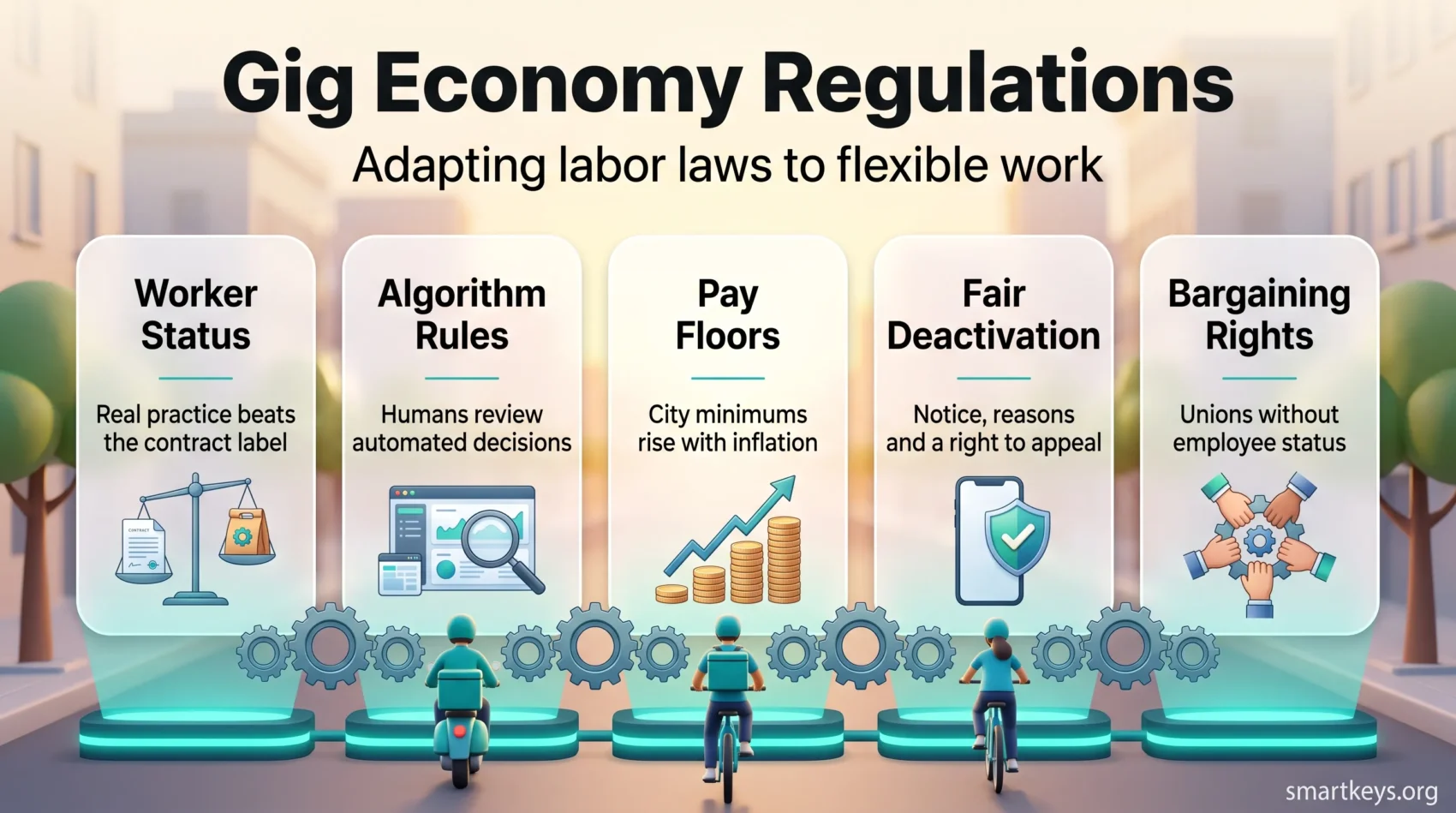
- Collective bargaining no longer requires employee status, as Massachusetts and California show.
What changed in 2026: the short version
If you read only one section, read this one. The table shows the state of play as of September 2026.
| Jurisdiction | What applies now | Key date |
|---|---|---|
| EU | Platform Work Directive (EU) 2024/2831: presumption of employment, rules for algorithmic management | National laws due 2 Dec 2026 |
| U.S. federal | 2024 rule still governs private FLSA lawsuits; DOL investigators use older guidance; rescission proposed, not final | Proposal published 26 Feb 2026 |
| California | Prop 22 contractor status intact; AB 1340 gives rideshare drivers union rights | In force 1 Jan 2026 |
| Massachusetts | App Drivers Union certified to bargain with Uber and Lyft | Certified May 2026 |
| New York City | $22.13/hour before tips; grocery delivery covered; payment within 7 days; itemized pay statements | 1 Apr 2026 / 26 Jan 2026 |
| Seattle | $0.47 per engaged minute plus $0.80 per mile, or $5.34 per offer, whichever is greater | Rates as of 1 Jan 2026 |
Why gig economy rules keep shifting
The pandemic showed how many essential workers had no basic legal protection. That gap invited a decade of lawsuits, and the lawsuits produced new laws.
Algorithms are now the legal centre of gravity
Platforms steer work through ratings, nudges to accept jobs, dynamic pricing and automatic account removal. Regulators increasingly treat that as management, whatever the contract says.
The UK Supreme Court took this view in Uber BV v Aslam (2021). It held that drivers were workers because Uber set fares and terms and controlled the relationship in practice. The EU directive goes further. It regulates automated decisions directly and requires a human to review significant ones, such as suspending an account.
For your company, product decisions are now compliance decisions. Our guide to algorithmic management covers the governance side in depth. Our overview of AI employee monitoring explains where tracking tools cross legal lines.
- Map where your system touches account removal, pay setting, scheduling nudges and job ranking.
- Make automated decisions auditable: log the inputs, the thresholds and who can override them.
- Treat stronger protections as a way to attract workers, not only as a compliance cost.
The core issue: employee or independent contractor
Legal tests look past the label on the contract to how the work actually happens. An employee gets minimum wage, overtime and benefits. An independent contractor runs their own business and gets none of those by default.
In the U.S., courts apply the Fair Labor Standards Act (FLSA), the federal law on minimum wage and overtime. They ask who sets prices, who carries the risk of losing money, how permanent the relationship is and whether the work is central to your business. Say a delivery app sets every fare and punishes drivers who decline jobs. A court may find those drivers are employees, even if each one signed a contractor agreement.
What actually drives worker status
- Why it matters: classification decides wages, benefits, tax duties and your exposure to back pay and penalties.
- Key indicators: chance of profit or loss, the worker’s own investment, permanence, how central the work is, and independent initiative.
- Common own goals: required shifts, exclusivity clauses, or bans on working for competing apps.
Actionable step: audit classification on a fixed schedule, and again whenever you change pricing logic, incentives or your removal policy. If you use freelancers outside app work too, our guide to managing freelancers covers the day-to-day side.
The federal picture: a proposed rollback, not a settled rule
U.S. federal policy has moved in the employer’s direction, but not cleanly. Three things are true at once, and mixing them up is expensive.
First, in May 2025 the DOL’s Wage and Hour Division told its investigators to stop applying the 2024 independent contractor rule. Investigators now work from older guidance.
Second, on 26 February 2026 the DOL published a notice of proposed rulemaking to replace the 2024 rule with a modified version of the 2021 test. That test puts two factors first: control over the work, and the chance of profit or loss. The comment period closed in late April 2026. As of September 2026 the final rule has not been published, and legal challenges are widely expected once it is.
Third, and most important: the 2024 rule still applies in private lawsuits. A worker suing you under the FLSA is not bound by how the DOL chooses to enforce.
How to act while the rule is unsettled
- Build a checklist: turn the factors into role-by-role questions instead of one company-wide answer.
- Watch the high-risk signals: platform-set pricing, route assignment and penalties for declining jobs all point toward control.
- Collect evidence now: invoices, business registrations, workers’ own tools and real profit-and-loss records.
- Plan for both outcomes: estimate the cost if a court applies the stricter 2024 test to your current setup.
State-by-state patchwork: where classification diverges
Federal loosening has not slowed the states. If anything, it has sped them up.
California: AB 5, Prop 22 and now union rights
Assembly Bill 5 wrote the ABC test into law in 2020. Under that test, a worker is an employee unless the company proves three things. The worker is free from its control, does work outside its usual business, and runs an independent trade. The Ninth Circuit upheld AB 5 in June 2024. Voters had already exempted app-based drivers through Proposition 22, and the California Supreme Court kept that exemption in Castellanos in July 2024.
The newest change is the one many businesses missed. AB 1340 took effect on 1 January 2026. It lets rideshare drivers organize and bargain collectively while remaining independent contractors. Uber and Lyft dropped their opposition as part of a deal that also reduced their insurance requirements. Delivery drivers are not covered. In August 2026, the state labor board confirmed that the California Gig Workers Union had cleared the 30% support threshold, putting it on track to begin bargaining.
California follows Massachusetts. Voters there approved union rights for rideshare drivers in a 2024 ballot measure, and the App Drivers Union was certified in May 2026. This hybrid model, contractor status plus collective bargaining, is the template other states are studying. For the wider labor context, see our piece on tech worker unionization.
Other states and the cost of venue shopping
New York, New Jersey, Illinois and Washington have tightened standards or added protections for app-based workers. The details vary enough that multi-state operators often face conflicting duties for the same role. For legislation beyond gig work, see our overview of future of work legislation.
- Practical impact: contracts, pay and onboarding vary by state whether you planned for it or not.
- Risk: building around the friendliest state lowers costs now and raises legal and reputational exposure later.
- Action: map status by state, then standardize the documents that support each position.
Pay floors and wage risk in 2026
City minimum pay laws now shape rate cards, promotions and surge pricing directly.
New York City: $22.13 and expanding
New York City phased in its floor from $17.96 in December 2023 to $19.56 in April 2024 and $21.44 in April 2025. On 1 April 2026 it rose to $22.13 per hour before tips, a 3.2% inflation adjustment.
The bigger change came on 26 January 2026. A package of local laws extended the minimum pay rate to third-party grocery delivery workers, for example through Instacart. Platforms must now pay within seven calendar days of the pay period and give itemized statements showing how pay was calculated. Apps must also show a tip option before or at checkout.
Seattle: per-offer minimums and a $15 million lesson
Seattle sets pay differently. Since 1 January 2026, covered companies must pay the greater of $0.47 per engaged minute plus $0.80 per engaged mile, or $5.34 per offer. “Engaged” means the time and distance from accepting a job to completing it.
A city data report from April 2026 covered the ordinance’s first 18 months. Average pay was $30.12 per engaged hour and $15.98 for all time logged in. Enforcement is real. In July 2025 Seattle’s Office of Labor Standards reached a $15 million settlement with Uber Eats, almost all of it paid to more than 16,000 delivery workers.
Overtime exposure when misclassification is found
Misclassified workers can claim back pay and overtime. Rigid scheduling, order batching rules and strict acceptance thresholds all raise that risk.
- Keep trip-level records: engaged time, miles, tips, wait time and expenses.
- Estimate the downside, back overtime plus penalties, and hold a reserve against it.
- Explain pay calculations in plain language so disputes end before they become claims. Our guide to pay transparency shows how to do this well.
Beyond wages: benefits, account removal and discrimination
Local laws increasingly decide how gig workers get benefits and how they can challenge being removed from a platform.
Paid sick leave keeps expanding. Washington grants paid sick time to rideshare drivers, and both New York City and Seattle let app-based workers build up leave.
Insurance and benefits
California’s Prop 22 requires platforms to provide occupational accident insurance for app-based drivers. Washington extends workers’ compensation to rideshare drivers. Portable benefits are the most discussed structural fix: benefit accounts that follow the worker, with each platform paying in based on the work done. Several states are testing voluntary versions. Our look at the evolution of employee benefits covers the wider benefits market.
Account removal now requires due process
Deactivation, the industry term for removing a worker from an app, is no longer just a product setting. Seattle’s App-Based Worker Deactivation Rights Ordinance has applied since 1 January 2025. It requires a valid reason, notice and a route to appeal. Ontario’s Digital Platform Workers’ Rights Act, in force since 1 July 2025, generally requires two weeks’ notice before removing a worker for 24 hours or more. The EU directive adds human review of significant automated decisions.
Anti-discrimination protections also reach beyond employees in some places. New York, for example, extends its human rights law to contractors.
- List benefits by state and city: sick leave, insurance, workers’ compensation.
- Rebuild account removal around notice, reasons and a documented appeal with a set response time.
- Align contracts so nothing conflicts with local protections.
Global blueprints: EU, UK, Spain, Canada and Australia
The EU is now the most consequential regulator of platform work anywhere.
The EU Platform Work Directive
Directive (EU) 2024/2831 was adopted in October 2024 and entered into force on 1 December 2024. Member states must write it into national law, a step called transposition, by 2 December 2026.
It does three things that matter to you:
- Presumption of employment: where the facts show direction and control, a worker is presumed to be an employee. The platform then has to prove otherwise.
- Algorithm rules: transparency and human oversight of automated decisions. These apply even to people who are genuinely self-employed.
- Enforcement: platforms must share more data with national authorities.
Progress is uneven. Italy’s government approved a draft transposition law in July 2026, and Germany confirmed in May 2026 that it was drafting one. Many other states were still at the drafting stage by mid-2026. The directive sets a minimum, so national versions will differ. If your platform also uses AI to manage work, check our guide to EU AI Act compliance, because both rulebooks can apply at once.
UK, Spain, Canada and Australia
The UK’s Aslam ruling confirmed that many ride-hailing drivers are workers, a middle category with minimum wage, holiday pay and pension rights. The U.S. has no equivalent. The UK government has floated a single worker status, but the Employment Rights Act 2025 did not introduce one.
Spain’s 2021 Rider Law reclassified delivery riders as employees and required algorithm transparency years before Brussels did. In Canada, Ontario’s platform worker law guarantees the provincial minimum wage for time spent on assignments, whatever the worker’s status. Australia went furthest this year. Minimum standards for on-demand delivery workers took effect on 17 August 2026, with hourly minimums of AUD 31.30 to 32.00 depending on the vehicle. If you operate across borders, our look at the global gig economy compares these markets. Our guide to global payroll solutions covers paying people in several countries.
The pattern: transparency, fair account removal and clear pay show up in every model. Build audits, data access and appeals once, then adjust the thresholds for each market.
Your compliance playbook
Repeatable checks, clear agreements and fast dispute handling beat one-off legal reviews. A simple risk management framework helps you decide which markets and roles to review first.
Classification audits and contract clarity
Audit against both the federal factors and the state tests that apply to you. Document findings, fixes and who signed off.
Write contracts that describe scope, pricing and tools without requiring shifts, supervision or exclusivity. Building a broader flexible-talent model? Our on-demand workforce strategy guide covers the operating design. Our analysis of the future of contract work explains where demand is heading.
Transparent pay and recordkeeping
Issue clear pay statements, keep trip-level records and match your calculations to local floors in New York and Seattle.
Due process for account removal
Offer a structured appeal with set response times. Clear notices and internal review reduce claims and protect your brand.
Technology, tax and training
- Monitor: track hours, acceptance prompts and patterns that create status or overtime risk.
- Automate tax: collect W-9 forms, validate tax ID numbers and file 1099-NEC forms for U.S. contractors.
- Train: managers and support staff need the basics of classification triggers, not a legal seminar.
Conclusion
The old yes-or-no question, employee or contractor, is slowly giving way to a better one: which protections attach to this work, in this place, right now?
You can see that shift in bargaining rights without employee status, EU algorithm rules that ignore classification, and city pay floors that apply whatever the contract says.
So build for it. Review contractor status on a schedule, refresh contracts, and budget for pay floors that rise every year. Line up the federal framework with the state and city rules that actually bind you. And treat account removal and pay transparency as product requirements, not legal afterthoughts.
For the market context behind these rules, see our overview of freelancing trends, and look further ahead with our forecast for the gig economy in 2030.
Found this useful?
Make SmartKeys a preferred source on Google, and our articles will surface more often in your Top Stories, AI Overviews, and AI Mode.
Add as Preferred Source