Hiring a freelancer is easy. Getting reliable work out of one, month after month, is a management skill. Most managers were trained to supervise employees: people who share your calendar, your tools and your working hours. A contractor shares none of that.
This guide covers what changes when the person doing the work runs their own business: a practical routine for briefing, onboarding, tracking and paying contract talent, plus the US tax and security rules that apply in 2026. None of it needs new software. It needs clearer scopes, faster feedback and a few written rules everyone can see.
Key Takeaways
- Judge contractors on delivered outcomes, not on hours logged or availability.
- A written brief with acceptance criteria prevents most rework before it happens.
- One shared project board and one file location remove the majority of status questions.
- The US 1099 reporting threshold rises from $600 to $2,000 for tax year 2026.
- Least-privilege access and prompt offboarding are the two security habits that matter most.
Why supervising contractors is now a core management skill
Independent work is no longer a niche. MBO Partners, which has surveyed the US independent workforce annually since 2011, counted more than 72 million Americans working independently in its 2025 State of Independence study. Upwork puts 28% of US knowledge workers in independent arrangements, earning a combined $1.5 trillion in 2024.
For you, that means the specialist you need probably exists. It also means you are one client among several, competing for that person’s attention. A freelancer who finds your briefs vague and your feedback slow will quietly prioritise an easier client. Being an easy client is not a courtesy here. It is how you keep access to good people.
The practical difficulties are predictable, and all are solvable with process rather than supervision:
- Time zones. A question asked at 4pm your time can cost a full day if the answer waits for an overlap window.
- Context gaps. Contractors miss the threads where decisions actually get made.
- Fragmented ownership. When three freelancers touch one deliverable, nobody is sure who owns the final version.
- Payment friction. Inconsistent invoice rules and slow approvals damage a relationship faster than a low rate does.
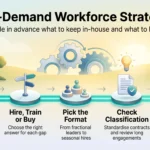
Still deciding how large a role contract talent should play? Our guide to building an on-demand workforce strategy covers that staffing decision, and our overviews of the global gig economy and current freelancing trends give the wider market picture.
The mindset shift: a freelancer is a business, not a junior employee
This is the single change that makes everything else work. A freelancer is an independent business owner. They invoice you, pay their own taxes, buy their own equipment and set their own hours. You are buying a result, not renting a person. Three things follow.
Buy outcomes, not attendance
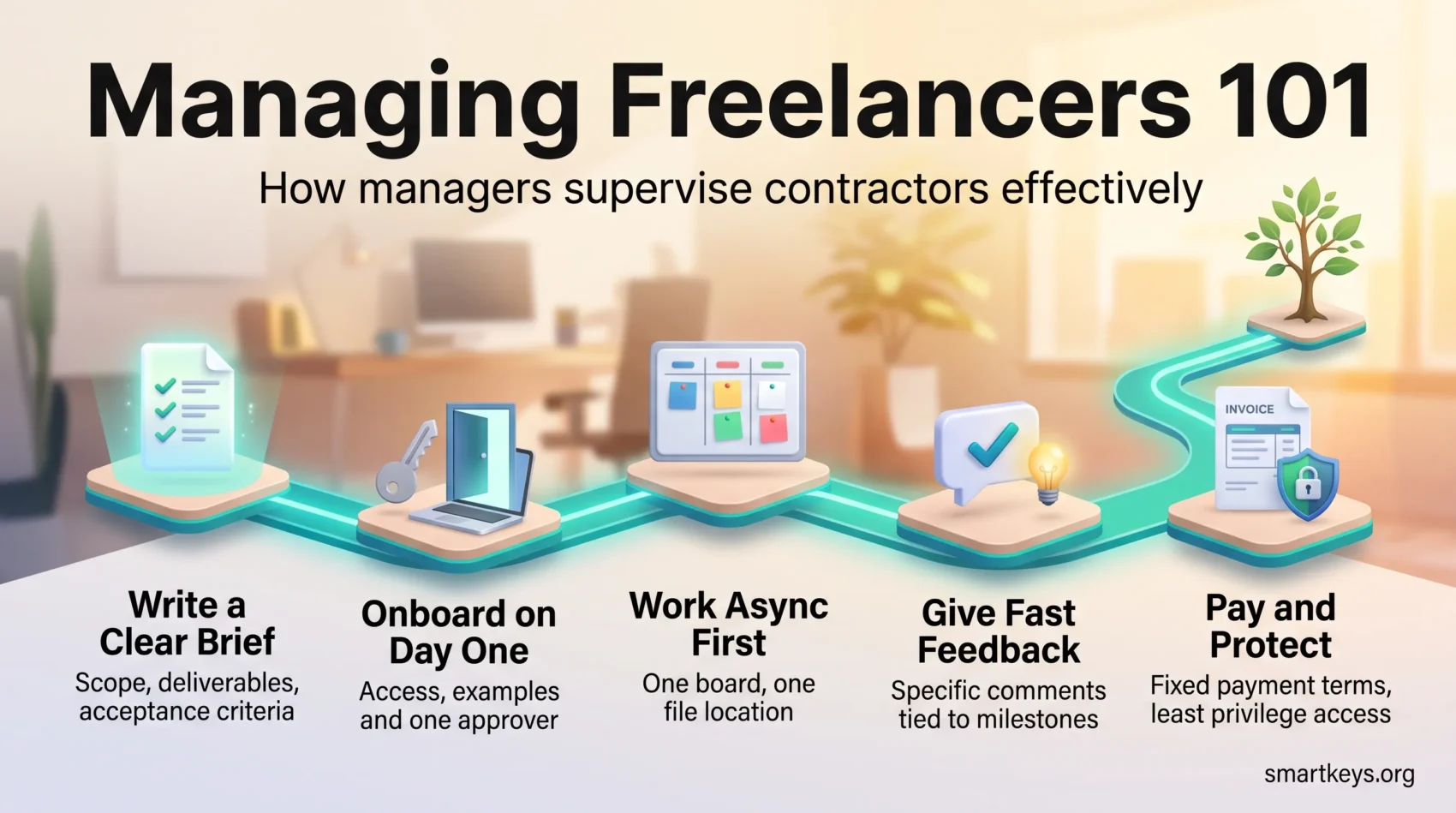
Stop asking when someone will be online and start defining what “done” looks like. Write the deliverable, the format, the deadline and the acceptance criteria: the specific conditions the work must meet before you approve it. For a blog post that might be 1,200 words, three internal links, a named target keyword and one round of revisions included. This is the principle behind outcome-based work, and it applies to contractors even more cleanly than to staff.
Give context, then get out of the way
Contractors deliver better work when they understand the goal behind the task. Tell them who the audience is, what the piece has to achieve and which constraints are non-negotiable. Then let them choose the method. You hired the expertise; second-guessing every decision wastes it.
Write down the minimum process
You still need rules, just fewer than you would use internally. Agree at kickoff where files live, who approves work, how often you check in, and how to escalate a blocker. Anything beyond that is usually overhead.
“Clear briefs, fast feedback and space to work. That combination costs nothing and keeps good freelancers coming back.”
Choosing and hiring freelancers who fit the project
Clarity does most of your filtering for you. A brief that names the scope, the required skills, the deliverables and the acceptance criteria lets the wrong candidates disqualify themselves before you read a single proposal.
Where you look depends on the work. Marketplaces such as Upwork, Fiverr and Freelancer.com suit well-defined, repeatable tasks; referrals and niche communities produce better results for strategic work. Our guide to crowdsourcing talent compares those channels.
What actually predicts a good engagement
Portfolios matter less than most managers assume. Look for these signals:
- A walkthrough, not a gallery. Ask a candidate to explain one relevant project: constraints, decisions, outcome. Someone who did the work can do this easily.
- Responsiveness during hiring. How someone communicates while pitching is how they will communicate on a deadline.
- Honest capacity. A freelancer who says they can start in three weeks is more reliable than one who promises tomorrow.
- A small paid test. For high-stakes work, pay for a scoped sample task. It reveals collaboration style better than an interview.
If you use automated screening, note that several jurisdictions now regulate it. Our article on AI hiring tools covers the New York City, Illinois, Colorado and EU requirements.
Be honest about budget and timeline
Experienced freelancers choose their clients. Vague budgets and compressed deadlines filter out exactly the people you want. Say what you can pay and when you need it, then negotiate scope rather than rate. Location-based pricing is worth settling before you post the role, because it shapes who applies. We covered both sides in our piece on global pay parity. For context on how independent work is evolving, see the future of freelancing, and if you are testing people with a view to hiring them later, read up on the contract-to-hire trend first.
Onboarding contractors properly on day one
Most freelance engagements lose their first two days to access problems and missing context. A short, reusable onboarding pack fixes that for good.
What to send before work starts
Send a non-disclosure agreement (NDA) if the work touches confidential material, then brand guidelines, tone-of-voice notes, a style guide and two or three examples of work you rate. Examples show your standard rather than describing it.
Agree how you will communicate
Pick a default channel and say what it is for: chat for quick questions, the project board for status, email for approvals. Set a response expectation, say one business day, so neither side waits in silence.
Name the approver and the escalation path
Write down who reviews drafts, who signs off, and who the contractor contacts when blocked. Ambiguity here is the most common cause of missed deadlines that were nobody’s fault.
The kickoff checklist
- Access confirmed to the CMS, design files, project board, shared storage and password manager.
- Deliverables, milestones and review dates entered in the project tool, not just agreed in a call.
- File naming and version conventions written down, with one folder as the home for finished work.
- Invoice format, payment terms and the W-9 collected before the first deliverable, not after it.
Keep this pack current and each engagement starts faster. Much of what works for onboarding employees remotely applies here; our guide to remote onboarding and training goes deeper on the first-week structure.
Communication, tools and processes that keep work moving
When your team spans time zones, the default communication style has to change. Async-first means treating written updates as the norm and live calls as the exception, so nobody’s progress depends on someone else being awake.
Our guide to asynchronous work explains the approach, and our comparison of asynchronous communication tools covers the software side.
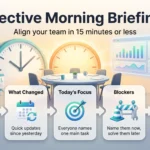
Use meetings for decisions, not status
Status belongs on a board anyone can read. Reserve live calls for what genuinely needs discussion: ambiguous requirements, competing priorities, creative direction. End every call with named owners and dates, written into the board before anyone leaves.
One board, one source of truth
Pick a single project tool and use standard stages such as Backlog, In Progress, In Review and Approved. The value is not the software; it is that everyone sees the same status without asking. Asana, Trello, ClickUp and Notion all do this well, and our Asana review covers what the free and paid tiers include.
Pair that with one agreed location for files. Work scattered across email attachments, chat threads and personal drives is the main reason teams ship the wrong version.
Track time without policing it
If you bill hourly or need budget visibility, use a tracker such as Harvest, Clockify or Toggl and look at totals, not timelines. Our Toggl Plan review explains what changed when Toggl folded that product into its newer suite. Watch two signals only: work trending well over estimate, and repeated rework on the same deliverable. Both point to a brief problem, not an effort problem. Running several engagements at once? Our guide to staying productive across multiple projects is a useful companion.
Plan the overlap deliberately
Agree a shared window of a few hours when everyone is reachable, and schedule handoffs to land at the start of someone’s day rather than the end. Our guides to managing cross-border remote teams and follow-the-sun scheduling cover how to structure this across wider spreads.
Tracking work, measuring success and giving feedback that lands
Vague feedback is the most expensive thing a manager gives a freelancer. “Make it punchier” costs two revision rounds. “Cut the intro to three sentences and lead with the pricing change” costs one.
Define what good looks like per role
Set two or three key performance indicators (KPIs), the measurable signals you judge the work by, and tie each to a milestone. For a writer that might be revision rounds per piece, on-time delivery and approval on first review. For a designer, approval rate and adherence to the brand system. Keep the list short enough to actually check.
Handle shared deliverables explicitly
When several contractors touch one project, map each person to a stage: draft, review, approval, launch. If quality slips you can see where, instead of guessing. Without this, feedback lands on whoever is easiest to reach.
Set a feedback rhythm
Batch your comments and send them once, referenced to the brief. Piecemeal feedback across a day produces contradictory instructions and unnecessary rework. Fast and specific beats thorough and late.
- Useful metrics: cycle time from brief to approval, revision rounds per deliverable, on-time delivery rate.
- Cadence: a short review at each milestone, using the same criteria every time.
- Recognition: tell contractors when their work performed well. Almost nobody does, which is why freelancers remember the clients who do.
Payments, invoices and US tax rules in 2026
A predictable payment process protects the relationship more than a higher rate does. Set the rules once and apply them to everyone.
Standardise invoicing and payment terms
Ask for a consistent invoice format with a purchase order or project reference, itemised lines and a due date. Choose payment terms you can actually meet, such as Net 15 or Net 30, meaning payment falls due 15 or 30 days after the invoice date, and say so before the engagement starts. Run payments on a fixed schedule rather than ad hoc: contractors plan their cash flow around your terms, and a missed run costs goodwill you will need later.
Tie milestones to acceptance
Link each payment to an accepted deliverable rather than to elapsed time. Add a short change-order process: if scope grows, the contractor sends a written estimate of the cost and timeline impact, and you approve it before the extra work starts. This one rule prevents most scope disputes.
Paying across borders
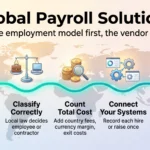
International contractors add currency conversion, transfer fees and local compliance. Our overview of global payroll solutions compares the main routes, including employer-of-record services for cases where a contractor relationship is not appropriate.
What changes for US 1099 reporting in 2026
Collect a signed W-9, the IRS form capturing a contractor’s name and taxpayer identification number, during onboarding rather than in January. Chasing them at year end is reliably unpleasant.
The reporting threshold itself changed. Under the One Big Beautiful Bill Act, signed in July 2025, the filing threshold for Forms 1099-NEC and 1099-MISC rises from $600 to $2,000, first applying to tax year 2026, with inflation adjustments from 2027. Many businesses will file fewer forms, but the record-keeping duty does not go away: you still need accurate payment records for every contractor, and state thresholds may differ from the federal one.
Classification is also in flux. In February 2026 the Department of Labor proposed rescinding its 2024 independent contractor rule and returning to an economic reality analysis focused mainly on control over the work and the worker’s opportunity for profit or loss. That proposal was still in rulemaking at the time of writing, so check specific cases with a qualified accountant or employment lawyer rather than assuming from a blog post.
Security, access and boundaries
Every contractor you onboard is another set of credentials pointing at your systems. The FBI’s Internet Crime Complaint Center logged just over one million complaints and nearly $21 billion in reported losses for 2025, so treating access as part of project setup is proportionate rather than paranoid.
Give the least access that works
Least-privilege access means each person gets only the permissions their task requires. A copywriter needs draft access to the CMS, not publishing rights. Keep production and staging environments separate, and revoke everything on the day an engagement ends rather than whenever someone remembers.
Make the basics non-negotiable
- Shared credentials: use a password manager with per-user access rather than sending logins over chat.
- Multi-factor authentication: require a second verification step on any account touching customer or financial data.
- Approved tools: list which file-sharing and collaboration tools are allowed, and say briefly why others are not.
- Access review: audit who still has access once a quarter. Old contractor accounts are a common finding.
Our guide to cybersecurity in remote work covers the wider practices, most of which apply unchanged to contractors.
Boundaries protect both sides
Write scopes that state what is included and, just as usefully, what is not. Cap revision rounds. Say whether weekend availability is expected, and if it is not, do not message at weekends. Scope creep, the gradual expansion of a project beyond what was agreed, is the most common reason good freelancers stop taking a client’s work.
Conclusion
Managing contract talent well comes down to a few repeatable habits: write briefs with acceptance criteria, keep one visible source of truth, give feedback quickly and specifically, pay on a schedule you announced in advance, and control access deliberately.
Close each engagement properly too. Confirm final deliverables, note the rate and turnaround for next time, and send a short thank-you with any performance data you have. That five-minute closeout turns a one-off gig into a contractor who answers your email first.
Treated this way, freelance relationships become a genuine capability: specialist skills you can reach in days rather than months, without adding headcount. If you work with independents from the other side of the table too, our collection of freelancer productivity hacks is worth passing along.
Found this useful?
Make SmartKeys a preferred source on Google, and our articles will surface more often in your Top Stories, AI Overviews, and AI Mode.
Add as Preferred Source