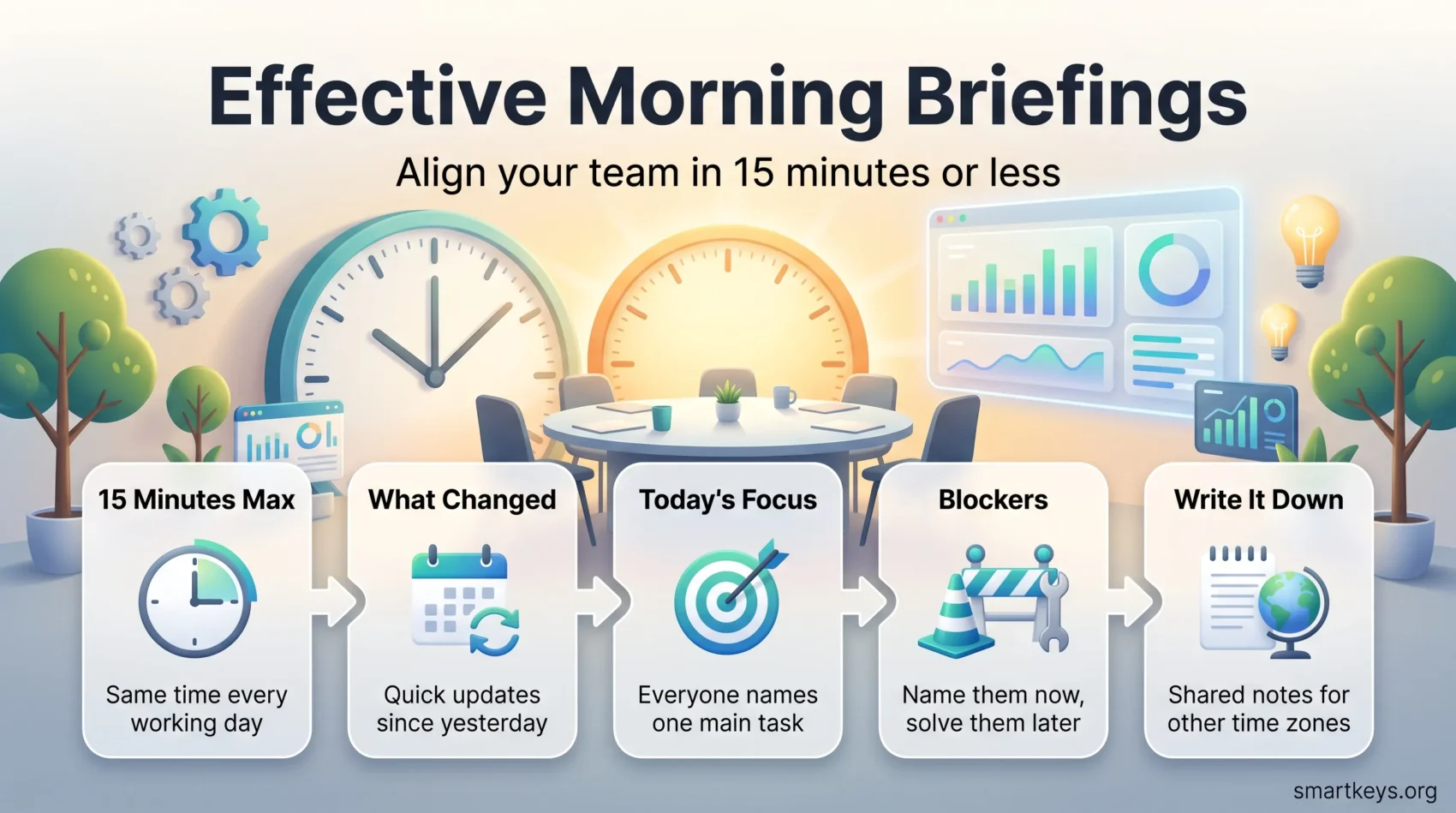
A morning briefing is a short, fixed meeting at the start of the workday where a team agrees on what matters today. It is not a status report to the manager, and it is not the place to solve problems. It answers three questions: what changed since yesterday, what is each person working on, and what is in the way.
Done well, it removes the small confusions that cost people half a morning. Done badly, it is one more meeting nobody wanted. This guide covers what belongs in a briefing, how long it should run, how to adapt it for a distributed team, and when to stop.
Key Takeaways
- A morning briefing works best at 15 minutes or less, at the same time every working day.
- Its job is alignment, not reporting. Problems get named in the briefing and solved afterwards.
- Gallup found only 49% of US employees know what is expected of them at work. That is the gap a briefing closes.
- Everyone speaks. If only the manager talks, it has become an announcement.
- Distributed teams need a written version so other time zones are not left out.
- Drop the briefing once it stops changing what people do that day.
Why Morning Briefings Matter
Most teams do not have an information problem. They have a scattering problem: the same update arrives four times through four channels, and the detail that mattered arrives at 4pm. A briefing collects that traffic into one predictable slot.
Clearer Communication in One Place
Microsoft’s 2025 Work Trend Index found that 57% of workplace meetings are ad hoc calls with no calendar invite, and that people are interrupted roughly every two minutes by a meeting, message, or notification. A briefing does not remove interruptions. It gives people somewhere to park the question that would otherwise become an unplanned call at 11am, which makes clear communication a habit rather than a reflex.
Building Team Cohesion
A daily briefing is one of the few moments a distributed team hears each other without an agenda item forcing it. Knowing what a colleague is stuck on makes it easier to help before a deadline slips. Gallup put global employee engagement at 20% in 2025, and a meeting where people speak is a cheap way to work against that.
Setting Expectations
This is the part with the clearest evidence behind it. Gallup reported in May 2026 that only 49% of US employees say they know what is expected of them at work. When half a workforce is unsure what today is for, a five-minute confirmation of priorities beats any tool. Saying out loud what you will finish today also makes it harder to drift, which helps with procrastination.
The format is not new. Scrum, the project framework built around short work cycles, defines its Daily Scrum as a 15-minute event held at the same time and place every working day. Healthcare uses the safety huddle, which the US Agency for Healthcare Research and Quality describes as an interdisciplinary meeting of no more than 10 to 15 minutes, held to flag risks before a shift. Both landed on the same length for the same reason: you can hold attention for a quarter of an hour, not for forty minutes. Teams outside software borrow the pattern often, as our guide to Scrum and Kanban beyond IT describes.
Components of an Effective Morning Briefing
Three things separate a briefing people value from one they endure.
Start on Time
Start at the stated minute, whether or not everyone has arrived. Waiting for latecomers teaches the team that the time is a suggestion, and the meeting drifts to five past. They catch up from the notes.
Keep It Short
Fifteen minutes is the ceiling, and ten is better for a team of five or fewer. The limit forces the useful behaviour: people prepare, they leave out detail nobody needs, and anything needing real discussion gets scheduled separately. A briefing that runs half an hour has stopped being a briefing.
Preparation is Key
Whoever runs it should know beforehand which two or three items need airing: a deadline that moved, a customer escalation, an absence that shifts the workload. Everyone else arrives knowing what they will finish today.
Morning Briefings and Team Dynamics
The briefing shapes how the team behaves all day, so be deliberate about who speaks.
Encouraging Engagement
Every person should say something, even one sentence. When a briefing becomes a monologue, attendance drops and people multitask through it. A simple fix is to rotate who runs it each week: the facilitator pays attention differently, and it spreads the sense that the meeting belongs to the team. For distributed teams this overlaps with remote employee engagement.
Aligning Team Goals
Daily work drifts away from quarterly goals unless someone connects them out loud. Once a week, spend two minutes linking today’s tasks to the target they serve. That catches the team that has been busy for three weeks on work that no longer matters. Our guides to goal setting and prioritization frameworks cover how to set those targets.
Three Rules for a Briefing That Sticks
This format works for a team of five to ten people, inside 15 minutes.
Consistency is Key
Same time, same channel, every working day. Consistency turns the briefing into a habit instead of a calendar negotiation. Pick a slot after people have settled in but before the first deep work block, so it does not cut a focus session in half. If the team uses time blocking, put it at the edge of a block.
Create a Brief Agenda
Four items: changes since yesterday (2 minutes), each person’s main task for today (5 minutes), blockers (3 minutes), and one closing decision or reminder (2 minutes). That leaves three minutes of slack, which you will use. Anything outside those buckets is not briefing material.
Encourage Team Member Participation
Ask each person to name one commitment for the day and check it briefly the next morning. This should never feel like surveillance. A commitment said in front of colleagues simply gets planned more realistically than one on a private to-do list. If someone misses two days running, talk in private.
Running Briefings for Remote and Hybrid Teams
A briefing designed for one room breaks the moment half the team joins from elsewhere. Microsoft’s 2025 data found nearly a third of meetings now span multiple time zones, so “meet first thing” does not survive contact with a distributed team.
Three adjustments cover most cases. Pick the slot that sits inside the working day for the widest part of the team, and accept it will not be morning for everyone. Write the briefing down as you go, so people outside that window get the same information without a recording to sit through. If the spread is too wide, run it in writing: a thread everyone answers within a few hours does the same job, and it fits how asynchronous work and silent meetings already work. When some people share a room and others do not, follow basic hybrid meeting etiquette: one person, one screen. Getting this right is core to remote leadership.
Keeping the Briefing From Going Flat
Teams that have run a briefing for a year often stop listening to it. Rotating the facilitator changes the rhythm and the questions. Once a month, swap the usual round for a three-minute scenario: a supplier misses a delivery, a client escalates overnight. The gaps people name are usually real process gaps. Daily icebreakers rarely survive a 15-minute limit, so use them sparingly.
Morning Productivity Tips
The briefing sets direction. What each person does in the twenty minutes afterwards decides whether that direction survives the day.
Prioritizing Daily Goals
Leave the briefing with one clear first task, not a list of nine. Four habits that help:
- Name one main outcome. Pick the thing that would make the day a success, and treat the rest as optional.
- Do the demanding task first. Most people have more capacity early, before the day fills with requests.
- Write the plan down. A plan you can see beats one held in your head, which is the idea behind daily intentions.
- Protect the first block. Defer what can wait an hour. Our guide to prioritization covers how to decide what waits.
Microsoft’s data showed half of all meetings falling between 9 to 11am and 1 to 3pm, so the quiet hour after a briefing is often the most usable focus time in a daily routine.

Utilizing Efficient Morning Routines
A briefing lands better when people are not starting the day already behind. That is a personal morning routine question rather than a team one, but the two interact.
Morning Rituals for Success
Keep the routine short enough to survive a bad week. A few minutes of quiet before opening email, some movement, and a look at the day’s plan is enough. Elaborate two-hour routines collapse the first time a child is sick.
Time Management Techniques
Time blocking reserves the hour after the briefing for the task you just committed to. The Pomodoro technique, working in timed intervals with short breaks between them, helps when the task is one you would rather avoid. Neither fixes a workload that is simply too large. Then the answer is delegation or cutting scope, not a better timer.

Common Mistakes to Avoid in Morning Briefings
Most failed briefings fail in one of three ways.
Overloading Information
A briefing is not a newsletter. Announcements, detailed metrics, and policy updates belong in writing, where people read them at their own pace. Share the two or three items that change what someone does today, and link the rest. If a topic needs slides, it is not briefing material.
Neglecting Team Feedback
If the same person raises the same blocker three mornings running and nothing happens, the team learns that speaking up is pointless. Close the loop: name who owns it and by when. A recurring pattern of blockers usually points to a missing process, where standard operating procedures help more than another meeting.
Letting It Become a Status Report
The most common drift is that people stop talking to each other and start reporting upward. It is easy to spot: everyone looks at one person while they speak. Fix it by having the manager speak last, or not at all.
How to Tell If the Briefing Is Working
Judge it by whether it changes behaviour. Blockers raised in the briefing get resolved faster than ones raised over chat. People stop sending duplicate updates through other channels. And if you cancel it for a week, someone asks for it back. If none of that holds after a month, run a meeting audit and replace the briefing with a written thread.
Conclusion
A morning briefing has a narrow job: make sure everyone knows what today is for before the day pulls them in different directions. Gallup’s finding that fewer than half of US employees are clear on what is expected of them shows the gap is real.
The rules that make it work are unglamorous. Fifteen minutes maximum, same time daily, everyone speaks, problems named and then solved elsewhere. Write it down for people who cannot attend live, and stop it if it stops earning its place. A briefing that stays short and honest is one of the few recurring meetings a team will defend.
Found this useful?
Make SmartKeys a preferred source on Google, and our articles will surface more often in your Top Stories, AI Overviews, and AI Mode.
Add as Preferred Source