Every message you send is also a choice about how fast the work moves. Post a decision in a busy chat channel and it scrolls away by lunchtime. Book a meeting for a status update and you have spent an hour of five people’s time on something a paragraph would have covered.
Picking between email, chat, and a meeting is not a matter of taste. It comes down to three questions: does the message need to survive the week, how fast do you need an answer, and how likely are people to misread you?
The pressure behind that choice has grown. Microsoft’s 2025 Work Trend Index, based on Microsoft 365 usage data, found that employees are interrupted every two minutes during core hours, roughly 275 times a day, and receive an average of 153 Teams messages and 117 emails per weekday. At that volume, choosing the wrong channel is how work quietly stalls.
This guide gives you a decision flow, a pre-send checklist, and a worked example. It also flags two popular communication claims that do not hold up.
Key Takeaways
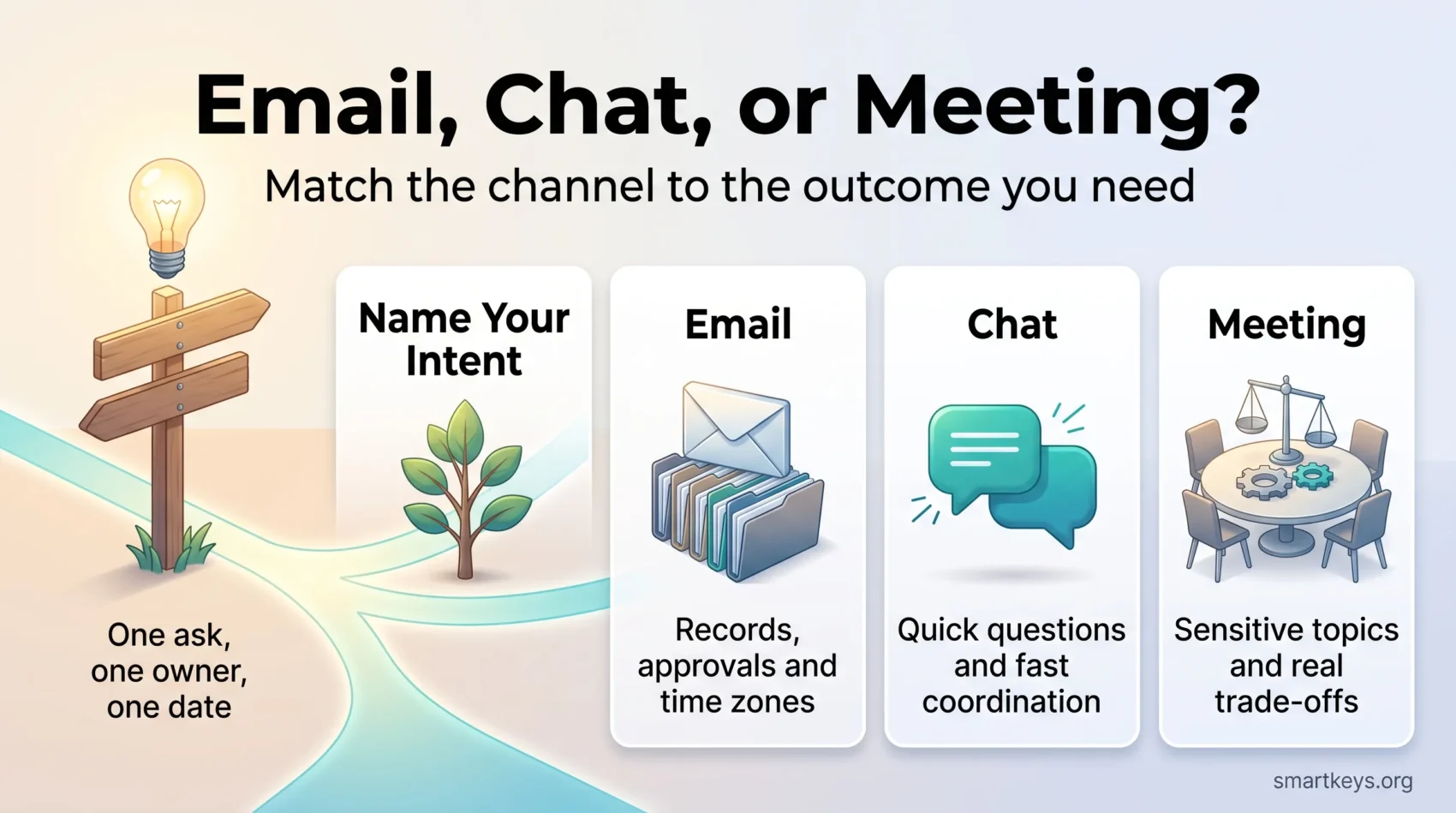
- Match the channel to the outcome you need, not to the habit you have.
- Email for records, chat for speed, meetings for nuance and hard calls.
- Name your intent in one sentence before you open any window.
- Default to writing; escalate to live only when delay costs more than the hour.
- One ask, one owner, one date removes most follow-up traffic.
Why the channel you pick decides how fast work moves
The channel shapes three things: who sees the message, when they act on it, and whether anyone can find it again in six weeks.
Start by naming your intent. Are you informing, requesting, deciding, aligning, or escalating? Writing that sentence to yourself first is the cheapest habit in this guide, because the intent usually names the channel. “I need a decision from two people by Thursday” is not a meeting. “I need to tell a colleague their project is being cut” is not a chat message.
What the message has to survive
Next, ask what the message must do after you send it. A budget approval will be quoted back during an audit next year, so it needs a searchable home. A question about which room to use has a shelf life of ten minutes. Four factors settle almost every case: urgency, complexity, sensitivity, and expected back-and-forth. High complexity or sensitivity points to live conversation; high urgency with low complexity points to chat. Everything else is usually a well written message.
What poor communication costs, and what that number is worth
The most quoted figure comes from Grammarly and The Harris Poll, whose 2022 survey estimated that poor workplace communication costs US businesses about $1.2 trillion a year, or roughly $12,506 per employee. Treat that as a survey-based estimate built on self-reported time loss, not a measured accounting cost. The upside figures from the same programme are more useful, because they describe what leaders observe: in the 2023 report, 72% of business leaders said effective communication had raised their team’s productivity, 63% reported higher customer satisfaction, and 60% greater employee confidence.
You do not need a trillion-dollar number to justify the effort. The local version is easier to see: a deadline missed because an approval sat in a chat thread, two people building the same report, a customer told two different things.
Clear communication starts with the 5 Cs
A short checklist turns a muddled note into something people can act on without replying to ask what you meant.
The five checks are clear, correct, complete, concise, and compassionate. Run them as a scan before you send.

The five checks before you hit send
- Lead with the ask. One action, one owner, one date, in the first sentence.
- Confirm the facts. Check dates, names and numbers, and link the source when a number matters.
- Answer the obvious question. Add the context or link that would trigger a reply.
- Cut the filler. Shorten long sentences, and replace jargon with plain words.
- Mind the tone. Text strips out warmth, so respect the reader’s time and mood on purpose.
Our guide to writing messages that prevent miscommunication goes deeper on structure and subject lines.
A worked example
The version most people send:
“Hi all, wanted to touch base on the launch. Let me know your thoughts when you get a chance.”
Nobody knows what is being asked, of whom, or by when. It produces silence or three unrelated replies.
The same message rewritten:
“Sara and Tom: I need a yes or no on the 14 April launch date by Thursday 5pm. The blocker is the pricing page copy, which is 80% done. If you cannot commit by Thursday, tell me and I will move the date to the 21st.”
It names the people, the decision, the deadline, the blocker, and the fallback. Two lines longer, and it saves roughly four messages.
How to choose: email, chat, or meeting
The deciding question is simple: what outcome do you need, and who has to act to produce it?
Use email when the message needs a record
Email fits when you need a searchable, timestamped record, when you are attaching documents, or when readers sit in different time zones. A well written email is self-serve: someone joining the project in October should understand the decision without asking you. Use it for approvals, formal briefings, and anything with legal or budget weight.
Use chat for quick coordination
Slack and Microsoft Teams are built for short questions, fast unblocking, and coordination too small to formalise. Our comparison of Slack and Microsoft Teams covers how the two differ.
Keep each thread to one question, one owner, and one deadline, because threads carrying three topics get answered on one. A decision made in a channel is one nobody will find again, so move the outcome into a document or email the same day.
Chat also needs boundaries. Agreeing when people are expected to reply, and when they are not, is the difference between a fast channel and a permanent interruption. See our guides to setting instant messaging boundaries and managing work notifications.
Use meetings for nuance and hard calls
Call a meeting when the topic is sensitive, when a decision depends on trade-offs that only surface in conversation, or when the group needs to think together. Performance conversations and early problem solving belong here. Prepare a goal, an agenda, and a pre-read, then close with written outcomes and owners. If you cannot say in one sentence what the meeting will produce, cancel it.
Build in the supporting pieces: a meeting notes template so action items survive the call, a one-on-one structure for check-ins, and hybrid meeting etiquette so remote attendees are not talked over. Our guide to running effective meetings ties the format together.
The decision flow, and why writing comes first
Run the same three questions every time. How urgent is this? How complex or sensitive is it? Who has to give feedback before it can move?
- A two-sentence update: chat.
- A plan with dependencies and approvals: email or a shared document.
- A real trade-off between two options: a meeting.
- Bad news for one person: a call, never a channel.
Default to writing and escalate only when the cost of delay or misunderstanding beats the hour you are about to spend. That default is what asynchronous work is really about, and the right asynchronous communication tools make it practical. To go further, silent meetings replace most of the talking with structured reading and written input.
Two habits protect the rest of the calendar: a periodic meeting audit to find recurring slots that have outlived their purpose, and a focus time policy giving everyone blocks meetings cannot touch. See also our guide to digital workflows.
Active listening that saves your team time
Active listening means working out what someone actually needs, rather than waiting for your turn to speak. It sounds soft. In practice it is the cheapest way to avoid doing the wrong work.
Three cues you can use today
- Paraphrase. “So the blocker is the vendor contract, not the design?” One sentence catches the misunderstanding before it costs a week.
- Ask before you solve. “What have you already tried?” saves you from suggesting it again.
- Let silence sit. People often finish their real point a few seconds after you think they are done.
Our guide to active listening at work covers the practice in more depth.
Listening on calls and video
Remote conversation strips out the small signals that keep an in-person discussion on track. Compensate on purpose: name people when you want their input rather than asking the group, slow your pace, and say the agreement out loud before the call ends. Then write it down, because an agreement that exists only in a recording is not one anyone will act on.
One older idea is worth dropping. The claim that listening with your right ear helps you detect emotion faster rests on narrow laboratory work about speech perception. It supports no practical advice about how to sit in a meeting.
Tone and body language in every channel
Your posture and voice shape how a message lands before anyone processes the words. The same sentence can read as helpful or passive-aggressive depending on delivery.
What the 55/38/7 rule actually says
You will hear that 55% of communication is body language, 38% is tone, and only 7% is the words. The figures come from two studies by Albert Mehrabian in 1967, and they are among the most misquoted numbers in business writing.
Mehrabian’s experiments tested a narrow case: how people judge whether someone likes or dislikes them when the words and the tone conflict. Participants heard single words and looked at photographs. The ratio describes that situation, not communication in general, and Mehrabian has said the figures should not be generalised. If they applied broadly, you could follow a lecture in a language you do not speak.
The useful point survives without the numbers. When your words say one thing and your face and voice say another, people believe your face and voice. On video, that means framing your upper body, putting the camera near eye level, and keeping your inflection steady.
Body language that supports what you are saying
Open posture, steady eye contact, and a slight forward lean signal interest. Crossed arms, fidgeting, and glancing at a second screen read as dismissal even when your words are polite. On video the second screen is the most obvious offender.
Cultural differences: read clusters, not single signals
Directness, gestures, and comfort with silence vary widely between cultures and individuals. A single crossed arm means nothing; a cluster of signals pointing the same way is worth acting on. When the stakes are high, stop guessing and ask: “Does this plan work from your side?” Five seconds, and it beats any reading of posture.
Barriers that derail communication, and how to remove them
Most blockers are recognisable early, and each has a standard fix.
Jargon and vague asks
Jargon creates hidden work, because the reader either guesses or asks. Translate the term the first time you use it, then use it freely. “We need to align on the SLA, the response time we have promised the customer in writing” costs eight words and saves a reply. Vague asks are worse. Fix them the same way every time: state the definition of done, attach an example of what good looks like, and name one owner and one date.
Stress and lost focus
When you feel rushed or annoyed, stop before you send. Say plainly that you need an hour; almost nothing in a normal workday requires an immediate reply. Then restate the need and the outcome before continuing. That single step defuses most escalations, because it moves the conversation back from tone to substance.
Norms across cultures and time zones
Distributed teams need written norms, because there is no shared office to absorb the ambiguity. Response windows, meeting limits, and a stated overlap window prevent most of the friction that otherwise reads as rudeness. Our guide to managing cross-border remote teams covers handing work between time zones without losing context.
Tools and habits that make good choices automatic
Tools do not fix communication. Habits do, and good tools make those habits cheap to keep.
Match the platform to the purpose
Email for durable records and decisions crossing time zones. Chat for coordination and quick unblocking. Shared documents for anything drafted by more than one person. And one place where the current state of the project lives, which is the idea behind a digital headquarters. The failure mode is rarely too few tools. It is having the same conversation in four of them.
Templates, checklists, and rituals
Build reusable formats for the messages you send often: decision memos, status updates, meeting notes.
- Written async standups instead of a daily call.
- A shared glossary and style guide to cut jargon and speed up onboarding.
- Forms and scheduled reminders so recurring inputs arrive without chasing.
Write the recurring processes down as standard operating procedures so the format survives staff changes. Then review the channels every few months and archive the stale ones.
How leaders set the standard
Teams copy what their manager does, not what the handbook says. Send three-line updates with a clear ask and you will get them back. Book meetings to avoid writing and so will everyone else.
Transparency and feedback loops
Share the reasoning early. People accept decisions they disagree with far more easily when they understand the constraint behind them. Open question sessions, retrospectives, and office hours give people a safe route to raise an issue before it becomes a problem. A culture of open communication is mostly a set of habits like these rather than a policy.
From conflict to clarity
Assertiveness means stating your need and your constraint while acknowledging the other person’s. Frame a disagreement around the goal and the trade-off, not the personalities, then lay out the options. If it needs escalating, do so calmly and in writing, so the decision-maker sees the substance rather than the friction. Doing this at a distance takes practice, which is why remote leadership skills are worth building on purpose.
Training that compounds
Active listening, conflict resolution, and coaching are learnable, and they reinforce each other. Sponsor them regularly rather than once, and keep decision logs so the team can run without you.
Conclusion
The whole method fits in four steps. Name your intent in one sentence. Pick the channel that matches it. Run the 5 Cs before you send. Close with an owner and a date.
That routine is short enough to actually use, and it removes much of the follow-up traffic that fills a normal week. Default to writing, escalate when the stakes or the ambiguity justify it, and record what was decided either way. You will see the effect in fewer repeated questions, fewer empty meetings, and decisions people can still find in a month.
Found this useful?
Make SmartKeys a preferred source on Google, and our articles will surface more often in your Top Stories, AI Overviews, and AI Mode.
Add as Preferred Source