Most hiring works in one order: a role opens, an ad goes out, everyone hopes the right person applies. A talent pipeline partnership reverses it. You agree with a college, a public training body or an apprenticeship sponsor on the skills you will need, and they train people toward those skills before the vacancy exists.
In ManpowerGroup’s 2026 US Talent Shortage Survey, 69% of US employers reported difficulty finding skilled workers, down only slightly from 71% a year earlier.
Key Takeaways
- You co-design training with a partner so candidates arrive ready, instead of hoping the market supplies them.
- Five partner types dominate in the US: colleges, workforce boards, state Vocational Rehabilitation agencies, community organizations and registered apprenticeships.
- Interns converted to full-time hires at 63.1% in NACE’s 2026 survey, and former interns stay longer.
- Removing degree requirements on its own changed almost nothing. Training partnerships move the numbers.
- The Work Opportunity Tax Credit lapsed on 31 December 2025, so do not build a 2026 business case on it.
Why Talent Pipeline Partnerships Matter Now
The core problem is timing. A vacancy is urgent, but the skills it needs take months or years to build. Recruiting can only sort the people who already exist. It cannot create a welder, a lab technician or a data analyst who is not there yet. That is why employers report hiring difficulty in a market full of applicants: the applications arrive, the skills do not.
Why dropping degree requirements did not fix it
Many employers tried the cheapest fix and deleted the bachelor’s degree from job postings. Research by the Burning Glass Institute and Harvard Business School found this mostly changed the wording. Requirements came off about 3.6% of roles, but only 37% of the companies announcing the change actually hired differently. It added roughly 97,000 non-degree hires a year out of about 77 million, fewer than one in 700.
The lesson is not that skills-based hiring fails. It is that a signal without a supply of trained candidates does nothing. Someone still has to do the training, and a partnership decides who.
What changes when you partner
- Earlier contact: you meet people while they are learning, not on the day they apply.
- Influence over the curriculum: if your team needs a specific control system, the training can include it.
- Shared cost: the partner carries part of the training, you carry part of the placement.
A pipeline only pays off if the far end is not leaking, so pair it with solid engagement practices and deliberate retention work.
What a Talent Pipeline Partnership Actually Is
A talent pipeline is the pool of people you could plausibly hire, kept warm over time. Most companies already have one: a spreadsheet of past applicants, a few referrals, a recruiter’s contacts. A partnership turns it into a shared system. You and the partner agree on target roles, the skills each needs, how candidates are assessed and what “ready to hire” means. The partner adjusts training; you commit to interviews or placements.
Take a manufacturer that needs six CNC machinists a year. Alone, it posts ads, competes on wages and waits. With a local community college, it helps shape a certificate program, offers eight paid summer placements and hires from that group in the autumn. Same headcount, different lead time.
What it does for hiring and retention
The best evidence comes from internships, the oldest version of this model. In NACE’s 2026 Internship and Co-op Survey, 63.1% of 2024-25 interns converted to full-time hires, a sharp rise on the year before, and 88.3% of those offered a job accepted.
Retention follows. NACE found more than three-quarters of hires from an employer’s own internship program were still there after a year, and more than half after five. Hires with no internship experience fell below half at one year and around a third at five. Both sides had months to test the fit before anyone signed a contract.
Co-defining a role also means describing it honestly. Shift work, travel or a hybrid schedule should come up during the training conversation, because mismatched expectations end more placements than skill gaps do. It is the same discipline that makes remote onboarding work.
The Five Partner Types That Power a US Pipeline
Each type solves a different problem, and most companies use two or three.
Colleges and community colleges
Internships, co-ops and capstone projects turn coursework into supervised work experience. A co-op is a longer paid placement alternating with study terms; a capstone is a final-year project a company sponsors with a real business problem. Community colleges are often the better partner for technical roles, because certificate programs are shorter and easier to adapt than a degree. For early-career office roles, remote internships widen the geography you can recruit from.
Regional workforce development boards
These are local public bodies funded under the Workforce Innovation and Opportunity Act (WIOA), the federal law that pays for adult job training in the US. They run American Job Centers, fund training vouchers and can co-design short programs around a documented employer need.
The system is in flux. On 21 April 2026 the House Committee on Education and the Workforce approved the Stronger Workforce for America Act of 2026, which would require half of adult and dislocated worker funding to go on training itself. SHRM reports the bill lost bipartisan support and is unlikely to advance. Confirm what your local board can commit to this year rather than assuming the national picture.
State Vocational Rehabilitation agencies
Vocational Rehabilitation (VR) is a state-run service helping people with disabilities prepare for and keep work. For an employer it is a free source of practical support: workspace accessibility reviews, Americans with Disabilities Act (ADA) training for managers, sign language interpreting, job coaching and help arranging accommodations. It is the most overlooked partner type and usually the cheapest to start with. Pair it with your wider accessibility practices.
Community-based organizations
Local nonprofits, veteran services, refugee resettlement agencies and disability organizations reach candidates who never see your job ads. They also provide the support that decides whether someone can take a job at all: transport, childcare referrals, digital access. Combine them with structured interviewing so the wider pool is judged fairly, and understand bias in AI hiring tools before automating any screening stage.
Registered apprenticeships and pre-apprenticeships
A registered apprenticeship is an earn-and-learn arrangement approved by the US Department of Labor or a state agency. The apprentice works for pay from day one, follows a structured curriculum and earns a nationally recognized credential. A pre-apprenticeship is the on-ramp for those not yet ready. The Department of Labor reported more than 386,000 newly registered apprentices nationally in the run-up to National Apprenticeship Week in late April 2026. Apprenticeships suit roles with a clear skills ladder and an expensive turnover problem, including many roles reshaped by automation.
How to Build a Partnership That Delivers
Start with the roles, not the partner. Choosing a college before you know which jobs you are solving for is how these programs drift.
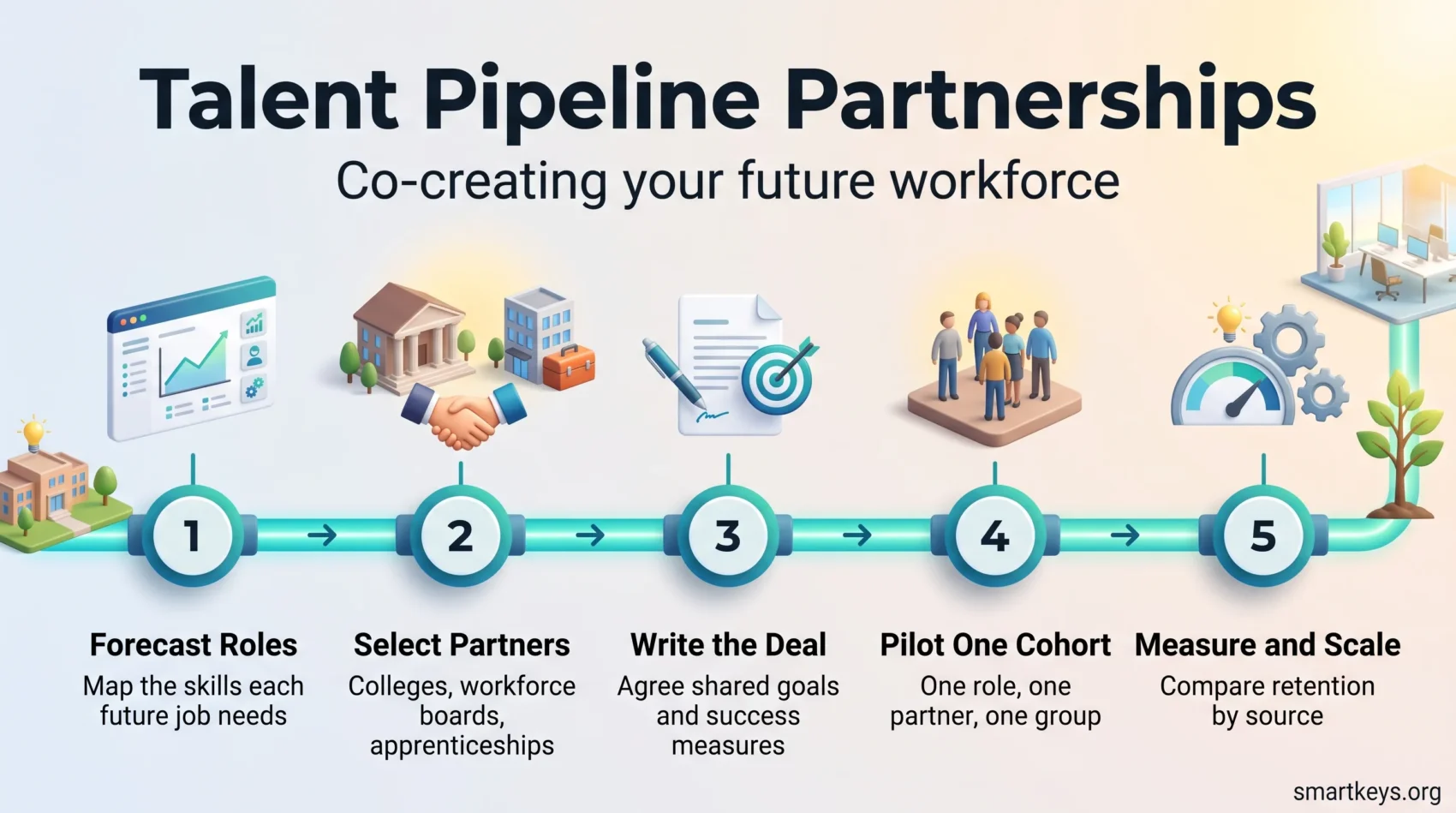
Step 1: Forecast roles and map skills
List the jobs you expect to open over the next 12 to 24 months from retirements, growth and turnover. For each, name the three or four skills that gate performance, separating what can be taught in weeks from what takes a year. A skills gap analysis gives the baseline; contingency planning shows which gaps hurt most.
Step 2: Evaluate and select partners
Judge partners on four things: whether they serve the population you need, whether they can adapt a curriculum, whether they have placed people into similar roles, and whether they report outcomes. Ask for placement numbers from their last two cohorts. A partner who cannot produce them will not share metrics later.
Step 3: Write the deal down
Record what each side owes and what success looks like, in a short memorandum of understanding that also covers data sharing and confidentiality. Typical shared measures are referrals received, interviews granted, training completions, offers made and one-year retention.
Step 4: Design the candidate route
Map the path from referral to offer and remove the steps that lose people: a named contact for the partner, a promised response time, structured interview questions used with everyone, and an accommodations process a candidate can trigger without explaining a diagnosis. Track drop-off with workforce analytics tools.
Step 5: Fund it honestly
Three routes are worth checking: WIOA training funds through your local board, state apprenticeship grants, and employer tax credits. Be careful with the last. The federal Work Opportunity Tax Credit (WOTC) expired on 31 December 2025 and is in hiatus through 2026. Wages for people hired on or before that date still qualify. For 2026 hires, state agencies accept certification requests as pending, subject to future reauthorization, so keep filing within the usual 28-day window but do not budget the credit as income.
From Pilot to Scaled Program
Run one small experiment before promising anything company-wide. One role, one partner, one cohort, one hiring manager who wants it to work. Set the timeline and success threshold first: six placements, four offers, three accepted, reviewed at nine months.
The gap between training and hiring is where pipelines leak. Scheduled check-ins, a site visit, a mock interview and a named contact do more than any campaign. Employees telling their own stories carry further than corporate messaging, the practical case for employee advocacy.
Managers decide whether the pipeline converts. Brief them on what the training covered, what it did not, and what ADA obligations apply during interviews. Pair each new hire with a mentor for the first quarter; mentorship matching tools help at scale.
None of this replaces promoting from within. Run both: an internal talent marketplace and a cross-training plan for existing staff, the partnership for skills nobody on the payroll has. Micro-credentials let both groups show what they can do.
Measure, Govern and Improve
Track a few measures well rather than a dashboard nobody reads. Six carry most of the value: time to fill, quality of hire, source of hire, offer acceptance rate, one-year retention by source, and training completion rate. Retention by source settles arguments, because it shows whether pipeline hires outlast job-board hires.
Agree one shared reporting format and rhythm: monthly during a pilot, quarterly once stable. Both sides bring the same numbers, which stops the meeting turning into a debate about whose figures are right. Name one owner on each side. Programs like this rarely fail loudly; they fade when nobody is accountable for the next meeting.
Read the drop-off. If completions are high but offers are low, the training misses something you screen for. If offers are high but retention is poor, the job was described too generously. Either finding means a curriculum or a job description has to change. Demographic change and evolving workforce legislation keep moving the target, so revisit the forecast once a year.
Conclusion
Talent pipeline partnerships are a slower answer to hiring than posting a job, and a more durable one. You trade short-term flexibility for candidates who arrive with the right skills and stay longer. The evidence supports the trade: interns convert at 63.1% and outstay hires with no internship background, while dropping degree requirements without a training partner barely moved the numbers.
Start small. Pick one role that keeps hurting, find one partner who can adapt training for it, agree five numbers you will both watch, and review in nine months. For another way to source people from outside the organization, see crowdsourcing talent. For flexible capacity while a pipeline matures, freelance talent platforms and AI in talent acquisition are worth a look.
Found this useful?
Make SmartKeys a preferred source on Google, and our articles will surface more often in your Top Stories, AI Overviews, and AI Mode.
Add as Preferred Source