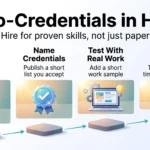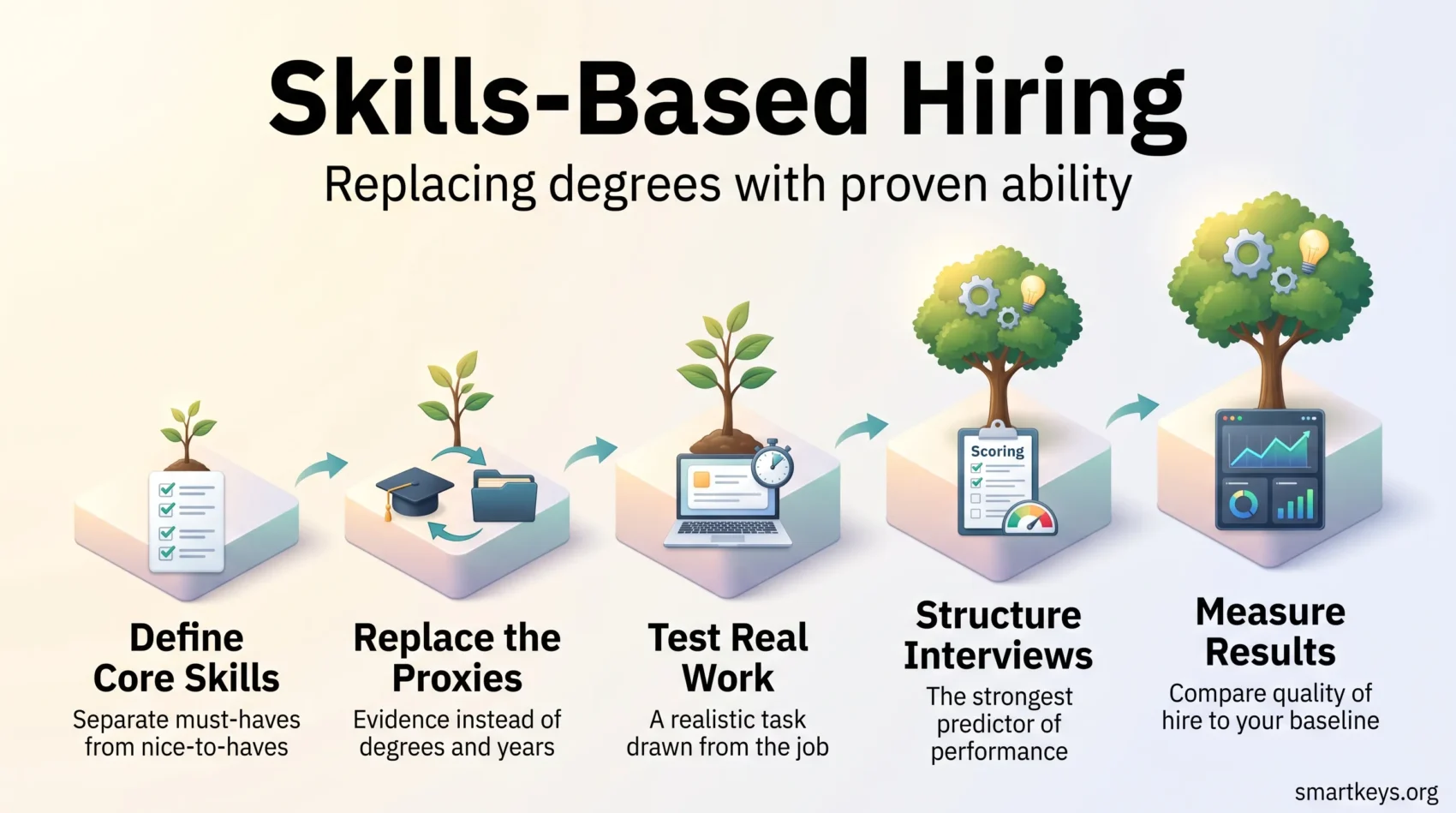
Most job ads still ask for a degree the work itself does not need. Skills-based hiring means selecting people on evidence of what they can do, rather than on the credential they hold. You decide what the role must produce, find a way to observe whether a candidate can produce it, and let that decide.
The idea is popular. Doing it is harder than the announcements suggest. This guide covers what the 2026 evidence shows, which selection methods predict performance, and how to rebuild one role’s process without lowering the bar.
Key Takeaways
- Skills-based hiring judges candidates on proven ability, not credentials.
- Degree requirements in US job postings are rising again.
- Fewer than 1 in 700 new hires benefited from dropped degree requirements.
- Hires without degrees stayed longer where companies truly changed their process.
- Structured interviews are the strongest predictor of job performance.
What Skills-Based Hiring Actually Means
A skill, for hiring purposes, is something observable. “Good communicator” is not one. “Writes a refund explanation a reviewer rates as clear and accurate” is. So is “builds a SQL query that returns the right rows”, SQL being the language used to pull data from a database.
The method rests on three questions. What must this person do? How well? And what result shows they did it? Answering them properly is called job analysis: a structured look at the tasks, tools and proficiency a role genuinely requires. It replaces the guesswork behind ads demanding five years of experience and a degree for work needing neither. For the wider shift, see how job descriptions are changing in the AI era.
Where the Practice Stands in 2026
The honest picture is mixed. Indeed’s Hiring Lab reported in January 2026 that a slight majority of US job postings, 51 percent, ask for no formal education requirement at all.
But the trend has stalled and partly reversed. The same analysis found 19.3 percent of US postings required a bachelor’s degree or higher in November 2025, up from 16.6 percent two years earlier. Degree screens are climbing again inside the same occupations, not just shifting with the job mix.
The gap between policy and practice is wider still. A February 2025 study by Harvard Business School’s Joseph Fuller and the Burning Glass Institute examined more than 11,000 US job postings from 2014 to 2023. Companies dropped degree requirements from many roles, but hiring barely moved. Fewer than 1 in 700 new hires benefited, and only about 37 percent of the companies studied changed measurably.
Where the change took hold, it paid off. At the leading companies in that study, hires without degrees stayed 10 percentage points longer than degreed colleagues, and workers entering previously degree-gated roles saw pay rise about 25 percent.
The lesson is not that skills-based hiring fails. It is that announcing it changes nothing.
Define the Skills Before You Change the Process
Start with one role and separate must-have skills from nice-to-have ones. Most job ads collapse that distinction, and that is what shrinks the pool.

Take a data analyst. The must-haves are narrow:
- Working-level SQL
- Interpreting a result and saying what it means
- Explaining that finding to someone outside the team
Python and Tableau belong in the second group. A capable analyst learns a new tool in weeks; listing them removes people who would have been fine.
Next, write the skills down so every role uses the same vocabulary. A skills taxonomy is simply that shared list. It needs plain-language names, proficiency levels so “intermediate” means the same thing in two departments, and behavioural indicators describing what someone at that level does. Tie each skill to a result you can point at. That vocabulary then feeds internal talent marketplaces, upskilling and reskilling programmes and workforce analytics tools.
What Actually Predicts Job Performance
This is what makes skills-based hiring defensible rather than fashionable. Personnel selection research measures how well each method predicts later performance, as a correlation between 0 and 1. Higher is better. The most recent major reassessment, by Paul Sackett and colleagues in 2022, corrected earlier estimates that had been inflated. Its ranking runs roughly:
- Structured interviews: 0.42
- Job knowledge tests: 0.40
- Empirically keyed biodata: 0.38
- Work sample tests: 0.33
- Cognitive ability tests: 0.31
Two points matter. The strongest predictor, the structured interview, means every candidate gets the same questions in the same order, scored against a written rubric. That costs discipline, not money. And nothing approaches 1: selection improves your odds, it does not remove risk. Treat any vendor promising near-perfect prediction with suspicion.
What a Skills-First Process Changes
The clearest effect is the size of the pool. LinkedIn’s Skills-First research, published in 2023, found that filtering by skills rather than job title expands talent pools by nearly ten times on average. That is mechanical, not a claim about quality: you stop excluding people whose job titles looked wrong.
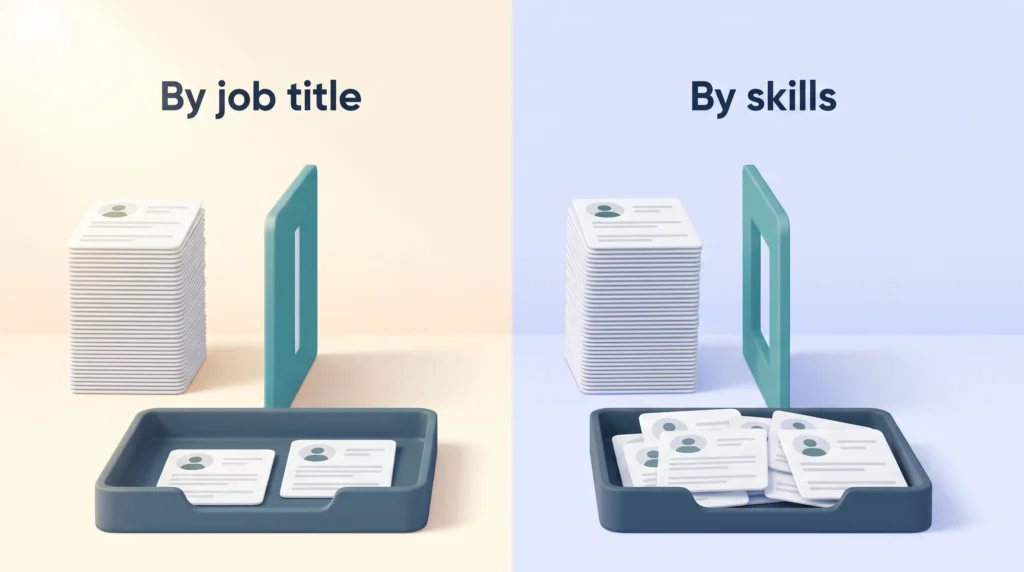
The group this reaches is large. Opportunity@Work counts more than 70 million US workers as STARs, meaning Skilled Through Alternative Routes: people who built their skills through work, training, military service or community college. Its State of the Paper Ceiling report, June 2026, found STARs who moved into higher-paying roles gained a median 14,800 dollars during 2024.
Access is the second effect, reaching career changers and self-taught practitioners. It overlaps with DEI tech tools and the career lattice.
Retention is the third, on narrower evidence: the 10 percentage point figure above is the strongest available. Vendor surveys claim more, but they survey their own customers. Pair any hiring change with talent retention strategies.
Practical Steps for Implementing Skills-Based Hiring
Pilot on one role first. Customer support and sales development work well: they hire often and performance shows within weeks. A contract-to-hire arrangement gives an even faster read on whether your criteria predict anything.
Run the job analysis. Sit with two or three people who do the job well and ask what a bad week looks like. The tasks that separate strong performers from weak ones are your must-have skills.
Rewrite the posting. State the outcomes, the skills required and how candidates will be assessed. Naming the steps in advance reduces dropout and is fairer to applicants. Naming the pay range helps too, and pay transparency is now legally required in a growing number of jurisdictions.
Replace the proxies. Remove the degree requirement and the years-of-experience floor unless a licence or law requires them. Put evidence in their place: a portfolio, a case description, a documented project.
Use a realistic work sample. Give candidates a task drawn from the job, not an abstract exercise. A 30-minute simulated support ticket tells you more than a puzzle. Pay for anything over an hour.
Structure the interview. Same questions, same order, written rubric, notes taken during the conversation. This is the highest-value item on the list.
Measure the result. Track quality of hire, ramp time and candidate experience against your old process. Without a baseline you cannot tell whether anything improved.
If software will score candidates, read first on what AI hiring tools can do and what the law requires and on bias in algorithmic recruitment tools. An automated screen that reproduces the degree filter is not skills-based hiring.
Getting Hiring Managers and Candidates on Board
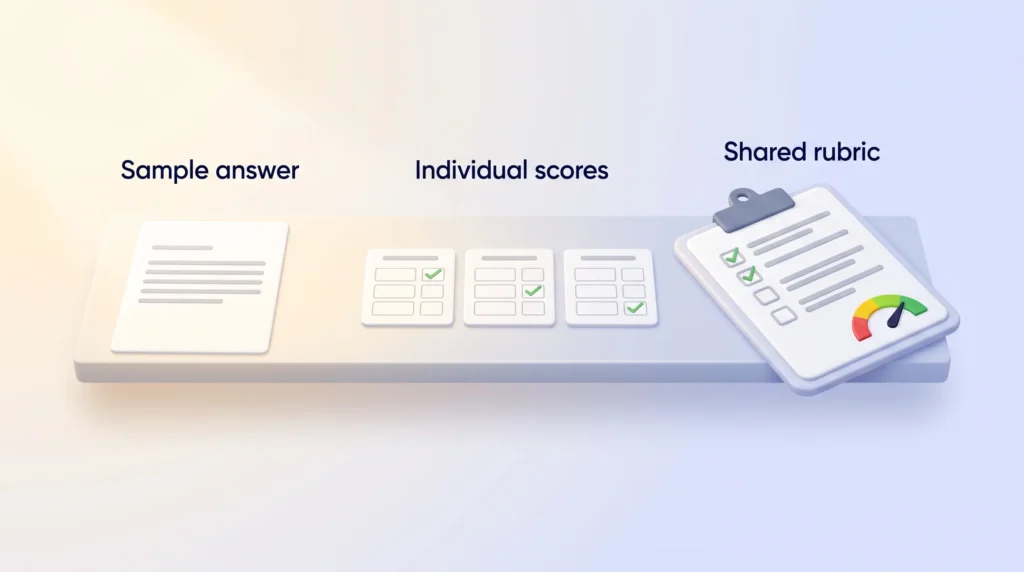
A skills-first process usually fails at the interview table, not on paper. Managers need to know what counts as evidence. Run a calibration session before the first interview round: give every interviewer the same anonymised sample answer, have them score it, then agree what strong, adequate and insufficient look like. Half an hour of disagreement prevents months of inconsistent hiring. The same habit underpins continuous performance management later.
Candidates need direction too. Many hold relevant evidence and never present it: volunteer work, military service, freelance projects, a side project that solved a real problem. This is where micro-credentials and mid-career retraining become useful signals.
Ask for behavioural answers in four parts: the situation, what they did, which skill they used, and what changed as a result. The last part is the one most people omit, and the one that carries the information.
Say clearly how you assess and how long it takes. If you interview remotely, check that the format is fair to everyone; the same question arises with virtual reality job interviews. And if a skill is learnable on the job, say so in the ad. Employers running talent pipeline partnerships find that one sentence changes who applies.
Conclusion
Skills-based hiring swaps a rough proxy for a sharper measure. The evidence for the pieces is solid. Structured interviews and work samples predict performance better than credentials, and the firms that genuinely rebuilt their process saw better retention and pay outcomes.
The evidence on adoption is sobering. Degree requirements are creeping back into US postings, and most announced reforms never reached the hiring decision. Assume yours will drift the same way unless you measure it.
So start small. One role, defined skills, a structured interview, one work sample, then compare against what you had. Extend the same vocabulary into measuring the return on employee development, a theme running through the wider HR management trends of 2026.
Found this useful?
Make SmartKeys a preferred source on Google, and our articles will surface more often in your Top Stories, AI Overviews, and AI Mode.
Add as Preferred SourceFAQ
What is skills-based hiring?
Skills-based hiring selects candidates on evidence of what they can do rather than on credentials. It has three steps. Define the tasks and proficiency levels the role genuinely needs. Replace filters such as degree requirements and years-of-experience floors with something observable, usually a work sample or a structured interview scored against a written rubric. Then compare candidates on those observations. It is not a lower standard, but a more specific one.
Do employers still require degrees in 2026?
Yes, and slightly more than two years ago. Indeed’s Hiring Lab reported in January 2026 that 19.3 percent of US job postings required a bachelor’s degree or higher as of November 2025, up from 16.6 percent in November 2023. About 51 percent of postings name no formal education requirement at all. So the picture is split: most roles no longer ask for a degree, but the share that does has stopped falling.
Which selection methods predict job performance best?
Structured interviews lead. In the 2022 reassessment of selection research by Paul Sackett and colleagues, structured interviews scored 0.42 on a scale where 1 would be perfect prediction, ahead of job knowledge tests at 0.40, work sample tests at 0.33 and cognitive ability tests at 0.31. Unstructured interviews, where the manager improvises, predict considerably less well. So structuring the interviews you already run is the cheapest improvement available.
How do I identify the skills a role really needs?
Talk to people who already do the job well. Ask what a difficult week looks like, which tasks separate strong performers from weak ones, and which tools someone could pick up after starting. Write the answers as observable behaviours rather than adjectives, so “builds a working SQL query” instead of “analytical”. Then sort them into must-have and nice-to-have; anything a competent person learns in a few weeks belongs in the second group.
Does dropping degree requirements lower the bar?
Only if you remove the requirement and put nothing in its place. A degree is a proxy: a rough signal that someone can learn and persist, collected years before the job started. A work sample or structured interview usually makes the decision more accurate, because it measures the specific work. In the Harvard Business School and Burning Glass Institute study of February 2025, hires without degrees at companies that genuinely changed their process stayed 10 percentage points longer than degreed colleagues.
How does skills-based hiring affect the talent pool and diversity?
It widens the pool substantially. LinkedIn’s Skills-First research, published in 2023, found that filtering by skills rather than by job title expands candidate pools by nearly ten times on average. The group this reaches is large: Opportunity@Work counts more than 70 million US workers as skilled through alternative routes, who built their abilities through work, training or military service. A wider pool is not automatically a more diverse hire. The gain materialises only if the assessment that follows is consistent.