Your chronotype is your body’s natural preference for when to sleep, wake and be alert. Some people are sharpest before 8 a.m. Others do their best thinking after dinner. Neither is about discipline or laziness: it is biology, and you can plan around it.
That matters at work because most calendars ignore it. A demanding task scheduled at 8 a.m. costs a night owl far more effort than the same task at 4 p.m. Move it, and the work gets easier without you working longer.
This guide explains what a chronotype is, how to find yours, and how to place your work around it, using the four animal types popularized by sleep specialist Michael Breus.
Key Takeaways
- Your chronotype describes when you are naturally alert, not how productive you are.
- Matching demanding tasks to your peak hours is usually easier than forcing focus at the wrong time.
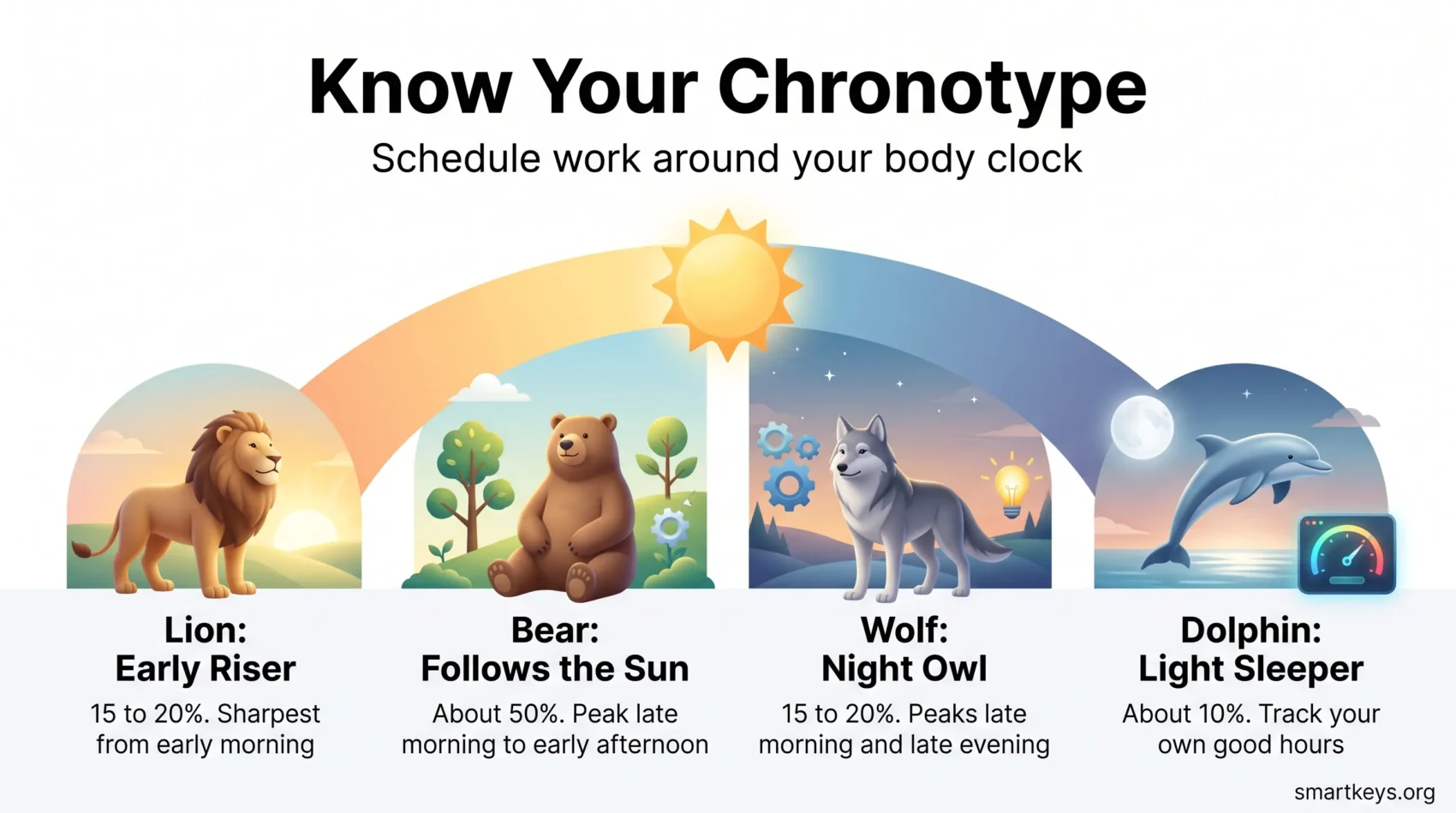
- Breus estimates that roughly half of adults are Bears, with Lions and Wolves at 15 to 20 percent each and Dolphins around 10 percent.
- Chronotype shifts with age: it runs latest around age 20 and moves earlier from then on.
- A late bedtime is linked to worse mental health even for night owls, so working with your chronotype does not mean staying up indefinitely.
What Is a Chronotype?
A chronotype is your natural timing preference for sleep and wakefulness. It is the reason two colleagues with identical workloads peak at different hours.
Behind it sits your circadian rhythm, the roughly 24 hour internal cycle that governs sleep pressure, body temperature, digestion and hormone release. The circadian rhythm is the clock. Your chronotype is where that clock is set relative to other people.
Two things move the setting. The first is genetics: variants in several clock genes are associated with morning or evening preference. The second is age. Children tend to be early. Sleep timing then drifts later through the teenage years, and chronobiologist Till Roenneberg’s 2004 study in Current Biology found that lateness peaks around age 20 before steadily reversing, which is why he proposed it as a biological marker for the end of adolescence.
Light and habit matter too. School and shift schedules routinely force people to wake hours before their body would choose. The gap between your biological timing and your social timing has a name: social jet lag, the same feeling as a time zone change without the trip.
The Science Behind Your Body Clock
Your circadian rhythm is kept on time mainly by light. Morning light reaching your eyes tells the clock to shift earlier; bright light late in the evening tells it to shift later. This is why a dark winter commute and a bright phone at midnight both pull in the wrong direction.
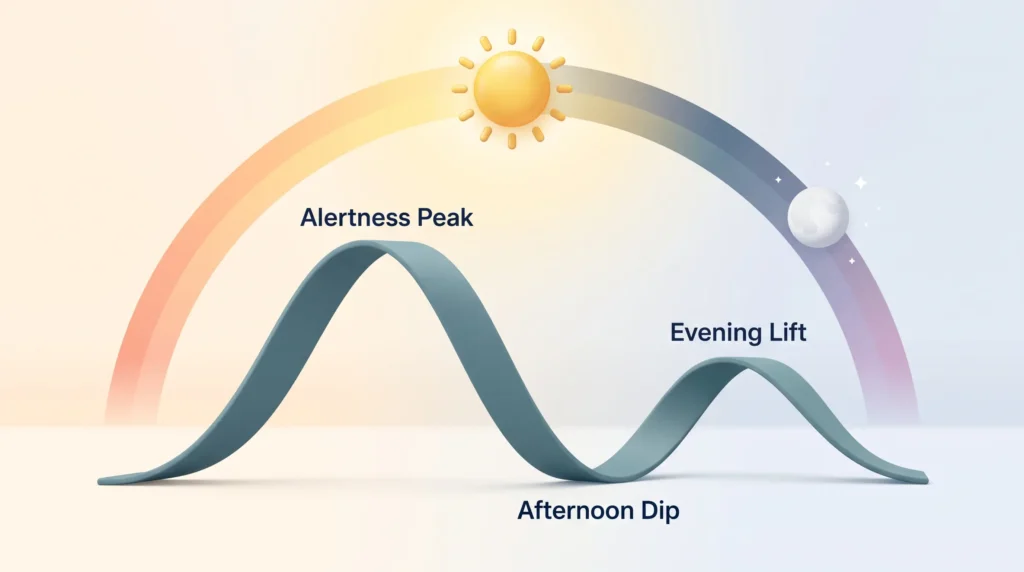
The clock does more than schedule sleep. Alertness, reaction time, core body temperature and even mood follow a predictable daily curve. Most adults get a strong alertness peak some hours after waking, a dip in the early to mid afternoon, and a second smaller lift in the early evening.
Your chronotype decides where that curve sits on the clock face, not whether you have one. A Lion and a Wolf both get a peak and a dip. The Lion’s arrives before lunch; the Wolf’s may not arrive until late afternoon.
This is the practical payoff. If you know roughly when your curve rises and falls, you can stop treating every hour of the workday as interchangeable. That idea sits at the heart of managing your energy rather than just your time, and it also explains why 90 minute work cycles feel natural to so many people.
Exploring Different Chronotypes
Breus groups sleep timing into four animal types. Treat the percentages below as his own estimates from clinical practice rather than peer reviewed epidemiology; the value of the model is the vocabulary, not the precision.
Bear Chronotype
Bears are the largest group. Breus puts them at about 50 percent of adults. Their clock roughly follows the sun: awake with daylight, most alert from late morning through early afternoon, ready for bed a few hours after dark. If you feel fine on a standard 9 to 5 but flag badly after lunch, you are probably a Bear.
Wolf Chronotype
Wolves are the classic night owls, around 15 to 20 percent of adults. Mornings are genuinely hard, not a matter of willpower. Breus describes two productive peaks for this group: one in the late morning and a second in the late evening, when the office has gone quiet.
Lion Chronotype
Lions wake early and easily, and account for roughly 15 to 20 percent of adults. Their strongest hours run from early morning through early afternoon, and they usually fade by mid evening. Lions get the most out of a standard workday, which is one reason early rising gets mistaken for virtue.
Dolphin Chronotype
Dolphins are light, restless sleepers, about 10 percent of adults in Breus’s estimate. He describes them as tired during the day and wired at night, which makes their energy less predictable than the other three types. Dolphins benefit most from tracking their own good hours rather than assuming a fixed window.
Most people recognize themselves in one type and borrow from another. That is fine. The label is a starting point for observation, not a diagnosis.
Chronotype Productivity: Maximizing Your Work Schedule
The core move is simple: put your hardest work in your best hours and protect those hours from everything else.
Start by naming your two or three most demanding recurring tasks. For a developer that might be writing new code; for a consultant, building the analysis; for a manager, thinking through a hiring decision. These are the tasks that go badly when you are tired.
Then defend that window on the calendar. Book it as a real appointment, decline routine meetings inside it, and turn off notifications while it runs. Paul Graham’s distinction between the maker and manager schedule is useful here: one badly placed meeting can cost far more than its 30 minutes. If you only protect one slot a day, make it the one holding your most important task.
Everything else fills the gaps. Email, expenses, scheduling and routine reviews survive being done at low energy.
Identifying Your Unique Chronotype
There are two ways to work this out, and they answer slightly different questions.
The research instruments come first. The Morningness Eveningness Questionnaire, published by Horne and Ostberg in 1976, places you on a scale from definite morning type to definite evening type and is still the standard measure in sleep studies. The Munich ChronoType Questionnaire, developed by Roenneberg’s group, instead asks when you actually sleep on work days and on free days, and uses the midpoint of your free day sleep. The gap between the two is your social jet lag.
Popular quizzes come second. Breus’s own quiz sorts you into one of the four animals, and it is quick. Just remember it is a self report questionnaire, not a clinical assessment.
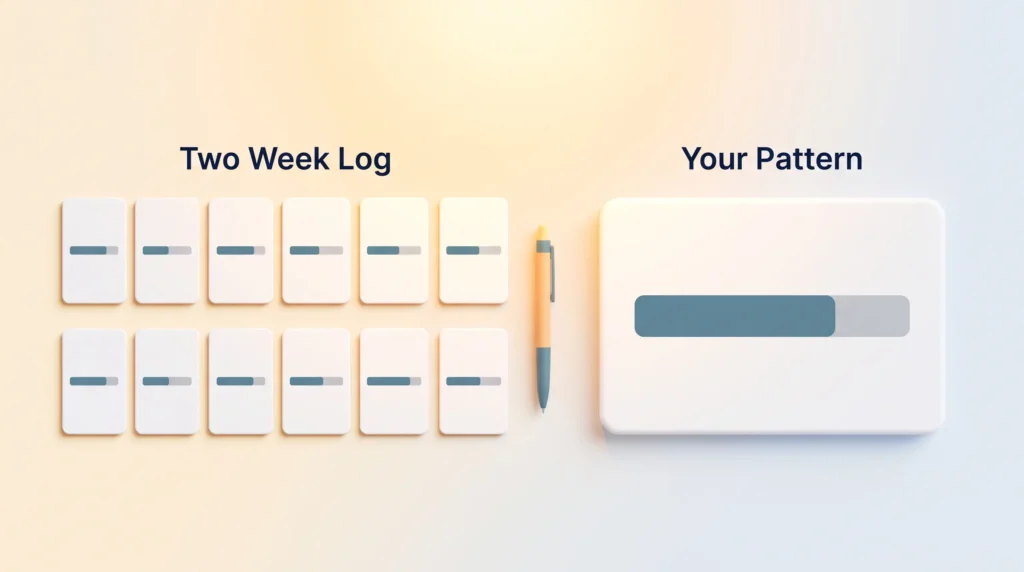
The most reliable method costs nothing. For two weeks, note three things at the end of each day: when you woke without an alarm, the hours you felt genuinely sharp, and the hours you struggled. A pattern usually appears within ten days. Tracking a few simple personal productivity metrics alongside it makes the pattern easier to trust, and it works even if you have never found the standard advice fits, which is often the case when you are still working out your own productivity style.
Designing a Personalized Daily Routine
Once you know your rough shape, build the day outward from two fixed points: when you get up and when you wind down.
If you are a Lion, protect the early morning for real work rather than spending it on email. Your best hours arrive before most people are online, which is an advantage worth using deliberately rather than by accident.
If you are a Wolf or a Dolphin, the evening needs more attention than the morning. Racing thoughts at bedtime are the main obstacle, and a written wind down helps: get the open loops out of your head onto paper with a brain dump an hour before bed, then stop working.
Exercise usually sticks better in an energy peak than a trough. There is no single best time to train, so pick the slot you will actually keep.
Finally, expect this to change. Your chronotype at 22 is not your chronotype at 45. Review the arrangement once a year rather than assuming it is fixed.
The Impact of Chronotype on Health and Mood
The evidence here is worth reading carefully, because it complicates the usual advice.
A Stanford study of 73,888 adults, published in Psychiatry Research in 2024, looked at bedtime, chronotype and rates of mental and behavioral disorders. The expected result would be that people do best when they live in line with their chronotype. That is not what the researchers found. Late bedtimes were linked to higher rates of depression and anxiety across the board, including among evening types who were following their natural preference. Night owls who stayed up late were 20 to 40 percent more likely to have such a diagnosis than those who went to bed earlier. The authors’ practical suggestion was lights out by around 1 a.m. for everyone.
This is an observational study, so it shows an association rather than proving cause. Still, the direction is clear enough to act on: use your chronotype to decide when you do which work, not as a licence to keep pushing your bedtime later.
Diet appears to follow the same pattern. Research on habitual diet in US women found later chronotypes reported poorer diet quality, which partly explained a link between chronotype and cardiovascular health.
None of this makes being a night owl a disorder. It does mean that if you are chronically short of sleep, the timing question is secondary. Fix the amount first, then the placement. If tiredness has already tipped into exhaustion, cynicism and dropping output, that is a different problem: see the warning signs of burnout, and note that burnout is usually a workload problem rather than a personal failing. Persistent insomnia or low mood is worth raising with a doctor rather than scheduling around.
Aligning Your Daily Tasks with Your Energy Levels
Peak hours are not only for the hardest work. They are for a specific kind of hard work.
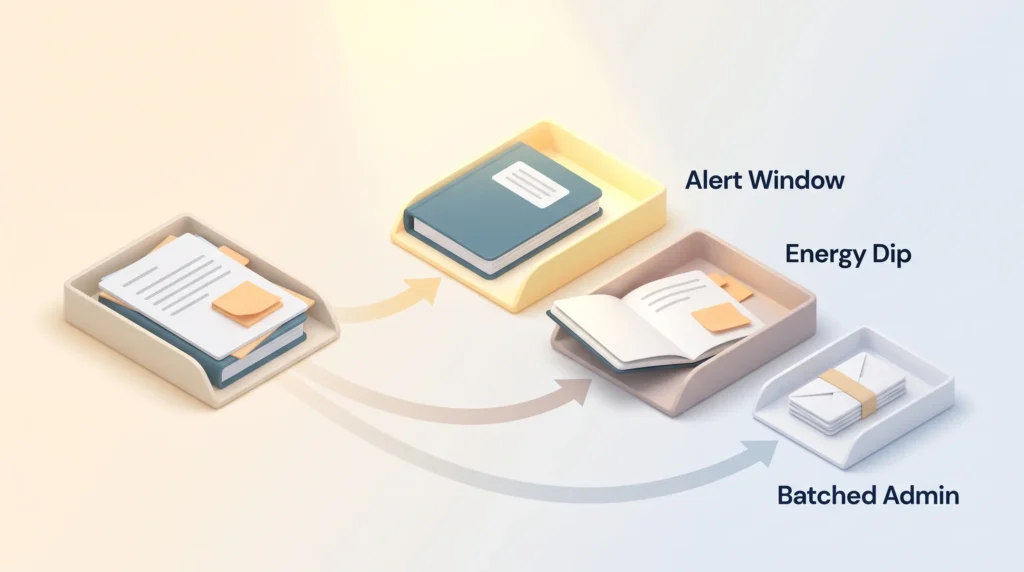
Analytical tasks, the ones that need accuracy and sustained attention, belong in your alert window: financial models, detailed writing, code review, careful reading. Errors are cheapest to avoid here. If holding attention that long is the problem, that is a separate skill you can train deliberately.
Creative and exploratory work often survives, and sometimes benefits from, a lower energy window. When you are slightly tired, your attention filters loosen and unrelated ideas connect more easily. Brainstorming, first drafts and messy problem framing can go in the dip.
Administrative work goes wherever it fits. Batch it so it does not colonize the good hours: one pass through the inbox, one pass through approvals. Asynchronous ways of working help here, because they stop other people’s schedules from dictating yours, and clear rules for chat and instant messaging keep the interruptions inside a window you chose.
Then test it. Run the same task in two different windows for a fortnight and compare how long it took and how it turned out. If you regularly lose track of where the hours went, time blindness may be the real obstacle, and a simple log fixes more of it than any new app.
Combating the Post-Lunch Slump: Work and Sleep Tips
The early afternoon dip is real and it is circadian, not just the sandwich. Alertness falls for most people in the hours after midday, and it falls hardest when you are already short of sleep. Bears typically feel it between roughly 2 p.m. and 4 p.m.
Plan for it instead of fighting it. Put low stakes work there: inbox, approvals, one to one catch ups, tidying documents. A short walk outdoors helps more than another coffee, partly because of the movement and partly because of the daylight. If the dip flattens your whole afternoon, there are more specific fixes for the afternoon slump worth trying.
Caffeine is a loan, not income. Drinking it late borrows alertness from tonight’s sleep and makes tomorrow’s dip worse. Late intense work does the same thing to your bedtime, which is the one variable the Stanford data suggests matters most.
Adapting Your Work Schedule to Your Chronotype
How much you can change depends on your job, so start with what you control.
If your hours are flexible, shift the start rather than the length. A Wolf who begins at 10 a.m. and finishes at 6:30 p.m. works the same day in better hours. If they are fixed, you can still move tasks inside the day, which is most of the benefit. Building a few dependable remote work habits makes that easier to hold, and a clear focus mode setup on your phone stops notifications from deciding your schedule for you. Simple focus tools and a handful of focus management techniques cover most of the rest.
For managers, the practical version is narrow and achievable. Publish core hours when everyone is reachable, and leave the rest open. Keep recurring meetings inside those core hours so nobody’s best window is repeatedly taken. Judge output rather than login times. Teams experimenting with a four day week run into the same question from a different angle: what actually needs everyone present at once is usually less than the calendar suggests.
Integrating Chronotype Insights into Everyday Life
Three adjustments do most of the work, and none of them require buying anything.
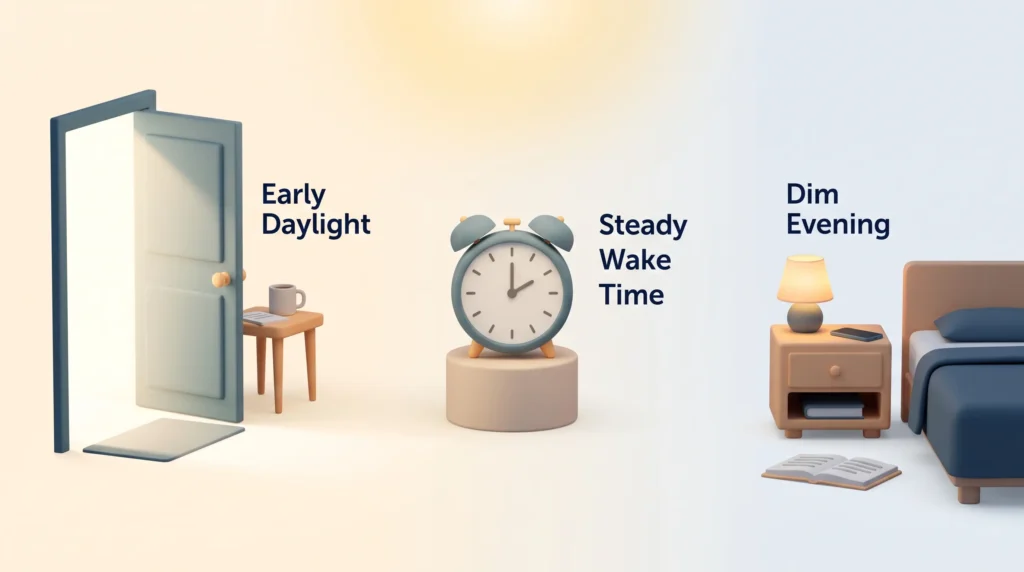
First, get daylight early. Ten to twenty minutes outside soon after waking is the strongest signal you can give your clock to shift earlier, and it beats any indoor lamp. If you need to wake before sunrise in winter, a sunrise alarm or dawn simulation lamp that brightens gradually is a reasonable substitute.
Second, dim the evening. Lower the lights in the last hour and keep bright screens out of bed. A company wide digital detox day makes the same point at team scale: constant light and pings extend the working day past the point of usefulness.
Third, keep your wake time steady, including at weekends. A consistent wake time anchors the whole rhythm more effectively than a consistent bedtime, and it shrinks the Monday morning version of social jet lag. A cool, dark bedroom helps, and it matters most for Dolphins, who wake at the smallest disturbance.
Conclusion
Your chronotype tells you when you are naturally sharp, and most people never use that information.
Find your pattern by watching yourself for two weeks. Move your two hardest tasks into your best window and defend it. Push routine work into the dip. Keep your wake time steady and your bedtime sensible, because the research suggests a very late night costs you regardless of type.
Start with one change this week rather than redesigning the whole day. Give it ten working days, then decide whether it earned its place.
Found this useful?
Make SmartKeys a preferred source on Google, and our articles will surface more often in your Top Stories, AI Overviews, and AI Mode.
Add as Preferred SourceFAQ
What is a chronotype?
A chronotype is your body’s natural preference for when to sleep, wake and be alert. It comes from your circadian rhythm, the roughly 24 hour internal cycle that also governs body temperature, digestion and hormone release. Your chronotype describes where that clock is set compared with other people, which is why one colleague is sharpest at 7 a.m. and another at 7 p.m. A chronotype says nothing about how capable or hard working you are. It only tells you when your good hours are likely to fall.
How do I find out my chronotype?
The most reliable method is two weeks of observation. Each evening, note when you woke without an alarm, which hours felt sharp, and which felt heavy. A pattern usually shows up within ten days. Questionnaires give you a faster starting point: the Morningness Eveningness Questionnaire, published in 1976, places you on a morning to evening scale, and the Munich ChronoType Questionnaire asks when you actually sleep on work days and free days. Animal type quizzes are quicker still, but they are self report tools, not clinical assessments. Use one to get a label, then check it against your own record.
Can I change my chronotype?
You can shift it somewhat, but not swap it. Light is the main lever: daylight soon after waking pulls your clock earlier, while bright light and screens late in the evening push it later. Moving your wake time in 15 minute steps and holding it for several days, weekends included, tends to work better than a sudden two hour jump. Expect to shift by up to an hour or two rather than to turn a night owl into an early riser.
Do night owls really perform worse at work?
Not inherently. Evening types do worse in schedules built for morning types, which is a different problem. Given hours that match their clock, they work perfectly well. One caveat matters: a Stanford study of 73,888 adults, published in Psychiatry Research in 2024, found that late bedtimes were linked to higher rates of depression and anxiety even among evening types who were following their natural preference. The study is observational, so it shows an association rather than proof of cause. The practical reading is that a night owl should use their late peak for work, but still avoid routinely going to bed after around 1 a.m.
What if my job does not allow flexible hours?
Most of the benefit comes from moving tasks inside the day, not from moving the day itself. Within fixed hours you usually still choose when to think hard and when to answer email. Identify your best 90 minutes, block them as an appointment, and put your most demanding task there. Push administrative work into the afternoon dip. If your peak falls outside working hours entirely, protect your sleep instead of trying to reclaim the hours, and ask your manager for one recurring protected block rather than a change to your contract. A small, specific request is far more likely to be granted.