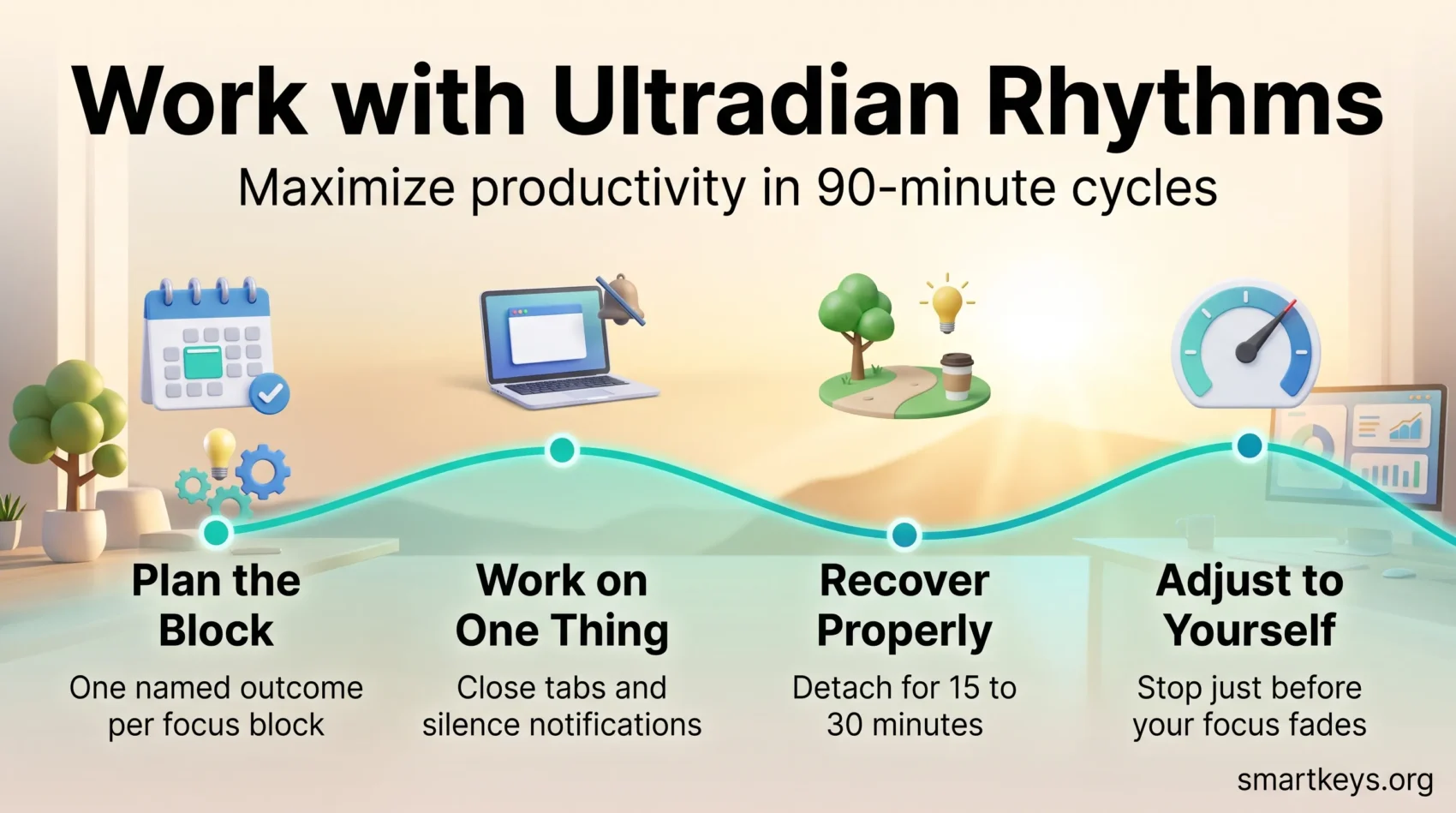
Your attention does not run flat all day. It rises, holds for a while, then fades. An ultradian rhythm is simply a body cycle that repeats more than once in 24 hours, and the best known one runs roughly 90 to 120 minutes. Work with that shape instead of against it and you get long stretches of real concentration followed by short, deliberate recovery.
This guide explains what the science actually supports, what it does not, and how to turn the idea into a workday you can run tomorrow: a focus block, an honest break, and a way to find your own cycle length instead of copying someone else’s.
Key Takeaways
- Ultradian means “shorter than a day”. The best known cycle runs about 90 to 120 minutes.
- Plan one demanding task per focus block, then take a real break of 15 to 30 minutes.
- The evidence for regular breaks is strong. The evidence for exact 90-minute timing is weaker.
- Your own cycle length matters more than the textbook number. Track it for two weeks.
- Breaks only work if they detach you from the task. Checking email is not a break.
- Sleep, light and food set the ceiling on how good your daytime peaks can be.
What an ultradian rhythm actually is
Your body runs several clocks at once, and they work on different timescales. Knowing which one governs a problem tells you whether to fix it with your calendar or with your evenings.
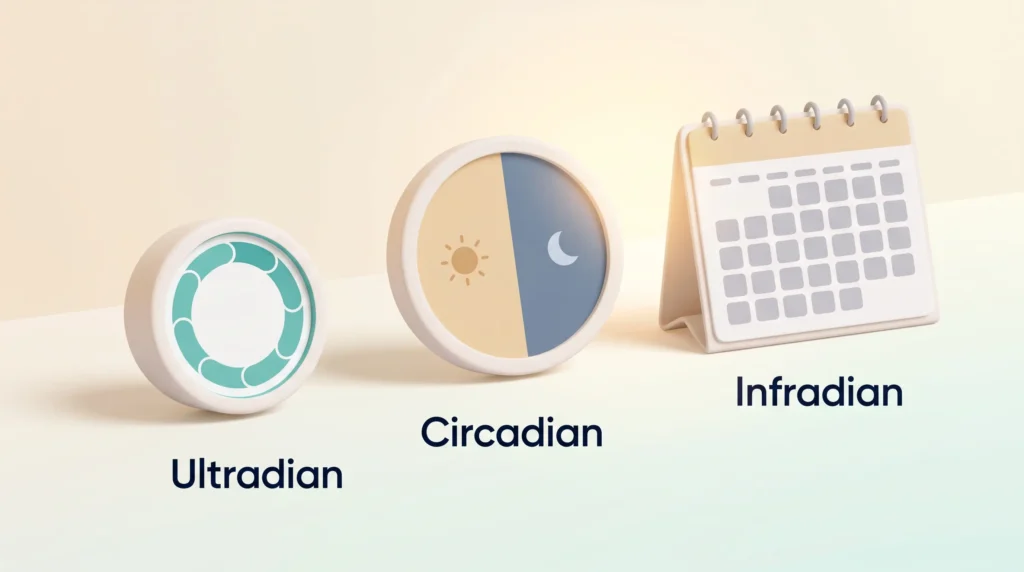
An ultradian rhythm is any biological cycle that repeats several times within a single day. Breathing, heart rate variability, digestive contractions and hormone pulses all follow ultradian patterns. In productivity writing, “ultradian rhythm” almost always means one specific version: the roughly 90-minute swing between higher and lower alertness.
A circadian rhythm, by contrast, is the 24-hour clock. A small region of the brain called the suprachiasmatic nucleus keeps it roughly synchronised to daylight, and it decides when you feel sleepy and when you feel awake. If you are tired every afternoon no matter what you do, that is usually a circadian and sleep question, not a focus-block question.
An infradian rhythm runs longer than a day. The menstrual cycle is the common example. These matter for planning over weeks rather than hours.
The practical split is simple. Circadian and infradian rhythms tell you which days and which hours are likely to be good. Ultradian rhythms tell you how to shape the hour once you are in it.
Where the 90-minute idea comes from
The 90-minute figure has a real origin, and it is worth knowing how solid it is before you build a day around it.
Sleep researcher Nathaniel Kleitman noticed that sleep cycles through REM and non-REM stages in repeating blocks of roughly 90 minutes. REM stands for rapid eye movement, the sleep stage where most vivid dreaming happens. Kleitman proposed that the same underlying cycle, which he called the Basic Rest-Activity Cycle or BRAC, continues while you are awake, showing up as alternating periods of sharper and duller attention.
The sleep half of that claim is well established. The waking half is more contested. Researchers argued for decades about whether a clean 90-minute attention cycle exists during the day at all, and more recent reviews point to ultradian patterns in waking alertness that appear to run on different mechanisms than the REM cycle. The honest summary: something cyclical is going on, the exact period varies between people and between days, and nobody can hand you a stopwatch number that is true for everyone.
That is less discouraging than it sounds. The useful part of the idea does not depend on the number being exactly 90.
What the break research really shows
The strongest evidence here is not about 90 minutes. It is about breaks.
A 2011 study by Atsunori Ariga and Alejandro Lleras at the University of Illinois tested what happens to attention during a long, boring task. Participants who briefly switched away from the task and back again kept their performance steady, while those who worked straight through got measurably worse over time. The researchers described it as deactivating and reactivating the goal: attention fades when a goal stays constant, and a short interruption resets it.
A 2022 systematic review and meta-analysis in PLOS ONE by Patricia Albulescu and colleagues pooled dozens of micro-break studies. It found a reliable improvement in how energetic and how tired people felt afterwards. The effect on actual task performance was smaller and less consistent, and it looked stronger for simple or creative tasks than for demanding cognitive work, where longer breaks may be needed.
Read together, those two results support a modest, believable claim. Regular breaks protect attention and reduce fatigue. They are not a productivity multiplier, and claims that a specific break schedule delivers a specific percentage gain should be treated with suspicion. Our overview of short breaks and work focus goes deeper into what the studies do and do not measure.
The 90/20 protocol: how to run it
Here is the whole method in four steps. The numbers are a starting point, not a rule.
1. Plan the block
Put two or three 90-minute blocks on your calendar, and give each one a single named outcome. Not “work on the proposal” but “draft the pricing section of the proposal”. The first block of your day should hold the task you would most regret not finishing. A short opening ritual helps too: close the inbox, fill a glass of water and write the outcome on a sticky note. Repeated often enough, that routine becomes the cue that focus time has started. If your team can agree on shared quiet hours, a formal focus time policy protects those blocks far better than personal willpower does.
2. Work on one thing
Inside the block, do that one task. Close the other tabs, silence notifications, and let messages wait. This is the part people skip, and it is the part that does the work. Switching between tasks carries a real cost in time and errors, which is why single-tasking beats trying to run two threads at once. If you want the mechanism, our piece on why multitasking hurts productivity covers the switching research.
3. Recover properly
When the block ends, stop for 15 to 30 minutes and detach. Stand up, walk, get outside, breathe. The test is whether your mind leaves the task, not whether your body leaves the chair. Scrolling a feed or triaging your inbox keeps you in work mode and gives you almost none of the recovery.
4. Adjust to yourself
If your attention reliably fades at 70 minutes, your block is 70 minutes. If you can hold 110, use 110. The goal is to find where your quality drops and stop just before it, not to hit a number from a blog post.
- Two or three protected blocks a day is a realistic target for most jobs.
- Batch shallow work (email, approvals, small requests) into its own slot so it stops leaking into the blocks.
- Leave a buffer between blocks. Back-to-back focus periods with no gap defeat the point.
If a full 90 minutes feels impossible right now, start shorter. The Pomodoro Technique runs the same logic in 25-minute units, and it is an easier on-ramp. Once blocks are on the calendar at all, time blocking is the habit that keeps them there.
What to do on the break
How you spend the pause decides whether you come back sharper or just later.

Move
Five to fifteen minutes of walking or light mobility is the highest-value default. It changes your posture, your view and your circulation at once. Our guide to movement breaks has specific routines if you want structure rather than “go for a walk”.
Calm down
If the block was stressful rather than just long, a few minutes of slow breathing does more than a walk. Simple breathing techniques take under five minutes and need no equipment.
Nap, occasionally
A 20 to 30 minute nap can restore alertness when you are genuinely sleep-deprived, and that window is short enough to avoid the heavy, groggy feeling of waking from deep sleep. It is a repair tool, not a daily habit. See our guide to power naps for timing.
Eat for steadiness
Something with protein or fibre beats something sugary, because it avoids the spike and dip that eats your next block. Our article on nutrition and productivity covers what the evidence supports and what it does not.
What does not count
- Clearing your inbox. It is a task, and it keeps the work goal active.
- “Quick” small jobs. Same problem, dressed differently.
- An open-ended scroll. Set a timer or the break eats the next block.
If your energy always collapses at the same point in the day, the fix is probably not a better break. Our piece on afternoon slump cures deals with that pattern directly.
Sleep sets the ceiling
No block structure rescues a bad night. Sleep also runs in roughly 90-minute cycles, alternating REM and non-REM stages, and the depth of the stage you wake from affects how rough the first hour of your day feels.
Two habits do most of the work here. Keep your bed and wake times reasonably consistent, including at weekends, so your body clock stops being reset every few days. And get outside light within an hour of waking, which is the strongest everyday signal for anchoring that clock.
The popular advice to schedule sleep in exact multiples of 90 minutes is worth treating loosely. Cycle length varies between people and across the night, so a calculator cannot tell you the perfect alarm time. Total sleep and consistency matter more than arithmetic. For the fuller picture, see sleep and productivity, and our guide to morning routines for what to do with the first hour once you are up.
Scheduling your day around your peaks
Most people have one or two windows a day when hard thinking is genuinely easier. The job is to find yours and defend them.
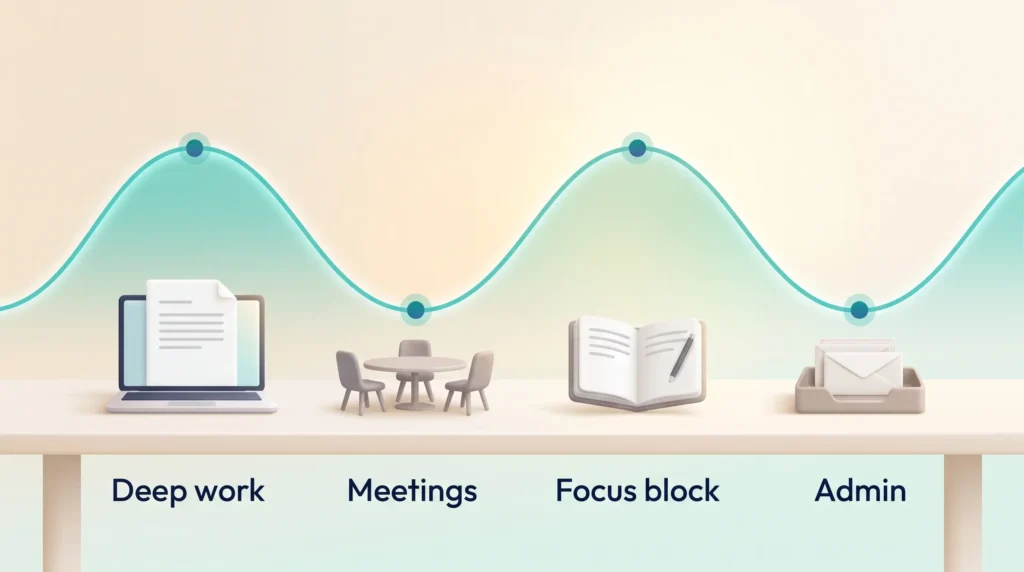
Where those windows fall depends partly on your chronotype, your natural lean towards being a morning person (a “lark”) or an evening person (an “owl”). A lark may do their best thinking at 8am. An owl may not hit their stride until late morning. Neither is wrong, so copy the structure from productivity advice, not someone else’s clock times.
Put deep work in those windows. Push meetings, admin and inbox time into the dips, where the cost of lower alertness is small. Cluster meetings together rather than sprinkling them through the day, because a meeting in the middle of a good window destroys more than the hour it occupies.
To find your windows, keep a two-week log: start time, task, and a one-to-five rating of how sharp you felt. That low-tech record beats any wearable at telling you when your good hours are. Log a few different kinds of work, because block length can vary by task. Analytical work such as writing or coding suits the classic long block. Physically demanding or repetitive work usually goes better with shorter stretches and a change of activity in between. Time-tracking tools such as RescueTime or Toggl can confirm the pattern from the other direction by showing where your hours actually went.
Then protect the result. Calendar work is mostly deciding in advance what gets to interrupt you, and managing work notifications is about making sure nothing else does.
Flow: when to ignore the timer
Sometimes a block goes better than planned. You lose track of time, the work moves easily, and stopping feels absurd. That is flow, and breaking it on schedule is usually the wrong call.
Keep going while it lasts, then take a longer recovery than usual afterwards, because a 2-hour flow session leaves you more depleted than a 90-minute planned one. Note how long your flow states typically run, so you can leave enough buffer in the day to absorb one without wrecking everything after it.
The caution is that flow and stubbornness feel similar from the inside. Real flow comes with easy progress and good output. If you are still at the desk mainly because stopping feels like losing, that is fatigue wearing a costume. The difference gets easier to feel once you have run a few dozen blocks and know what your own good work looks like.
Adapting the rhythm to night and shift work
If you work nights or rotating shifts, the same method applies with a few adjustments. Your 24-hour clock is pushing you towards sleep while you work, so the dips come sooner and run deeper. That is especially true in the small hours before dawn, when most people’s alertness is at its lowest.
Plan somewhat shorter focus stretches than you would on a day shift, and take breaks more often. Save the tasks where a mistake is costly for the start of the shift, when you are fresher, rather than the last hours.
Light and caffeine are the two main levers. Bright light during the shift supports alertness. Keeping light low on the way home, for example with sunglasses, makes it easier to fall asleep afterwards. Caffeine helps most early in the shift. Taken in the final hours, it tends to eat into the sleep you need once you are home. The NIOSH training on shift work and long hours covers both in more detail.
Making it work in a team
Individual focus blocks fail quickly in a culture that treats immediate replies as a virtue. A few structural changes make them survivable.
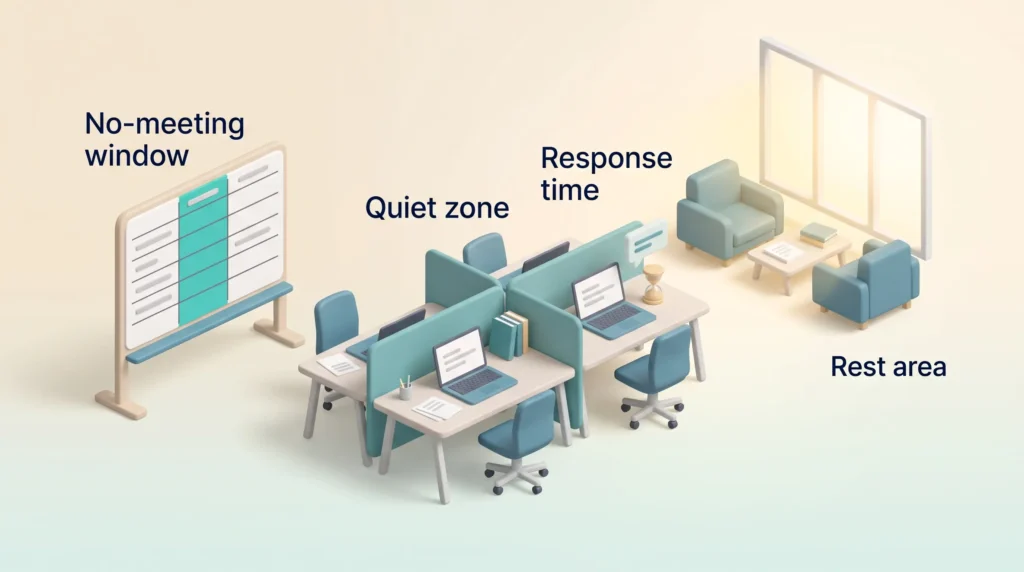
Agree on shared no-meeting windows so calendars stop fragmenting each other. Set an expected response time for internal messages, so people can leave chat closed without feeling reckless. Give people somewhere quiet to work and somewhere genuinely different to rest, because a break room next to the desks is not a change of scene. Where work needs constant coverage, stagger breaks so someone is always on duty. Cross-training helps here: if two people can handle the queue, one person’s recovery no longer stops it.
Judge output rather than hours visibly online. That single norm does more for concentration than any tool, and it is the one most often missing.
If you are introducing focus blocks across a team, decide in advance what you will look at. Useful signals are how much planned work gets finished, how often errors or rework happen, and how tired people say they feel. Note where things stand before you start, compare again after a few months rather than a few days, and adjust block lengths from what you see. Our guide to remote work productivity covers how these norms hold up when the team is distributed.
The honest limits
Three caveats worth keeping in view.
The number is soft. Ninety minutes is a useful default, not a biological constant. Treat any advice that depends on precise timing with scepticism.
The benefit may come from the breaks, not the rhythm. Critics reasonably argue that most of the measured gains come from taking regular breaks at all, and that framing them as ultradian cycles just makes people more likely to take them. If that is true, the method still works. It just works for a plainer reason.
Rigidity backfires. Plenty of jobs cannot be run in protected 90-minute blocks. Support, clinical and operational roles run on other people’s timing. In those jobs, aim for one protected block rather than three, and put more effort into recovery than into structure.
Be careful, too, about workplace tracking. Tools that monitor biometric signals to infer employee energy raise real consent and privacy questions, and an employer inferring your alertness from your heart rate is a different proposition from you noticing your own attention fading. If this is being introduced where you work, the details of consent and data use matter.
A workday you can actually run
Pick two 90-minute windows tomorrow. Give each one a single task and a real break after it. Keep the two-week log so the second week is calibrated to you rather than to an average.
Then work on the ceiling rather than the technique. Consistent sleep, morning daylight, food that does not spike your blood sugar, some exercise and decent workspace lighting do more for your peaks than any timing system layered on top of a depleted week. Treating breaks as maintenance rather than as a reward is also one of the more reliable habits in burnout prevention.
For the wider approach this fits into, see our guide to managing energy rather than time, and deep work for the philosophy behind protecting long blocks in the first place.
Found this useful?
Make SmartKeys a preferred source on Google, and our articles will surface more often in your Top Stories, AI Overviews, and AI Mode.
Add as Preferred Source