Multitasking still has the reputation of a productivity skill. The research says otherwise: the brain does not run two demanding tasks in parallel, it switches between them, and every switch costs time and accuracy. That gap between how efficient multitasking feels and how it actually performs is the single most expensive illusion in modern knowledge work.
The pressure has grown. Microsoft’s 2025 Work Trend Index, based on aggregated Microsoft 365 signals, found that employees are interrupted by a meeting, email or chat roughly every two minutes during core working hours – about 275 interruptions a day – and that 48% describe their work as chaotic and fragmented. Understanding the mechanics of task switching is no longer an academic exercise. It is how you get your day back.
Key Takeaways
- The brain switches between demanding tasks rather than running them in parallel, and each switch has a measurable cost.
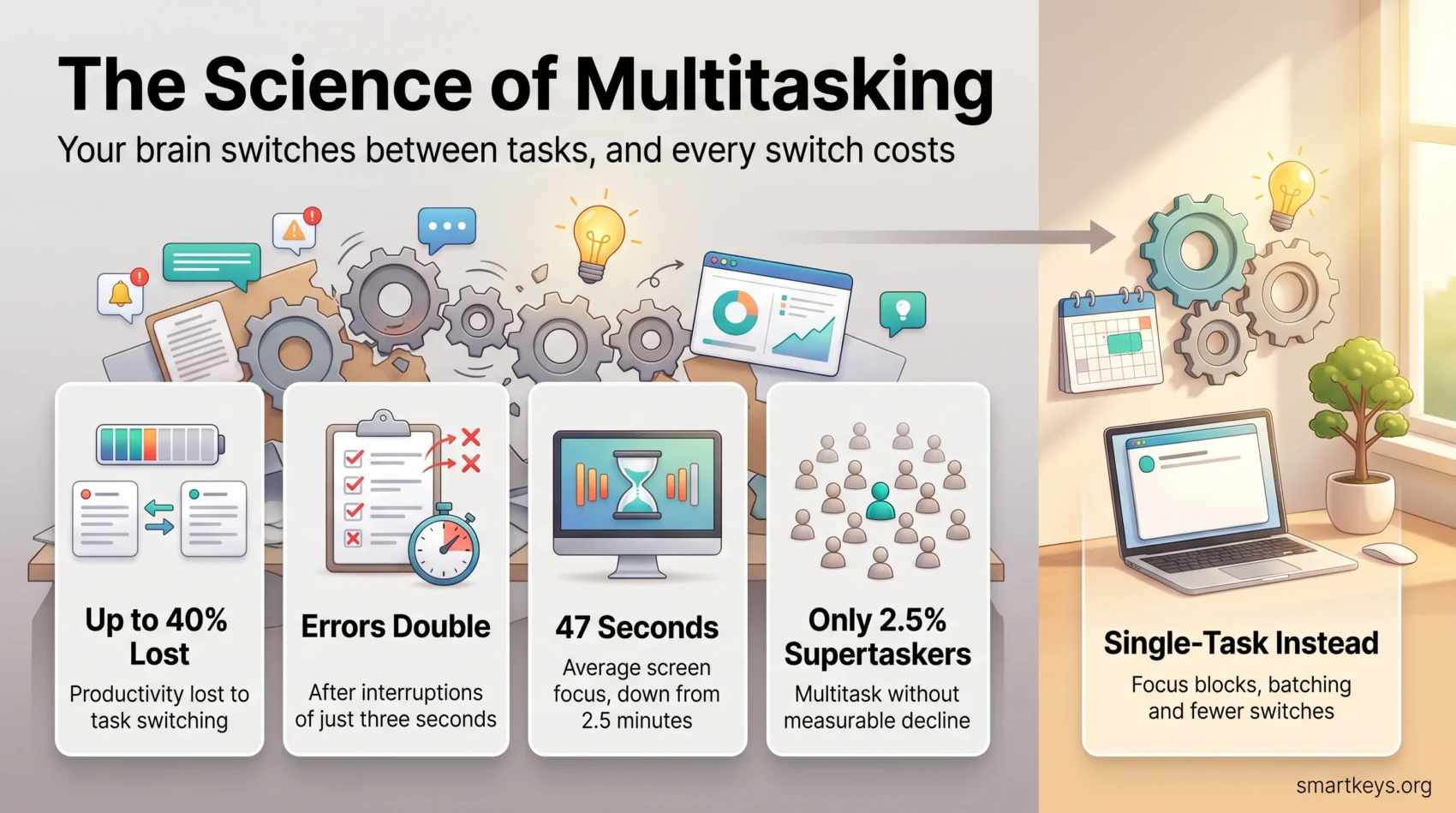
- The APA attributes a productivity loss of up to 40% to the mental blocks created by switching between tasks.
- Interruptions of about three seconds were enough to double error rates in a 300-person experiment.
- Average attention on a screen has fallen from roughly 2.5 minutes in 2004 to about 47 seconds, according to Gloria Mark’s research.
- Genuine multitasking ability is rare: Watson and Strayer identified it in around 2.5% of participants.
- Single-tasking, batching and protected focus blocks work better than trying to multitask more efficiently.
Understanding Multitasking
Multitasking describes two different things, and conflating them causes most of the confusion. Combining an automatic activity with a demanding one – walking while talking – works fine, because only one task competes for conscious attention. Running two tasks that both require attention does not work that way. What feels like parallel processing is rapid alternation.
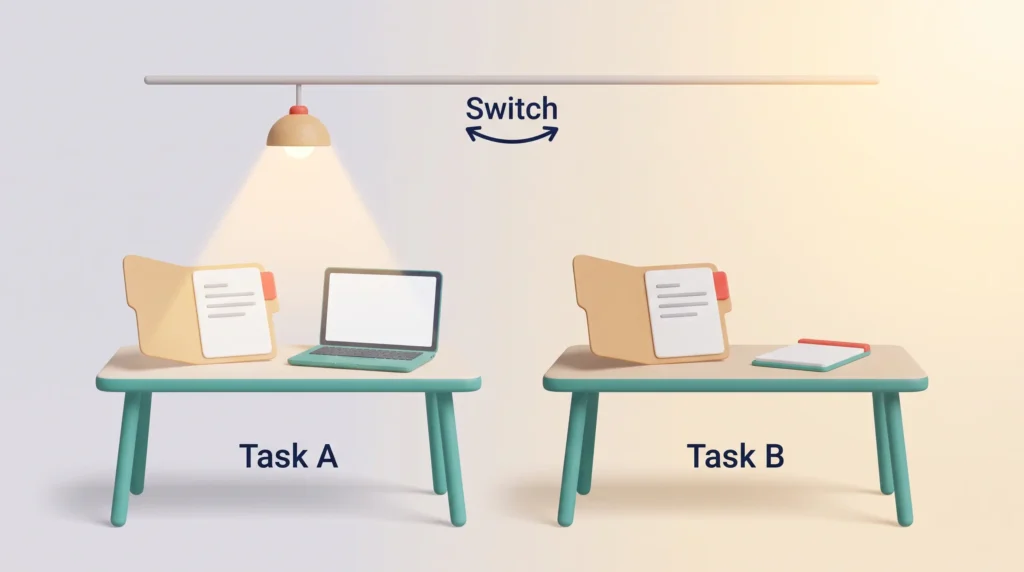
That alternation is where the cost sits. Each switch forces the brain to set aside the rules of one task and load the rules of another, a process cognitive psychologists call goal shifting and rule activation. The switch itself takes a fraction of a second, which is why it feels free. Repeated hundreds of times a day, it is not.
Genuine exceptions exist but are rare. Watson and Strayer’s Supertaskers study, published in Psychonomic Bulletin & Review, found roughly 2.5% of participants – about one in forty – who could drive a simulator and complete a demanding memory task without measurable decline. The other 97.5% degraded on both. Statistically, you are almost certainly in the second group, and so is everyone on your team.
The Human Brain is Not Designed for Multitasking
The limit is structural. Working memory holds only a small amount of information at once, and executive function – the system that sets priorities, suppresses distractions and keeps a goal in view – is a bottleneck by design. Ask it to hold two goal states simultaneously and performance on both drops.
Meetings are where this plays out most visibly. A large-scale study by researchers at Microsoft and Stanford, combining telemetry from US Microsoft employees with a 715-person diary study, found that multitasking during remote meetings is widespread and that intrinsic meeting characteristics – size, length, time of day and meeting type – significantly predict how much of it happens. Long, large, recurring meetings invite divided attention; short, small, purposeful ones do not. That makes multitasking partly a scheduling problem, and a structured meeting audit is often the fastest way to fix it.
The same logic applies to written channels. A ping is cheap to send and expensive to receive, so the norms around instant messaging at work do more for collective focus than any individual willpower. Where teams are distributed, the case for deliberate remote work practices is stronger still: without shared expectations about response times, everyone defaults to constant availability.
Attention is a finite resource, and it should be allocated deliberately rather than spent by whoever pings first.
How Multitasking Affects Attention Span
Habitual switching trains the brain to expect a new stimulus, which makes sustained concentration progressively harder. The most striking evidence comes from Gloria Mark’s long-running observational work at UC Irvine: in 2004, people averaged about two and a half minutes on a screen before switching. In recent measurements the average is roughly 47 seconds, with a median closer to 40.
Two caveats are worth stating plainly, because both are widely repeated online without support. The claim that multitasking costs ten IQ points has been disowned by the researcher whose small, unpublished study produced it. And the familiar “23 minutes and 15 seconds to refocus” figure has no clearly identifiable peer-reviewed paper behind it. The direction of the evidence is solid – interruptions are costly and recovery is not instant – but the precise numbers are not.
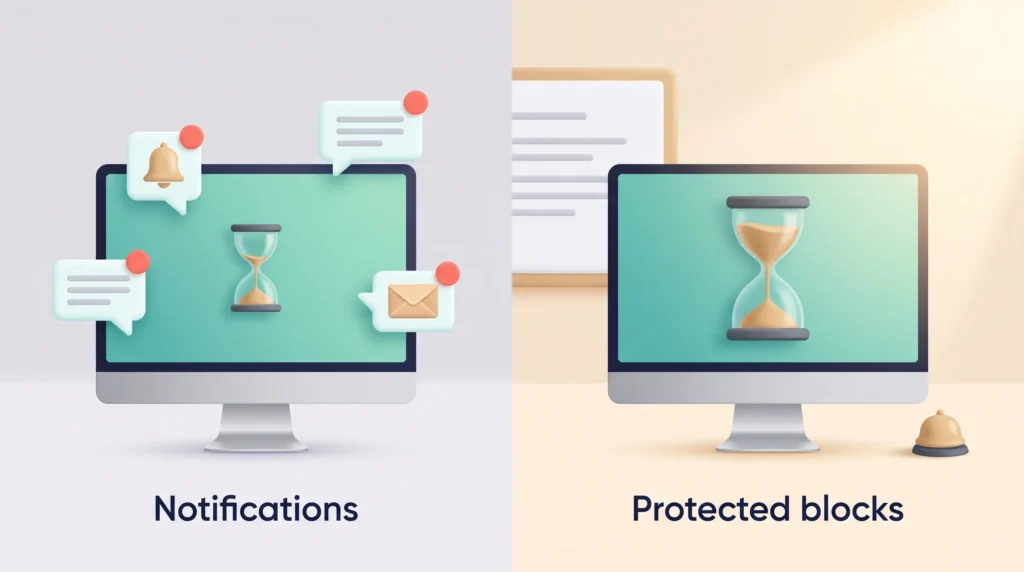
The practical consequence is that attention span at work behaves less like a fixed trait and more like a habit shaped by your environment. Environments dense with notifications produce short attention; environments with protected blocks produce longer ones. That is encouraging, because environments can be redesigned.
Start with the inputs. Turning off non-urgent alerts, closing the mail client between checks and using focus tools that block distractions costs nothing and removes most of the triggers. For a broader repertoire, these focus management techniques cover the ground systematically.
Multitasking Productivity: The Reality Check
The honest version of the 2026 picture is that individual discipline is fighting a system built for interruption. The Microsoft data quantifies it: an average of 117 emails and 153 Teams messages per weekday, 57% of meetings called ad hoc with no invite, and half of all meetings landing in the 9-11am and 1-3pm windows when concentration is usually at its best.
Against that background, “just focus harder” is poor advice. The realistic goal is to reduce the number of switches you are forced to make, and to make the remaining ones cheaper. That means effective task management and agreements about when people are expected to be reachable, not more willpower.
One overlooked lever is memory offloading. Much of what feels like multitasking is really rehearsal: holding six unfinished items in your head so you do not forget them. Writing them down ends the rehearsal. A quick brain dump at the start of the day, a reliable second brain system for reference material, and consistent digital note-taking free working memory for the task in front of you.
The same applies to planning. Well-built to-do lists reduce the number of decisions you make under time pressure, and fewer decisions means less decision fatigue by mid-afternoon. Some people process workload better visually; if that describes you, visual thinking for task management is a useful alternative to another list.
Illusions of Productivity: Task Switching Explained
Task switching feels productive because it produces constant visible activity. The output tells a different story. The American Psychological Association’s summary of switching-cost research attributes a productivity loss of up to 40% to the mental blocks created when people switch between tasks – a figure associated with psychologist David Meyer’s work on the subject.
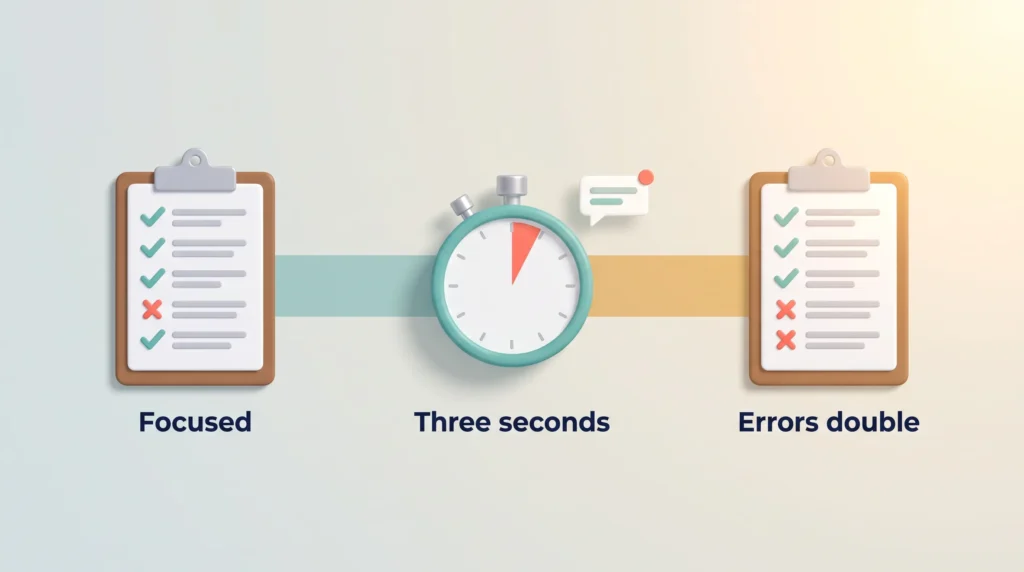
Accuracy suffers before speed does. In a study of roughly 300 participants published in the Journal of Experimental Psychology: General, Altmann, Trafton and Hambrick found that interruptions of about three seconds – not enough time to do anything else – were sufficient to double the rate of sequence errors. Three seconds. That is the length of glancing at a notification.
A 2009 Stanford study by Ophir, Nass and Wagner added an uncomfortable finding: heavy media multitaskers performed worse at filtering irrelevant information and switching between tasks than light multitaskers. Practice did not build the skill; it appeared to erode the ability to ignore distraction.
Three habits reduce the switch count more than any app:
- Pick three to five tasks that genuinely matter today and treat the rest as optional.
- Keep an explicit “not doing” list so recurring temptations get decided once, not daily.
- Turn off notifications during focus blocks and check messages on a schedule instead.
Reducing distractions and focusing on key tasks improves productivity far more reliably than trying to switch faster. If switching is genuinely unavoidable in your role, the techniques for managing task switching deliberately reduce the damage.
Impact of Multitasking on Cognitive Function
The costs fall into two categories that behave differently, which matters when you decide what to fix first.
Decreased Brain Efficiency
Splitting attention spreads limited cognitive resources thin. Information gets encoded less deeply, which weakens recall later, and complex reasoning suffers most because it depends on holding several elements in mind at once. Routine work survives divided attention reasonably well; analysis, writing and problem-solving do not.
Higher Error Rates in Task Completion
Errors rise faster than speed drops, and they are the more expensive failure. Procedural mistakes – a skipped step, a wrong recipient, a stale figure carried into a report – often surface long after the moment that caused them, when correcting them costs far more than the switch appeared to save. The three-second interruption finding is the clearest illustration: the time lost is trivial, the accuracy lost is not.
Stress, Well-Being, and Multitasking
Constant switching does not only cost output. It changes how work feels. Unfinished tasks stay mentally active, so a fragmented day leaves you tired without a matching sense of progress – a pattern consistent with Microsoft’s finding that nearly half of employees describe their work as chaotic.
The Stanford research on heavy media multitaskers points the same way: struggling to filter distraction is cognitively effortful, and sustained effort without visible results is a reliable route to feeling overwhelmed. The remedy is structural rather than motivational.
Practical steps help more than reframing. Delegate what does not need you. Close the day by writing down where you stopped, so unfinished work does not follow you home. Broader approaches to managing stress for better productivity apply directly here, and a predictable daily routine lowers the number of decisions you face before the real work starts.
Where switching is driven by avoidance rather than demand – jumping to email because the difficult task feels hard – the underlying issue is different. Using effective time management techniques alongside realistic goals addresses that directly.
Alternatives to Multitasking
The alternative is not working slower. It is concentrating the same hours on fewer things at a time.
Single-tasking as a Productive Strategy
Single-tasking means giving one task your full attention until a natural stopping point, then switching deliberately. It works because it eliminates the switch cost entirely rather than trying to minimise it, and because deep engagement with one problem is what makes a flow state possible at all.
Starting is simple: one task, one window, a defined stretch of time. A practical guide to single-tasking in daily work covers how to protect those blocks when your calendar disagrees.
The Benefits of Task Prioritization
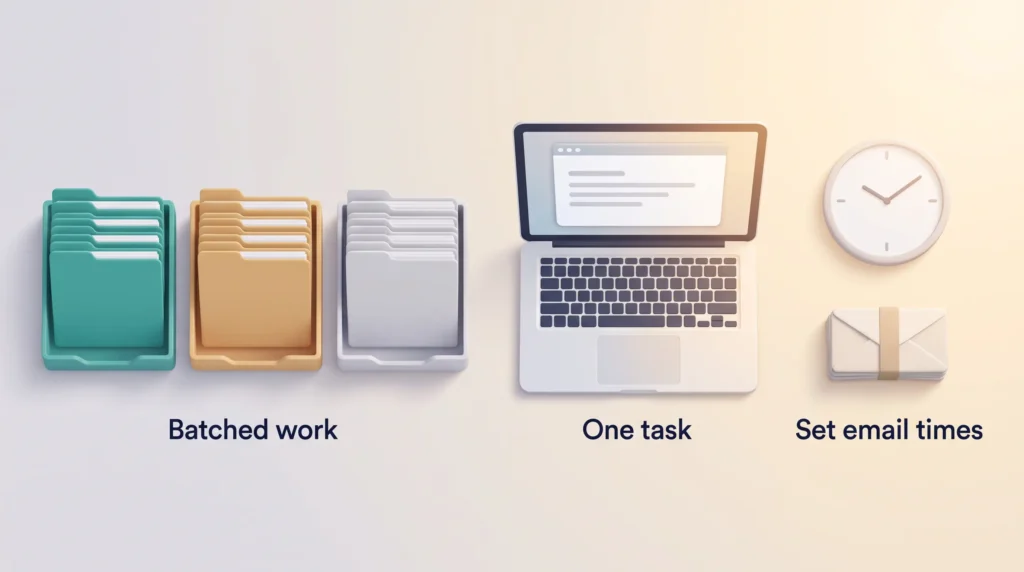
Prioritisation reduces switching before it starts. If the day’s most important task is decided in advance, you are not renegotiating it every time something arrives. Grouping similar work – all calls, all reviews, all admin – keeps you in one mode for longer, and fixing times for email rather than checking continuously turns dozens of small switches into two or three planned ones.
Recovery belongs in the same conversation, since attention is a daily budget. On that point, how sleep shapes daily productivity is worth reading alongside this article.
Tips for Effective Task Management to Boost Productivity
Three practices deliver most of the benefit.
Batching and Time Blocking Techniques
Batching groups similar tasks so the brain loads one set of rules and keeps it. Time blocking assigns those batches to specific hours, which converts intention into a calendar commitment other people can see. Blocking your two best hours – typically mid-morning – for the hardest task of the day is the highest-leverage version, and it directly counters the pattern of meetings filling exactly those windows.
Keep blocks realistic. A protected 90 minutes that survives contact with the day beats a four-hour block that gets dismantled by 10am.
Cultivating Mindfulness in Daily Routines
Mindfulness here means noticing the switch as it happens. The moment you reach for your phone mid-sentence is the moment a choice exists; without awareness, the habit runs unopposed. Short breaks between blocks, a workspace clear of competing cues and a brief end-of-day review build that awareness without adding a practice to maintain.
Conclusion
The science on multitasking is unusually consistent. Demanding tasks are not processed in parallel, switching between them carries measurable costs in time and accuracy, and the people who do it most tend to be least aware of the price. The gap between how productive multitasking feels and what it delivers is where hours disappear.
The response is not more discipline. It is fewer forced switches: protected blocks for demanding work, agreements about response times, notifications off by default, and unfinished tasks written down instead of rehearsed. Each removes a source of switching rather than asking you to absorb it.
That is worth doing deliberately, because in a working day interrupted every couple of minutes, sustained attention has become the scarce resource – and the one that decides what actually gets finished.
Found this useful?
Make SmartKeys a preferred source on Google, and our articles will surface more often in your Top Stories, AI Overviews, and AI Mode.
Add as Preferred Source