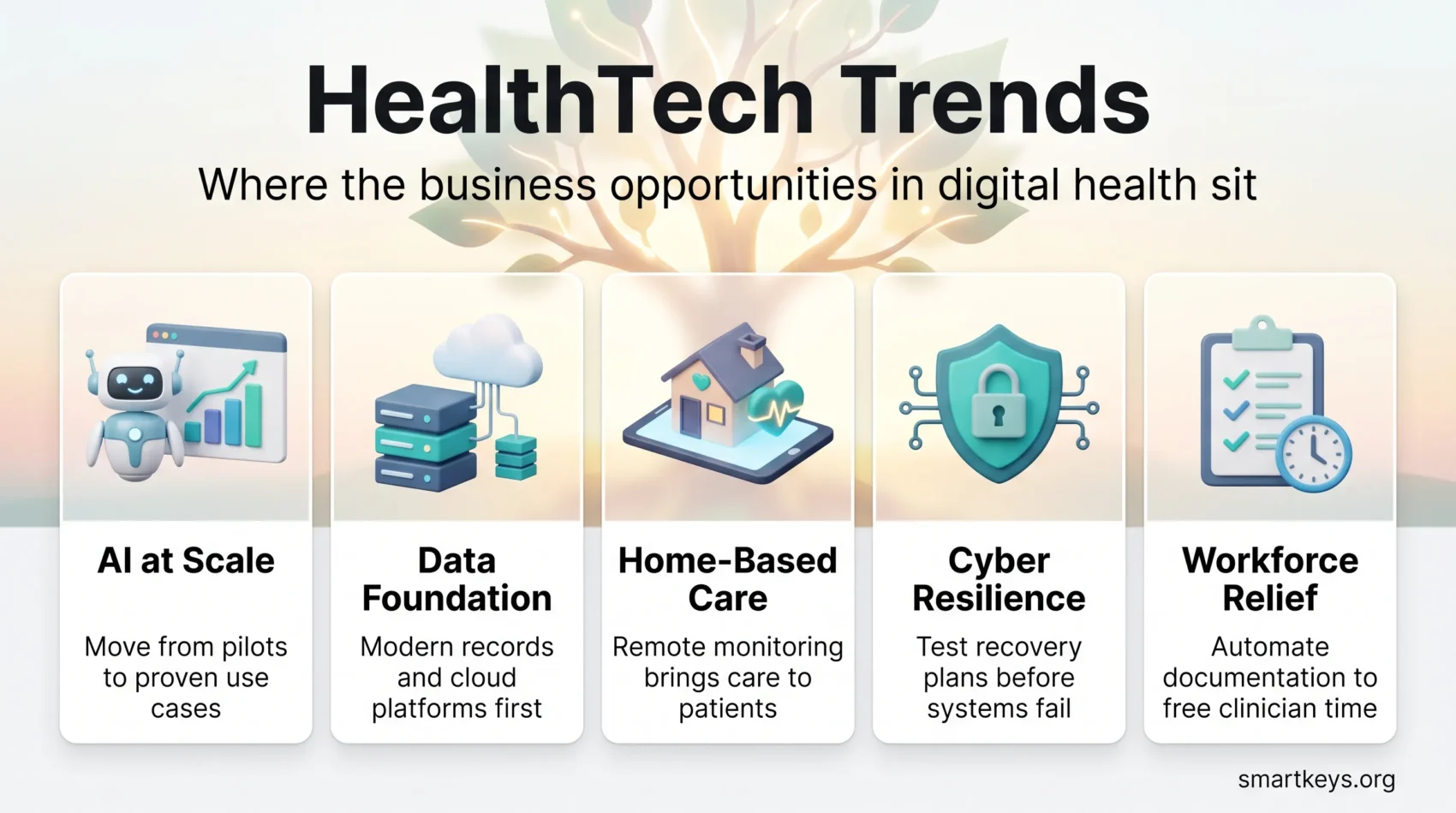
US health care is entering 2027 with the fastest cost growth in 17 years, a rewritten Medicaid rulebook, and AI programs that are splitting into winners and write-offs. That mix is uncomfortable for payers and providers. For companies that sell technology, services, or care models into the system, it is also the clearest map of where the money is moving.
This guide covers the HealthTech trends that matter for business decisions in 2026 and 2027. HealthTech, short for health technology, means the software, devices, data platforms, and digital services used to deliver, pay for, and manage care. You will see what the current cost, policy, and cyber data say, where organizations are spending, and which opportunities hold up. Every figure comes from a named source.
Key Takeaways
- PwC projects a 9% medical cost trend for 2027, the highest in 17 years, driven by GLP-1 drugs, hospital prices, and behavioral health demand.
- AI has moved from experiment to sorting phase: about a third of health systems have scaled it, a third are piloting, and a third have paused or dropped projects.
- The 2025 budget law adds Medicaid work requirements from January 2027, and enhanced ACA subsidies have expired. Both reshape who is insured and how.
- Medicare telehealth rules are settled through the end of 2027 and hospital-at-home through 2030, which gives home-based care a stable footing.
- Cyber breaches hit fewer people in 2025 than in 2024, but 710 large incidents and a pending HIPAA Security Rule overhaul keep security at the top of the budget.
Why 2026 Is a Pivotal Year for Digital Health
Three forces converged in 2025 and early 2026. Costs accelerated, federal policy changed direction, and organizations finished their first full cycle of AI investment with mixed results.
Costs came first. PwC’s Health Research Institute now projects a 9% medical cost trend for the group market in 2027 and 8.5% for the individual market. It also revised its 2026 estimates upward to the same levels. Medical cost trend means the year-over-year increase in the cost of treating patients, before any benefit design changes. A 9% figure is the highest PwC has recorded in 17 years (PwC, Medical cost trend: Behind the numbers 2027, June 2026).
Policy came second. The budget reconciliation law signed on July 4, 2025 introduces Medicaid work requirements from January 2027 and shortens eligibility checks to every six months. At the same time, the enhanced premium tax credits for Affordable Care Act (ACA) marketplace plans expired at the end of 2025. The Congressional Budget Office projects marketplace enrollment will fall from 22.4 million in 2025 to 13.1 million in 2027 (cited in Deloitte’s US Health Care 2026 Mid-Year Outlook, July 2026).
AI results came third. Deloitte’s mid-year survey of 64 health system and health plan finance chiefs found AI initiatives split into thirds. One third have scaled across several functions. One third are still in pilot or limited use. One third have been paused or abandoned. That sorting is healthy: it tells vendors and buyers which use cases actually pay.
What stakeholder reactions signal for the next few years
Executives are less sure about the industry than they were a year ago. Deloitte’s 2026 US Health Care Outlook surveyed 120 C-suite leaders at large health systems and plans. Of those, 43% described the near-term outlook as uncertain or neutral, up from 28% the year before. Yet 80% said regulatory and policy factors will shape their 2026 strategy. And 70% plan alliances with technology or digital companies.
Read together, those numbers say leaders expect turbulence and want partners who can absorb part of it. That is the opening for HealthTech vendors with proven implementations and clear economics.
HealthTech Trends Shaping the US Market Right Now
Drug demand and hospital prices are pushing the cost curve up. PwC identifies five main inflators for 2027. GLP-1 prescriptions, the class of drugs used for diabetes and weight management, reached 3.5 million in December 2025, nearly double the December 2024 figure. Hospital services inflation ran at 7.59% year over year in February 2026. Behavioral health claims grew 62.6% between 2018 and 2024. Providers won 88% of the 2.6 million No Surprises Act arbitration cases filed in 2025, which pushes reimbursement up. And 70% of health plans rank AI tools that help providers capture more revenue as a top-three cost driver (PwC, June 2026).
That last point deserves a pause. AI is not only a cost-cutting tool in health care. Used by providers to improve coding and billing, it raises what payers pay. Vendors on both sides of that contest are selling briskly.
Affordability is now a consumer issue, not only a payer issue. More than a third of US consumers say they have a health need they are not addressing because of cost, according to PwC’s future of health research (September 2025). Products that make prices clear before a visit, steer patients to lower-cost sites of care, or keep people on medication they can afford have a receptive market.
Utilization, margins, and practical levers
Higher use of services, which the industry calls utilization, lifts hospital volumes and squeezes health plan margins. Plans respond with value-based contracts, where providers are paid for outcomes rather than volume, and with tighter pharmacy management.
- Improve coding accuracy and outreach to protect quality bonuses and risk-adjustment revenue. If you sell the AI tools that do this, be ready to show audit trails, because payers now treat them as an inflator.
- Use near-real-time claims and care management data to spot utilization spikes early instead of at quarter end.
- Partner with specialty pharmacies and adherence platforms to manage chronic-condition spend, especially GLP-1s.
Transparent navigation and social risk data help vulnerable patients avoid skipping care because of cost.
AI and Data: From Pilots to Platform-Level Value
Health care AI is past the “should we” stage and into the “which projects survive” stage. In Deloitte’s 2026 outlook survey, more than 80% of executives expect generative or agentic AI to deliver moderate to significant value across functions. Yet only about a third are operating AI at scale, 49% are still experimenting, and 18% have not adopted it at all.
The gap between expectation and scale is where the business opportunity sits. Organizations that scaled AI usually had one thing in common: a data foundation that was ready for it.
Why the data foundation decides the outcome
AI models are only as good as the records they read. EMR and ERP systems, short for electronic medical record and enterprise resource planning, are the software that holds clinical and business data. Health systems running on fragmented versions of both spend most of an AI budget on plumbing before any model runs.
Move past pilots by migrating to cloud platforms and enforcing data lineage, meaning a record of where each data point came from. Build one source of truth for patient and financial information. Integration platforms that connect legacy systems through standard interfaces are a practical first step. Our guide to iPaaS and business integration explains how they work.
Agentic AI and workflow automation
Agentic AI is software that carries out a multi-step task on its own instead of only answering a question. Examples include checking a prior authorization, drafting the appeal for a denied claim, or scheduling a follow-up. In health care, the early wins sit in exactly that administrative work, plus clinical documentation.
The catch is oversight. Every agent that touches a claim or a chart needs a human checkpoint and a log. Our overview of AI-powered assistants at work covers how other industries are building those controls.
Responsible AI and regulatory oversight
Regulation is moving on two tracks. In the US, the Food and Drug Administration (FDA) has authorized more than 1,400 AI-enabled medical devices since 1995. Of those, 331 were authorized in 2025 alone, according to the FDA list last updated on March 4, 2026 (as tracked by MedTech Dive). Most are in radiology.
In the EU, the AI Act’s transparency rules under Article 50 apply from August 2, 2026. Anyone deploying a chatbot or generating AI content for patients must disclose it. The stricter high-risk obligations were postponed by the May 2026 omnibus agreement. Stand-alone high-risk systems now have until December 2, 2027. AI embedded in regulated products such as medical devices has until August 2, 2028 (Gibson Dunn summary of the EU AI Act omnibus, 2026). Our guide to AI regulation in 2026 tracks the full timeline.
- Prioritize: EMR/ERP modernization and cloud migration before large model deployments.
- Define: a small number of use cases tied to operational metrics, such as days in accounts receivable or documentation minutes per visit.
- Educate: clinical and business teams on safe use. A structured data literacy program is a cheaper investment than a failed rollout.
Consumerization of Care: Convenient, Affordable, and Personalized
Patients now compare their health care experience with their banking and shopping apps. Deloitte’s mid-year 2026 research found that roughly one in three US adults now consults AI for health information. Consumers who rate their provider or plan highly on technology and app experience are about ten times more likely to stay loyal than those who rate it poorly.
Employers are pushing in the same direction. Individual coverage health reimbursement arrangements (ICHRAs), where an employer gives staff a fixed monthly allowance to buy their own insurance, keep growing. The HRA Council reported in August 2026 that more than 20,000 US businesses offer an ICHRA or its small-business cousin, the QSEHRA. Together they cover at least 500,000 employees. Large employers more than doubled their adoption year over year.
The American Medical Association warns against one-size-fits-all consumerization because it can create new access gaps. A young professional in a city and a rural parent working two jobs need different front doors. Telemedicine removes a barrier for one and may miss clinical signals for the other.
Building your digital front door and omnichannel engagement
Design a single front door that links scheduling, benefits, payments, and virtual visits across mobile and web. Use the channels patients already prefer, whether text, chat, phone, or email, to lift appointment show rates and medication adherence. AI chatbots in customer service handle a growing share of that first contact, provided the EU-style disclosure and escalation rules are built in.
Personalization without new pitfalls
Use data-driven segmentation to tailor outreach by language, clinical risk, and social context. Bring in social determinants of health data, meaning information about housing, transport, income, and food access, so outreach meets people where they are.
- Balance convenience with clinical appropriateness across virtual, retail, and in-person settings.
- Show costs before the visit so patients choose the right site of care without surprise bills.
- Turn experience signals and complaints into product changes on a fixed cadence.
Governance and interoperability matter: make sure every channel shares the full patient context and that personalization does not quietly disadvantage groups with less data.
Access and Equity: Digital Health Without New Care Deserts
Equity in digital care requires more than a video link. It needs partnerships, protocols, and logistics that reach patients where they are.
The policy ground here is finally stable. The Consolidated Appropriations Act, 2026, signed on February 3, 2026, extended Medicare telehealth flexibilities through December 31, 2027. That includes the home as an originating site, the removal of geographic restrictions, audio-only visits, and the waiver of the in-person requirement for behavioral telehealth. The same law renewed the Acute Hospital Care at Home program through September 30, 2030 (Telehealth.org policy summary, February 2026).
For vendors, that means a two-year window in which telehealth reimbursement is not a quarterly question, and a four-year runway for hospital-at-home models.
Closing gaps for rural and underserved populations
Partner with community groups to tackle broadband, device, and language barriers. Offer mobile clinics or rotating on-site services as a hybrid option where connectivity is unreliable.
When telehealth helps and when an in-person visit is essential
Use short video consults for follow-ups, medication checks, and behavioral health so patients do not lose a workday. Build protocols that flag when a physical exam is clinically necessary so convenience never overrides quality.
- Capture social and behavioral data to tailor outreach and navigation.
- Define clear transitions between virtual and in-person care, with triage rules staff can apply in seconds.
- Measure equity outcomes by geography and income to confirm the model expands access rather than shifting it.
Design for language access and accessibility across every digital channel, as a product requirement rather than a compliance afterthought.
Policy Shifts in Medicare and Medicaid: What They Mean for Growth Bets
Federal policy now sets the boundaries of most growth plans in US health care. The numbers involved are large.
Medicare covered 69.4 million people in 2025, of whom 34.9 million were in Medicare Advantage, the private-plan version of Medicare (CMS Fast Facts, April 2026). Medicaid and the Children’s Health Insurance Program (CHIP) covered 73.5 million people in May 2026 (Medicaid.gov enrollment highlights). That Medicaid figure has been falling since the end of pandemic-era continuous enrollment, and the 2025 budget law will push it lower.
What the 2025 reconciliation law changes. From January 1, 2027, adults in the ACA Medicaid expansion group must complete 80 hours of work, training, or community service per month to keep coverage. States must verify eligibility at least every six months. The Congressional Budget Office estimates the work requirement alone will leave about 4.8 million more people uninsured by 2034. It also cuts federal Medicaid spending by roughly $326 billion over ten years (KFF analysis of the 2025 budget reconciliation law).
On the Medicare side, Deloitte’s mid-year outlook notes that stronger-than-expected Medicare Advantage rates for 2027 gave plans some relief, though affordability remains uncertain.
How to respond:
- Stress-test growth models under several Medicare reimbursement and Medicare Advantage rate scenarios rather than one base case.
- Map state-level Medicaid exposure, including how each state will run work-requirement verification and what churn that creates.
- Build eligibility, enrollment, and redetermination tools. Six-month checks for tens of millions of people are an administrative burden that states and plans will pay to automate.
- Use data to protect quality scores and risk capture, which drive plan bonuses.
- Plan scale moves, whether alliances, deals, or targeted exits, before the 2027 changes land.
Prepare clear briefing packs for boards and investors that show scenario plans tied to policy dates.
Pharma and PBMs: Transparency, Rebates, and Next-Generation Models
As specialty medicines and GLP-1 spend swell, plan sponsors want to know who benefits from rebates. Pharmacy benefit managers (PBMs), the intermediaries that negotiate drug prices for insurers and employers, face pressure to disclose drug-level pricing and pass savings through.
- Rewrite contracts so fees follow outcomes and total-cost reductions rather than spread margins.
- Integrate pharmacy and medical data so utilization, adherence, and site-of-care decisions line up with clinical goals.
- Adopt value-based drug contracts and outcome guarantees to balance access and affordability.
Strengthen governance and audit trails so contracts survive scrutiny. Show employers real-world outcomes for specialty treatment in both financial and clinical terms. With GLP-1 volumes nearly doubling in a year, adherence and affordability tools around that drug class are one of the most concrete near-term opportunities in the market.
Cybersecurity Resilience: Preparing for Inevitable Disruption
When clinical systems go dark, patient safety and revenue are at risk within hours, so plans must be tested, not filed.
The 2025 numbers are better than 2024, but not good. Health care organizations reported 710 large data breaches (500 or more people) to the US Department of Health and Human Services in 2025, down 4.3% from 742 in 2024. At least 61.6 million people had health information exposed, down from a record 289.2 million in 2024, a year dominated by the Change Healthcare attack. Business associates, meaning vendors that handle patient data on behalf of providers, accounted for 35.8% of 2025 breaches (HIPAA Journal, 2025 Healthcare Data Breach Report).
That vendor share matters for HealthTech companies. If you hold patient data, you are part of your customer’s attack surface and part of their compliance file.
The HIPAA Security Rule overhaul
The Office for Civil Rights proposed a major update to the HIPAA Security Rule on December 27, 2024. It would make encryption and multi-factor authentication mandatory rather than “addressable.” It would also require a written inventory of systems that handle patient data, and the ability to restore critical systems within 72 hours of an incident. The final rule has slipped: the federal regulatory agenda now lists July 2027 for final action (HIPAA Journal, July 2026). Smart vendors are building to the proposed standard now, because customers’ security questionnaires already ask for it.
Defenses, integrated risk management, and vendor strategy
Upgrade first- and second-line defenses, from identity and access management to network segmentation and continuous monitoring tailored to clinical systems. A zero-trust approach, where no device or user is trusted by default, fits hospitals with thousands of connected devices. Organizations with many security tools from different vendors can tie them together with a cybersecurity mesh architecture.
Integrated risk management connects enterprise risk, cyber analytics, and incident response across business units and vendors. Assess cloud and billing partners rigorously and write security obligations into contracts.
Quantifying exposure and stress-testing continuity
Model downtime scenarios that include revenue-cycle disruption, patient diversion costs, and fines. The principles in our guide to workforce contingency planning apply directly: know who does what when the system is down.
- Measure resilience KPIs: mean time to detect (MTTD), mean time to respond (MTTR), and recovery hours, mapped to clinical and financial outcomes.
- Run tabletop exercises with executives and clinical leaders so decisions happen in minutes during a real event.
- Ensure 24×7 coverage and defined escalation paths.
| Focus | Action | Metric |
|---|---|---|
| Defenses | IAM, segmentation, monitoring | MTTD |
| Risk | Integrated analytics, vendor oversight | MTTR |
| Continuity | Downtime playbooks, insurance | Recovery hours |
Adopt secure-by-design for new technology and weigh cyber insurance against your quantified exposure. Employee data deserves the same care as patient data; our guide to data privacy at work covers the 2026 rules.
Home Health Surge: Care Moving Closer to the Patient
Delivering more services at home changes how you staff, pay, and monitor clinical work.
Labor and policy signals both favor expansion. The US Bureau of Labor Statistics projects employment of home health and personal care aides to grow 18% from 2025 to 2035, with about 760,500 openings a year. Median pay was $35,800 in May 2025 (BLS Occupational Outlook Handbook, updated August 2026). Low pay and high turnover are the constraint. Scheduling, training, and retention tools for this workforce are therefore a market in their own right.
The reimbursement runway is also longer than it was. With Acute Hospital Care at Home renewed through September 2030 and Medicare telehealth settled through 2027, providers can plan home-based episodes without fearing a policy cliff every few months.
Tech-enabled monitoring that makes home care safe
Align with reimbursement paths for hospital-at-home, skilled nursing at home, and remote patient monitoring so episodes scale sustainably.
- Define clinical criteria and escalation protocols so home care stays safe across settings.
- Deploy technology kits, including remote patient monitoring devices and virtual nursing, so data flows back to care teams in real time. Our guide to IoT in healthcare explains what connected devices actually deliver and where they fail.
- Redesign logistics for on-time supply, pharmacy, and equipment delivery to the patient’s door.
Opportunities include chronic care management, post-acute recovery, and palliative services. Quantify hours saved from avoided facility visits and build payer partnerships with shared-savings models to prove value.
Workforce of the Future: Productivity, Retention, and Well-Being
Staffing pressure is changing how health care work is designed. Deloitte estimates that technology could free 13% to 21% of nurses’ time, roughly 240 to 400 hours per nurse per year. Documentation is the largest single opportunity at 95 to 134 hours (Deloitte, Technology and the health care workforce, May 2024). That potential only turns into better care and less burnout if workflows change with it.
Cut low-value work to reclaim clinician time
Target documentation, referrals, and scheduling for automation so clinicians spend more time with patients. Ambient documentation tools, which listen to a visit and draft the note, are the most widely adopted example. Use technology cautiously: automation should remove steps, not add a new layer of review.
Upskill, redesign, and build trust
Invest in hands-on training so staff use AI and digital tools with confidence. Our guide to upskilling and reskilling in 2026 covers what works. Pair training with team-based roles and co-design so frontline staff shape the tools they will use.
Enterprise strategies that stabilize costs and improve quality
Embed staffing analytics and flexible schedules to smooth peaks and reduce overtime. Link productivity gains to retention and clinical outcomes.
| Focus | Action | Metric |
|---|---|---|
| Automation | Reduce admin tasks | Hours saved |
| Education | Upskill staff | Confidence scores |
| Workforce | Staffing analytics | Overtime hours |
Make this enterprise-led: govern workforce strategy alongside the tech roadmap and use workforce analytics to track progress. Employers outside health care are buying AI wellness coaching for their own staff, an adjacent market for health-focused vendors.
New Value Pools: Prevention, Personalization, Prediction, and Point of Care
Mapping value pools helps you shift from reactive care to prevention-driven business models.
PwC estimates that about $1 trillion of annual US health spending will shift by 2035. It moves away from administrative overhead, episodic care, and facility-heavy models toward digital-first, proactive, and personalized care (PwC, From breaking point to breakthrough, September 2025). PwC’s 4Ps framework, Prevention, Personalization, Prediction, and Point of Care, is a practical way to sort opportunities.
Shifting business models to improve outcomes and lower cost
Prevention means using clinical, behavioral, and social data to spot rising risk and act before a hospital visit is needed.
Personalization tailors treatment and outreach to genetics, behavior, and preference so patients stay on plan.
Prediction uses models to trigger early action that avoids complications. Our guide to predictive analytics in business covers why data quality decides whether those models pay off.
Point of care brings services into homes, workplaces, and retail sites so access expands without sacrificing safety.
- Prove value with outcome and cost metrics tied to specific chronic conditions.
- Run short pilots and scale only when clinical and financial signals both hold.
- Integrate pharmacist, behavioral health, and nutrition support into care pathways.
Design governance that keeps access equitable as you deploy new models, and share prevention savings with the partners who generate them.
Deals and Ecosystem Plays: Where Value Is Moving
Deal activity is rising, but its shape has changed. In Deloitte’s mid-year 2026 survey, 59% of health care finance leaders said mergers and acquisitions are a rising priority, up from 42% in 2025. Yet about two thirds of first-quarter 2026 deals were divestitures: health systems trimming portfolios rather than expanding. Roughly two thirds of health plan finance chiefs said they are likely to pursue partnerships with technology, digital health, employer, and local business partners.
Pick partners that accelerate your roadmap while lowering execution risk. Platform deals that de-risk claims, denials, and care coordination modernization get measurable results fastest. The SaaS consolidation wave of 2025 and 2026 means many HealthTech vendors will themselves be acquired, so buyers should check ownership stability as part of due diligence.
Partnering with hyperscalers, AI companies, and solution providers
Use a clear thesis for every deal: how it advances your model, shortens time to market, and protects what makes you different. When evaluating targets, demand evidence on security, compliance, and clinical validity. Industry-specific AI, built on a general model plus health data, rules, and integrations, attracts much of the venture money. Our guide to vertical AI solutions explains how to judge those vendors.
- Align integration plans to your operating model so solutions scale across service lines and regions.
- Focus investment where the market is migrating: self-insured employers, virtual and at-home care, and the automation layer around claims and eligibility.
- Set outcome-based service agreements that pay for value realized, not software delivered.
Weigh build, buy, and partner options against speed, cost, and differentiation.
Operating Model Modernization: From Tech Debt to Scalable Platforms
When you inventory tech debt and act on it, maintenance drag turns into a platform that supports analytics, automation, and better care delivery. Tech debt means the accumulated cost of old systems and quick fixes that must be paid down before new capabilities can be added.
Interoperability, privacy, and measurable outcomes as table stakes
Start with a clear catalog: map legacy systems, custom builds, and manual workflows so you know where information is trapped.
Then consolidate onto scalable platforms that support standard interfaces so data moves across settings and partners without friction. If your organization is still at an earlier stage, our explainer on EHR and telemedicine adoption in healthcare walks through electronic records, record exchange, and virtual care step by step. The broader lessons in our guide to digital transformation in 2026 apply: returns, not ambition, decide which projects survive.
- Protect privacy by design: embed security controls and access policies before enabling cloud or AI use.
- Measure impact: define baselines and link platform investments to operational and clinical outcomes on transparent dashboards.
- Restructure roles: align product, data, engineering, and clinical owners so adoption and accountability speed up.
Rationalize vendors and deploy change-management playbooks so frontline teams adopt new workflows quickly. Climate risk belongs in this plan too. Extreme weather and power outages test the same continuity systems as a cyberattack. Our overview of climate tech trends shows what resilience investment looks like elsewhere.
Go-to-Market Strategies: Turning Trends into Near-Term Opportunities
Buyer-specific offers make it easier to prove value and win procurement cycles. Start with segmentation so each audience sees a tailored path from pilot to scale.
Segmented offers for employers, payers, and health systems
Employers want transparent pricing, cost control, and a better employee experience, and a growing number are moving to ICHRAs. Payers focus on utilization, administrative efficiency, and the new eligibility workload. Providers need throughput, documentation relief, and margin.
Build distinct value propositions that map to each buyer’s priorities while reusing one platform backbone.
Validating ROI with evidence and real-world data
Use short, measurable pilots with clear success criteria: time to implement, workflow impact, and outcome improvement. Capture data fast and publish referenceable case studies.
- Match pricing to risk tolerance: shared savings, subscriptions, or performance guarantees.
- Package implementation playbooks and integration accelerators to cut adoption friction.
- Arm sales with economic models, clinical evidence, and security documentation for faster due diligence.
Aim to validate ROI within a quarter where possible, then expand accounts by tracking outcomes and securing executive sponsorship.
Conclusion
Leaders who focus on measurable wins in security, data, and simpler care will capture the biggest opportunities of 2026 and 2027.
Turn volatility into momentum by modernizing platforms, scaling AI where it has proven itself, and hardening cyber defenses ahead of the HIPAA Security Rule. Prioritize actions that lift outcomes and affordability together, and choose partners that speed capability building without adding risk.
Double down on consumer design and workforce support to expand access. Align Medicare and Medicaid plans to the 2027 policy calendar, and scale home-based and point-of-care models where the reimbursement runway is now clear. Concentrate on the few moves that create the most impact now.
Found this useful?
Make SmartKeys a preferred source on Google, and our articles will surface more often in your Top Stories, AI Overviews, and AI Mode.
Add as Preferred Source