The software as a service (SaaS) market has moved from a decade of land grab into a decade of consolidation. Mergers and acquisitions are now the main way software companies add capability, buy their way into a category, or simply survive a market that no longer rewards growth at any cost. The middle market is where most of this happens: thousands of quiet deals a year, far below the headlines, that steadily reduce the number of independent vendors.
The scale is easy to underestimate. Software Equity Group’s 2026 Annual SaaS Report counted nearly 2,700 SaaS M&A transactions in 2025, up 28% on 2024 and the highest annual total the firm has recorded. Private equity was involved in close to 58% of those deals. Consolidation is no longer a phase the industry is passing through; it is the normal state of the market.
It is also not only about numbers. Much of the activity is about assembling end-to-end products through vertical integration, so a customer can buy one platform instead of five overlapping tools. Deals like ClearPathGPS joining GPS Insight in fleet management, or Actionstep buying Soluno in legal software, show the pattern: a specialist adds an adjacent capability and becomes harder to displace.
Key Takeaways
- SaaS M&A hit a record in 2025 with nearly 2,700 transactions (Software Equity Group).
- Private equity was involved in roughly 58% of those deals, and AI featured in 72% of target positioning.
- Buyers are consolidating their own tech stacks at the same time, with about 36% of licences going unused (Zylo).
- Vertical integration is the dominant product logic behind the deals.
- Valuations have split: strong assets earn premium multiples, the rest cluster in low single digits.
Understanding SaaS Consolidation
SaaS consolidation covers two related movements that are easy to confuse. On the supply side, vendors merge or acquire each other to gain market share, fill product gaps, and reach profitability faster. On the demand side, buyers consolidate the software they already own, cutting overlapping subscriptions down to a smaller set of platforms. The two feed each other: every buyer who wants fewer vendors makes the case for a bigger, broader vendor.

The money behind this is not shrinking. Gartner expects worldwide IT spending to reach $6.15 trillion in 2026, a 10.8% increase, with software alone at $1.433 trillion and growing 14.7%. Software budgets are still expanding; what has changed is that the growth is concentrating in fewer, larger platforms rather than spreading evenly across new entrants.
On the buyer side, the waste is well documented. Zylo’s 2026 SaaS Management Index puts unused licences at an average of 36% and median SaaS spend at $9,455 per employee. It also found that business units now control 81% of SaaS spend while IT directly manages around 15%, which is exactly how duplicate tools accumulate without anyone noticing.
- Consolidating a tech stack removes duplicate licences and the admin work around them.
- Standardising on fewer tools cuts training and support overhead.
- Fewer vendors means a smaller attack surface and fewer integrations to secure.
A regular SaaS audit is the practical starting point: list every application, map it to an owner, check actual usage against seats paid for, and retire what overlaps. Pairing that review with disciplined cloud cost optimisation and a working FinOps practice turns a one-off cleanup into an ongoing control.
Factors Driving SaaS Industry Consolidation
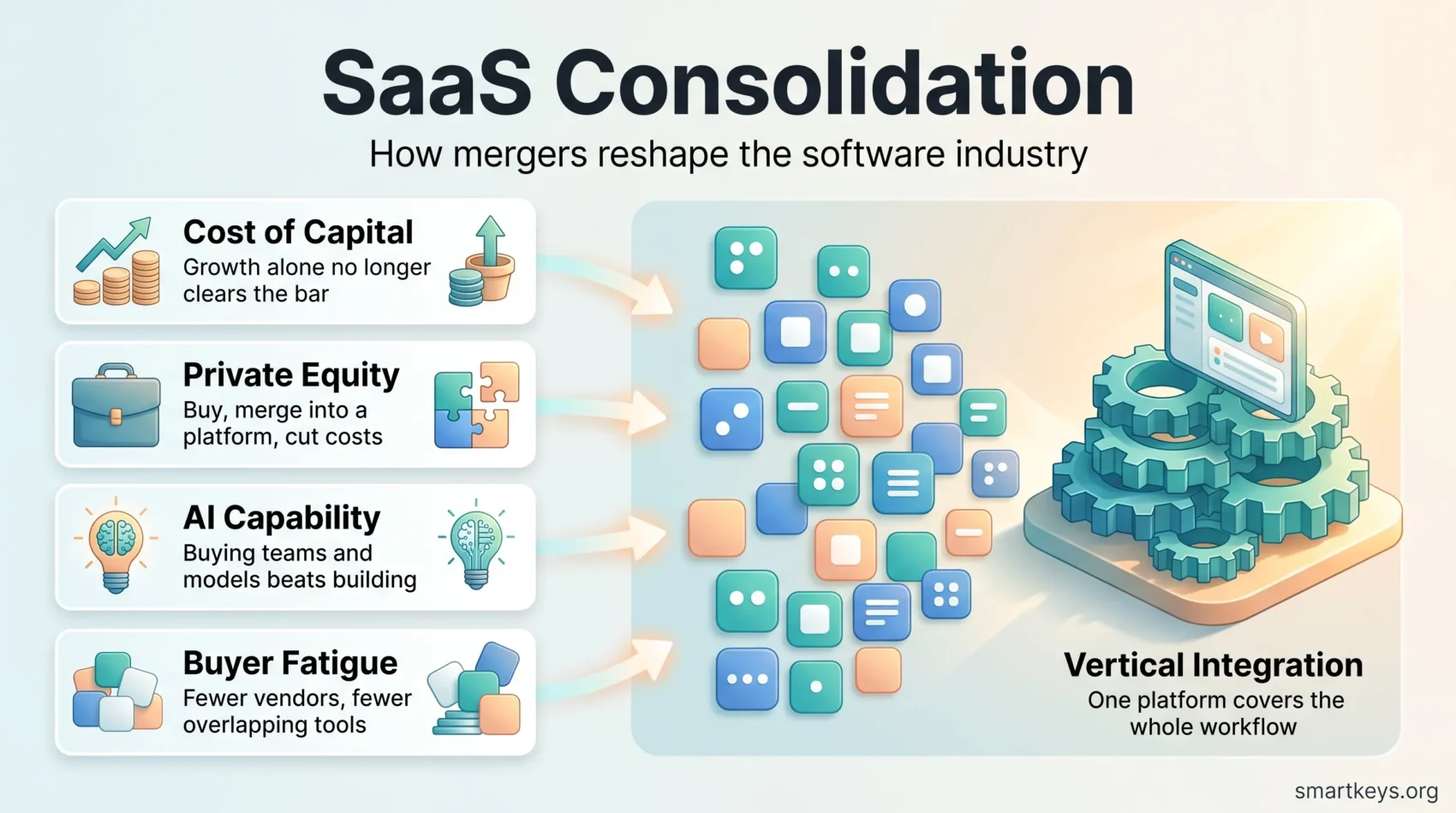
Four forces sit behind most of the current deal flow. The first is the cost of capital. After years of cheap money, growth alone no longer clears the bar, and companies that cannot fund their own expansion look for a buyer instead. The second is private equity, which entered 2026 with a large pool of committed capital and a proven playbook: buy, merge into a platform, cut duplicated cost, sell.
The third is AI. Software Equity Group found that 72% of 2025 SaaS transactions referenced AI in how the target was positioned. Buying a team and a model is often faster than building one, and buyers are willing to pay for it. Vendors that have shipped credible AI-driven SaaS innovation are being priced differently from those that have not.

The fourth is buyer fatigue. Zylo reports that large enterprises add roughly 21 applications a month, and that 78% of IT leaders were hit by unexpected charges from consumption-based or AI pricing in the past year. That experience pushes procurement towards fewer, larger contracts, which in turn rewards vendors broad enough to absorb several categories at once. It is the same pressure that drives subscription fatigue among business customers.
SaaS Consolidation Trends
The pattern in 2026 is high deal volume paired with sharply divided pricing. Plenty of companies are changing hands; only some of them are getting the valuations owners hoped for.
Recent M&A Activity in the SaaS Market
Deal count set a record in 2025 and activity carried into 2026. FE International’s mid-year 2026 report put announced technology transactions at $649 billion in the first half of the year, within a global M&A market of roughly $2.8 trillion. Strategic acquirers drove most of the headline value, while private equity kept competitive pressure on almost every process.
The valuation picture is less comfortable. FE International put public enterprise SaaS comparables at about 3.3x trailing revenue at mid-year 2026, down from 4.9x at the end of 2025. Assets with an AI, infrastructure, or security angle still command double-digit multiples; ordinary subscription businesses do not.
Key Drivers of Market Consolidation
Profitability now matters more than growth rate. Software Equity Group recorded a median EBITDA margin of 9.1% across its SaaS index in 2025, and buyers increasingly underwrite deals on cash generation rather than forward revenue. Integration capability is the other differentiator: a product that plugs cleanly into an existing platform is worth more than one that needs rebuilding, which is why integration platforms and a solid API strategy have become due-diligence topics rather than technical details.
Emerging SaaS Consolidation Patterns
The clearest pattern is vertical integration: acquirers buying adjacent capability so the combined product covers a whole workflow instead of one step in it. A field service platform buys scheduling, then invoicing, then payments, and the customer stops shopping for the missing pieces.
The second pattern is depth over breadth. Rather than competing with horizontal giants, vendors are going after specific industries with software that reflects how that industry actually works. The vertical SaaS landscape has become one of the more active corners of the market for exactly this reason, and the same logic is now producing industry-specific AI solutions and packaged industry cloud offerings.
A third pattern runs in the opposite direction. Small, focused products continue to appear and find buyers quickly, which keeps the pipeline of acquisition targets full. Watching micro SaaS is a reasonable way to see which categories will be consolidated next, and white label SaaS gives larger platforms a fast route into a category without building from scratch.
The Impact of M&A on the SaaS Industry
Consolidation changes what customers can buy, what they pay, and how much leverage they keep.
Changes in Market Dynamics
Fewer independent vendors means fewer alternatives at renewal. Buyers who once played three suppliers against each other may find two of them under the same owner. Vertical-focused SaaS businesses remain the most sought-after targets because their customer relationships are hard to replicate and their churn tends to be low.
Customer Experience Enhancements
The upside is real when integration is done properly: one login, one support contract, one data model, and fewer handoffs between systems. The risk is equally real. Acquired products sometimes stall, roadmaps get reordered around the acquirer’s priorities, and pricing moves to the buyer’s model. Reviewing how usage-based pricing is applied after a merger is worth doing before signing a multi-year term.
IT Consolidation Strategies Employed by SaaS Companies
Acquirers face their own consolidation problem the day a deal closes. Two companies arrive with two clouds, two billing systems, two security models, and two support desks. Merging them well is where most of the promised savings actually live.
Outsourcing non-core functions is one lever. Delegating billing operations, tier-one support, or infrastructure management to specialists lets the combined engineering team focus on the product rather than the plumbing.
Automation is the second. Reducing manual work in provisioning, onboarding, and reconciliation cuts cost and removes the errors that make integration projects run late.
Platform consolidation is the third and hardest. A single identity layer, one data warehouse, and a shared deployment pipeline are what make an acquired product feel like part of the same suite. Many acquirers use a hybrid cloud strategy during the transition so both estates can run while workloads move.
These programmes also have to hold the line on compliance and security. Consolidation expands the blast radius of any single failure, so cybersecurity practice has to scale with the portfolio, and the unsanctioned tools that surface during integration make shadow IT a governance issue rather than an annoyance.
Strategic Partnerships and Alliances
Not every combination needs an acquisition. Partnerships and reseller agreements deliver some of the same reach at a fraction of the cost and risk, and they often precede a deal. Looking at how strategic alliances are structured explains a lot about which mergers follow.
Case Study: GPS Insight and ClearPathGPS
GPS Insight’s acquisition of ClearPathGPS brought two fleet management providers together under one roof. The combined business could serve a wider range of fleet sizes with a single platform, which is the classic argument for consolidating within a niche rather than expanding outside it.
Case Study: Actionstep Acquiring Soluno
Actionstep’s acquisition of Soluno added billing and accounting capability to a legal practice management platform. Law firms buying practice management software generally also need trust accounting, so the deal closed a gap the customer would otherwise have filled elsewhere.

For most vendors the practical version of this is a well-run partner ecosystem: certified integrations, shared support processes, and clear commercial terms. It delivers a broader offer without the integration debt an acquisition creates.
To understand the infrastructure side of these combinations, see how cloud computing trends shape what is technically possible to merge.
Market Consolidation: New Market Entry Strategies
Acquisition is often the fastest route into a market a vendor has no presence in. Buying an established player brings customers, domain knowledge, regulatory familiarity, and a sales team that already knows the buyers, none of which can be hired quickly.
Example: Ideagen and Tritan
Ideagen’s acquisition of Tritan extended its compliance software portfolio into the maritime sector. Rather than learning maritime regulation from scratch, Ideagen acquired a team that already understood it and plugged the product into an existing compliance platform. That is the core logic of consolidation as a market entry strategy.
Vendors weighing this route should be honest about the alternative. Building takes longer but leaves no integration debt; buying is faster but the real work starts after the deal closes. Either way, procurement discipline on the buyer’s side is what keeps the resulting portfolio from becoming its own sprawl problem.

The Role of Technology in SaaS Mergers
Technical fit now decides which deals get done. A target with clean APIs, a modern data model, and a single-tenant-free architecture is far easier to absorb than one carrying years of bespoke customer code.
End-to-End Solutions Through Vertical Integration
Vertical integration is what turns a portfolio of acquisitions into a product. It means one identity system, one permissions model, one reporting layer, and data that moves between modules without an export step. Customers notice the difference immediately, because that is what separates a suite from a collection of logos on the same invoice.

AI has raised the stakes here. A model is only as good as the data it can reach, so acquirers increasingly value targets for their data as much as their product. That makes data governance, consent, and residency central to due diligence rather than an afterthought.
Security cuts the same way. Every merged system inherits the weakest configuration on either side, which is why integration plans now run alongside a security review rather than after it.
Future Predictions for SaaS Market Consolidation
Expect volume to stay high and pricing to stay split. With software spend growing 14.7% in 2026 on Gartner’s numbers, there is enough money in the market to keep funding deals, and enough pressure on margins to keep pushing weaker vendors towards an exit.

Three developments are worth watching. Pricing models will keep shifting towards consumption as AI features make per-seat pricing a poor fit for actual usage. Vertical platforms will keep gaining ground on horizontal suites in regulated industries where generic software struggles. And buyers will get more organised: the same discipline they apply to cloud spend is arriving in software procurement.
For teams absorbing new tools after a merger, the practical constraint is rarely the technology. It is getting people productive on the new system, which makes structured onboarding and training a genuine part of the integration plan.
Conclusion
SaaS consolidation is now the market’s default setting rather than a passing cycle. Record deal volume in 2025, heavy private equity participation, and a valuation gap that rewards profitable, AI-capable businesses all point the same direction: fewer independent vendors, larger platforms, and more pressure on anyone caught in the middle.
For buyers, the response is straightforward. Know what you own, retire what overlaps, and read renewal terms carefully when a supplier changes hands. For vendors, the questions are whether the product integrates cleanly, whether the economics work without subsidised growth, and whether there is a defensible position in a specific industry. Salesforce’s $27.7 billion purchase of Slack showed how far a platform will go to own a workflow; most deals are far smaller, but the reasoning is identical.
The companies that come through this well will be the ones that treat integration as the real work, not the paperwork after the announcement.
Found this useful?
Make SmartKeys a preferred source on Google, and our articles will surface more often in your Top Stories, AI Overviews, and AI Mode.
Add as Preferred Source