Super apps bundle messaging, payments, shopping, transport and financial services into a single mobile application. In much of Asia they are already the default way people transact: Tencent reported a combined 1.43 billion monthly active users for Weixin and WeChat as of 31 March 2026, and Ant Group says Alipay now connects more than a billion users to over 10,000 types of consumer services. In the United States and Europe the model has taken longer to land, but 2026 brought the clearest test yet with the US rollout of X Money.
This guide covers what super apps are, what the current numbers support, how they change consumer behavior, and where the model still struggles.
Key Takeaways
- Super apps combine several everyday services in one place, which removes the friction of switching between separate apps.
- The proven examples are Asian: Weixin and WeChat reached 1.43 billion combined monthly users in early 2026, and Grab reported 51.6 million monthly transacting users in the first quarter.
- Payments are the anchor. Once money moves inside the app, every other service becomes easier to add.
- Western attempts are now real rather than theoretical, with X Money launching to US subscribers in July 2026.
- Grand View Research projects the super apps market at USD 968.77 billion by 2033, a 30.1% compound annual growth rate from 2026.
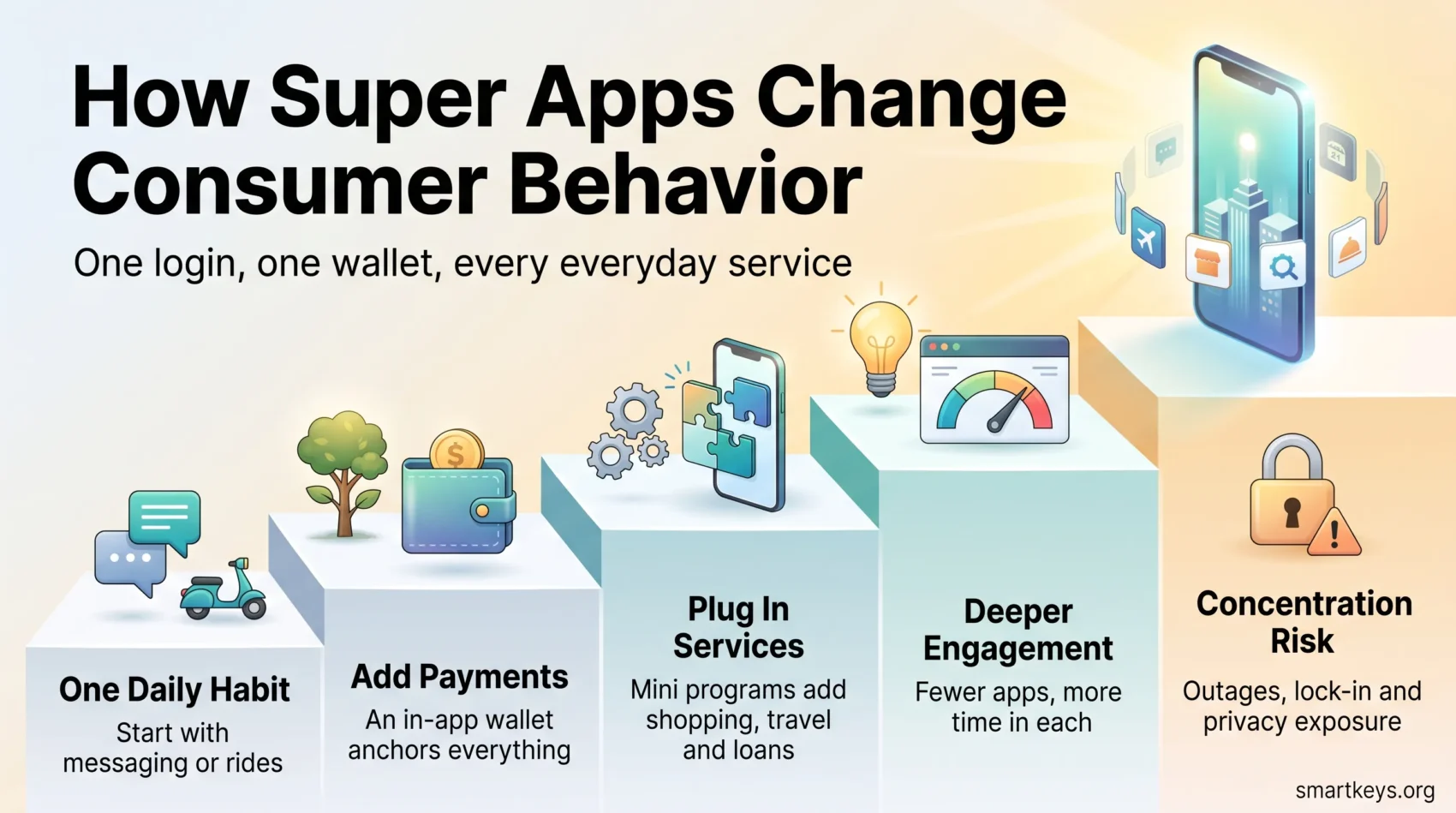
- Concentration brings risk: outages, lock-in and privacy exposure all scale with the number of services in one app.
Introduction to Super Apps
The idea behind a super app is simple. Instead of installing one app for messaging, another for payments, another for food and another for transport, you use one that does all of it. The services sit behind a single login, a single identity and a single wallet.
That model took hold first in markets where smartphones arrived before entrenched banking and retail infrastructure. Users had no legacy habits to unlearn, so a messaging app that added payments faced very little resistance.
The scale it reached is documented. Tencent’s first quarter 2026 results put combined Weixin and WeChat monthly active users at 1.43 billion, up 2% year on year, with commercial payment volume growing faster than in the previous quarter. Grab, which began as a ride-hailing service in Southeast Asia, reported 51.6 million group monthly transacting users in the same quarter, up 16%, alongside USD 6.1 billion in on-demand gross merchandise value and a gross loan portfolio of USD 1.44 billion.
Together they show what a mature super app looks like: enormous reach on one side, a financial services business growing inside it on the other.

What Are Super Apps?
A super app is a multifunctional platform that merges services which would normally live in separate products: social networking, e-commerce, transport, and digital wallets and payments. WeChat and Alipay are the reference cases, but the pattern repeats across Grab in Southeast Asia, Gojek in Indonesia and KakaoTalk in South Korea, which Ofcom notes is used by around 90% of the country’s population.
The growth path is consistent. Each of these started with one high-frequency behaviour, messaging or ride-hailing, then added payments, then used the payment rail to add everything else. Gojek began with motorbike rides and now runs bill payments, food delivery and financial products from the same app.
The architecture behind this is usually a mini-program model. Third parties build lightweight services that run inside the host app rather than as separate downloads, which is how one super app can offer thousands of services without building them all. Ant Group describes this structure when it talks about AI agents and mini programs for retailers running on top of Alipay.
North American and European platforms built for the web first and treated mobile as one channel among several. That history is a large part of why the model has been slower to arrive there.
Super Apps Business: The Rise of All-in-One Platforms
The super apps business model rests on a straightforward economic argument. Acquiring a user is expensive; selling that user a second, third and fourth service is comparatively cheap. Every additional service raises the value of the app to the user and raises switching costs at the same time.
Grab’s 2026 numbers illustrate the pattern. Its gross loan portfolio grew 130% year on year to USD 1.44 billion, with loans disbursed up 67% to a record USD 1.1 billion in a single quarter. Those loans are sold to people the platform already knows through their ride and delivery history, which is a lending advantage a standalone bank does not have.
Tencent shows the same effect on the commerce side, reporting rapid growth in Mini Shops gross merchandise value inside the Weixin ecosystem while payment volume accelerates. The commerce, the payment and the social graph reinforce each other.
The hard part is product discipline. Every added service competes for space in a navigation bar that has to stay legible on a phone screen. Companies that get this wrong end up with a bloated app that does many things badly, which is the usual failure mode for super apps assembled by acquisition.
How Super Apps Are Reshaping Consumer Behavior
The behavioural change is less about doing new things than about doing familiar things in fewer places. When ordering food, paying a friend and booking a ride all sit behind one login, the cost of each action drops.
Two effects follow. The first is consolidation of attention. Sensor Tower’s State of Mobile 2026 found that global app downloads were essentially flat in 2025 while time spent kept rising, with social apps alone absorbing close to 2.5 trillion hours and averaging over 90 minutes per person per day. People are not installing more apps; they are going deeper into the ones they already have. That is the condition a super app needs.
The second is payment habit. Once a wallet is embedded in an app people already open several times a day, cash and card become the slower option. Ant Group reported that Alipay’s AI Pay feature passed 100 million users in February 2026 and processed more than 120 million transactions in a single week, which shows how quickly a new payment behaviour can scale inside an existing base.
The travel sector is a useful example of the knock-on effect. Revolut has moved from payments into travel and experience bookings and signed a global payments partnership with Booking.com in late 2025. For online travel agencies, that turns a payments company into a distribution competitor.
None of this is frictionless. Data protection, competition scrutiny and consumer trust all get harder as services concentrate, which regulators have started to say out loud.
Efficiency and Convenience of Super Apps
The practical appeal of a super app is that it removes small repeated costs. Fewer logins, fewer stored card details, fewer password resets, one transaction history instead of six.
That convenience compounds. Ordering food, booking a ride, messaging a colleague and settling a bill in one session means no context switching between apps, no re-authentication and no re-entering payment details. The same logic applies at a smaller scale when you consolidate your productivity apps instead of running a dozen overlapping tools.

For the business running the app, the same consolidation produces advantages that standalone products cannot match:
- Higher engagement and retention, because more daily needs are met in one place.
- Better personalization, because behaviour across services feeds a single profile.
- Cross-selling that costs almost nothing, because the user is already inside the product.
The trade-off is complexity. A single app carrying payments, chat, commerce and lending has a far larger attack surface and a harder compliance burden than any of those products alone, which is one reason the model has spread unevenly.
Mobile-Only Engagement: A Shift in Usage Patterns
Super apps depend on people treating the phone as the primary computing device rather than a secondary one. In markets where most users came online through a smartphone and never used a desktop for banking or shopping, that condition was met years ago.
Sensor Tower’s 2026 report points to a maturing market rather than a growing one: downloads flat, spend rising, and consumers spending more in apps than in games for the first time. Growth now comes from depth of usage, not from new installs. In that environment, the platform that already owns a daily habit is best placed to add the next service.
AI assistants are the newest example of that depth. Sensor Tower recorded a 426% year-on-year rise in time spent with AI assistant apps in 2025, and both Alipay and WeChat have moved AI-driven services into their existing bases rather than launching separate products. Conversational interfaces fit the super app model well, because a chat window is a natural front door to dozens of services. Our guide to conversational commerce covers that shift in more detail.
Seamless Integration of Services
Integration is what separates a super app from a large app with many features. The services have to share identity, payment and data, or the user experiences them as separate products that happen to live under one icon.
Partnerships do most of the heavy lifting. Rather than build a bank, a super app plugs into one; rather than build a hotel inventory, it plugs into a travel platform. That is how Revolut added experiences and how Grab layered financial services onto transport and delivery. For small and medium businesses, being inside the host app means access to a customer base they could not reach alone, which is a version of the digital marketplace model applied to services.

The technical enabler is the embedded finance layer. When payment, credit and insurance are available as building blocks inside the app, adding a new vertical stops being a banking project and becomes a product decision. We cover that shift in our article on embedded finance, and the same infrastructure argument runs through open banking.
For most traditional businesses, building a super app is not realistic, which makes distribution partnerships the practical route. It is worth understanding how the host platform monetises that relationship before signing one.
The Role of Mobile Payment Solutions in Super Apps
Payments are the load-bearing wall. Without a wallet, a super app is a collection of links; with one, every service is a one-tap transaction and the platform sees all spending.
Almost every super app therefore owns a payment product or is built on one. WeChat Pay and Alipay were the originals, Grab built financial services on its transport base, and Revolut came the other way, starting in payments and adding lifestyle services.
The security model matters as much as the convenience. Tokenised card credentials, device-level biometrics and in-app fraud monitoring are what make people comfortable keeping a balance in the app, and they are the same building blocks discussed in our piece on biometric payment systems. Where those controls are weak, the concentration of services turns from a feature into a liability.
A super app is only as useful as the payment rail underneath it: consolidate the services and the wallet becomes the product.
The commercial logic is straightforward. More transactions inside the app mean more revenue per user and more data to personalise the next offer, which is the same flywheel described in our overview of fintech business trends.
Personalization and User Experience in Super Apps
Personalization in super apps works better than in standalone products for a structural reason: the platform sees behaviour across categories. A standalone food app knows what you eat. A super app knows what you eat, where you travel, when you get paid and what you buy.
Tailored Recommendations and Offers
That cross-category view is what makes recommendations feel useful rather than intrusive, and it is why super apps can time an offer to a payday or a commute. The same techniques now shape retail generally, as covered in our guide to e-commerce personalization and our look at AI-powered personalization.
The line between helpful and uncomfortable is thin, and it is drawn differently by market. Users who accept a transport recommendation based on payment history may react badly to a health or credit offer built from the same data, which is a design problem as much as a legal one.
Loyalty Programs and Consumer Engagement
Loyalty schemes work unusually well inside super apps because points earned in one service can be spent in another. A ride earns credit that pays for lunch, which pulls the user across services they might otherwise never open.
X Money’s launch package follows this logic, offering up to 3% cash back on selected purchases and a headline savings rate for paying subscribers. The reward is not really about the cash; it is about establishing the app as the default place money sits. Retention economics of this kind are the same ones covered in our article on subscription fatigue and in our look at the freemium model.
Impact of Super Apps on Traditional Business Models
Super apps compress several industries into one interface, which is uncomfortable for anyone whose business depends on owning the customer relationship directly. Banks, retailers, taxi firms and travel agents all end up one layer removed from the customer when the super app owns the front door.
Grand View Research puts the market on a path to USD 968.77 billion by 2033, growing at 30.1% a year from 2026, with Asia Pacific accounting for over 48% of it in 2025 and social and messaging the largest application segment. Those are forecasts rather than facts, but the direction is consistent with what platform operators are reporting.
The realistic responses for an incumbent are limited:
- Distribute through the super app and accept thinner margins for wider reach.
- Compete on depth in a category where a generalist app cannot match specialist service.
- Build a narrower vertical ecosystem around an existing strength, which is what most banks and retailers attempt.
Whichever route a company takes, it should be clear about what it gives up. Distribution through a platform means handing over the customer relationship and often the data attached to it, the same calculation companies face across digital transformation programmes generally.
Future Trends in the Super Apps Market
Three things are worth watching over the next few years.
First, the Western test case. X Money began rolling out to US X Premium and Premium+ subscribers in late July 2026, with an X Visa debit card, fee-free peer-to-peer transfers inside the app, cash back and a savings rate. Whether a social platform can convert users into account holders at scale is the open question, and it will say more about the model’s portability than any forecast.
Second, AI as the interface. Alipay’s AI Pay reached 100 million users within months, and time spent in AI assistant apps rose sharply through 2025. If the entry point to a super app becomes a conversation rather than a grid of icons, the practical ceiling on how many services one app can hold rises considerably.
Third, regulation. Ofcom has flagged four concerns about super apps: fraud exposure across wider functionality, competition risk from customer lock-in, resilience after a multi-day KakaoTalk outage left users without several services at once, and privacy exposure when data is concentrated. Gartner’s often-cited projection that more than half the global population will be daily users of multiple super apps by 2027 is precisely why those questions matter. Anyone building in this space should read it alongside our coverage of data privacy trends and privacy compliance frameworks.
Growth is not guaranteed by market forecasts. It depends on whether users in low-trust, high-choice markets decide that convenience is worth the concentration.
Conclusion
Super apps are proven in Asia and unproven almost everywhere else. The evidence for the model is strong where it exists: 1.43 billion combined monthly users for Weixin and WeChat, more than a billion Alipay users across over 10,000 service types, and a Grab business where lending now grows faster than rides.
What travels less easily is the context. Western users already have banking apps they trust, retail apps they use and messaging apps they will not leave, so a new super app has to displace incumbents rather than fill a gap. X Money’s US rollout in 2026 is the first serious attempt to do that at scale, and its results will be more informative than any market projection.
For businesses, the practical question is not whether to build a super app but where you sit relative to one. If a platform is going to own the customer’s front door in your category, you need to decide now whether you want to be inside it, beside it, or deliberately outside it.
Found this useful?
Make SmartKeys a preferred source on Google, and our articles will surface more often in your Top Stories, AI Overviews, and AI Mode.
Add as Preferred Source