Updated August 2026 with the latest cancellation, spend, and churn data.
Subscription fatigue stopped being a mood and became a measurable behavior. In 2026, Zuora’s Subscription Economy Index put active cancellations among U.S. consumers at 47%, up from 31% in 2024. Nearly half the market cut something loose in a single year.
Your customers are not rejecting recurring pricing. They are rejecting recurring charges they cannot justify, cannot find, and cannot cancel without a fight.
This guide shows you what the current data says, why cancellations cluster where they do, and which retention moves actually work when attention is the scarcest resource in the market.
Key Takeaways
- Cancellation is now routine. 47% of U.S. consumers actively cancelled a subscription in 2026 (Zuora SEI), and 43% of Americans expect to drop a streaming service within three months (Reviews.org, 2026).
- The perception gap drives the cuts. U.S. households spend roughly $273 per month on subscriptions, and about 89% underestimate that total (West Monroe).
- Price hikes are the trigger. 52% of Americans have cancelled or downgraded after a price increase.
- Clarity beats bundling. Simple plans, honest renewal notices, and a one-click exit outperform retention scripts.
- Flexibility is a feature. 65% of subscribers name pause/cancel-anytime as their top reason to subscribe at all.
- Regulators are watching. The FTC restarted negative-option rulemaking in March 2026 and continues enforcing under ROSCA.
What subscription fatigue is and why it matters to your business
Subscription fatigue is the exhaustion customers feel from managing too many recurring services, logins, billing dates, and renewal decisions at once. It shows up as cancellation, downgrade, and rotation — not as complaints.
From streaming to software to AI tools
The model spread from media into software, ecommerce, fitness, groceries, and now AI assistants. Every expansion added another billing cycle to your customer’s month.
The AI wave made this concrete fast. Bango research from late 2025 found Americans pay for roughly four premium AI subscriptions at about $66 per month, and 53% cancel and restart those tools as projects come and go.
That rotation behavior is the new normal, and it is spreading to categories that used to be sticky. If you build recurring revenue, see how the wider subscription economy shifted from ownership to access before you design your next pricing tier.
The real burden: admin load, not just cost
Money is only half the friction. Each service adds a password, a payment method, a renewal date, and a cancellation path to remember.
C+R Research found 74% of consumers say recurring charges are easy to forget, and roughly two-thirds admit to missing a free-trial cancellation deadline. Forgotten charges do not build loyalty; they build resentment that surfaces the moment someone audits their bank statement.
- Define the problem: many products means many commitments.
- Fix the friction: centralize account controls and make billing legible.
- Protect trust: remove dark patterns so customers feel in control.
The 2026 market picture: data that shows the scale of fatigue
Spending keeps climbing while patience keeps shrinking. Both things are true at once, and the gap between them is where churn lives.
Spend is up, tolerance is down
Fortune Business Insights sizes the global subscription economy at roughly $536 billion in 2025, heading toward about $859 billion in 2026. Growth is not the problem.
The problem is the perception gap. West Monroe research puts average U.S. household subscription spend near $273 per month, with about 89% of consumers underestimating their own total. When people finally see the real number, something gets cut.
Streaming remains the bellwether
Deloitte’s Digital Media Trends work found 47% of consumers believe they pay too much for the streaming services they use, and 41% say the content is not worth the price. About 39% had cancelled at least one SVOD service in the prior six months, rising to 52% among millennials.
The churn math confirms it. Churnkey’s analysis of late-2025 data showed monthly video-streaming churn climbing from about 2% in 2019 to 5.5% by early 2025.
What consumers say they will do next
A 2026 Reviews.org survey of 1,000 Americans found households keep about three paid streaming services on average, 52% have cancelled or downgraded because of a price increase, and 43% expect to cancel at least one service within three months.
Two findings in that survey matter more than the churn numbers: 68% would consolidate all their streaming into a single monthly bill if they could, and 58% regularly substitute free ad-supported video for paid content.
| Signal | 2026 figure | Source |
|---|---|---|
| Consumers who actively cancelled a subscription | 47% (vs. 31% in 2024) | Zuora Subscription Economy Index |
| Average U.S. household subscription spend | ~$273 / month | West Monroe |
| Cancelled or downgraded after a price hike | 52% | Reviews.org, 2026 |
| Monthly churn, video streaming | 5.5% (vs. 2% in 2019) | Churnkey |
| Average monthly subscription churn, all categories | 5.3% | Marketing LTB, 2026 |
| Say flexibility is their #1 reason to subscribe | 65% | Marketing LTB, 2026 |
What this means for you: more market spend does not buy you loyalty. Top-performing subscription companies hold monthly churn below 3% — roughly half the category average — and they get there through clarity, not lock-in.
The psychology behind subscription fatigue
Cancellation is usually a cognitive decision before it is a financial one. Understanding that changes which levers you pull.
Decision fatigue and the paradox of choice
Too many options raise anxiety and stall action. When customers compare six near-identical tiers, they defer, then default to cutting rather than choosing.
The same mechanism that drains your customers also drains your team; the research on decision fatigue and work performance maps directly onto pricing-page design.
Cognitive overload from fragmented platforms
Deloitte’s Connected Consumer work found 28% of people now find managing their devices and subscriptions overwhelming, up from 24% in 2022. Different logins, different interfaces, and different renewal rhythms fragment attention until the whole category feels heavy.
Perceived value erosion and price sensitivity
When updates feel cosmetic or catalogs repeat, perceived value drops faster than price rises. Recent consumer research suggests a meaningful share of satisfied subscribers would still leave over a $5 increase — tolerance is that thin.
- Reduce tiers and use plain-language plan names with sensible defaults.
- At renewal, remind people of the specific features they used, not the ones they ignored.
- Measure satisfaction by feature so you fix what actually drives cancellations.
How subscription fatigue shows up across industries
The pattern differs by category, and so should your response.
Media and streaming: abundance and volatility
Fragmented catalogs and exclusive windows push viewers into deliberate rotation: subscribe Friday, finish the season, cancel Monday. That is not disloyalty; it is efficiency, and it is now a habit rather than an exception.
Ecommerce and retail: convenience versus cost creep
Retail subscribers are far more selective than they were three years ago. Flexible pause options, skip-a-shipment controls, and visible per-delivery savings keep boxes coming when budgets tighten. A well-run customer loyalty program does more here than a discount ever will.
Software and AI tools: less volatile, but no longer safe
B2B software still churns less because it sits inside workflows and proves ROI. But AI tooling broke that assumption — buyers now stack, compare, and drop assistants monthly.
If your product converts free users into paying ones, the mechanics of a freemium model matter as much as your retention playbook: fatigue kills weak upgrade paths first.
Retention strategies that counter fatigue
Retention starts when customers can see, in seconds, what they get and why it is worth next month’s charge.
Radical transparency and proactive notifications
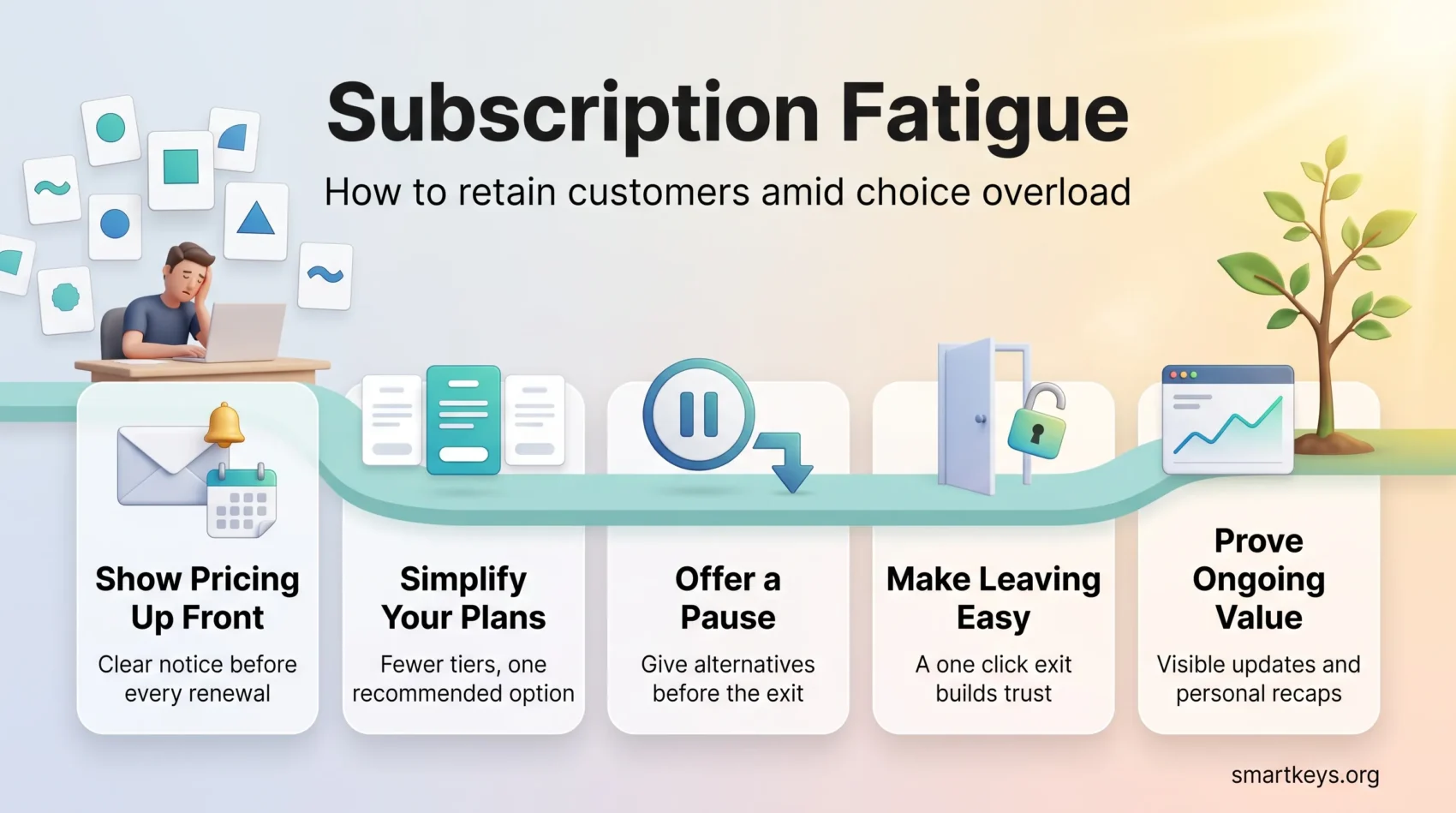
Show pricing and billing up front. Send a sign-up confirmation, 30 days’ notice before any price change, a pre-renewal reminder, and a clear post-charge invoice.
This is no longer only good practice. After the Eighth Circuit vacated the FTC’s Click-to-Cancel rule in July 2025, the agency issued a new advance notice of proposed rulemaking on negative option marketing in March 2026 and continues enforcing against deceptive cancellation flows under ROSCA. Build for the stricter standard now.
Simplify plans and reduce decision load
Offer fewer tiers with clearer inclusions. Use plain labels, highlight one recommended option, and make the downgrade path as visible as the upgrade path.
If your tiers no longer match how customers use the product, revisit them with a value-based pricing lens rather than a cost-plus one.
Make cancellation effortless
Let people leave without obstacles. Easy exits raise return rates and referrals, and they protect you from regulatory risk. Capture the reason, then follow up weeks later with a targeted offer instead of blocking the door.
Better still, offer alternatives before the exit: pause for a month, drop a tier, or switch to an ad-supported plan. A pause beats a cancellation every time.
Live your value proposition
Ship visible improvements on a steady cadence and say plainly what changed. Pair product wins with honest messaging about the benefit, not the feature list.
Loyalty, support, and reliability
- Design loyalty formats that fit the category: tenure pricing, referrals, or early access.
- Prioritize fast, consistent support — one strong recovery preserves months of goodwill.
- Handle failed payments and disputes with empathy and a clear next step.
Personalization, content freshness, and experience design
A platform that visibly improves is a platform people keep paying for. Stagnation reads as overcharging.
Keep the offering dynamic
Small, frequent releases beat rare, large ones. Track update cadence against engagement and cancellation rates to see which improvements actually retain.
Use behavior to tailor what people see
Personalized home screens and discovery paths shorten the distance to value. When recommendations match intent, customers find the reason to stay before they find the cancel button.
- New-release calendars that make upcoming value visible.
- “What’s changed” recaps tied to features the person actually uses.
- Micro-personalization using recency and frequency to rank large catalogs.
- Feedback loops so relevance improves and priorities stay honest.
Balance novelty with stable navigation. Updates should feel helpful, never disorienting.
Operational levers: data, payments, and subscription management
Day-to-day operations decide churn more than campaigns do. Turn usage signals into timely, specific interventions.
Let usage data shape pricing and packaging
Map feature usage to tiers, then test elasticity in small experiments. Customers accept price changes far better when the packaging obviously reflects what they use.
Monitor churn signals early
Watch for declining logins, unopened notifications, support tickets, and cancellation-page visits. Route at-risk cohorts to proactive outreach — modern customer success tools can automate the flagging so your team spends time on the conversation, not the spreadsheet.
Streamline billing and account dashboards
Fix the money side. Smart dunning, card-updater services, and multiple payment methods stop involuntary churn that has nothing to do with satisfaction.
- Make upgrade, pause, and cancel equally visible in the dashboard.
- Set alerts on cancellation patterns and support sentiment.
- Show usage summaries inside billing emails so value and cost appear together.
- Run a monthly retention review that connects KPIs to roadmap decisions.
Conclusion
The 2026 market rewards businesses that make value obvious and choices simple.
Subscription fatigue is not a rejection of recurring revenue. It is a correction: customers now audit what they pay for, and they keep what proves itself.
Do three things this quarter: align pricing with visible value, cut your tier count so plans are easy to compare, and rebuild your cancellation flow so leaving is as easy as joining. Then watch whether cohort retention moves.
Treat retention as ongoing work rather than a save campaign. Steady, honest improvement is what turns weariness back into trust.
Found this useful?
Make SmartKeys a preferred source on Google, and our articles will surface more often in your Top Stories, AI Overviews, and AI Mode.
Add as Preferred Source