Subscriptions stopped being a novelty a long time ago. In 2026 they are simply how a large share of software, media, retail and even industrial products are sold. What has changed is the tone. The land-grab phase is over and growth is harder to buy. Regulators have also started paying close attention to how easy it is to cancel.
That makes this a good moment to look at the subscription economy without the hype. Where is the model genuinely working, where is it straining, and what does a durable recurring revenue model actually require today?
Key Takeaways
- Subscriptions have matured from a growth story into an operating discipline built on retention, pricing and cash flow.
- Zuora’s Subscription Economy Index found that indexed companies grew revenue roughly 11% faster than the S&P 500 over a two-year period.
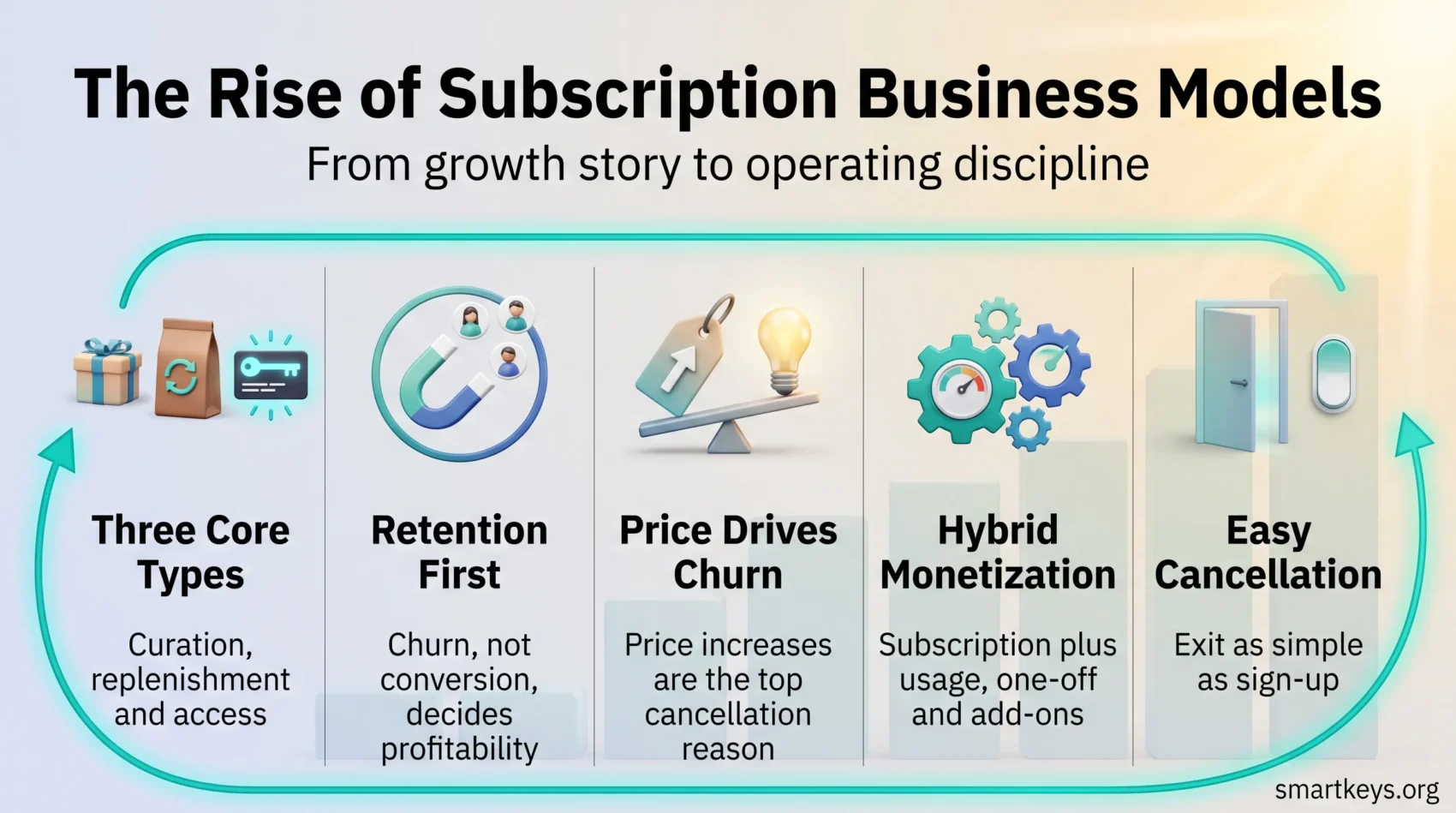
- Price is the single most common reason subscribers cancel, which makes pricing changes a retention decision rather than a finance one.
- Regulators in the US are actively rewriting the rules on cancellation, and enforcement is already expensive.
- Hybrid monetization, where a subscription is combined with usage, one-off and add-on revenue, is increasingly the norm rather than the exception.
- Curation, replenishment and access are the three basic subscription types, and each keeps customers for a different reason.
Understanding the Subscription Economy
The subscription economy describes the shift from selling a product once to selling continuing access to it. The customer pays on a recurring cycle; the company keeps earning only for as long as the customer keeps deciding the service is worth it. That single structural difference reshapes almost everything else about the business.

What Defines the Model
Three characteristics separate a real subscription business from a company that simply invoices monthly:
- Predictable cash flow: revenue arrives in a recurring, forecastable pattern, which changes how the business plans, hires and raises capital. It also makes disciplined cash flow management for sustainable scaling a core competency rather than an afterthought.
- Retention as the primary metric: acquisition still matters, but the economics only work if customers stay. Churn, not conversion, is the number that decides profitability.
- Continuous value delivery: the product has to keep justifying itself every billing cycle, which pushes companies toward ongoing improvement rather than annual releases.
Those pressures are why so many companies now treat subscriptions as one component of a broader business model innovation effort rather than a pricing tweak.
How the Model Spread
Recurring payment is not a digital invention. Milk delivery, newspaper publishers, book clubs, academic journals and health clubs all used it long before software did. What software added was the ability to change the product continuously, meter usage precisely and adjust pricing without reprinting anything.
From there the pattern spread outward. Freemium tiers became the standard on-ramp for consumer apps and developer tools, and the mechanics of converting free users into paying customers turned into a discipline of its own. Tiered pricing let SaaS vendors serve a solo user and an enterprise from the same codebase. E-commerce brands added replenishment subscriptions. The model kept working because it fit both sides: predictable revenue for the seller, lower upfront cost for the buyer.
The Three Main Types of Subscription Models
Most consumer subscriptions fall into one of three types. Knowing which one you run tells you why customers stay and what makes them leave.
- Curation: the provider picks products for the customer, as in beauty, snack or book boxes. The appeal is discovery and surprise, so the service lives or dies on how well the selection matches personal taste.
- Replenishment: essentials such as razors, coffee, pet food or contact lenses arrive on a fixed schedule. Amazon’s Subscribe & Save is the familiar example. Customers stay because they never have to remember to reorder.
- Access: members pay for a bundle of perks, lower prices or content. Amazon Prime (free shipping plus streaming) and most software plans work this way. The service keeps members only while they use the perks often enough to justify the fee.
These types describe what the customer receives. How they pay is a separate choice: a flat fee, several tiers at different price points, a free entry tier, or a charge that rises with use. Many businesses now mix these, and usage-based pricing in particular has spread quickly in software.
Key Drivers of Subscription-Based Businesses
Changing Consumer Preferences
Access has become a reasonable substitute for ownership across music, film, software, transport and increasingly physical goods. Consumers have grown comfortable renting outcomes rather than buying assets. The same instinct shows up in adjacent models such as the sharing economy and the recommerce and resale market. The common thread is flexibility: people want to start easily and leave easily.
Part of the shift is cultural. Many younger buyers care more about using something than keeping it, and they measure status by experiences rather than possessions. Fashion rental services such as Rent the Runway let customers wear high-end clothes without buying them.
Financial Accessibility
A monthly fee spreads cost over time and removes the large upfront decision. In a period of tighter household and corporate budgets, that framing has kept subscriptions competitive against outright purchase. But it cuts both ways. The same low switching cost that makes signing up painless makes cancelling painless too.
Personalization and Data
Recurring relationships generate continuous behavioral data, and companies use it to tailor recommendations, pricing and onboarding. Applied well, this is the model’s strongest advantage: the provider learns what the customer values and adjusts. Tools drawn from behavioral analytics and AI in marketing have made that loop faster and cheaper to operate than it was even two years ago.
Where Subscription Growth Stands in 2026
What the Public Numbers Show
Reliable market-wide figures are harder to come by than the round trillion-dollar projections that circulated a few years ago, largely because the biggest operators have grown more selective about what they disclose. Netflix, for example, announced in 2024 that it would stop reporting quarterly subscriber counts from 2025 onward. Its argument: revenue and margin are the more meaningful measures of a mature subscription business.
Where numbers are still published, they remain substantial. Spotify reported 300 million Premium subscribers and 777 million monthly active users for the second quarter of 2026, alongside revenue of €4.777 billion and operating profit of €655 million. That is a business still adding paying subscribers at scale, more than fifteen years after launch.
Zuora’s Subscription Economy Index offers a broader read. Across the companies it tracks, revenue grew roughly 11% faster than the S&P 500 over a two-year window, with unique subscribers up around 25%. The index also found that companies running four or more revenue models grew average revenue per account (ARPA, the average amount each customer pays) faster than those relying on a single model. That point is worth sitting with, because it suggests the winning pattern is no longer “pure subscription” at all.
Consumer Spending and Subscription Fatigue
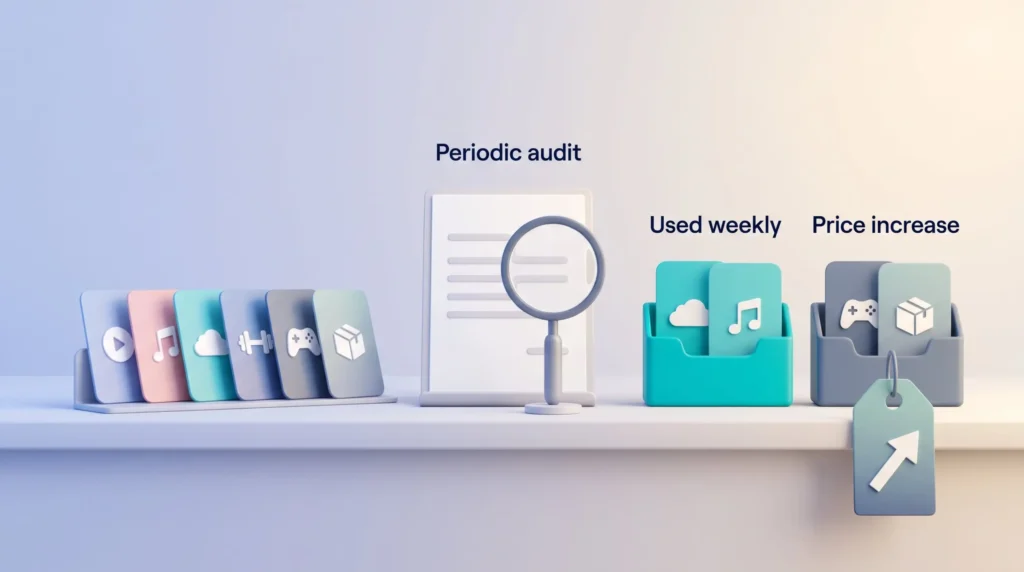
The counterweight to that growth is fatigue. Households now juggle streaming, music, storage, fitness, news, gaming and delivery memberships simultaneously, and the cumulative bill has become visible in a way individual sign-ups never were. Zuora’s index found that among consumers who cancelled a subscription in 2024, 47% cited a price increase as the reason.
That reframes the retention problem. The threat is rarely a competitor; it is the customer’s own periodic audit of what they are paying for. Services that survive an audit tend to be the ones used weekly rather than owned occasionally.
Industries Where the Model Has Taken Hold
Entertainment and Media
Streaming remains the clearest example of access replacing ownership, and it is also where the model matured first. Growth now comes from pricing tiers, advertising-supported plans, password-sharing enforcement and bundling rather than from unclaimed new users. The strategic question has shifted from “how many subscribers” to “how much margin per subscriber”.
Retail and Consumer Goods
Replenishment subscriptions, curated boxes and paid loyalty memberships all sit under the same umbrella. Retailers use them to smooth demand and lock in repeat purchases. That is why the model shows up so consistently in e-commerce growth trends and in the rise of social commerce as an acquisition channel.
Software and B2B Services
Software is the model’s native territory, but it is also where the structure is changing fastest. AI features have pushed vendors toward consumption-based pricing layered on top of a subscription base, because inference costs scale with usage in a way that seat-based pricing cannot absorb. Meanwhile the market itself is reshaping through SaaS consolidation, the growth of focused vertical SaaS players, and small independent operators building sustainable micro SaaS businesses.
Finance and Platforms
Subscription mechanics have also migrated into places that used to charge per transaction. Paid tiers on payment platforms, memberships bundled with credit products and recurring plans inside non-financial apps all reflect the spread of embedded finance, meaning financial services built into non-financial products. Meanwhile, consumer super apps increasingly wrap several subscriptions into one relationship.
The Regulatory Shift Around Cancellation
The most consequential recent development for subscription businesses is not a market trend but a legal one. In the United States, the Federal Trade Commission (FTC) adopted a “click-to-cancel” rule that would have required cancelling to be as simple as signing up. The Eighth Circuit Court of Appeals vacated it in July 2025 on procedural grounds, before it took full effect.

That did not end the matter. The FTC opened an advance notice of proposed rulemaking (a formal first step toward a new rule) in March 2026 to revive the requirements. Comments closed in April, and no draft rule had been published by September 2026. In the meantime it has continued enforcing against negative-option practices under the Restore Online Shoppers’ Confidence Act and Section 5 of the FTC Act. The scale of that enforcement is not theoretical: in September 2025 Amazon agreed to a $2.5 billion settlement over how customers were enrolled in and cancelled from Prime.
Federal rules are only part of the picture. Roughly 30 US states have their own automatic-renewal laws. California’s version, for example, requires businesses to send subscribers an annual reminder with the renewal date, the price and how to cancel.
The practical implication is clear. Cancellation flows, renewal disclosures and consent mechanics have moved from growth-team territory into compliance territory, and a friction-based retention strategy is now a liability rather than a tactic.
Challenges Facing Subscription-Based Businesses
Retention and Churn
Churn splits into two problems that need different solutions. Voluntary churn happens when the customer decides the service is not worth the price. The fix is product value, communication and honest pricing, not a harder cancellation path. Involuntary churn happens when a payment simply fails, through an expired card or a declined transaction, and it is often the larger and more recoverable share.
Reducing involuntary churn is unglamorous operational work: card-updater services, intelligent retry timing, clear pre-dunning notices and multiple payment methods. It rarely appears in strategy decks, yet it typically returns more revenue per hour of effort than any acquisition campaign.
Pricing Without Triggering Cancellations
Because price is the leading stated reason for cancellation, raising it is a retention event. The companies that manage it well tend to give long notice, explain what changed, grandfather loyal cohorts and offer a genuine downgrade path rather than a binary stay-or-leave choice. A cheaper tier that keeps someone in the relationship is worth far more than a full-price cancellation.
Cost Structure and Margin
Recurring revenue does not guarantee recurring profit. Support, hosting, payment processing and, increasingly, AI inference (the computing cost each time an AI feature runs) all recur alongside the revenue. If cost per customer rises faster than revenue per customer, growth quietly makes the problem worse. This is where a clear go-to-market strategy matters: acquiring the wrong customers at the wrong price is expensive for years, not quarters.
Marketing and Retention Strategies That Work
Subscription marketing is judged over a customer’s lifetime, not at the point of sale. Most proven customer retention strategies apply here, and a few approaches have held up consistently:
- Onboarding that reaches first value fast: most cancellations trace back to a customer who never got the product working.
- Proactive communication: telling subscribers about changes before they notice them preserves trust that discounts cannot buy back.
- Community: people leave products easily and leave communities reluctantly, which is the underlying logic of community-led growth.
- Social proof: reviews, case studies and visible customer outcomes still do more for consideration than feature lists.
Support quality belongs in this list too. A subscriber’s most memorable interaction is often a problem being handled well. That is why current customer service trends and the sensible use of AI-powered chatbots sit close to the center of retention rather than at the edge of it.
How to Launch a Subscription Offer
Whether you start a subscription business or add a plan to an existing one, decide in this order:
- Find a repeat need. Subscriptions work when customers need something again and again. Coffee beans, bookkeeping or design assets qualify. A sofa does not.
- Define the value in one sentence. Say what the subscriber gets each cycle that a one-off buyer would not. If you cannot, the offer will struggle at the first price audit.
- Choose the type and the price structure. Decide whether you curate, replenish or grant access, then pick flat, tiered or usage-based pricing. A written pricing strategy keeps later price changes defensible.
- Pick billing tools. Start with your store platform’s subscription features. Move to a dedicated billing tool once plans, taxes and upgrades get complex.
- Design the exit before the entry. Build a cancellation flow that is as easy as sign-up, with a pause or downgrade option. It keeps you compliant and saves customers who only need a break.
Start with a small group, watch how many renew after the first cycle, and adjust before you scale.
Subscription Management and Billing Systems
Billing is where subscription strategy either works or quietly fails. Recurring billing has to handle proration, mid-cycle upgrades, trials, taxes across jurisdictions, dunning (automated reminders after a failed payment) and cancellation. All of it has to work correctly, every cycle, without manual intervention. Getting it wrong shows up as involuntary churn and support load rather than as an obvious billing failure.
Dedicated subscription management platforms exist because building this in-house tends to be underestimated. The features that matter most in practice are unspectacular: reliable retries, flexible plan changes, clean proration, self-service cancellation that meets regulatory expectations, and reporting that separates voluntary from involuntary churn. Hybrid pricing raises the bar further, since usage-based components require accurate metering before they can be billed at all.
The Role of Technology
AI has changed subscription operations in two ways. It improves prediction: models trained on usage patterns can flag accounts likely to lapse early enough to act. It also adds a cost per use, which pushes vendors toward hybrid pricing.
Connected products extend the model into physical goods. When equipment reports its own condition, manufacturers can sell maintenance, monitoring and uptime as ongoing services rather than selling a machine and hoping for service revenue later.
Sustainability and the Circular Economy
Subscriptions can also support a circular economy, an approach that keeps products in use through repair, reuse and recycling instead of throwing them away. When a company rents rather than sells, it keeps ownership of the item. That gives it a direct reason to build products that last and to refurbish them between customers.
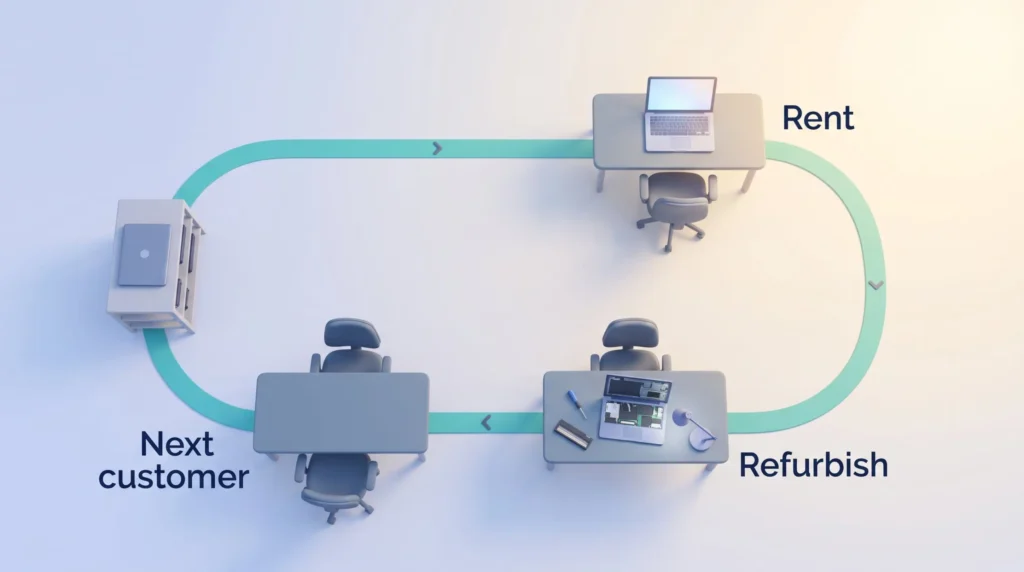
Device-as-a-service plans for laptops and phones follow this logic: the business pays a monthly fee, and the provider replaces, repairs and later refurbishes the hardware. Resale and trade-in programs such as Patagonia’s Worn Wear apply a similar idea to clothing, even without a subscription.
A subscription is not green by default, though. Frequent small shipments add packaging and delivery emissions, so the model only helps when it extends product life or cuts waste.
The Membership Economy
Building Communities Through Subscriptions
Some subscriptions sell access to a product; others sell access to a group. Membership models lean on belonging: shared identity, member-only spaces, direct contact with creators or experts. That is a harder thing to build and a much harder thing to replicate, which is exactly why it defends against churn so well.
Premium and Luxury Memberships
Premium brands use the same logic at the top of the market. Instead of discounts, they sell recognition and service: personal shopping, concierge support, invitations to private events and first access to limited collections. Tiered loyalty programs reward the most active customers with perks that ordinary buyers cannot get. The goal is loyalty among the best customers, not just recurring revenue.
Exclusive Content and Member Benefits
Exclusivity is the practical expression of membership: early access, member pricing, content that is not published elsewhere, or a direct line to the people behind the product. Creator platforms demonstrate the effect clearly. When a subscriber’s relationship is with a person or a community rather than a feature set, price comparison stops being the deciding factor.
Conclusion
The subscription model is no longer the interesting part of a business plan; how it is run is. The evidence from 2026 points in a consistent direction. Growth is available but not automatic, and pure subscription pricing is giving way to hybrid models. Price increases are the main cause of churn, and cancellation friction has become a legal risk rather than a retention lever.
For anyone building or reviewing a recurring revenue business, the useful questions are narrow. Does the product deliver value every cycle, or only at sign-up? Is involuntary churn measured separately from voluntary churn? Would the cancellation flow survive a regulator reading it? Answering those honestly is worth more than any market-size forecast.
Found this useful?
Make SmartKeys a preferred source on Google, and our articles will surface more often in your Top Stories, AI Overviews, and AI Mode.
Add as Preferred Source