Community-led growth means building a space where your users help each other, then using what happens there to improve your product and win customers. Instead of pushing messages at buyers, you host the conversation they are already having about your category.
Here is what that looks like. Someone evaluating a project management tool joins a public Slack group, asks how other teams handle recurring tasks, gets three answers from real users within an hour, and signs up the next day. Nobody in marketing touched that deal, but your community produced it.
Atlassian, Asana, Figma, HubSpot and Webflow all run user communities that feed product decisions and support. The pattern is common enough in software that it now has its own job titles, tooling and budget lines.
The evidence backs the enthusiasm, with a caveat. In the 2025 CMX Community Industry Report, 85% of community professionals agreed community is critical to their company’s mission and 76% reported growing interest from other departments. Only 24% could confidently put a financial number on that value. Community is widely believed in and thinly measured, which is the gap this guide is about.
Key Takeaways
- Community-led growth turns member activity into awareness, adoption and retention.
- It works alongside product-led growth rather than replacing it.
- Buyers increasingly research without a sales rep, which is why peer conversation carries weight.
- Most community teams are small, so start with one channel and one measurable outcome.
- Measurement is the industry’s weak point. Connect community data to your CRM early.
- For the wider picture, see our guide to social media trends.
What Community-Led Growth Means, and Why It Matters Now
Buyers finish most of their research before they speak to anyone at your company. Gartner surveyed 646 B2B buyers between August and September 2025 and found that 67% prefer a buying experience without a sales representative. In the same study, 45% said they used AI during a recent purchase.
That changes where influence sits. If two thirds of buyers would rather not talk to you, the people they do listen to are other users, in Slack groups, on Reddit, in LinkedIn comments and in vendor forums.
Why peer conversation carries so much weight
A vendor page gives a prospect a claim. A thread where three customers describe how they configured the tool gives them evidence, which is harder to fake and builds confidence faster.
This is why peer voices now sit inside marketing plans rather than outside them. The same logic drives B2B influencer marketing and employee advocacy, where credibility comes from a named person rather than a brand account.
How communities drive awareness, adoption and retention
A community touches three stages of the customer relationship, and each needs a different kind of activity.
- Awareness: public threads put your product in front of people searching for a solution, not for you.
- Adoption: peer help removes the small blockers that stall a new user in week one, such as an undocumented integration.
- Retention: members who have asked a question, been answered, then answered someone else have a reason to stay that no feature list can match.
Put simply, community is a practical way to turn member activity into measurable impact across your funnel. The techniques overlap heavily with ordinary customer retention strategies, carried out by users rather than staff.
Community-Led Growth vs Product-Led Growth: Better Together
Product-led growth optimizes the tool. Community-led growth optimizes the experience around the tool. Both are ways of letting people reach value before a salesperson gets involved, and most companies end up running the two together.
Product-led growth, usually shortened to PLG, means the product itself does the selling: a free tier, self-service signup and in-app prompts that lead users toward paid features. If that model is new to you, our comparison of product-led and sales-led growth covers the trade-offs.
The mindset shift: from solution-first to user-first
PLG asks what the product should do next. A community-led view asks what the user is trying to accomplish, including the parts your product does not handle. The second question surfaces problems long before they reach a feature request.
Feedback: scattered tickets versus open conversation
In most companies, feedback arrives split across support tickets, review sites, sales calls and social posts, so nobody sees the whole picture. A community concentrates it in one readable place. When the same question appears four times in a fortnight, you have a documentation gap or a design flaw, and you found it without running a survey.
Metrics: product-qualified leads and community-attributed revenue
Two measures matter here, and they answer different questions.
A product-qualified lead, or PQL, is a user whose behavior inside the product suggests they are ready to buy, for example someone who has invited three colleagues and hit a usage limit. PQLs tell you whether activation is working.
Community-attributed revenue, sometimes shortened to CAR, links closed deals back to accounts that engaged in your community first. It tells finance whether the community is worth funding.
Use both: PQLs tune the product experience, community-attributed revenue defends the budget. This is where most teams struggle. Fewer than a quarter can quantify community value in money, and CMX found that teams whose community data is connected to their CRM are roughly twice as likely to rate themselves extremely successful at hitting business goals.
Who owns what
Marketing, product, sales and customer success all draw on the same community signals, so ownership has to be explicit.
- Align metrics: map PQLs and community-attributed revenue onto the same funnel so the two teams argue about the same numbers.
- Route feedback: tag incoming signals and assign each type a named owner.
- Close the loop: tell members what happened to their suggestion, even when the answer is no.
Companies such as Figma, Asana and dbt Labs run both motions at once. Pairing product usage data with community insight gives you better prioritization and a more human experience for customers. The same alignment problem shows up in revenue operations forecasting, where scattered data quietly ruins the numbers.
Core Components of a Working Strategy
Treat your community as a product: map the journey from first post to trusted advocate, and set a small milestone for each step.
The community flywheel: from first post to advocacy
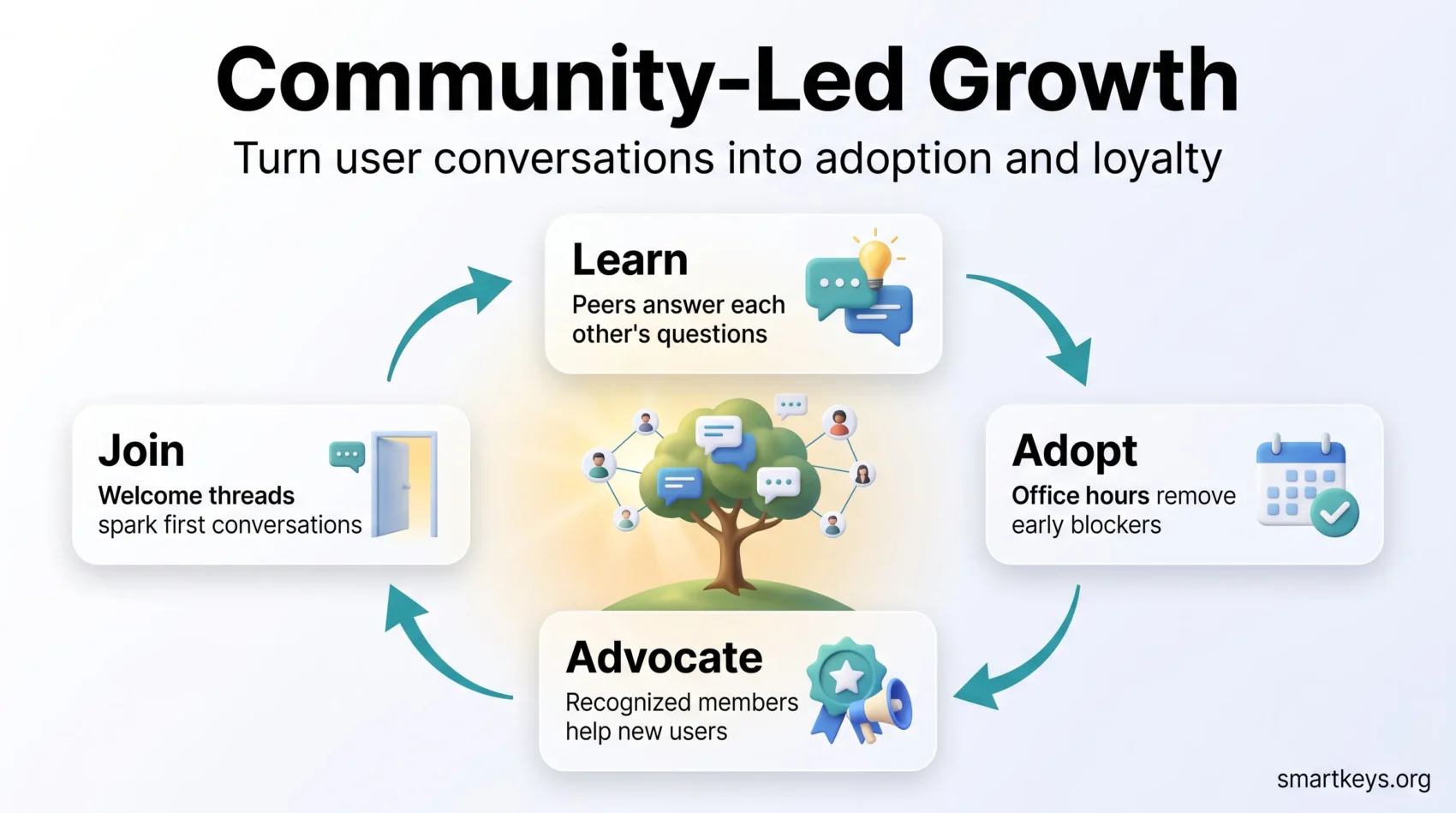
Members move through four stages: join, learn, adopt, advocate. Each stage needs one repeatable thing that nudges people onward.
A welcome thread with a real question moves someone from join to learn. A weekly office hour moves them to adopt. A public thank you moves them to advocate. None of it requires software.
Choosing channels that fit your audience
Pick the platform your audience already opens. Developers tend to gather on Discord, GitHub and Reddit; operations and marketing teams lean toward Slack and LinkedIn; regulated industries often prefer a hosted forum you control. Start with one. A second channel doubles the moderation load and halves the conversation in each.
Content that gives people a reason to come back
Balance three content types: things that teach, things that prompt discussion, and things that showcase members. Rotate them rather than favoring one.
- Resources: templates, short how-to posts and worked examples showing the product doing real work.
- Events: office hours and AMA sessions, short for “ask me anything”, where an expert answers live questions.
- Recognition: spot your most helpful contributors early and give them a visible path to more responsibility.
Finding Fit: Is There an Audience That Will Show Up?
Before you buy tooling or hire anyone, answer one question: is there an audience that cares enough about this topic to show up and talk? Interviews, social listening and a small pilot group answer it within a few weeks.
Community-market fit versus community-product fit
Community-market fit asks whether people care about the category at all. Test it cheaply with a podcast, a webinar or an open AMA and watch whether attendance and signups follow.
Community-product fit asks whether your customers will gather around your product specifically. The signals are repeat questions, users trading configuration tips and members answering each other before you do.
Category communities versus customer communities
Category communities are open to anyone in the field and build awareness. Customer communities deepen adoption and advocacy, because every member shares the same product context.
- Validate first: interviews, social listening and a pilot group before any platform choice.
- Pick a type: a category community to attract new audiences, a customer community to lift retention.
- Layer deliberately: start with broad content, then meetups, then a customers-only space.
- Write a purpose statement: one sentence on what members get, not what you get.
- Set success criteria: agree what week twelve should look like before launch.
“Design for the people you want to serve, not the messages you want to send.”
Building and Launching Without Overengineering
Launch with a small circle of believers. Twenty engaged users who model helpful behavior beat two thousand silent members. Culture is set in the first month and is very hard to change afterwards.
Choose one channel: Slack or Discord for live chat, a forum for threaded discussion people can find later through search. Add structure before you add platforms, meaning welcome threads, topic tags and a fixed weekly rhythm. Publish short guidelines covering what belongs where, how to ask a good question and what behavior gets someone removed, then seed the first conversations yourself so newcomers do not arrive at an empty room.
Appoint a visible owner. Early on that is often a founder, later a community manager with volunteers hosting meetups. Set a cadence you can genuinely sustain, because a community that goes quiet for a month is harder to restart than to launch.
- Recognition: shoutouts, spotlights and a direct message of thanks encourage repeat contribution.
- Feedback loop: collect ideas openly and let members shape the program.
- Documentation: record what worked and retire what did not, so the next hire does not start from scratch.
It is the same discipline behind good scaling strategies for startups: prove the small version works before you scale it.
Engagement That Scales Without Feeling Salesy
Engagement becomes self-sustaining when members meet peers with the same problem. Your job is to design the introductions, not the pitch.
Designing member-to-member connections
Match people by role, industry or challenge. Role-based circles, small group calls and peer introductions all work, and none need custom software to start. Recurring rituals matter more than clever ones: a predictable monthly session beats an inventive format nobody remembers.
Champion and ambassador programs
Build a tiered path with clear, non-cash rewards: early access to features, a speaking slot at your event, a private channel with the product team. Recognition converts helpful users into advocates without asking them to sell anything. Handled well, it is a natural extension of ordinary customer loyalty work, with contribution rather than spend as the trigger.
Guidelines that keep the space trustworthy
Write rules that protect people who ask basic questions and people who disagree politely, and publish how moderation decisions are made. A community where the loudest voice wins loses its quiet majority, and that quiet majority is where most of your buyers sit.
Measurement: From Community Health to Business Impact
Two sets of numbers matter, and confusing them is the most common reporting mistake. Health metrics say whether the community is alive. Business metrics say whether it is worth funding.
Health: growth, engagement, sentiment
Track total members, weekly active members and the share who post rather than lurk. Watch reply rate and time to first reply, because an unanswered question is the clearest sign a community is fading. Simple ratios beat dashboards: posts per active member and the percentage of questions answered within a day tell you almost everything.
Business impact: revenue, retention, expansion
Connect community identities to CRM accounts, then measure pipeline that touched the community first, retention among members against non-members, and expansion inside member accounts.
Treat vendor case studies with caution. Platform providers publish striking conversion figures from single customers that are neither independently verified nor transferable to your business. Your own before-and-after comparison, however rough, is worth more. Tools for assembling that view appear in our overview of business intelligence tools and customer success tools.
Reporting cadence
- Balanced scorecard: pair health measures with business measures so neither can be cherry-picked.
- Quarterly review: report wins, failures and what changed as a result.
- Integration first: connect community data to the CRM before you invest in analysis, since disconnected data cannot be attributed.
- Trend watching: repeated feature requests and falling sentiment are early warnings.
Your Community Team: Roles and Alignment
Community teams are small. The 2025 CMX report found 30% of respondents working as the only person on their community team, and 17% with no full-time community staff at all. Plan for that reality rather than an imagined department.
Community managers, operations and developer advocates
The community manager runs the space and routes what they learn to product, support and sales. Where the team is big enough to specialize, community operations builds the automations and playbooks that stop handoffs depending on one person’s memory. Developer advocates matter in technical markets: they write the code samples, answer hard questions in public and carry feedback back to engineering.
Cross-functional partnerships
Marketing supplies narrative, content and events. Product turns recurring member feedback into roadmap items. Sales and customer success act on the signals, which works best when the handoff is defined in advance. Teams running account-based strategies and sales enablement programs usually already have the routing habits this requires.
Executive sponsorship
Secure a sponsor early, because budget and cross-team cooperation both depend on one. Salesforce Trailblazer and the Notion ambassador program are useful reference points when an executive asks what a mature version looks like.
- Define roles: write down who answers what, and how fast.
- Enable contributors: give staff a short playbook before asking them to post.
- Plan capacity: decide what you stop doing when the community grows.
- Report clearly: tie activity to outcomes your sponsor already cares about.
Turning Community Signals Into Go-to-Market Results
When three colleagues from the same company start asking about the same feature, that is a buying signal. It often appears in your community weeks before it reaches your CRM, which is the practical advantage of running one.
From conversation to qualified opportunity
Watch for clusters: several people from one organization joining, a spike in questions about a specific integration, or a member asking about pricing tiers in public. Link community profiles to account records so those moments reach the right person. This is timing intelligence rather than lead generation: it tells your team when to reach out. Our guide to building a go-to-market strategy covers where this fits in the wider plan.
Enriching outreach
Give the sales team context: which features the account asked about, which integrations came up, who inside the company is advocating for you. Outreach built on a real question is helpful; outreach built on a scraped list is not, and members tell the difference immediately. One rule keeps this honest: never use community activity in a way you would be embarrassed to explain to the member.
Spotting churn early
Falling participation from a previously active account, or a run of frustrated posts, warns customer success before the renewal conversation. Fixing the problem in public, where it was raised, also shows everyone else reading that you respond.
- Translate signals: convert clusters of interest into tracked opportunities.
- Equip sales: supply context, not contact lists.
- Build expansion plays: listen for teams asking about higher-tier features.
- Monitor sentiment: treat a quiet, once-active account as a risk signal.
- Formalize champions: make referrals and co-created content easy for people who want to help.
- Standardize tracking: record community influence the same way each quarter so trends mean something.
Platforms and the Maturity Curve
Match your tooling to your phase. Communities fail from neglect, not from missing features, so buying a platform before you have a habit of showing up is the wrong order.

Phase one: seeding
Prove that conversations start and continue. Keep tooling to whatever your audience already uses.
- Health measures: member growth, weekly active members, whether questions get answers.
- Business measures: first trials or demos sourced from the community.
- Actions: one platform, a weekly rhythm, one named owner.
Phase two: growing
Add predictable programs: events, a champion path, role-based groups. This is where a dedicated platform, or a Slack and Discord integration, starts to earn its cost.
- Health measures: engagement rate, posts per active member, reply rate.
- Business measures: influenced opportunities and expansion conversations inside member accounts.
- Platform needs: onboarding automation, recognition workflows and event tooling.
Phase three: proving impact
Connect community data to revenue data and report it on a fixed schedule.
- Health measures: sentiment trend and the share of members active month after month.
- Business measures: revenue attributed to community, retention lift among members, deals influenced by member conversations.
- Outcome: a defensible answer when someone asks what the community returns.
Where AI actually helps
AI arrived here quickly. The 2026 CMX Community Industry Report found 93% of community professionals now using AI tools, up from 81% a year earlier.
The useful applications are unglamorous: summarizing long threads, tagging questions by topic, flagging unanswered posts and spotting sentiment shifts across thousands of messages. Those tasks scale badly with human attention and well with software. How vendors are folding these features in is covered in our piece on AI in SaaS, and the same shift is reshaping customer relationship management and AI-driven marketing.
What AI does not do is have the conversation for you. A community that answers members with generated text loses the thing that made it credible.
Conclusion
When users help each other, your product learns faster and your customers stay longer. That is the case for community-led growth, and companies running it alongside product-led growth report better adoption and retention.
The honest caveat is measurement. Most teams still cannot put a number on community value, so connect community data to your CRM from the start, even crudely. Predicting revenue impact is a data problem before it is a community problem, as anyone working with predictive analytics will recognize.
Start small: one channel, one owner, one metric you report each quarter. Grow the program only when the small version genuinely works.
Found this useful?
Make SmartKeys a preferred source on Google, and our articles will surface more often in your Top Stories, AI Overviews, and AI Mode.
Add as Preferred Source