Sales enablement is the work of giving salespeople the content, training, coaching, and tools they need to have better conversations with buyers. Done well, it turns slide decks and one-off workshops into a repeatable system that shortens ramp time, lifts win rates, and speeds up deals.
The job has changed in 2026. Buyers do most of their research alone, often with AI, and bring in a salesperson only to check what they found. Sellers still lose most of their week to work that is not selling. And finance expects enablement leaders to show revenue impact, not training completion rates.
This guide covers what sales enablement is, why it matters more now, how to set goals you can measure, and how to build the content, coaching, and tools behind them. For the bigger picture of running sales, marketing, and customer success as one revenue system, see the companion piece on RevOps business trends.
Key Takeaways
- Sales enablement blends content, coaching, training, and tools into one system aimed at measurable revenue results.
- Two thirds of B2B buyers now prefer to buy without a rep, yet most still want a person to validate what AI told them. Enablement has to prepare sellers for that moment.
- Pick one primary KPI (ramp time, win rate, deal size, or cycle length) and tie every program to it.
- Deliver learning in the flow of work: short modules, CRM-triggered checklists, and coaching based on real calls.
- Integrate the stack around the CRM. Tool sprawl costs selling time; a connected stack gives it back.
What sales enablement is (and what it is not)
Define it simply: sales enablement is the function that gives reps the knowledge, content, coaching, and tools they need to move a conversation forward and win with confidence.
It is the layer between “we hired good salespeople” and “our salespeople consistently hit their numbers.” A new rep still needs to know which customer story fits a hospital buyer, how to answer the pricing objection, and where the security one-pager lives. Enablement makes sure those answers are ready before the rep needs them.
How it differs from sales training and sales operations
Sales training teaches a specific skill, such as negotiation or discovery questions, usually in a workshop or course. It is one input into enablement, not the whole thing.
Sales operations runs the systems: the CRM (customer relationship management software, the database where every deal and contact lives), reporting, territories, and commission plans.
Sales enablement sits between the two. It takes what training teaches and what operations measures, then packages both into content, playbooks, and coaching that reps use in live deals. A simple way to keep it focused: plan, deliver, reinforce.
Why sales enablement matters more in 2026
Three things changed at once: how buyers buy, how much time sellers have, and what leadership expects to see.
Buyers research alone and bring sellers in to validate
Gartner surveyed 646 B2B buyers in late 2025 and published the results in March 2026. Two thirds (67%) prefer a rep-free buying experience, and 45% used AI during a recent purchase. Yet 69% of the same buyers prefer to validate AI-generated insights with a sales rep.
So the seller’s job has moved. Reps are no longer the first source of information. They are the person a buyer calls to confirm what they already read, reduce risk, and build the internal case. A rep who cannot do that gets cut out of the deal.
Sellers still lose most of their week to non-selling work
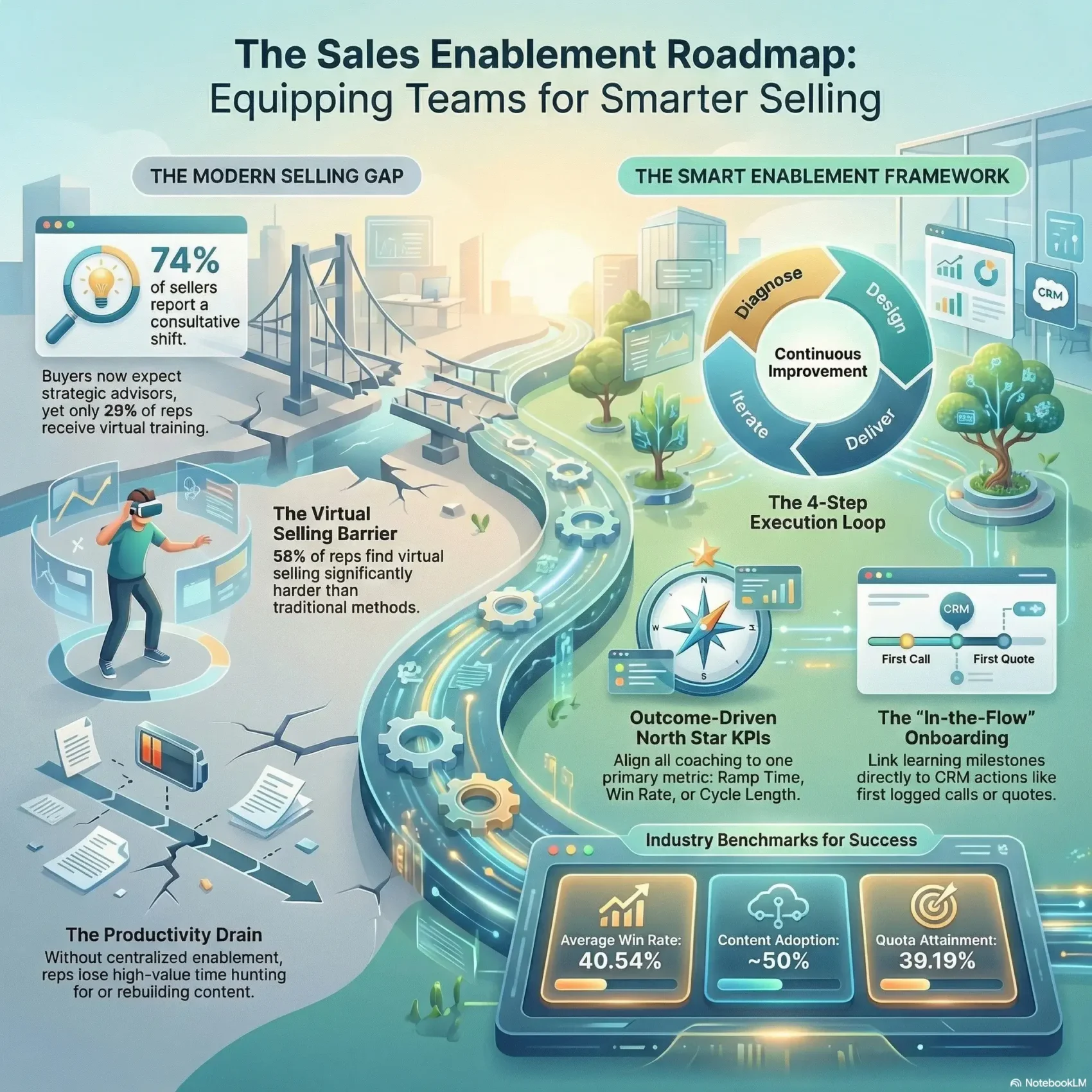
Salesforce’s State of Sales report, a survey of 4,050 sales professionals, found that reps spend about 60% of their time on tasks other than selling. It also found that 46% of Gen Z sellers rarely get feedback on their sales conversations and 47% lack role-play practice before customer calls. Those are enablement gaps, not talent gaps.
Leaders want revenue proof, not attendance
Highspot’s State of Sales Enablement survey of 350 go-to-market professionals found that 55% of organizations struggle with sales training or coaching, and that companies with a well-integrated enablement tech stack were 42% more likely to increase sales productivity. Enablement gets funded when it can show what changed in the pipeline.
The payoff when it works
Good enablement connects teams. Marketing, product, and sales tell one story, so a buyer hears the same message in the ad, the demo, and the proposal. Content and coaching notes live where reps already work, and call data shows where deals stall, so coaching targets the real problem. Building that shared story is its own discipline. The guide on aligning sales and marketing covers the written agreements (one lead definition, shared metrics, one customer record) that make it stick.
Core principles of a modern enablement strategy
A few practical principles keep programs focused on the customer and useful to the seller.
Buyer-centric and seller-friendly by design
Anchor everything in the buyer journey. Every asset and coaching moment should answer a real question a buyer asks at a specific stage. A comparison sheet belongs in the evaluation stage, not in the first email.
Then design for the seller: fewer clicks, simpler templates, and an obvious next best action. If a rep has to search three systems for a case study, the case study will not get used.
Data-driven and just-in-time learning in the flow of work
Use data to decide what to teach. Engagement and pipeline signals show which content and which behaviors move deals. A 40-minute course nobody applies is worth less than a two-minute clip that appears when a rep creates a proposal. The microlearning strategy guide explains how spacing and recall make short lessons stick.
Go-to-market alignment across sales, marketing, and customer success
Align the teams around one process and one message. Test content on real deals, measure which pieces correlate with wins, and refine. Treat process as a guide that nudges behavior, not as extra paperwork.
Setting the right enablement goals and KPIs
Choose one KPI that ties learning and content to revenue. A KPI (key performance indicator) is the one number you agree to be judged on. Make it the north star for a quarter, and let it decide which programs get built first.
Choose a primary KPI
- Ramp time: how long a new rep takes to reach full quota. Good when you are hiring fast.
- Win rate: the share of qualified opportunities you close. Good when deals stall late.
- Average deal size: good when reps discount too early or sell the smallest package.
- Sales cycle length: good when deals close but take too long.
Translate goals into behaviors and metrics
Define the specific behavior you will coach. If the goal is a higher win rate, the behavior might be “fewer discount mentions, more value framing in discovery calls.” If the goal is shorter cycles, it might be “a mutual action plan sent after every second meeting.”
Then pick practical metrics to confirm the behavior is changing: content usage, call keyword shifts, quota attainment. Build your baseline from your own CRM data; win rates and cycle lengths vary too much by industry and deal size for a vendor benchmark to be useful. The guide to RevOps productivity metrics walks through the formulas for win rate, pipeline coverage, and net revenue retention.
From strategy to execution: your sales enablement process
Execution needs a tight loop: diagnose, design, deliver, iterate. Start with the one KPI, map the behaviors that move it, and keep every module short enough to use between calls.
Diagnose gaps, design programs, deliver, and iterate
Use call analysis to find patterns. Conversation intelligence tools (software that records and transcribes sales calls, then flags keywords and talk ratios) can show, for example, that reps mention discounts in the first ten minutes of discovery calls. That is a coachable behavior you can measure before revenue moves.
Behavior shaping: moving from discounting to value-based selling
Make the change specific: fewer discount mentions, more questions about the cost of the buyer’s current problem. Mirror the sales stages in your content library so reps know which asset fits which moment. Design one focused intervention at a time, allocate manager time realistically, and track behavior signals rather than attendance.
For deeper tracking of what reps and buyers actually do, behavioral analytics closes the loop between coaching and performance.
Onboarding and continuous sales training that sticks
Onboard in the flow of work so new hires learn while managing real opportunities. Tie milestones to CRM actions (first logged call, first qualified meeting, first quote) so progress is visible without a separate tracker.
Onboard in the flow of work to reduce ramp time
Design short lessons that trigger at CRM events: when a rep books a first demo, the demo checklist and the two best recorded demos appear. For distributed teams, the guide to remote onboarding and training covers what fails after week one and how to prevent it.
Bite-size learning and certifications to boost retention
Replace long content dumps with micro-modules and quick assessments. Use short certifications (a recorded pitch, a scored objection-handling drill) to confirm core knowledge before a rep moves to the next stage. That gives managers an honest picture of readiness instead of a completion checkmark.
Coaching that scales: peer modeling and AI feedback
Peer modeling lets new hires copy top performers by watching real calls. AI feedback adds instant notes on pitch clarity and objection handling, because no manager can review every call. The Salesforce data above shows why this matters: nearly half of Gen Z reps rarely get feedback or role-play practice. AI role-play and call scoring fill that gap, as long as a human manager still owns the coaching conversation. The article on AI performance coaching explains how to pilot these tools and what they cost.
Training budgets get cut when nobody can show a result. The guide on measuring upskilling ROI shows how to connect a course to a business outcome finance will accept.
Sales enablement tools: building a high-impact tech stack
Pick tools that mirror how your team already works. Start with what removes busywork and surfaces the next best action. Every extra tab costs selling time.
CRM as the data backbone
Your CRM holds customer data and deal milestones. Use it to trigger alerts, flag at-risk opportunities, and show managers where to spend coaching time. Salesforce found that high-performing teams prioritize data hygiene far more often (79%) than underperformers (54%); enablement built on a messy CRM produces messy recommendations. For where the platforms are heading, see the overview of CRM trends or the Salesforce vs HubSpot comparison.
Platforms for content, coaching, and workflows
Choose one platform to host content, playbooks, and micro-lessons. One place to look beats three.
Conversation intelligence and call coaching
Record calls to surface keywords, coachable moments, and behavior change over time. Objective data turns a vague “work on your discovery” into a specific plan. One caution: call recording is regulated. In several US states and under EU data protection rules, everyone on the call must be informed, and in some places must consent, so check the rules for the regions you sell into. If you also use AI to summarize meetings, the AI meeting notes workflow shows how to turn transcripts into CRM updates without extra typing.
AI agents and assistants
The newest layer in 2026 is the AI agent: software that drafts outreach, researches an account, or answers a rep’s product question inside the CRM. Salesforce reports that 87% of sales organizations use some form of AI and 54% of sellers have used agents. Gartner advises enablement leaders to deploy agents for both buyers and sellers, break content into modular blocks an agent can assemble, and embed all of it in the seller’s existing systems. Set usage rules before rollout; the generative AI usage guidelines show what a one-page policy should cover.
Learning management for ongoing growth
Add an LMS (learning management system) for certifications, progress tracking, and course libraries, and integrate it with the CRM so training shows up where reps work. Platforms such as the one in the LearnWorlds review handle the course side; the enablement platform handles the in-deal side. Whatever you pick, a smaller connected stack beats a large disconnected one.
Content that moves deals: enablement content strategy
The best content strategies map assets to buyer signals and rep actions. The goal is a library where the right resource is obvious at the right moment, not the biggest library.
What to create: customer stories, demos, battlecards, and more
Build focused assets: customer stories, product decks, demos, datasheets, and competitive battlecards (one-page summaries of how you compare with a rival and how to answer the usual objections). Each piece should be short, tied to a stage, and written for the buyer’s question at that stage. Keep battlecards simple enough that a rep can use them live on a call.
Modular content for buyers who research alone
Because most buyers now research without a rep, content has to work in two modes: on its own when a buyer finds it on your site, and as raw material a rep or an AI assistant can assemble into a tailored answer. That is why Gartner recommends modular building blocks rather than long static decks: a pricing block, a security block, an integration block, combined per account.
Activation: serve the right content at the right time
Surface assets inside the workflow: when a rep creates a quote, books a meeting, or drafts a proposal. Track which assets get opened, sent, and viewed by buyers, and let that data decide what stays.
Driving adoption and consistency in messaging
Partner with marketing to refresh positioning and close the loop with usage and win data. Standardize naming and tags so reps find resources in seconds, and retire stale pieces before they cause confusion. A shared system for storing company knowledge, as described in the guide to knowledge management, keeps sales content from living in six private folders.
Alignment in action: sales, marketing, and enablement teams
You get faster, more consistent outcomes when each team knows its role. Decide who makes assets, who uses them, and who measures impact.
Roles and responsibilities
In smaller companies, several departments share the work and one person coordinates it. In larger organizations, a dedicated enablement team owns the roadmap.
- Marketing owns messaging and asset creation.
- The enablement team curates, tags, and measures content usage.
- Front-line managers drive adoption through coaching and deal reviews.
Closing the loop between content creation, usage, and outcomes
Set a simple process: marketing creates, reps use, enablement measures, everyone iterates. Highlight assets that show up in closed deals and retire what underperforms. The loop should extend past the signature; the guide to customer success tools covers how post-sale teams feed insight back into the pitch.
When to expand into revenue enablement
Revenue enablement extends the same approach to marketing and customer success, so every customer-facing team works from one message and one set of metrics. Move to that model once you need consistency across the whole customer lifecycle, from first ad to renewal.
Set simple intake and rhythms: one request form, triage by priority, and a weekly review that routes work to the right team. Written procedures help; the guide on standard operating procedures shows how to write ones people actually follow.
- Define response times so requests do not stall.
- Use dashboards so leadership sees outcomes and return on investment.
- Prioritize content by field data, not by whoever asks loudest.
Implementing enablement: a practical roadmap you can use
Start with a one-page roadmap that ties training and content to measurable outcomes and keeps leaders aligned.
Align with leadership on business goals and budget
Secure one goal (ramp time, win rate, or cycle length) and match the budget to the expected impact. Executive buy-in makes it easier to get manager time and hold the project accountable. If the company is still deciding which markets or segments to prioritize, settle that first; the go-to-market strategy guide covers the choices enablement has to support.
Listen to the field: diagnose with data and call reviews
Use CRM signals and call recordings to find the real blockers, and ask reps which content they cannot find and which objections they dread.
Build solutions: programs, content, and coaching plans
Design short programs mapped to funnel stages, with concise content and role-play coaching reps can use in live deals the same week.
Deliver, reinforce, and iterate with analytics
- Deliver simply: push micro-lessons into daily workflows.
- Reinforce often: manager check-ins and quick refreshers keep changes alive.
- Iterate with data: measure usage, behavior shifts, and outcomes, then adjust.
“Start small, prove impact, then scale. Teams without a dedicated headcount can still show quick wins.”
Remote and hybrid teams face extra coordination questions, covered in the guide to remote sales teams.
Measuring impact and optimizing performance
To prove program value, link what reps do to concrete outcomes and track it consistently.
Leading and lagging metrics
Balance leading signals, which change first, with lagging results, which confirm the effect later.
- Leading: content adoption, call behaviors (discount mentions, question count), training completion, coaching frequency.
- Lagging: win rate, sales cycle length, quota attainment, average deal size, time to first deal for new hires.
- Efficiency: selling time versus admin time. With reps reporting about 60% of their week on non-selling work, any hour you give back is measurable.
Correlate training completion and behavior change to revenue
Link course completion to observed behavior shifts on calls and in the CRM. When training maps to fewer discount mentions and the win rate on those reps’ deals moves, you have a story finance will accept. Correlation on a small team is suggestive, not proof, so compare cohorts over more than one quarter.
Dashboards, benchmarks, and review cadence
Build simple dashboards that managers open in weekly reviews and benchmark against your own baseline. For teams automating the reporting layer, the roundup of RevOps automation tools lists which platforms cover forecasting, conversation intelligence, and enablement.
Conclusion
Close the loop: commit to one clear goal, tight content mapped to the buyer, and coaching based on real calls. Prepare reps for the moment buyers now reserve for them: validating what they already learned and reducing the risk of the decision.
Keep coaching timely, keep content concise, and keep the stack simple so reps spend more time with customers and less on admin. For the broader shifts in how selling is changing, see the overview of sales trends.
Result: a reliable sales enablement engine that raises productivity and keeps your business ready for what comes next.
Found this useful?
Make SmartKeys a preferred source on Google, and our articles will surface more often in your Top Stories, AI Overviews, and AI Mode.
Add as Preferred Source