You will probably work longer than your parents did, and in more than one way. Lynda Gratton and Andrew J. Scott are the London Business School professors behind the 2016 book The 100-Year Life. They argue that the old single track of school, one long job, then retirement no longer fits how people live. Instead, you can plan a flexible, multi-stage path that includes retraining, side projects, and breaks.
This guide explains why longer lives change how you work and plan. It lays out practical steps to build skills, health, reputation, and networks so you can take up new opportunities across decades, not just in your twenties.
You will learn how to treat your career as a portfolio of roles: inside companies, as an independent, and within wider networks of clients and partners. The aim is to separate age from career stage and leave room for exploration throughout your working years.
We balance optimism about longer, healthier lives with realism about who actually gets them. Read on for a clear, U.S.-focused roadmap that meets you where you are today.
Key Takeaways
- Plan for several career stages, not one long arc.
- Build four kinds of assets: skills, health, reputation, and networks.
- Separate age from stage to lower ageism and widen your options.
- Mix employer roles, self-employment, and project work over time.
- Plan around U.S. institutions, and account for unequal health and income.
Why a Longer Life Changes How You Plan Your Career Today
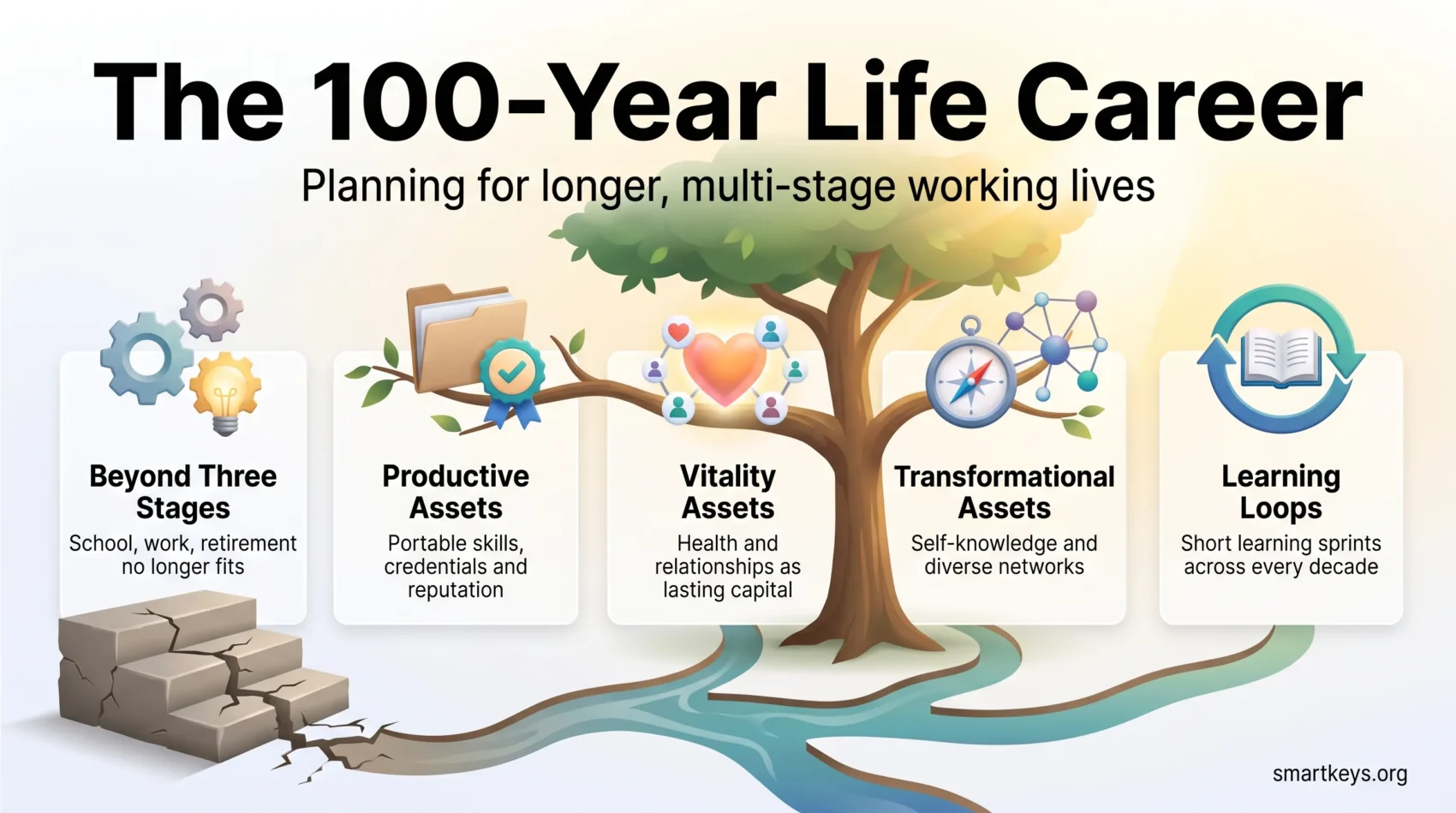
A longer working life breaks plans that were built for a single, steady path. Gratton and Scott call the old pattern the three-stage life: full-time education, then one long stretch of work, then retirement. When work lasts 45 or 50 years instead of 35, that middle stretch becomes too long for one set of skills and one employer.
You need a practical way to prepare for a multi-decade, multi-stage working life. That means breaking a long horizon into manageable chunks, so the move you make this year adds options for the next decade.
Who this guide helps
This guide is for workers, career changers, and employers in the United States. It shows how to plan flexible paths that include retraining, part-time switches, and breaks, and how to test each transition with a low-stakes experiment before you commit.
If you are already thinking about a change in your forties or fifties, our guide to mid-career retraining covers learning something new while you still earn.
What to watch in policy and practice
Policy choices shape your options. Health coverage that does not depend on one employer, and real enforcement of age discrimination law, make it easier to change roles late in a career. Employers can help by offering paid learning time, flexible schedules, and benefits that move with the worker.
- Plan learning loops instead of front-loading all your education before age 25.
- Diversify income and skills to reduce the risk of one industry shrinking.
- Map staged growth: explore, build, harvest, refresh.
To see which skills employers are paying for right now, read our guide on future job skills.
Is a 100-Year Life Realistic? What Longer Lives Mean for Your Work, Health, and Retirement
Rising life expectancy forces practical choices about money, health, and how you structure work over decades. You do not need to assume everyone will reach a century to change how you plan. Use current data and realistic scenarios to shape your next moves.

Life expectancy trends and projections
The latest official U.S. numbers come from the CDC’s National Center for Health Statistics. Life expectancy at birth was 79.0 years in 2024, up 0.6 years from 2023. The more useful figure for career planning is life expectancy at age 65: an average of 18.4 more years for men and 20.8 for women. In plain terms, a typical 65-year-old today can expect to live into the mid-eighties.
Living to 100 remains rare. A 2024 study in Nature Aging, led by S. Jay Olshansky, found that gains in life expectancy have slowed since 1990 across the longest-lived countries. The authors predict that survival to age 100 is unlikely to exceed 15 percent for women and 5 percent for men, even in the best-performing populations.
More people work past 65 than ever before
The working life is stretching even if the lifespan is not. Pew Research Center reported in 2023 that 19 percent of Americans aged 65 and older were employed, up from 11 percent in 1987. That is roughly 11 million workers. The Bureau of Labor Statistics projects the trend will continue: participation among 65-to-74-year-olds is expected to rise from 27.1 percent in 2024 to 29.6 percent by 2034. See our article on demographic shifts at work for the wider picture.
Slowing gains, inequality, and realistic planning
U.S. life expectancy fell during the COVID-19 pandemic and has only recently recovered. Inequality matters: higher-income groups live longer than lower-income groups, so your personal outlook depends on income, location, and health habits as much as on national averages.
Practical takeaway: stress-test for uncertainty
Plan as if you will need income and purpose into your late eighties, but build flexibility. Use a conservative number for your planning horizon and run stress tests for shocks like illness, layoffs, or caregiving.
- Base forecasts on current expectancy data, not hopeful extrapolations.
- Assume most people will live 80 to 90 years, even if few reach a century.
- Keep contingency paths: savings, flexible work, and health investments.
From Three Stages to Multi-Stage Careers: Education, Work, Transitions, and Reinvention
Work now unfolds in several stages that can be reordered, instead of a single long stretch. Gratton and Scott argue that the three-stage model breaks down because a 45-year middle stage exhausts both skills and energy. The alternative is a multi-stage life with new kinds of phases, and with transitions between them treated as normal rather than as failures.
New stages such as exploration, portfolio work, and an independent producer phase let you test ideas, diversify income, and build leverage. Companies change faster than careers do. Innosight’s corporate longevity research finds that the average tenure of companies in the S&P 500 index has been shrinking for decades, and it forecasts about 12 years by 2028. Your career will probably outlast several of your employers.
Designing exploration, portfolio, and independent phases
Use short experiments, such as projects, bootcamps, or small gigs, to explore before you commit. Then combine part-time roles, freelance work, and learning blocks into a portfolio. Holding several paid roles at once now has a name: polywork.
When you decide to double down, an independent producer phase helps you ship products, publish work, or lead ventures. Our overview of freelancing trends shows what independent work looks like in 2026.
Separating age and stage
Separate age from stage so people can explore in their fifties and scale a business in their twenties. This reduces age-based assumptions and helps teams value different kinds of experience. Managers of multigenerational teams see this when a 28-year-old and a 58-year-old bring different strengths to one project.
Relationships and community as assets
You will invest in relationships and community, meaning mentors, peers, and cross-generational networks, that support you through transitions. Organizations should recognize these intangible assets and support re-entry and refresh points, for example through returnship programs for people coming back after a break.
“The multi-stage model gives you tools to reorder work and learning to match a fast-changing world.”
Building Your Asset Mix for Longevity: Tangible and Intangible Assets You Must Invest In
Treat what you own, meaning skills, health, and networks, as a portfolio that needs active tending. Gratton and Scott group these intangible assets into three types: productive, vitality, and transformational. That mindset helps you prepare for repeated transitions across your working years.
Productive assets
Inventory your productive assets: list the skills, credentials, and evidence of work that travel with you from one employer to the next.
Target the gaps that block your next move. Use short learning sprints to add knowledge, and publish proof (portfolios, papers, or public projects) so your reputation is portable. Shorter credentials are gaining ground with employers, as our article on micro-credentials in hiring explains.
Vitality assets
Protect health and relationships like compounding capital. Sleep, prevention, and strong social ties fuel sustained performance over decades. The research on sleep and productivity and on exercise and productivity shows how directly these habits affect your working capacity.
Schedule routine checks, build buffers, and treat family and friends as active supports for transitions. Long careers also need pacing; see our guide to burnout prevention.
Transformational assets
Invest in identity, self-knowledge, and diverse networks. These assets boost adaptability and help you reframe change as opportunity. A good mentor is one of the cheapest transformational assets you can acquire. Mentorship matching platforms make it easier to find one in a large organization.
“Identity is crafted, not inherited, and reputation helps you move between roles with trust.”
Maintenance cadence
- Every 3-5 years, rebalance where you spend time and money across skills, wellbeing, and networks.
- Keep an emergency buffer and portable benefits to protect your security during shifts.
- Schedule monthly micro-upgrades and quarterly learning sprints so small moves compound into real options.
The Future of Work in the U.S.: Learning Loops, Flexibility, and New Employment Ecosystems
Work in America is recomposing into flexible networks that reward constant learning. Routine, middle-skill jobs face the most pressure from automation, while demand grows for both high-skill roles and many hands-on manual roles. Economists call this “hollowing out,” and it changes where you should place your bets.
Hollowing out of work
Pinpoint the pressure: automation and AI hit routine tasks first. You will target durable skills in analysis, creativity, and service roles where demand is rising. The 2026 evidence on which tasks AI is absorbing, and which it is not, is laid out in our article on AI job augmentation versus replacement.
Continuous learning
You will design short learning loops: stackable courses, project sprints, and on-the-job stretch assignments. These let you reskill and upskill without pausing your income. For a broader view of what companies are doing, see our guide to upskilling and reskilling.
Employment models
Large firms now rely on ecosystems of smaller vendors, contractors, and startups. That makes combining company employment with self-employment a practical way to assemble income over a long career. Inside large companies, an internal talent marketplace can give you the same variety without leaving.
- Build a portable toolkit of skills and proof so you can move between companies.
- Negotiate flexible arrangements for study and sabbaticals.
- Use professional communities and bootcamps to speed up your next move.
“Treat change as a signal: double down in a firm when cycles favor it; build an external portfolio when ecosystems open new markets.”
The 100-Year Life Career: Strategies You Can Use to Thrive Across Multiple Stages
Break your next decade into clear stages so you can learn, earn, and pivot with confidence.
Your next-decade playbook: 20s, 30s, 40s, 50s+ planning in a longevity world
In your 20s, explore widely and build proof of work. Use short projects and public outputs to make future moves easier.
In your 30s, focus on depth: scale your skills and negotiate roles that buy you time for learning and family. Target benefits that protect health and savings.
In your 40s, lead and diversify. Shift some hours to mentoring, consulting, or a portfolio of work so your income is less tied to a single employer. Sideways moves count too; a career lattice approach treats lateral moves as growth rather than as stalling.
In your 50s and beyond, refresh and redesign your roles. Phased retirement, part-time leadership, or independent projects can keep both purpose and security. Our article on phased retirement programs explains how these arrangements work in practice.
Partnering with employers: flexibility, benefits, and transitions that work for you
Negotiate flexibility (remote options, reduced loads, or sabbaticals) to make room for study, caregiving, or health needs. If your company has no formal break policy, our guide to sabbatical policy shows what a workable one looks like.
Ask HR for targeted benefits: HSA access, tuition support, paid leave, and phased retirement. These improve your financial and health security during transitions. The package you should expect in 2026 is covered in our article on the evolution of employee benefits.
“Work across decades needs new arrangements that let people move in and out of roles without losing security.”
Use pilots, such as returnships, mentor circles, and cross-age projects, to reduce age bias and normalize multi-stage moves. Cite Lynda Gratton and Andrew Scott when you propose these experiments to leadership.
For practical steps on workplace scheduling and flexibility, see flexible work schedules to help frame requests with HR.
Conclusion
Preparing for a longer working life means treating each decade as a set of options. Use the data: most Americans who reach 65 will live into their eighties, and a growing share will work past that age. Only a small minority reach a full century. That range shapes how you plan for retirement, health, and work.
Start small: assess your assets, pick the next stage, run a low-risk test, and review the results every few years. Push for portable benefits, anti-ageism practices, and learning loops inside your company.
Carry Lynda Gratton and Andrew Scott‘s idea forward: design multi-stage paths that match your values. This week, do one course, one conversation, or one habit. Those small moves compound into real options across decades.
Found this useful?
Make SmartKeys a preferred source on Google, and our articles will surface more often in your Top Stories, AI Overviews, and AI Mode.
Add as Preferred Source