Remote work has settled, but remote hiring has narrowed. About 25% of paid workdays in the US were worked from home in May 2026, according to Stanford’s Survey of Working Arrangements and Attitudes (SWAA). At the same time, only 8.5% of US job postings on Indeed mentioned remote or hybrid work at the end of July 2026, down from a peak of 10.5% in early 2022.
That gap changes how you should search. Remote jobs are not spread evenly across the economy. They cluster in a handful of functions where the work can be measured by output, handed across time zones, and done from a laptop without losing quality.
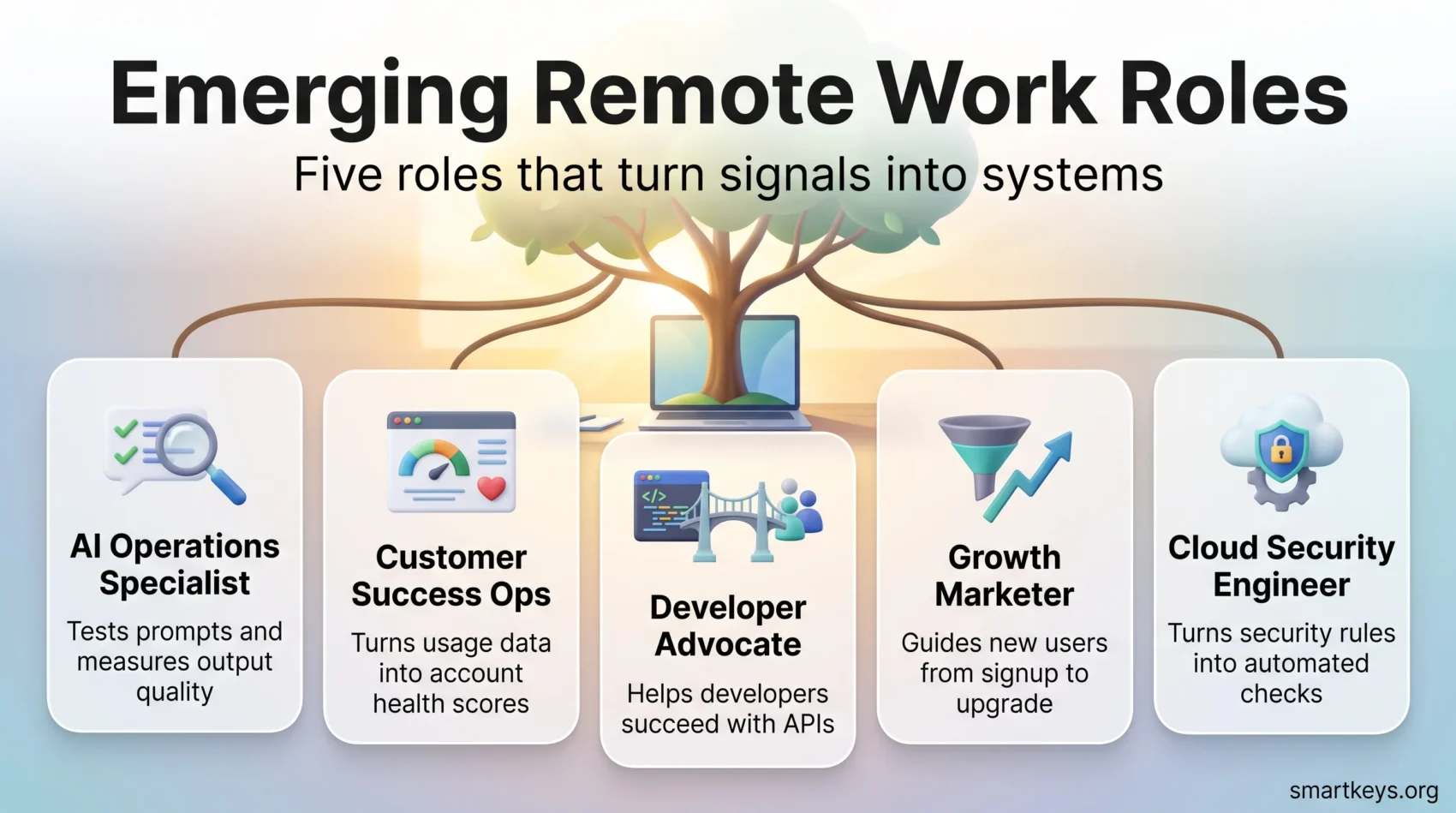
This guide looks at five roles that fit that pattern and are growing in 2026: AI operations specialist, customer success operations manager, developer advocate, product-led growth marketer, and cloud security automation engineer. For each one, you get what the job actually involves, why demand is rising, the skills hiring managers ask for, and where to look next.
Key Takeaways
- Remote postings are scarce (8.5% of US postings on Indeed in July 2026), so it pays to target functions where remote hiring is still normal, such as software (31.8%) and marketing (25.4%).
- AI engineers, AI consultants and data annotators are three of the five fastest-growing job titles in LinkedIn’s Jobs on the Rise 2026 list, and each offers remote or hybrid work in more than half of listings.
- Cybersecurity teams name AI skills (41%) and cloud security (36%) as their top needs, according to the 2025 ISC2 workforce study.
- The five roles share one trait: they turn signals into systems, whether that means model outputs, account health data, developer feedback, product usage or cloud configuration.
- Hiring teams judge remote candidates on documented outcomes and clear written communication rather than lists of responsibilities.
Why emerging remote roles matter right now
Remote work did not disappear after the return-to-office push, and it did not take over either. The SWAA data for the twelve months to May 2026 shows 12% of full-time employees fully remote, 26% hybrid and 62% fully on site. Roughly a quarter of paid days happen at home, a level that has held steady for several years.
Hiring tells a different story. Indeed’s remote tracker shows that only 8.5% of US postings mentioned remote or hybrid terms in July 2026, compared with 2.5% in early 2019 and a peak of 10.5% in February 2022. Robert Half’s analysis of Q2 2026 postings found 87% fully on site, 10% hybrid and 3% fully remote.
So the remote jobs that do exist attract heavy competition. The way around that is to look where remote hiring is still normal. On Indeed, 31.8% of software development postings and 25.4% of marketing postings mentioned remote or hybrid work in July 2026, several times the all-industry average.
The roles below sit inside those functions. They also line up with what employers say they need next. The World Economic Forum’s Future of Jobs Report 2025 projects 170 million new jobs and 92 million displaced by 2030, and names AI and big data, networks and cybersecurity, and technology literacy as the fastest-growing skills. For a wider view of that shift, see our guide to future work trends through 2030.
How we chose these five roles
We used three filters. A role had to show growth in published hiring data, not just in vendor marketing. It had to be genuinely doable from anywhere, meaning the output can be reviewed asynchronously and does not depend on being in a building. And it had to have a visible career path rather than being a one-year fad.
The data behind the list
- LinkedIn Jobs on the Rise 2026: LinkedIn ranked job titles by growth in jobs started by members between January 2023 and July 2025. AI engineer (#1), AI consultant and strategist (#2) and data annotator (#4) all sit in the top five.
- ISC2 Cybersecurity Workforce Study 2025: a survey of 16,029 security professionals found that 95% of teams report at least one skills gap, with AI (41%) and cloud security (36%) the most cited needs.
- McKinsey State of AI 2026: nearly nine in ten respondents report regular AI use in at least one business function, yet only 37% can attribute any profit (EBIT) impact to it. That gap is where AI operations work lives.
- Indeed Hiring Lab remote tracker: the share of postings mentioning remote or hybrid work, by sector, which tells you where remote hiring is still routine.
Customer success operations, developer advocacy and product-led growth marketing do not appear as separate lines in these datasets. They are included because they are established, remote-friendly specialisations inside software companies, and because the demand for them follows directly from the trends above. Where we could not verify a figure, we left it out.
1. AI operations specialist (prompt and evaluation work)
An AI operations specialist keeps AI systems useful after launch. The job covers writing and testing prompts, building evaluation sets, reviewing model outputs for errors, and reporting quality to product and engineering teams. Earlier versions of this role were called prompt engineer; the 2026 version is broader and more about measurement than clever wording.
Why demand is rising
McKinsey’s 2026 survey found nearly nine in ten organisations using AI regularly in at least one function, but only 37% could attribute any profit (EBIT) impact to it. Companies that have deployed AI now need people to make it reliable, and that work is what this role does.
The hiring data agrees. Data annotators, who label and check the data AI models learn from, are the fourth fastest-growing job title in LinkedIn’s Jobs on the Rise 2026 list, with 28% of listings remote and 29% hybrid. AI engineers, the number one title, are 26% remote and 27% hybrid.
Regulation adds a second driver. In the EU, transparency rules under the AI Act began applying to AI systems that interact with people in August 2026. Someone has to document how the system behaves and prove it. Our guide to EU AI Act compliance explains what that involves.
Skills and tools
- An analyst mindset: you sample outputs, count failure types and turn them into a metric a team can track.
- Basic Python for pulling samples and scoring results, plus comfort with spreadsheets and issue trackers.
- Evaluation tooling, annotation interfaces and version control, so every prompt change is logged and reversible.
- Clear writing. Most of the job is explaining why an output was wrong and what should change.
A typical day
You start by reviewing a batch of flagged outputs, then update a test set so the same failure gets caught automatically next time. Midday overlap is used for a short sync with engineers. The afternoon goes to writing up findings so a colleague in another time zone can pick up the thread. The work is naturally asynchronous, which is why remote listings for it are common.
If your company is building this function from scratch, our articles on LLM operations strategy and AI agent workflows cover the processes an operations specialist would own.
2. Customer success operations manager
A customer success operations manager builds the data and playbooks that let a customer success team act before an account is in trouble. Customer success managers talk to customers. The operations manager makes sure they know which customers to talk to, about what, and when.
From reactive support to planned retention
Software companies grow mainly by keeping and expanding existing customers, so churn (customers cancelling) is watched closely. The operations role connects product usage data, support tickets and contract dates into a single health score per account. When usage of a key feature drops, the right person gets a task, not a surprise at renewal time.
That makes the job a remote fit. It is measured in numbers (renewal rate, expansion revenue, time to onboarding) and it runs on dashboards and documented processes rather than on hallway conversations.
Toolstack: CRM, product analytics and adoption metrics
- A CRM such as Salesforce or HubSpot as the system of record, with success plans and health scores stored where sales and support can see them.
- Product analytics (Amplitude, Mixpanel or a similar tool) to track which features signal long-term retention.
- A customer success platform or automation layer that turns signals into tasks. Our comparison of customer success tools covers the main options.
- Playbooks for onboarding, adoption and renewal, written so a new hire can follow them without a meeting.
Why the role shows up on job boards: once a SaaS company passes a few hundred accounts, nobody can hold the picture in their head. The operations manager is hired to build the system. If you want the strategy side of the same problem, read our guide to customer retention strategies.
3. Developer advocate for SaaS platforms
A developer advocate helps outside developers succeed with a company’s APIs and SDKs, and brings their feedback back to the product team. An API (application programming interface) is the set of rules that lets one piece of software talk to another; an SDK (software development kit) is the toolkit that makes using it easier. Platforms that sell to developers live or die by how quickly a newcomer gets to a working result.
Bridging product, engineering and community
On a normal week you might answer questions in a community forum, notice that three people hit the same authentication error, file the bug with a reproducible example, and write the docs fix so nobody hits it again. The API economy keeps growing, and every platform in it needs someone doing this job.
Content and media: docs, demos and remote events
Developer advocates produce sample apps, tutorials, livestreams and conference talks. Nearly all of that is created and consumed online, which is why the role has been remote-friendly since long before 2020.
Technical core: APIs, SDKs and working code
- Fluency in at least one language the platform’s developers use, often Python or JavaScript, and the ability to write code that others can copy.
- Understanding of authentication flows, rate limits and error handling, because that is where developers get stuck.
- Metrics that matter: time to first successful API call, documentation completion rates, issues filed and resolved.
4. Product-led growth marketer
A product-led growth marketer uses the product itself as the main way to win and keep customers. Product-led growth (PLG) means users can sign up, try the product and upgrade without talking to a salesperson. The marketer’s job is to make each of those steps smoother and to measure the effect.
What the work looks like
- Run experiments on onboarding, pricing pages and free-trial limits, then read the results in product analytics.
- Find the “aha moment”, the action that separates users who stay from users who leave, and guide new signups to it faster.
- Segment users by behaviour and send lifecycle emails and in-app messages that match what they actually did, instead of one message for everyone.
- Track acquisition, activation, retention and expansion as one connected funnel, so the team knows which fix to ship next.
Everything on that list is done inside analytics tools, email platforms and the product, in writing, with results that can be reviewed the next morning by someone in another time zone. That is why PLG teams are so often distributed.
Where these jobs appear
Product-first software companies post these roles under titles such as growth marketer, lifecycle marketer or product marketing manager (growth). Before applying, it helps to understand the model itself. Our product-led growth playbook walks through onboarding to expansion, and our comparison of PLG and sales-led growth explains when each approach fits.
5. Cloud security automation engineer
A cloud security automation engineer turns security rules into code, so that unsafe changes are blocked automatically before they reach production. Instead of reviewing every deployment by hand, the engineer writes checks that run inside the delivery pipeline (the CI/CD process that tests and ships software) and in the templates teams use to create cloud resources.
Why demand is rising
Security teams say they are short of exactly these skills. In the 2025 ISC2 Cybersecurity Workforce Study, 95% of the 16,029 respondents reported at least one skills need, and the two most cited were AI (41%) and cloud security (36%). The study’s headline finding was that the most pressing problem is no longer headcount but skills.
The cost side is just as clear. IBM’s Cost of a Data Breach Report 2026 puts the global average breach at $4.99 million, a record and 12% higher than the year before. Organisations using security AI and automation extensively saved $1.93 million per breach compared with those using none. Automation is the part of security that pays for itself fastest.
Focus areas: identity, CI/CD and policy as code
- Policy as code: writing rules (for example, “no storage bucket may be public”) in a form that tools enforce automatically on every change.
- Infrastructure as code: maintaining approved templates so product teams can deploy safely without opening a ticket.
- Identity and access: making sure people and services only have the permissions they need, the principle behind zero-trust security.
- Alert quality: enriching alerts with who owns the resource, what changed and how to fix it, so incidents are acted on instead of ignored.
This role is remote-friendly because the entire job happens in code repositories, pipelines and cloud consoles. Expect to use Python or a similar scripting language daily and to work with platform teams across time zones. If you are new to the environment, our guide to cloud-native architecture explains the building blocks.
What hiring teams look for in remote candidates
Remote hiring managers favour evidence of impact over long lists of duties. With far more applicants than remote openings, they need a fast way to tell who can deliver without supervision.
Portfolio, outcomes and written communication
Show a short portfolio of results: a dashboard that changed a decision, an incident class that stopped recurring, a feature launch with before-and-after numbers. Lead with the outcome and keep the responsibility list short.
Then show that you can communicate without a meeting. Crisp written updates, a short recorded walkthrough and a one-page proposal all prove more than a line saying “strong communicator”. Our guide to asynchronous communication tools covers the formats distributed teams use every day.
- Self-direction: mention handoff protocols, on-call rotations or documentation standards you set up.
- Cross-functional work: show where you partnered with support, sales or engineering and what changed as a result.
- Visibility: remote workers get promoted when their work is seen. Our article on remote career advancement explains how to make that happen.
Where to find and apply for remote roles
Use a small number of high-quality sources and check them on a schedule. Remote openings fill fast, so a weekly digest beats endless refreshing.
Boards, company pages and communities
- Filter major job sites for remote-only listings, and set alerts for the exact titles above plus their common variations (AI ops, prompt engineer, CS operations, growth marketer, DevSecOps).
- Follow the careers pages of remote-first software companies directly. They usually state time-zone requirements, pay bands and equipment policy up front.
- Join the communities where your target role gathers: developer forums, customer success groups, security Slack and Discord servers. Referrals often appear there before a listing goes public.
How to read a company profile
Look for signs of a real remote culture rather than a tolerated one: documented decisions, written onboarding, stated response-time expectations and a clear policy on which hours must overlap. A company that publishes its remote or hybrid policy has at least thought about it. If you plan to work from abroad, check the digital nomad visa rules and the employer’s stance on cross-border work before you apply.
Salary, benefits and total value
Pay for remote roles mixes base salary with elements that change the long-term value of a job. Compare offers the way you would compare tools: what helps you stay healthy, keep learning and deliver over several years.
What to weigh beyond base pay
- Retirement matching, equity and profit sharing, which can outweigh a small difference in salary.
- Health, dental, vision and mental wellness budgets that keep work sustainable.
- Hardware, home office and coworking stipends, so your setup supports reliable output.
- Time perks such as paid leave, sabbaticals or a four-day week, and how many in-person retreats the company expects each year.
- The location policy. Some employers pay the same rate everywhere; others adjust by city. Our article on global pay parity explains both models.
Also weigh hours flexibility against coverage expectations. A team spread across continents may only need one shared overlap hour a day, but security and customer roles can carry on-call duties. For a full picture of what packages look like in 2026, see our guide to employee benefits trends.
Skills to prioritise in 2026
A few core skills make your application and your daily work far more convincing. The five roles differ in their tools, but they reward the same underlying habits.
- Data literacy: pick the right metric, read it honestly and tell a clear story about outcomes.
- Written communication: short handoffs, clear ownership and checklists other people can follow without you.
- Product sense: propose fixes that balance user needs and business goals, and test them small before scaling.
- Security awareness: safe defaults for identity, access and secrets, whatever your function.
- Working with AI tools: the ability to check AI output rather than accept it, which the WEF lists among the fastest-growing skill demands.
The WEF expects 39% of workers’ existing skills to change or become outdated between 2025 and 2030, so a plan for continuous learning matters as much as your current stack. Our guides to future job skills and upskilling and reskilling show how to build and prove those skills.
What comes next for your remote career
Each of the five roles leads somewhere. AI operations specialists move into AI product or platform leadership. Customer success operations managers become heads of revenue operations. Developer advocates lead developer relations or product. PLG marketers grow into heads of growth. Cloud security automation engineers move toward platform security or security architecture.
Distributed companies also keep creating senior roles that did not exist a few years ago. Our article on emerging C-suite roles covers the new executive titles.
Whichever path you take, the compounding skills are the same: product sense, data literacy and systems thinking. Choose teams that value clear writing and asynchronous work, and your best work will be visible without extra meetings.
Conclusion
Remote work is stable at about a quarter of US workdays, but remote hiring is concentrated. The roles that are still hired remotely in 2026 share a pattern: they turn raw signals (model outputs, account data, developer feedback, product usage, cloud configuration) into systems that other people can run.
Target the functions where remote hiring is normal, build a short portfolio of measurable outcomes, and show that you can communicate without a meeting. Then keep a steady weekly cadence of applications and follow-ups. For the bigger picture on how work settled after the pandemic, see how remote work changed the workplace.
Found this useful?
Make SmartKeys a preferred source on Google, and our articles will surface more often in your Top Stories, AI Overviews, and AI Mode.
Add as Preferred Source