The C-suite is the small group of executives who report to the chief executive and run a company’s major functions. For most of the last decade that group got bigger. Deloitte found that Fortune 500 leadership teams grew 23% between 2018 and 2023, from an average of 6.7 senior leaders to 8.2, while the skills expected of the CFO, CHRO and COO rose by more than 20%.
Then it started going the other way. Between 2022 and 2025, the number of executives reporting directly to the CEO at Fortune Global 500 companies fell about 9%, from 12.0 to 10.9, according to an analysis of The Official Board database reported by Newsweek.
Both things are true, and together they explain the question in front of most leadership teams right now. New titles keep appearing (chief AI officer, chief sustainability officer, chief transformation officer), while the total number of seats is being squeezed. So the useful question is no longer “which new roles exist?” but “which of them earns a seat at our table, and what happens to everything it touches?”
This guide answers that with the data that exists in 2026, a test for deciding between a new hire and a wider remit, and a 90-day plan you can run without pausing the business.
Key Takeaways
- Growth has reversed: teams expanded through 2023, then began contracting. Adding a seat is now a trade, not an addition.
- The fastest-growing functions were ESG, communications and legal, which tells you what boards were worried about.
- The chief AI officer went mainstream fast, from a rarity to a majority of surveyed organizations in a single year.
- Overlap is the real problem, not scarcity of talent. Decision rights matter more than titles.
- Tie every new role to one or two measurable outcomes, or it becomes overhead within a year.
Why New Executive Titles Keep Appearing
New titles are usually a response to work that has outgrown its old home. When a function starts consuming board attention, carrying legal exposure and needing its own budget, someone senior ends up owning it full time.
Three pressures do most of the work here.
Technology moved into every function. Deloitte’s 2026 Global Technology Leadership Study found that 71% of organizations now have five or more technology leaders in the C-suite. The study’s central point is that the hard part is no longer controlling systems, it is coordinating them. That is a structural argument for clearer ownership, not for more titles.
Regulation became continuous. Sustainability and AI rules now require evidence on a schedule rather than a statement once a year. Someone has to own the data trail. Our guide to future of work legislation covers the employment side of this in more detail.
Boards want a named owner. When a topic carries real downside, directors want to know who answers for it. A title is the cheapest way to answer that question, which is also why titles get created for the wrong reasons.
The practical risk is overlap. A chief information officer, a chief technology officer, a chief data and analytics officer, a chief information security officer and a chief AI officer can all plausibly claim the same decision. Without a written split, the same argument gets rerun every quarter.
The C-Suite Grew for Years, Then Started Shrinking
Before you redesign anything, it helps to know which part of the curve you are on.
What the growth data showed
Deloitte’s analysis of Fortune 500 companies found the top team grew 23% from 2018 to 2023. The growth was not evenly spread. Measured over that period, executive roles focused on ESG (environmental, social and governance work, meaning a company’s environmental impact, its treatment of people and how it is governed) grew 230%. Communications roles grew 133%, legal 127% and strategy 94%.
That list is a fair summary of what boards were anxious about: disclosure, reputation and legal exposure.
Deloitte also found these roles often arrive stacked rather than standalone. Among legal function executives, 67% held a dual title. The same was true for 48% of ESG executives and 27% of technology executives. In other words, the C-suite was already absorbing new work by widening existing jobs, not only by adding seats.
What changed after 2022
The contraction is now visible in the same population. CEO direct reports at Fortune Global 500 companies fell from 12.0 to 10.9 between 2022 and 2025. The chief marketing officer took the sharpest hit, with 13% fewer Fortune 500 companies keeping the role over that period. SHRM’s own count found the C-suite grew 160% between 1990 and 2023, then fell 4.7% in 2023 against the prior year.
The reasons given are familiar: cost, speed and a preference for executives who can cover more than one specialism.
What this means for you: the case for a new role is now competitive. You are not asking whether the work matters. You are asking whether it matters more than something already on the org chart. For the wider context on how leadership expectations are shifting, see our overview of leadership trends.
Role Spotlights: The Titles Worth Understanding
Four roles account for most of the genuine additions. Here is what each is actually for.
Chief AI officer (CAIO)
The CAIO owns AI strategy, model governance and the decisions about where AI capability is built or bought. Adoption moved unusually fast. IBM’s Institute for Business Value reported that 76% of surveyed organizations had a CAIO in 2026, up from 26% in 2025. The same research found companies with a CAIO reported a 5% higher return on their AI investments.
The reason the role sticks is unglamorous. IBM found that nearly seven in ten executives admit they lack full visibility into the AI their own teams are using. Someone has to hold the inventory, the model risk register and the approval path. Our guide to building an AI governance model covers what that structure looks like in practice, and AI decision making covers how managers use these systems day to day.
Chief sustainability officer (CSO)
The CSO owns emissions data, supply chain standards and the reporting that regulators and investors now expect. This role shows what happens after a growth wave peaks. The Weinreb Group counted 193 CSOs at US publicly traded companies in 2026, down from 216, a 10% fall and the first decline since it began tracking in 2011. For scale, there were 29 in 2011 and 216 by 2025.
Where the role sits also changed. Only 14% of CSOs now report directly to the CEO, down from roughly a third historically, while 23% report into legal, up from 3% in 2011. Read that as sustainability moving from communications into compliance. Our ESG framework guide and our review of corporate social responsibility trends go deeper on the reporting side.
Responsible AI or AI ethics lead
This role turns principles into checks that actually run: fairness testing before deployment, documentation that survives an audit, and a path to stop a system that misbehaves. It is often a director-level job rather than a C-suite seat, and that is usually the right call. We cover the mandate in detail in the AI ethics officer role, and the technical side in explainable AI.
Chief transformation officer
This is a deliberately temporary role. It exists to make a large change programme land, then to hand the work back to the line. If nobody has written down when the role ends, it will quietly become permanent. Pair it with a real change plan rather than an announcement: our guide to change management strategy covers the adoption side, and digital transformation covers where the money is going.
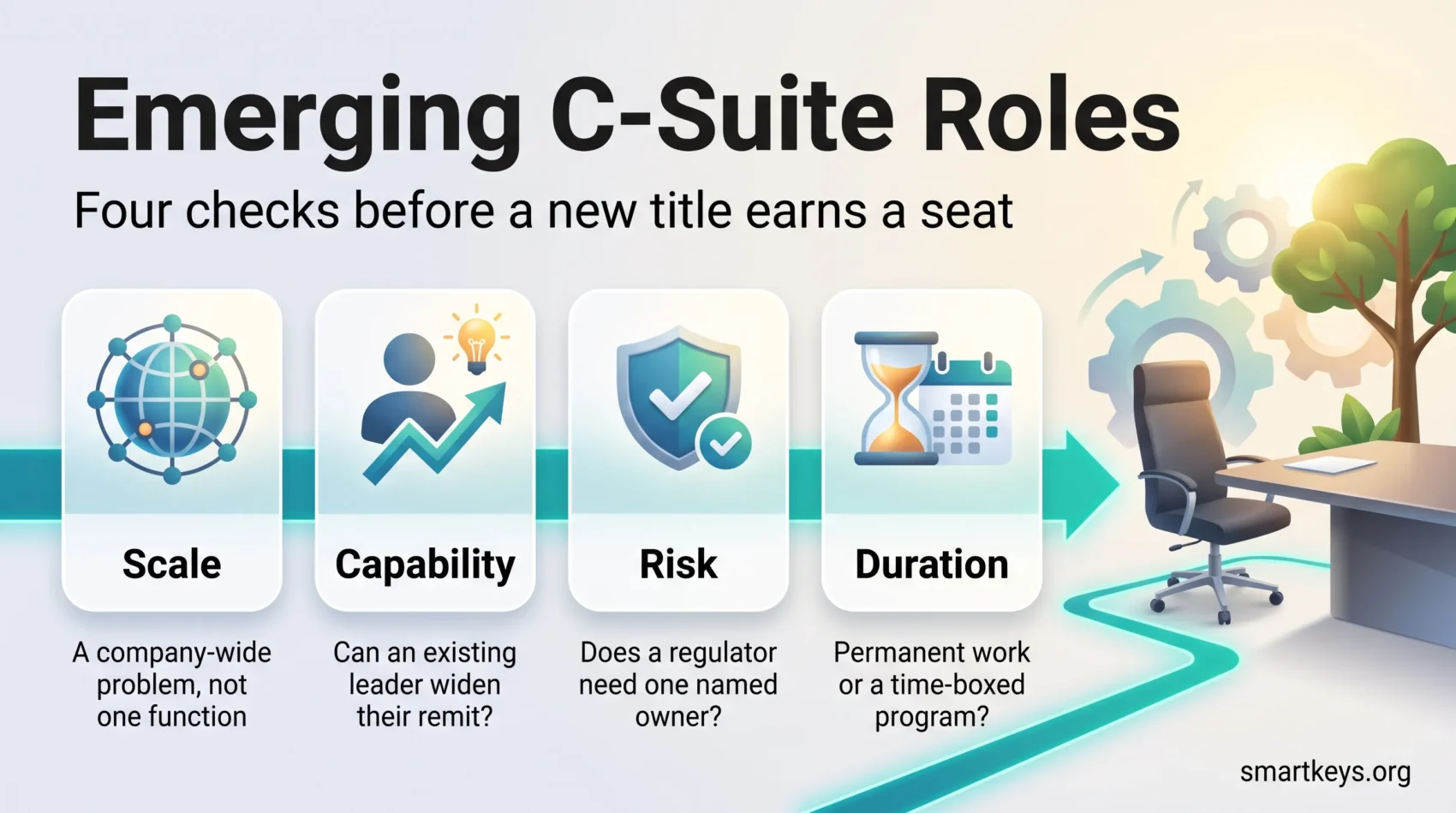
New Role or Wider Remit? A Simple Test
Run four questions before you touch the org chart.
- Scale. Is this a company-wide problem or one function’s problem? A single function’s problem does not need a C-suite seat.
- Capability. Can an existing leader do this with training and one or two hires beneath them? If yes, widen the remit and adjust their objectives.
- Risk. Does a regulator, auditor or customer need one named accountable person? If yes, that pushes strongly toward a formal role.
- Duration. Is this permanent work or a two-year programme? Programme work suits a time-boxed mandate with an agreed end date.
If you create the role, write a one-page charter first. It should state the scope, the two or three outcomes the role is judged on, the budget it controls, and the decisions it can make alone versus the ones it must escalate. If you cannot write that page, you are not ready to hire.
Also decide up front what happens when the role succeeds. Roles created for a specific push should have a merge or sunset trigger written into the charter. That is easier to agree at the start than three years later. For help writing the actual job specification, see how job descriptions have changed in the AI era, and our guide to AI-driven organizational design for how structures are shifting around these roles.
From Overlap to Orchestration: Deciding Who Owns What
Most friction at the top comes from two people believing they own the same call. The fix is boring and effective: write it down.
Pick the domains where overlap actually happens and assign one accountable executive to each. In most companies that list is short:
- Data: who defines quality standards, retention and who may access what. Our data governance strategy guide covers the mechanics.
- AI models: who approves a model for production and who can pull it.
- Security: who accepts a risk and who can block a release.
- Customer experience: who arbitrates when speed and safety conflict.
Use a RACI for each one. RACI is a simple grid naming who is responsible for doing the work, who is accountable for the outcome, who must be consulted and who is kept informed. One accountable name per domain, never two.
Then set a rhythm so decisions do not wait for a crisis. A workable default is weekly working sessions for delivery teams, a monthly forum where the technology, data, security and AI leads settle trade-offs, and a quarterly review that aligns roadmaps and budgets. Name the tie-breaker in advance, usually the COO or CEO, so a stuck decision has somewhere to go.
Governance and Reporting: What the Rules Now Require
Two regulatory changes shape how these roles are built in 2026, and both moved recently.
Sustainability reporting narrowed. The EU Council signed off the Omnibus I simplification in February 2026. Under the final text, the Corporate Sustainability Reporting Directive applies to companies with more than 1,000 employees and net turnover above 450 million euros. The due diligence directive covers companies above 5,000 employees and 1.5 billion euros, with member states given until 26 July 2028 to transpose it and compliance due by July 2029. Many mid-sized companies that were preparing to report now fall outside the scope, though large customers often ask for the same data through contracts anyway.
AI obligations split into two tracks. From 2 August 2026, the EU AI Act’s transparency duties apply. People must be told when they are interacting with an AI system unless it is obvious, AI-generated audio, image, video and text must carry machine-readable marking, deepfakes must be labelled, and anyone exposed to emotion recognition or biometric categorisation must be informed. Generative systems already on the market before that date have until 2 December 2026 to implement the marking requirement. The heavier obligations for high-risk systems listed in Annex III, which include hiring, education and credit scoring, were deferred to 2 December 2027, and AI embedded in regulated products to 2 August 2028.
The deferral is a timing change, not a reprieve. If you use AI in hiring, the requirements are still coming. Our EU AI Act compliance guide sets out the tiers and duties, and AI hiring tools covers what the law already requires of recruiters in the US and EU. If you monitor employees with AI, the rules are stricter again: see AI in employee monitoring.
For the board, translate this into three artefacts: a charter per role, a risk register that names owners, and a short quarterly pack that shows evidence rather than intent.
Talent and Succession for New Executive Roles
The talent market for these roles is thin, and the external hire is not always the answer.
Start with a pilot rather than a job posting. Give a high-potential internal leader a real programme with a budget and a deadline. You learn more about judgment in six months of live work than in any interview, and the programme delivers value either way.
Close skill gaps deliberately. The recurring gaps in 2026 are practical: reading a model’s limitations without being an engineer, explaining data honestly to a board, and knowing which regulation applies to which system. Our guides to upskilling and reskilling and future job skills cover how to structure that training.
Build the bench in parallel. Name a likely successor for each new role and give them exposure to the board and to peer functions. Roles created quickly are often filled quickly and vacated just as fast, and retaining senior talent is harder when a role has no obvious next step. Our overview of HR trends covers the wider workforce planning picture.
Metrics That Show Whether the Role Worked
A new executive role should be measurable within a year. Pick two or three numbers before the person starts, not after.
Useful pairs look like this. For an AI role: how many models are in production with a named owner and an approval record, and how long it takes a new use case to go from request to live. For a sustainability role: how much of your emissions data is auditable without manual rework, and whether disclosures were filed on time and without restatement. For a transformation role: adoption of the new process by the teams meant to use it, and the specific cost or cycle-time change it promised.
Avoid vanity measures. Number of workshops held, policies published or tools purchased tell you nothing about whether the work landed.
Report them the same way every quarter, in the same format, so trends are visible. A metric that changes definition between quarters is not a metric.
Risks: Role Inflation, Fragmentation and Compliance Gaps
Role inflation. Titles are cheap to grant and expensive to unwind. Each one adds a direct report, a budget line and a standing meeting. If a role cannot name the decision it now owns that nobody owned before, it is inflation.
Fragmentation. Splitting a domain across three leaders slows it down. Watch for the warning signs: handoffs that get missed, two teams building the same thing, or KPIs that pull in opposite directions. Fix them by reassigning the decision, not by adding a coordinator.
Compliance gaps. Reorganisations create holes. When responsibility for a control moves, the control often stops running for a few months and nobody notices until an audit. Keep a list of controls with named owners and check it after every structural change.
Dual reporting. A leader with two bosses and no tie-breaker will optimise for whoever asks most often. If you use dual reporting, name who sets objectives and who signs off performance.
Your 90-Day Plan
Days 1 to 30: agree the problem. Write one page stating the problem, the outcomes that would count as success, and what is out of scope. Interview the leaders whose work overlaps. Do not announce anything yet.
Days 31 to 60: design the structure. Draft the charter and the RACI for the affected domains. Agree the meeting rhythm and the escalation path. Socialise the draft with the peers who will have to live with it, and change it based on what they say. Most resistance at this stage is information you need.
Days 61 to 90: run something real. Pick one pilot with a genuine deadline. Measure time to value and the two or three numbers from the charter. Then decide: scale it, adjust the mandate, or stop.
By day 90 you should have a written charter, a decision map people can point at, and one piece of evidence that the arrangement produces results. That is a far stronger basis for a permanent appointment than a job description.
Conclusion
The C-suite grew for five years and then began to shrink, which means every new title now competes with something that already exists. That is a healthier test than the one most companies applied during the growth years.
So treat the org chart as a tool rather than a signal. Decide what the company needs owned, name one accountable person for it, write down what they can decide alone, and check in a year whether the numbers moved. Where an existing leader can carry the work with support, that is usually the cheaper and faster answer.
Pick the one domain where ownership is genuinely unclear today, and fix that first.
Found this useful?
Make SmartKeys a preferred source on Google, and our articles will surface more often in your Top Stories, AI Overviews, and AI Mode.
Add as Preferred Source