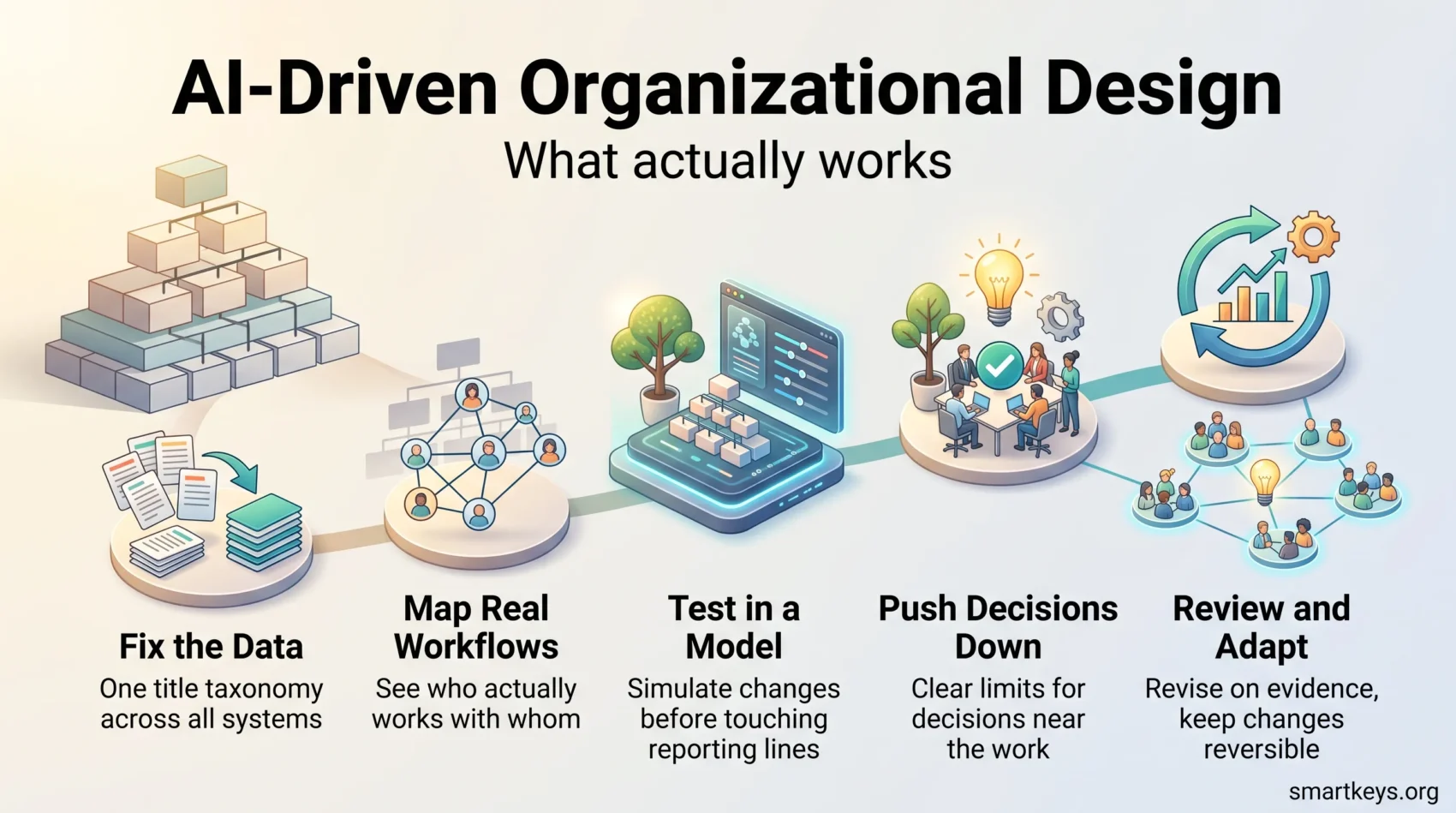
Companies are not just adding AI tools to the org chart they already have. They are changing the chart itself: fewer management layers, wider teams, and squads that own an outcome instead of a department. AI-driven organizational design is the practice of using workforce data, collaboration data and simulation tools to decide how a company should be structured, instead of redrawing boxes once a year in a slide deck.
That shift is measurable. Payroll provider Gusto, looking at roughly 8,500 small and mid-sized businesses, found the number of individual contributors per people manager rose from about 3 to 3.5 in 2019 to nearly six by late 2024, while the share of workers in management roles fell 34% over the same period. Gallup’s January 2026 analysis of 92,252 teams put the average number of direct reports at 12.1 in 2025, up from 10.9 in 2024.
The catch is that structure alone does not produce a return. McKinsey’s 2026 State of AI survey (1,719 respondents, fielded May and June 2026) found that while nearly nine in ten organizations use AI in at least one function, only 37% can attribute any EBIT impact to it, unchanged from the year before. What separated the small group of high performers was not more tools. Nearly three quarters of them had fundamentally redesigned how work flows, against about one quarter of everyone else.
This guide covers what that redesign involves: the structures companies are moving toward, the data you need before you touch a reporting line, the tools that let you test a change first, the governance that keeps it legal, and the roles and culture work that decide whether people go along with it.
Key Takeaways
- Manager layers are thinning: ICs per manager nearly doubled at US SMBs between 2019 and 2024 (Gusto), and average team size keeps rising (Gallup).
- Tools alone do not pay off. Only 37% of organizations report any EBIT impact from AI, and the ones that do have redesigned the work itself (McKinsey, 2026).
- Wider teams work only under conditions: engaged employees, capable managers, and managers who are not buried in individual contributor tasks.
- Test structural changes in a model before production. Simulation makes assumptions visible; it does not make them correct.
- Clean, consistent people data is the precondition for all of it. Mismatched job titles across systems will quietly ruin every analysis.
- Governance is not optional: EU AI literacy duties already apply, and rules for AI in recruitment and performance management arrive in December 2027.
Why org design is back on the agenda in 2026
For most of the last decade, reorganizations were triggered by growth or cost pressure. Two things changed that. First, AI absorbed a lot of the coordination work that middle management existed to do: collecting status, summarizing it, and passing it upward. Second, the numbers stopped supporting the idea that buying software is enough.
Gallup reported in July 2026 that 47% of US employees say their organization has integrated AI tools, up from 41% earlier in the year, and that 52% of workers now use AI in their own role. Adoption is no longer the bottleneck. The bottleneck is that most organizations bolted AI onto processes designed for a different kind of company, which is why so few can point to a profit effect. Our overview of AI and automation at work covers that gap in more detail.
What flatter actually means in practice
Flatter does not mean no managers. It means each manager covers more people and spends less time relaying information. That only works when a few conditions hold. Gallup’s team size research found that managers who spend less than 40% of their time on individual contributor tasks keep their engagement steady no matter how many people report to them. Above that threshold, engagement falls as the team grows. In other words, widening a span of control (the number of people reporting to one manager) fails if you also hand that manager a full delivery workload.
It is also worth keeping the scale honest. Gallup’s median is still five to six direct reports, and 66% of managers oversee fewer than ten people. The averages are pulled up by a minority of very large teams, not by a uniform move to flat structures. If you want the fuller argument on both sides, see our comparison of holacracy and fully flat organizations and our look at whether AI is making traditional managers obsolete.
The structures companies are moving toward
Three patterns show up repeatedly in companies that have redesigned rather than rebadged.
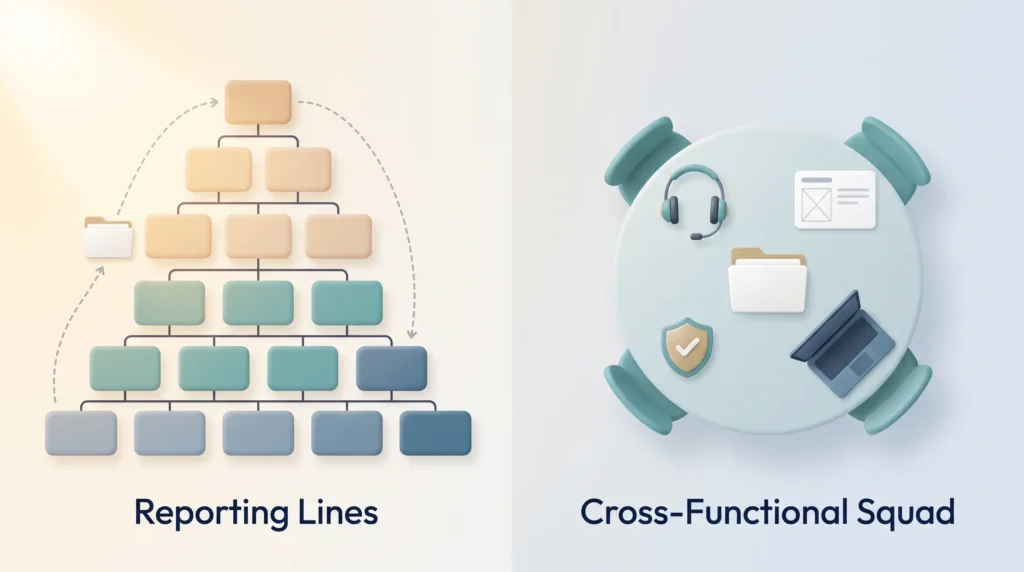
Design for information flow, not reporting lines
The question stops being “who does this person report to” and becomes “how many handoffs does a decision need”. A pricing change that touches finance, legal and sales can either travel up three hierarchies and back down, or sit with one team that holds all three perspectives. The second is faster because it removes waiting time, not because anyone works harder.
Cross-functional squads that own an outcome
A squad is a small standing team with the mix of skills needed to finish something end to end: for example, a five-person group owning customer onboarding, containing someone from support, someone from product, an engineer and a compliance reviewer. The point is that no part of the job needs to be requested from another department. Our guide to building a cross-trained workforce covers how to keep such a team from collapsing when one person is away.
The org network alongside the org chart
Organizational network analysis, usually shortened to ONA, maps who actually works with whom based on collaboration signals such as meeting patterns or shared documents. Compared with the formal chart, it tends to reveal two things: a handful of people everything routes through, and teams that are supposed to collaborate but barely interact. Both are structural problems you can fix without a reorganization.
A caution worth stating plainly: ONA reads employee activity data, so it belongs under the same rules as any other workforce monitoring. Aggregate the results, tell people it is happening, and keep it away from individual performance decisions. Our article on AI in employee monitoring sets out where the legal lines now sit.
Data is the part that decides whether any of this works
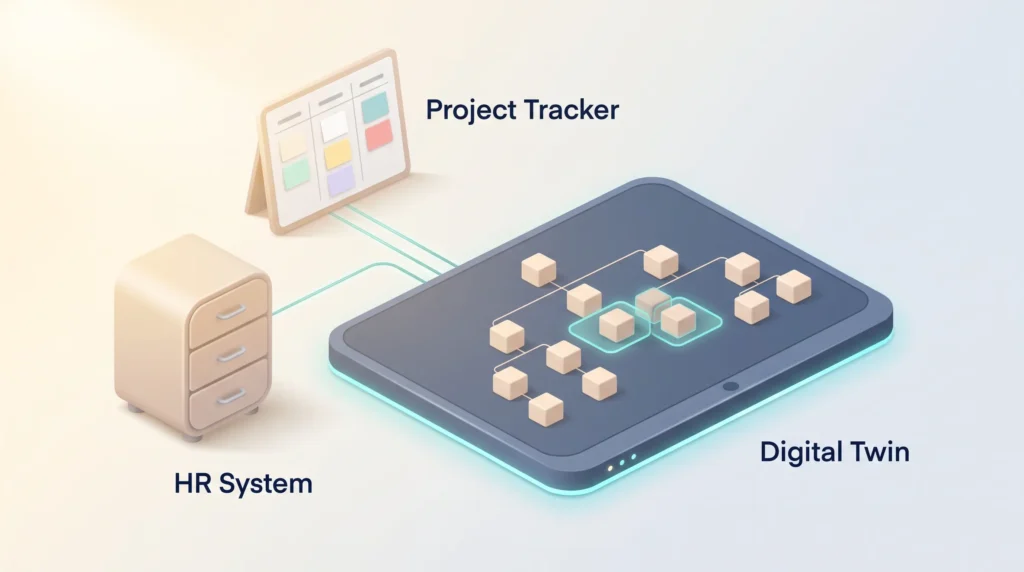
Every technique above runs on your people data, and most companies underestimate how bad theirs is. The same job exists as “Account Executive” in the CRM, “Sales Rep II” in the HR system and “AE (Enterprise)” in the project tracker. Any analysis built on top of that will produce confident nonsense.
Clean and standardize before you analyze
Start with a single agreed list of job titles, levels and reporting lines, then reconcile every system to it. The same discipline underpins any forecasting you layer on top, as our guide to predictive analytics for business explains. Record where each field comes from and who owns it. This is unglamorous work that usually takes longer than the redesign itself, and skipping it is the most common reason org analytics projects quietly die. Our data governance strategy guide covers the roles and policies involved.
Govern it across regions
If you operate in the EU, UK or Canada, employee data carries restrictions on what you may collect, how long you may keep it and where it may travel. Build consent, retention limits and access controls into the systems rather than promising them in a policy document. Our privacy compliance framework walks through mapping overlapping rules onto one set of controls.
Tools that let you test a change before you make it
Start with one division, one clear question, and a result you can check.
Role definitions and responsibility mapping
Generative tools draft role profiles and RACI matrices quickly. RACI simply labels, for each task, who is Responsible for doing it, Accountable for the outcome, Consulted, and Informed. The value of a generated draft is that it gives people something concrete to argue with, which surfaces disagreements about ownership that would otherwise stay hidden until something goes wrong.
Interactive org modeling
Platforms such as Functionly let you drag roles between teams and see headcount, cost and span of control update immediately, without touching the live HR system. This is useful for the mundane reason that it stops a proposed structure from being evaluated purely on a static slide.
Digital twins and scenario planning
A digital twin of an organization is a working model of how your teams, roles and workflows fit together, kept current from your real systems, so you can run a change in the model first. Ask it what happens to workload if two teams merge, or where approvals would queue if you removed a layer.
Be clear about what this buys you. A simulation tests the logic of your assumptions; it does not verify them. Vendor case studies claiming large percentage gains from organizational digital twins are rarely independently documented, so treat them as marketing until you see the method. The honest benefit is cheaper mistakes: you find the bottleneck in a model instead of in your customers’ experience.
- Pick one measurable question before choosing a tool, not after.
- Connect the tool to your HR and project systems so the model does not drift from reality.
- Write down what you expect to happen before you run the scenario, then compare.
- Give the change a defined review date and a way to reverse it.
Pushing decisions closer to the work
Distributed decision-making means the person nearest a problem can act on it without escalating, because they have the context and the authority. AI helps with the context half: a support lead can see churn risk, contract value and past issues in one place instead of asking three teams.
The authority half is a management decision, and it is the part that gets skipped. Giving someone a dashboard while still requiring two sign-offs changes nothing except how well informed they are while they wait. Decide explicitly which decisions move, up to what value or risk level, and what happens when someone gets one wrong. Our guide to decision-making models is a useful starting point for drawing those lines.
- Name the decisions that move, with limits, in writing.
- Keep escalation for genuine exceptions, and say what counts as one.
- Review reversed or escalated decisions monthly to see whether the limits are right.
- Treat AI recommendations as input to a human decision, not as the decision.
Governance: what is required and when
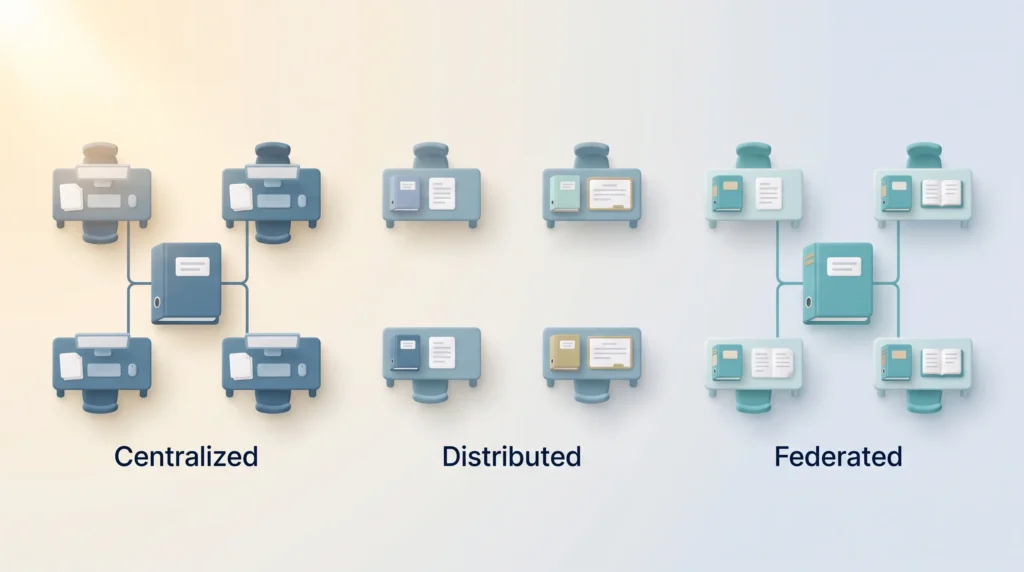
Choosing a governance model. Centralized governance, often run as a center of excellence, gives you one set of standards and shared tooling, which suits regulated work. Distributed governance lets teams move at their own pace. Federated governance keeps the standards central and lets regions adapt the details, which is why most multinationals end up there.
The rules that actually apply in 2026
Two dates matter for anyone using AI in people processes in Europe. The EU AI Act’s AI literacy duty under Article 4 has applied since 2 February 2025: as a deployer, you are expected to take and document measures that build AI competence among the staff using these systems. Separately, the EU’s digital omnibus agreement of May 2026 pushed the high-risk obligations covering employment uses, including recruitment, selection, performance monitoring, promotion and termination, from August 2026 to 2 December 2027, with transparency duties for AI-generated content landing on 2 December 2026.
The delay is time to prepare, not a reason to wait. Documentation, human review steps and bias testing take longer to retrofit than to build in. Our articles on algorithmic management and AI hiring bias cover the employer duties in the US states that already regulate this, and our generative AI usage guidelines give you a one-page policy to adapt.
Audit readiness
Build logging, permissions and data lineage in from the start. If you cannot show which data a recommendation used and who approved the resulting decision, you cannot defend it later, whether the question comes from a regulator, a works council or an employee’s lawyer.
Roles and skills the redesign needs
New titles are worth creating only where a decision currently has no owner. Three gaps recur.
An AI orchestrator owns the connection between business goals and deployed systems, and makes sure a tool nobody uses gets retired rather than renewed.
An ethics or responsible AI reviewer holds the gate: which use cases proceed, what evidence they need, and who signs off.
A data governance lead owns definitions, lineage and access, which is the role that makes everything in the data section above someone’s actual job.
Before inventing a new C-suite title, read our piece on which new executive roles earn a seat. Overlapping decision rights at the top cause more delay than the missing title solved.
Skills for the people already there
The skill that matters most is the ability to judge a model’s output: to see when a recommendation rests on thin data, and to ask what it would take to be wrong. That is a mix of domain knowledge and basic data literacy, and it is learned faster through real cases than through generic courses. Our upskilling and reskilling guide covers program design, and an internal talent marketplace is how you match those skills to work once people have them.
A workable sequence for implementation
Order matters more than speed.
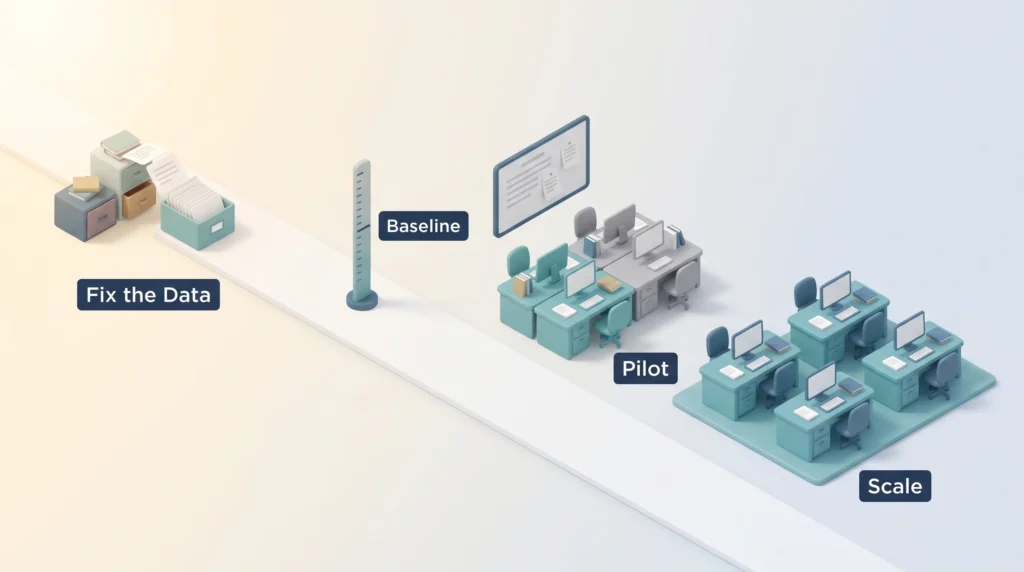
- Fix the data first. One title taxonomy, reconciled systems, named owners.
- Pick a narrow use case. Multi-country payroll, compliance monitoring and benefits administration are popular starting points because the rules are explicit and errors are visible.
- Define success before you start. Cycle time, error rate, employee-reported friction. Record the baseline.
- Pilot in one team or region. Keep a comparable group unchanged so you can tell whether the change did anything.
- Review on a schedule. Monthly for the first quarter, then quarterly, with authority to stop.
- Only then scale. And write down what you learned, including what failed.
Our continuous performance management framework pairs well with this rhythm, since frequent check-ins give you feedback on a structural change long before an annual review would.
Keeping the human side intact
Structural change lands on people as uncertainty about their job. The fastest way to lose a redesign is to let the reasoning stay invisible.
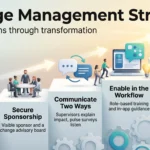
Explain why the change is happening and what it means for specific roles, including roles that shrink. Offer concrete learning paths rather than a promise of support. Make it safe to report that something is not working, because a team that hides a broken process will keep working around it for months.
Two practical points. Recognition and coaching should stay human even when the surrounding process is automated; being managed entirely through a dashboard is a reliable way to lose good people. And if your teams span several age groups and locations, expect different reactions to the same announcement. Our guide to multigenerational teams covers that, and the hybrid work policy template helps keep new structures compatible with how people actually work. Broader context sits in our leadership trends overview.
What the evidence supports, and what it does not
It is worth separating the two.
Reasonably well supported: management layers at US small and mid-sized businesses have thinned substantially since 2019, average team sizes are growing, AI use at work is now majority behavior, and the organizations reporting financial benefit are overwhelmingly the ones that changed their workflows rather than just their software.
Not well supported: specific percentage gains attributed to organizational digital twins, merger integration models or network mapping tools. These figures circulate widely in vendor material without a published method. If a supplier quotes you one, ask what was measured, over what period, against what comparison group. The absence of an answer is the answer.
The practical implication is modest and useful. Treat org design as something you revise on evidence, at a defined cadence, with the ability to reverse a change. That is a different habit from the annual reorganization, and it is the part that actually distinguishes the companies getting value from AI. Our overview of augmentation versus replacement covers the judgment that comes up most often along the way.
Found this useful?
Make SmartKeys a preferred source on Google, and our articles will surface more often in your Top Stories, AI Overviews, and AI Mode.
Add as Preferred Source