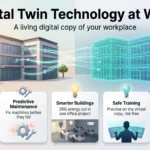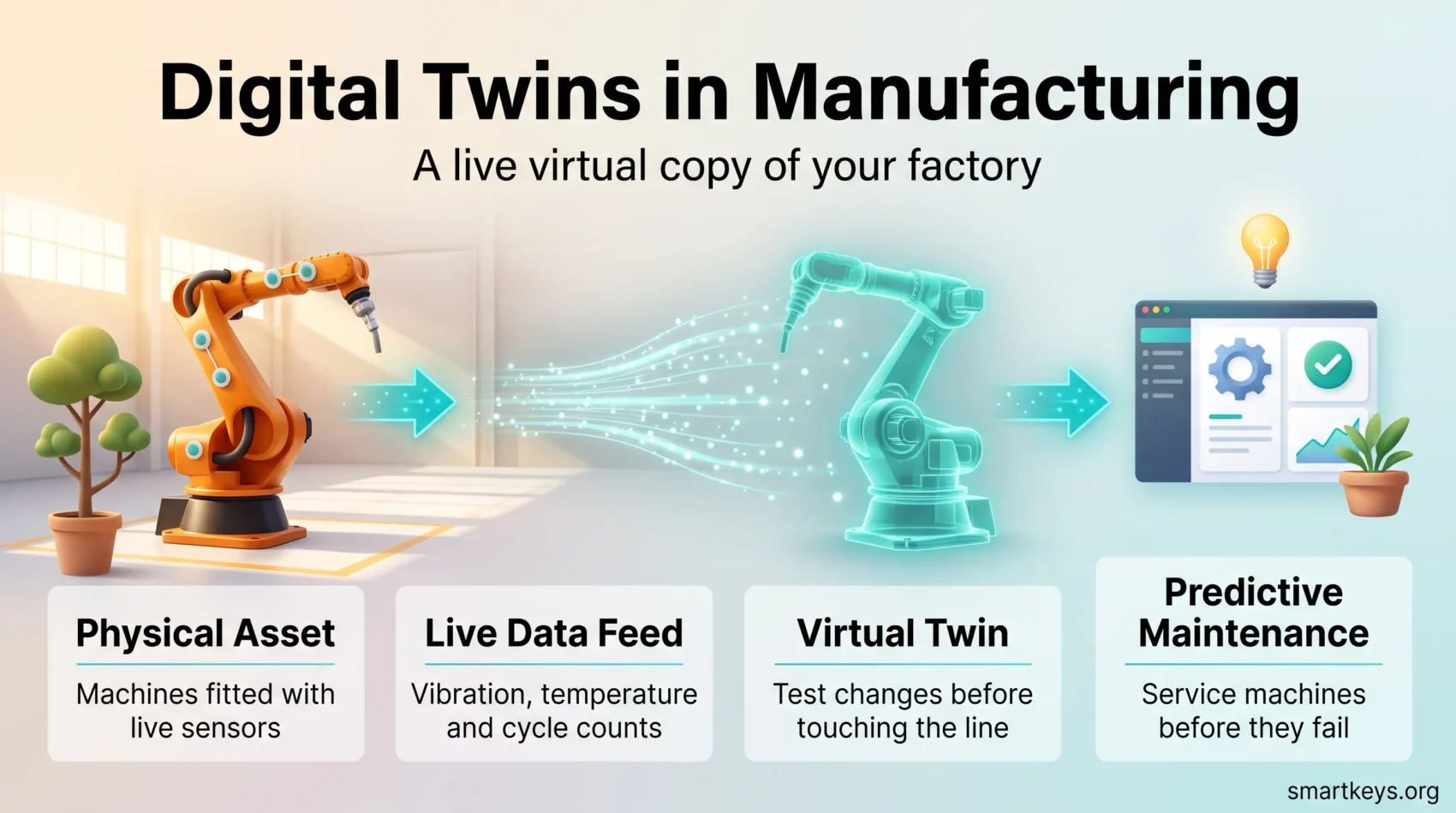
A digital twin is a live virtual copy of a physical thing: a machine, a production line, or an entire plant. It is fed by sensor data from the real object, so it changes as the real object changes. That is the part that separates it from an ordinary 3D model. A model shows you what something looks like. A twin shows you what it is doing right now, and lets you test a change before you make it on the factory floor.
Manufacturers care about this for one practical reason. Stopping a line to try something is expensive; trying it in software is not. Once the virtual copy is accurate enough to trust, an engineer can move a robot cell, reroute a conveyor or change a maintenance interval in the model first, and only then touch the real equipment.
The market has grown accordingly. Grand View Research put the global digital twin market at USD 35.8 billion in 2025 and estimates USD 49.5 billion for 2026, forecasting USD 328.5 billion by 2033 at a compound annual growth rate of 31.1 percent. Automotive and transport was the largest single segment in 2025.
Key Takeaways
- A digital twin is a virtual copy kept in sync with a real asset by live sensor data.
- Grand View Research estimates the global market at USD 49.5 billion for 2026, growing to USD 328.5 billion by 2033.
- Predictive maintenance is usually the clearest payback, because unplanned downtime is so expensive.
- ISO 23247 now defines how twins from different vendors should fit together.
- Most failed projects fail on data quality and legacy system access, not on the modelling software.
What a Digital Twin Actually Is
The term gets stretched to cover almost any 3D visualisation, so it helps to be precise about what makes a twin a twin.
A Working Definition
Three things have to be true. There is a physical asset. There is a virtual representation of it. And there is a data connection running between them, usually in both directions. Break the connection and you are left with a simulation, which is still useful but is a different tool.
The virtual side does not have to be a photorealistic 3D scene. A twin of a pump might be a set of equations plus a live feed of vibration, temperature and flow rate. A twin of an assembly hall might be a spatial model you can walk through. The right level of detail depends on the question you are trying to answer.
How the Idea Developed
The concept took shape in the early 2000s inside product lifecycle management, the software discipline that tracks a product from first sketch to retirement. Early versions were rich engineering models updated by hand.
Three developments made them live. Cheap sensors made it affordable to instrument equipment. Industrial connectivity made it possible to move that data continuously. Machine learning made it possible to turn raw sensor streams into predictions. The result is what people now call a digital transformation project rather than a modelling exercise: the model is half the work, and the data plumbing is the other half.
How IoT Data Keeps a Twin Current
The Internet of Things, meaning physical equipment fitted with sensors and network connections, is what makes a twin live rather than static. In an industrial setting this is usually called the IIoT, the industrial Internet of Things.
The Sensor Layer
Sensors on a machine typically report vibration, temperature, pressure, current draw, cycle counts and rotational speed. Individually these readings mean little. Tracked together over time, they describe how a machine is behaving compared with when it was new.
Getting data off the shop floor is often the harder half. Older equipment may output nothing at all, and retrofitting sensors to a twenty year old press is a project in itself. This is why IoT deployments usually start with a handful of critical machines, not the whole plant.
Turning Live Data Into Decisions
Raw readings arrive far faster than anyone can read them, so the processing usually happens close to the machine. Edge computing, meaning computation performed on or near the equipment instead of in a distant data centre, filters the stream and sends only what matters upstream. That keeps bandwidth costs down and keeps response times short enough to be useful during a production run.
The practical payoff is narrow but real. An operator sees that a spindle is drawing more current than it did last week, checks the twin, and finds that the pattern matches a bearing that failed on an identical machine six months ago. That is live data doing something concrete rather than filling a dashboard.
What Digital Twins Deliver in Practice
The benefits are easiest to see when you look at specific decisions rather than general claims about efficiency.
Fewer Physical Prototypes
Building a physical prototype costs money and, more importantly, time. If a design change can be tested against an accurate virtual model, the number of physical iterations drops. This is the same logic that makes immersive product prototyping attractive, and it works best on products where the physics are well understood and can be modelled reliably.
It works less well where material behaviour is unpredictable or safety certification requires physical testing anyway. In those cases a twin narrows the field of candidates rather than replacing the test rig.
Faster Line Changes and Layout Planning
This is where the clearest published results sit. Siemens reported at CES in January 2026 that PepsiCo had turned US manufacturing and warehouse facilities into 3D digital twins, and cited a 20 percent throughput increase on the initial deployment, capital expenditure reductions of 10 to 15 percent through virtual validation, and up to 90 percent of potential issues identified before any physical change was made. These are figures reported by the vendor and its customer rather than independently audited, so treat them as an indication of scale rather than a guarantee.
The mechanism behind them is straightforward. Reconfiguring a packaging line normally means guessing, building, and fixing. With an accurate twin, most of the guessing happens in software.
Better Testing Before Anything Is Built
A twin lets you run scenarios that would be dangerous, expensive or slow in reality: a jam at the worst possible point in the cycle, a supplier delivering slightly out of tolerance parts, a shift running at 110 percent of rated speed. None of that risks equipment or people.
Where this connects to other work is immersive training. Once a plant has an accurate virtual model, using it to train operators on a new line before the line exists costs very little extra.
Predictive Maintenance: The Clearest Payback
Predictive maintenance means servicing a machine based on its actual condition rather than on a fixed calendar. It is the application where the business case is easiest to write, because the cost of getting it wrong is well documented.
What the Downtime Numbers Look Like
Siemens, through its Senseye division, publishes a regular study on the cost of unplanned downtime. Its 2024 edition estimated that the world’s 500 largest companies lose roughly USD 1.4 trillion a year to unplanned downtime, around 11 percent of their combined revenues, and that an idle production line at a major automotive plant can cost up to USD 2.3 million per hour.
Those are headline figures from a vendor with an interest in the answer. Even discounted heavily, they explain why maintenance teams fund projects that shift failures from unplanned to scheduled.
How a Twin Changes the Maintenance Schedule
A twin compares current sensor behaviour against the machine’s own history and against similar machines. When the pattern drifts toward a known failure signature, it flags the asset. Maintenance then gets planned into a gap in the schedule instead of happening at 3am on a Tuesday.
The gain is not really fewer failures. It is the same number of interventions, moved to a time you choose. Our overview of predictive maintenance programmes covers where these projects stall, and the pattern is consistent: the model is rarely the problem, the data history is.
Where the Market Stands in 2026
Beyond the headline market size, two things are worth knowing.
First, uptake is uneven by sector. Automotive, aerospace and defence run the most mature programmes, largely because they already had detailed engineering models and high downtime costs. Logistics, energy and process industries are further behind but moving, often starting from predictive analytics projects rather than from 3D models.
Second, the technology is being pulled forward by AI infrastructure investment rather than by digital twin demand on its own. Siemens and NVIDIA said in early 2026 that they intend to build what they describe as the first fully AI driven adaptive manufacturing sites, starting with the Siemens electronics factory in Erlangen, Germany. Siemens also announced Digital Twin Composer, a tool for assembling twins with NVIDIA Omniverse simulation, for release in mid 2026. Whether that arrives on schedule is a separate question, but it shows where the platform vendors are investing. Our piece on AI in business operations covers why near universal adoption has so far produced little measurable return.
Standards Are Finally Catching Up
For years the main complaint about digital twins was that every vendor built them differently, so a twin of a machine from one supplier would not talk to a twin of the line it sat in.
ISO 23247, the digital twin framework for manufacturing, addresses this by defining a common architecture and vocabulary. Part 6, published on 14 July 2026, covers composition: how separate twins are combined, using three patterns it calls integrated, unified and federated, so that models built by different vendors and internal teams can work together.
This matters more than it sounds. Interoperability is what turns a collection of machine level twins into a plant level one, and it is the difference between a pilot and something you can extend.
Why Digital Twin Projects Fail
The technology rarely fails on its own. Projects stall for two recurring reasons.
Legacy Systems and Missing Data
Most factories are not greenfield. They contain equipment bought across three decades, running control systems that were never designed to publish data to anything. Connecting those machines means retrofitting sensors, adding protocol converters, or in some cases accepting that a particular asset stays outside the twin.
Budget for this explicitly. Connectivity work often costs more than the modelling software, and it is the part that gets underestimated when a pilot on new equipment is scaled to a whole plant.
Data Quality, Governance and Security
A twin is only as good as the data feeding it. Inconsistent tag names, gaps in the sensor history, and readings from miscalibrated instruments all produce a model that looks convincing and is wrong. Cleaning this up is unglamorous and usually the largest single time cost.
Security is the other half. Connecting operational technology, meaning the control systems that run physical equipment, to corporate networks creates exposure that did not previously exist. A zero trust approach, where no device is trusted by default just because it sits inside the network, has become the standard answer. There are also obligations around what you collect: if sensors capture anything that identifies individual workers, employee data rules apply.
Digital Twins and the Rest of the Smart Factory
A twin is rarely deployed alone. It sits alongside several other technologies, and understanding which does what saves a lot of confusion.
Private 5G networks provide the reliable, low latency connectivity that wireless sensors and mobile robots need on a factory floor, where Wi-Fi coverage is often patchy. Industrial robots and cobots, meaning robots designed to work safely alongside people, are frequently the assets being twinned. Augmented reality, which overlays digital information onto a real view through a headset or tablet, gives technicians a way to see twin data while standing at the machine.
Additive manufacturing pairs naturally with twins for spare parts, since a validated digital model is most of what you need to print a replacement locally, and supply chain tracking systems extend the idea beyond the plant gate. The world’s leading 3D printing manufacturers use twins to check accuracy before a build starts, which shows how the approach scales from a single component to an entire plant.
Sustainability has become a genuine driver. A twin that models energy use per unit produced lets a plant test efficiency changes before committing to them, which supports circular manufacturing goals and the reporting obligations now facing larger manufacturers.
How to Start Without Overcommitting
The pattern that works is narrow and boring. Pick one asset where downtime is expensive and data already exists. Build a twin of it. Prove it predicts something useful. Then extend.
The pattern that fails is a plant wide programme launched before anyone has confirmed the data is good enough. Ask three questions before committing budget: which machines already publish usable data, what decision will the twin improve, and who owns the model once the consultants leave. If any of the three has no clear answer, the project is not ready.
Conclusion
Digital twins have moved from a vendor concept to something with standards, an installed base and published results. The market is growing quickly, the interoperability problem is being addressed by ISO 23247, and the maintenance use case has a business case that survives scrutiny.
What has not changed is where the difficulty sits. Building the model is the easy part. Getting clean, continuous, trustworthy data out of equipment never designed to provide it is the real work, and it separates the plants running twins in production from the ones still running pilots. Start with one machine, prove the data, then grow.
Found this useful?
Make SmartKeys a preferred source on Google, and our articles will surface more often in your Top Stories, AI Overviews, and AI Mode.
Add as Preferred Source