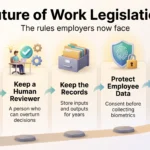
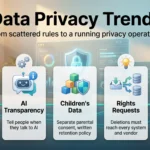
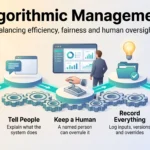
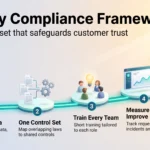
Employee data privacy has quietly become one of the most regulated areas your company manages. Payroll records, badge swipes, HR systems, collaboration tools, monitoring software and AI screening tools all generate personal information about your staff. In 2026 a growing share of it falls under enforceable privacy law rather than internal policy alone.
The California Consumer Privacy Act (CCPA) set the precedent by extending full consumer rights to employees, applicants and contractors in January 2023. No other US state has followed that far, but twenty states now have comprehensive privacy laws on the books, and the EU’s AI Act begins applying transparency duties to workplace AI from August 2, 2026. Together these rules reshape how you collect, explain and delete workplace data.
Congress has not closed the gap. The American Privacy Rights Act, once floated as a national standard, expired at the end of the 118th Congress in January 2025 and has not been reintroduced. For now, workplace data privacy compliance means managing a patchwork deliberately and in writing. This guide stays on the employer side: staff records, monitoring and AI tools that judge people. For the full picture across customers, children’s data, data brokers and litigation, see our overview of how data privacy rules are changing in 2026.
Key Takeaways
- Twenty US states have comprehensive privacy laws; California is the only one that fully covers employee data.
- The federal APRA never passed, so the state patchwork is the operating reality.
- GDPR fines still reach €20 million or 4% of global annual turnover, whichever is higher.
- EU AI Act transparency duties apply from August 2, 2026; high-risk hiring rules were deferred to December 2027.
- California’s ADMT rules cover employment and compensation decisions from January 1, 2027.
- Electronic monitoring of staff needs a stated purpose, a written notice and, in the EU, an impact assessment first.
Why Employee Data Privacy Matters at Work
Every organization now runs on employee data it did not deliberately choose to collect. Device telemetry, calendar metadata, chat logs, productivity dashboards and wellness apps accumulate quietly, and each new tool widens the surface you have to explain, secure and eventually delete.
Trust is the practical stake. Pew Research Center found in 2023 that 70% of Americans who had heard of artificial intelligence had little or no trust in companies to use it responsibly, and 81% expected the information companies collect would be used in ways they were not comfortable with. Your workforce sits inside that same sentiment, and unlike customers, they cannot simply walk away.

The legal stake is just as concrete. Under GDPR, non-compliance can cost up to €20 million or 4% of total annual worldwide turnover, whichever is higher. US state regulators impose per-violation penalties rather than turnover-linked fines, but the operational cost (audits, remediation, response deadlines) lands the same way.
A workforce that understands what is collected and why tends to report incidents faster and resist shadow tooling less. That is why practical controls around unapproved tools and clear generative AI usage guidelines do more for compliance than another all-hands slide deck. Training that focuses on phishing, data handling and escalation paths addresses the failure mode that actually causes most breaches: ordinary people under time pressure.
What Data Privacy Laws Ask of Employers
Privacy laws differ in detail, but applied to staff records most of them converge on the same five duties, whatever the jurisdiction.
Notice. Tell people what categories of data you collect, why, how long you keep it, and who receives it. Do this at or before the point of collection.
Purpose limitation and minimization. Collect what the stated purpose requires and stop there. This is where monitoring tools and analytics dashboards most often fail an audit.
Rights handling. Be able to find, export, correct and delete an individual’s data across HR systems, backups and vendors within statutory deadlines.
Vendor control. Your payroll processor, background-check provider and engagement-survey vendor are extensions of your obligations. Contracts need deletion, purpose and subprocessor terms that you can actually enforce.
Security and documentation. Reasonable safeguards, plus written evidence that you assessed the risk before deploying the system.
- Map where employee data lives, including unstructured repositories and departed vendors.
- Set retention schedules per data category, not per system.
- Log the decision rationale for any high-risk processing before launch.
A privacy compliance framework that ties these duties to named owners beats a policy document nobody opens. Pair it with a working data governance strategy so classification and retention decisions are made once, centrally.
The US State Patchwork in 2026
Twenty states now have comprehensive consumer privacy laws on the books. Indiana, Kentucky and Rhode Island came into force on January 1, 2026, with further statutes and amendments taking effect through July 1, 2026 in states including Arkansas and Utah. No new comprehensive state law was passed in 2025, so the near-term work is implementation rather than tracking new bills.
Here is the detail that matters for HR: most of these statutes exempt employment data. They regulate how you treat customers, not staff. California remains the outlier. Since January 2023, employees, job applicants and independent contractors hold the same access, deletion, correction and opt-out rights as consumers.
That asymmetry shapes your architecture. If you employ people in California, the strictest rules effectively set your baseline, because building two parallel HR data processes is more expensive than building one good one. The same logic applies to data localization requirements once your workforce spans borders.
California is not standing still. The California Privacy Protection Agency opened preliminary rulemaking focused specifically on employee data on April 20, 2026, with comments due the following month. Final rules are unlikely to take effect before 2027, but the direction of travel is clear: more prescriptive obligations for employers, not fewer.
What GDPR Requires for Employee Data
The General Data Protection Regulation, in force since May 25, 2018, remains the most complete framework for employee data protection anywhere. It applies to any organization processing the data of people in the EU, wherever that organization is headquartered.
GDPR’s contribution to workplace privacy is structural. Article 35 requires a Data Protection Impact Assessment before high-risk processing, and employee monitoring, biometric access control and algorithmic performance scoring all qualify. Articles 37 and 38 govern when you must appoint a Data Protection Officer and how independent that role has to be.
The regulation also constrains a habit many employers still rely on: treating employee consent as a valid legal basis. Because of the power imbalance in an employment relationship, consent is rarely freely given, so contractual necessity, legal obligation or legitimate interest usually has to carry the weight instead. That distinction changes how you document recruitment, record-keeping and monitoring.
For distributed teams, GDPR discipline pays off beyond Europe. Its documentation habits map cleanly onto US state requirements and onto digital trust practices in remote teams, where employees rarely see the controls protecting them and have to take them on faith.
How AI Is Reshaping Workplace Data Privacy
AI moved employee data from a storage problem to a decision problem. Screening tools rank candidates, scheduling systems allocate shifts, and analytics platforms infer engagement from behavioural signals that no one explicitly submitted.
Regulators have responded by targeting the decision, not just the data. The EU AI Act classifies recruitment and employment-related systems as high-risk under Annex III. The Digital Omnibus agreement deferred the obligations for stand-alone Annex III systems from August 2, 2026 to December 2, 2027, and pushed AI embedded in regulated products to August 2, 2028. August 2, 2026 still matters, though: the Article 50 transparency duties, which require telling people when they are interacting with an AI system, apply from that date as originally planned.

California takes a parallel route through privacy law rather than AI law. Its finalized rules on Automated Decisionmaking Technology, approved on September 23, 2025, cover systems used to make significant decisions, explicitly including employment, independent contracting and compensation. Businesses already using ADMT for those purposes must comply by January 1, 2027.
- Inventory every system that scores, ranks or filters people, including embedded vendor features.
- Document inputs, logic and human review steps before deployment, not after a complaint.
- Give candidates and employees a route to contest an automated outcome.
- Check vendor claims about bias testing in recruitment tools against actual evidence.
An AI governance model that assigns ownership for these reviews prevents the common failure: a tool bought by one team, deployed by another, and explained by nobody. Larger organizations increasingly formalize this in a dedicated AI ethics role.
What Actually Changed in 2026
Several deadlines moved this year, and a few landed. Knowing which is which keeps your roadmap honest.
Colorado rewrote its AI Act. Senate Bill 26-189 delayed the effective date to January 1, 2027 and stripped out the duty to avoid algorithmic discrimination, mandatory impact assessments, risk management programs and AG reporting. What survives is disclosure-shaped: clear pre-use notice before automated technology materially influences an employment decision, an explanation within 30 days of an adverse decision, the right to correct inaccurate data, meaningful human reconsideration where commercially reasonable, and three years of records. Only the state attorney general can enforce it.
California’s compliance clock started. Risk assessments are required for qualifying processing activities conducted from January 1, 2026, with the first submissions to the CPPA due April 1, 2028. Cybersecurity audits phase in by revenue: April 1, 2028 for businesses above $100 million, 2029 for $50-100 million, and 2030 below that.
The EU softened its timeline but not its direction. High-risk obligations were deferred, not cancelled. That makes 2026 and 2027 preparation years rather than quiet years.
The practical lesson is that deferrals reward the organizations that kept building. Teams that already inventoried their systems for the original August 2026 deadline now have breathing room; teams that waited have the same work with less time. Pairing this with EU AI Act compliance planning and a broader view of the wider data privacy landscape keeps the roadmap grounded in dates rather than headlines.
Generative AI and Employee Data
Generative AI created a new category of privacy exposure: employees pasting confidential material into tools the company never evaluated. The risk is not exotic. It is a recruiter summarizing candidate notes, or a manager drafting a performance review, in a consumer chatbot.
Governance works better than prohibition. Blanket bans push usage underground, which is worse than usage you can see. The workable approach is to classify tools by contractual footing: consumer-grade services with no enterprise terms on one side, vendors bound by data processing agreements on the other. Route sensitive work only to the second category.

- Define which data classes may never enter a general-purpose AI tool, in plain language.
- Check whether inputs are used for model training and whether that setting can be disabled contractually.
- Confirm data residency and subprocessor terms before approving non-EU or non-US vendors.
- Review outputs that inform decisions about people, since fluent text hides errors well.
Enterprise tiers generally offer the retention controls, audit logs and processing terms that consumer versions do not. Approving a small, well-documented set of tools, and saying so clearly, is more effective than a policy nobody can follow. The same principle underpins a sensible bring-your-own-application policy: legitimize the useful, control the risky, and make the boundary obvious.
Employee Monitoring: Where the Lines Are
Monitoring is where employee data privacy stops being abstract. Keystroke loggers, screenshot tools, email scanning and location tracking all create detailed records about individual people, and each one needs a reason you can state in a sentence.
In the US, several states require notice before you monitor electronically. New York has required employers since May 2022 to give new hires written notice of phone, email and internet monitoring and to post that notice where staff can see it. Connecticut and Delaware have similar notice rules. Where no statute applies, a clear written policy is still your best protection when a monitoring decision is challenged.
In the EU, systematic monitoring of staff is a textbook case for the Data Protection Impact Assessment described above. Regulators expect you to show why a less intrusive option would not work before you switch on the tool.
- Write down the purpose of each monitoring tool before deployment, not after a complaint.
- Tell staff what is tracked, when, and who sees the results.
- Collect the minimum: aggregate reports usually answer the business question without screenshots of individuals.
AI makes this harder, because modern tools infer mood, focus or flight risk from behavior. Our guide to AI-driven employee monitoring covers where those tools help and where they cross a line, and a wearable technology policy matters as soon as devices collect health or location signals.
Compliance Duties Employers Cannot Skip
Employers sit under overlapping regimes: privacy law, employment law, sector rules and, increasingly, AI rules. Knowing which apply to your headcount and footprint is the first compliance task, not the last.

Enforcement in this space is real but uneven. European authorities have issued substantial GDPR fines against major technology companies, while US state regulators are still building capacity and often lead with cure periods and investigative letters. The asymmetry is a reason to document early, not a reason to relax: written evidence of a considered decision is what turns an inquiry into a short conversation.
- Assign a named owner for each obligation: notice, rights, vendors, security and AI review.
- Train the teams that actually touch employee data: HR, IT, payroll and people managers.
- Run rights-request drills against real deadlines before a regulator sets one for you.
Technical controls carry part of the load. Zero-trust access models and a layered security architecture reduce the blast radius when something fails. For distributed teams, remote work security fundamentals and careful handling of biometric authentication matter more than any single tool, since biometrics carry strict consent and retention duties in states like Illinois, Texas and Washington.
Centralizing data management across departments is what makes all of this repeatable. Otherwise every rights request becomes a scavenger hunt across systems no one has mapped.
Privacy Rights and Employee Data Management
Protecting employee privacy builds the trust that monitoring tools quietly erode. Where the CCPA applies, staff can access, correct and delete their data, and they increasingly know it. Elsewhere, giving people similar visibility is a choice, and a defensible one.
Communicate in specifics. A notice that lists the actual systems, the actual retention periods and the actual recipients does more for trust than a paragraph about your commitment to privacy. It also forces the internal clarity that compliance depends on.
Review policies on a fixed cadence rather than after incidents. Laws shift, vendors change, and tools accumulate. Organizations that treat this as ongoing operations rather than a project with an end date spend less and worry less. That posture is what turns compliance into durable digital trust, and it travels well as teams spread across jurisdictions under digital nomad and employee mobility policies. Wider cybersecurity trends and shifts in first-party data strategy feed back into what you must protect, so review them on the same cadence.
Found this useful?
Make SmartKeys a preferred source on Google, and our articles will surface more often in your Top Stories, AI Overviews, and AI Mode.
Add as Preferred SourceFAQ
Do US data privacy laws actually cover employee data?
Mostly not. Of the twenty states with comprehensive consumer privacy laws, California is the only one that fully extends those rights to the workforce. Since January 2023, California employees, job applicants and independent contractors can access, correct, delete and limit the use of their personal information just as consumers can. Everywhere else, employment data is typically exempt, and workplace privacy is governed by sector rules, employment law and specific statutes covering areas like biometrics. If you employ people in California, the practical approach is to build one process to the stricter standard rather than maintaining two.
Did the United States pass a federal privacy law?
No. The American Privacy Rights Act was introduced in 2024 as a bipartisan attempt to create a national standard and pre-empt the state patchwork, but its committee markup was cancelled and the bill expired at the end of the 118th Congress in January 2025. It has not been reintroduced. Planning should therefore assume the state-by-state model continues. That means tracking effective dates per state, adopting a nationwide baseline that meets the strictest requirements you face, and layering state-specific exceptions on top rather than waiting for Congress to simplify the map.
What does GDPR require from employers outside the EU?
GDPR applies wherever you process the personal data of people in the EU, including your own staff there. In practice that means a lawful basis for each processing activity, transparent notices, a Data Protection Impact Assessment under Article 35 before high-risk processing such as monitoring or biometric access control, and a Data Protection Officer where Articles 37 and 38 require one. Employee consent is a weak basis because of the power imbalance in an employment relationship, so contractual necessity, legal obligation or legitimate interest usually applies instead. Fines reach €20 million or 4% of global annual turnover, whichever is higher.
Which AI rules affect hiring and employment decisions?
Three matter most right now. The EU AI Act classifies recruitment and employment systems as high-risk under Annex III; the Digital Omnibus agreement moved those obligations to December 2, 2027, while Article 50 transparency duties still apply from August 2, 2026. California’s finalized ADMT regulations cover automated decisions about employment, independent contracting and compensation, with compliance required by January 1, 2027. Colorado’s amended AI Act takes effect January 1, 2027 and now centres on notice, explanation and human review rather than a broad anti-discrimination duty. Several cities and states also regulate automated hiring tools directly.
What changed in Colorado’s AI Act?
Senate Bill 26-189 substantially narrowed the law and delayed it to January 1, 2027. Removed were the affirmative duty to avoid algorithmic discrimination, mandatory impact assessments, risk management programs, annual reviews and attorney general reporting. What remains for employers is procedural: clear and conspicuous notice before automated technology materially influences an employment decision, an explanation of the decision and the system’s role within 30 days of an adverse outcome, a route to correct inaccurate data, meaningful human reconsideration where commercially reasonable, and three years of supporting records. Only the state attorney general can enforce it; there is no private right of action.
How should we handle generative AI without banning it?
Classify tools rather than prohibiting them. Separate consumer-grade services with no enterprise terms from vendors bound by a data processing agreement, and permit sensitive work only in the second group. Define in plain language which data classes may never enter a general-purpose tool, confirm whether inputs are used for model training and whether that can be switched off contractually, and check data residency and subprocessor terms. Blanket bans tend to push usage into personal accounts where you have no visibility at all, which is a worse outcome than a small approved toolset with clear boundaries and audit logs.
Can employers monitor employees’ email and devices?
Usually yes, but only with a clear purpose and proper notice. In the US, company systems can generally be monitored, yet states such as New York, Connecticut and Delaware require employers to tell staff in advance about electronic monitoring of phone, email or internet use. California employees can also request access to the data collected about them. In the EU, systematic monitoring normally requires a Data Protection Impact Assessment and must be proportionate, so blanket keystroke logging or constant screenshots are hard to justify. Whatever the jurisdiction, write down what you track, why, who sees it and how long you keep it.
What should an employer do first?
Start with an inventory: every system that holds employee data and every system that scores, ranks or filters people. Most organizations discover tools nobody formally owns. Next, assign a named owner to each obligation (notice, rights handling, vendor terms, security and AI review), because unowned duties fail quietly. Then set retention schedules by data category rather than by system, so deletion actually propagates. Finally, run a rights-request drill against a real statutory deadline. The gap between the policy and what your systems can do in ten days is usually where the risk sits.