Data localization laws decide where your customers’ records are allowed to live, and who is allowed to open them. For a SaaS company (software sold as an online subscription rather than installed on a customer’s own servers), that turns a hosting decision into a market access decision.
The pressure is not theoretical. Russia requires the first copy of a citizen’s record to sit on a Russian server. Saudi regulators expect sensitive personal data to stay in the Kingdom. Vietnam brought a full data protection law into force on 1 January 2026. India notified the rules under its new privacy act in November 2025, with the main obligations landing in 2027.
Even where storage is free to move, access often is not. Under the EU’s General Data Protection Regulation (GDPR), a support engineer in Manila opening a ticket that contains EU customer data counts as an international transfer, even though the database never left Frankfurt. That single point reshapes support rotas, logging and deployment pipelines more than any server location ever will.
This guide sets out what the rules actually say in 2026, what compliance costs, and how to build a platform that can prove where data sits without freezing your roadmap.
Key Takeaways
- Localization is a legal duty to keep records inside a border. Residency is your own choice of hosting location. They are not the same obligation.
- Under the GDPR, remote access from outside the EEA is treated as a transfer, so support and admin design matter as much as server location.
- Russia, China, Saudi Arabia and sector rules in the UAE impose the hardest storage constraints. The EU, Brazil and Vietnam regulate the transfer instead.
- Penalties are now revenue linked in several countries, and Vietnam can fine up to 5% of annual revenue for unlawful cross-border transfers.
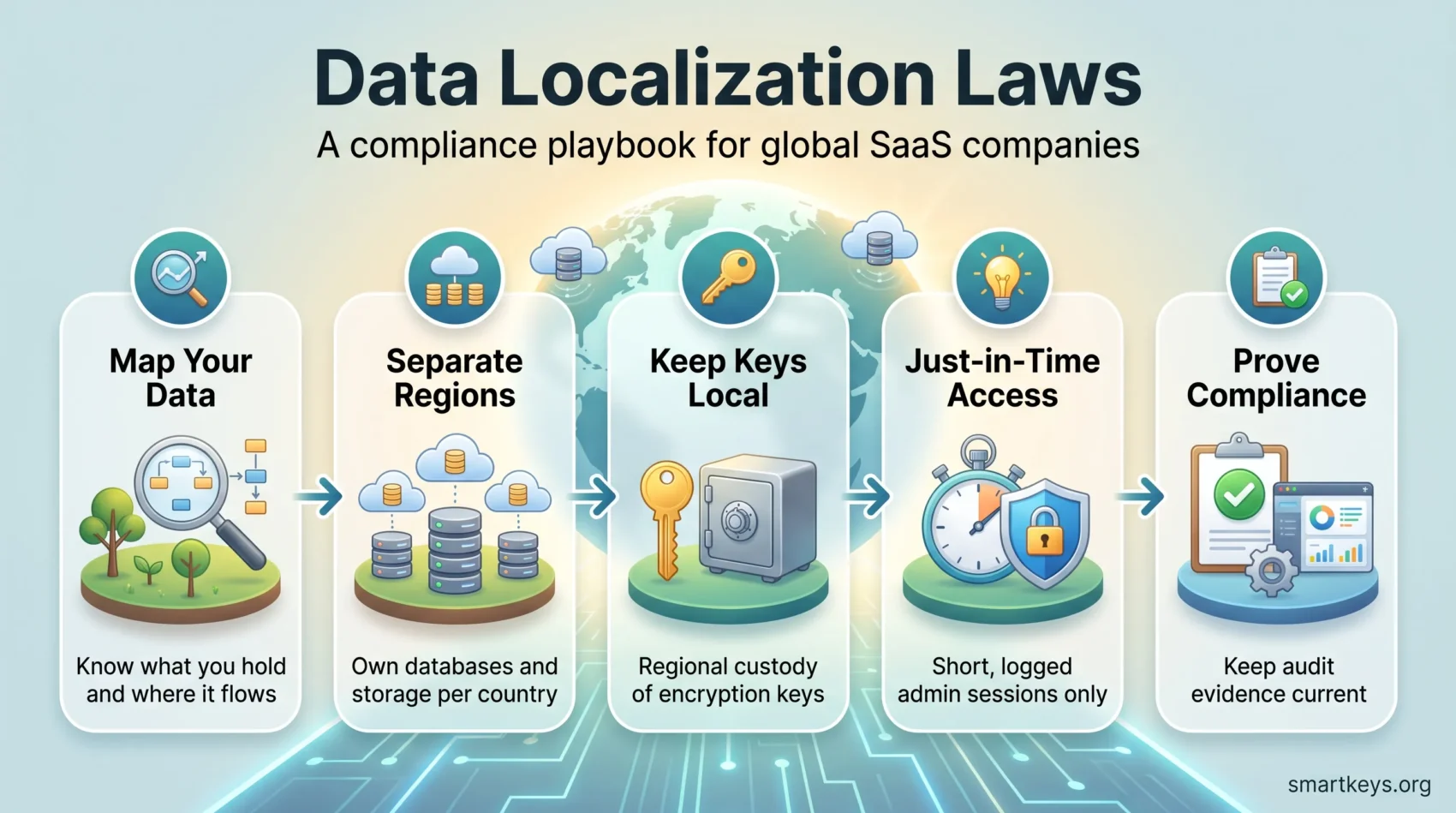
- Start with a data map, then regional stores, local key custody and just-in-time admin access. Evidence beats intention in an audit.
What data localization actually means
Three terms get used interchangeably and mean different things. Getting them straight saves a lot of wasted engineering.
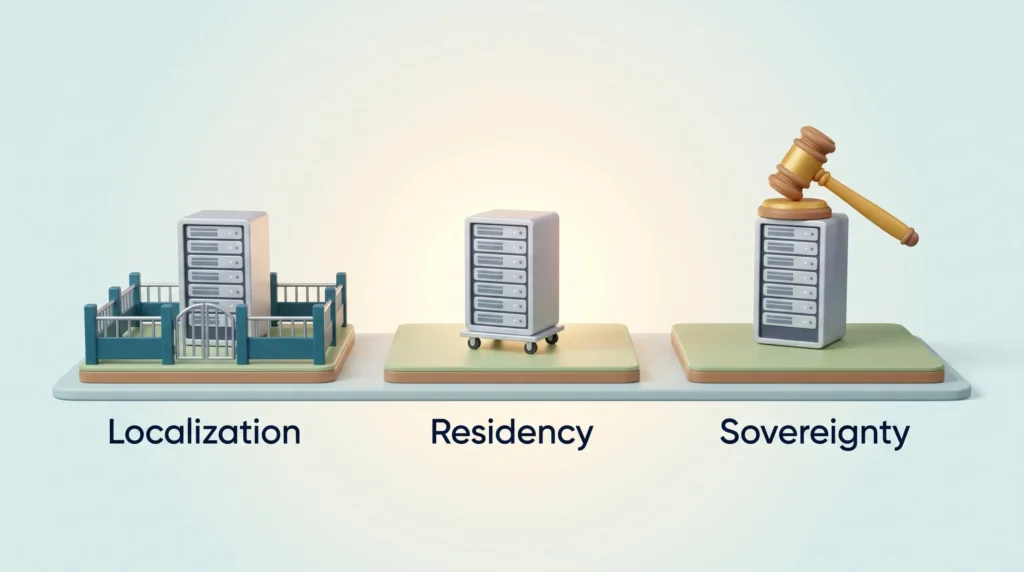
Data localization is a legal requirement to keep certain records physically inside a country. Russia’s rule is the clearest example: the master copy of a Russian citizen’s personal data has to sit in Russia.
Data residency is your own decision about where to host, usually taken to win a deal or cut latency. Nobody forces it. You can reverse it.
Data sovereignty means the laws of the host country apply to the records stored there, including the powers its authorities have to demand access. A European customer worried about sovereignty is usually asking who could compel disclosure, not which building the disk is in.
The obligations attach to personal data, meaning anything that identifies a person: names, email addresses, payment details, health records, employment files. The person behind that data is the data subject, and the rights that follow (access, correction, deletion) travel with the record wherever you put it.
Two categories catch teams out. Logs and telemetry usually contain identifiers such as user IDs, IP addresses or email addresses, which makes them regulated content rather than harmless diagnostics. Backups and disaster recovery replicas are full copies of the same regulated data, so a replica in the wrong region breaks the rule just as effectively as a primary database would.
Why the rules keep tightening
Governments give three reasons, and all three are partly true.
The first is oversight. If records sit locally, a regulator can inspect them, and law enforcement can request them without waiting on a foreign court. That argument carries the most weight in finance, telecoms and health, where an outage or a breach has knock-on effects across the economy.
The second is industrial policy. Requiring local hosting pushes cloud providers to build local data centres, which brings investment and jobs. Critics call this digital protectionism, and in some markets the label fits.
The third is privacy itself. After a decade of cross-border surveillance disputes, several governments concluded that the simplest way to protect citizens is to keep the data at home.
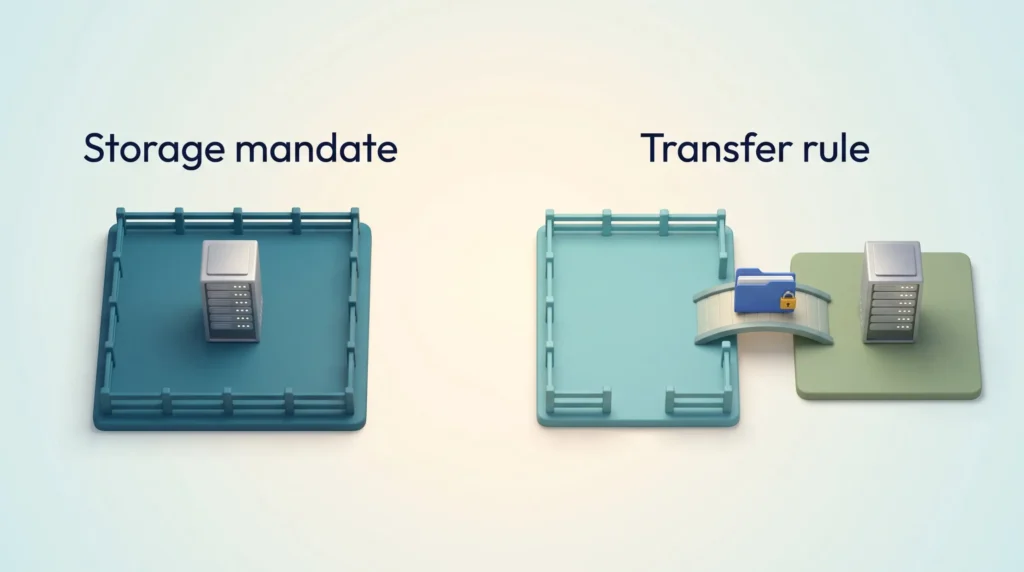
For your business, the motive matters less than the shape of the rule. A storage mandate forces you to run infrastructure in that country. A transfer rule lets you keep one platform, provided you can document the safeguards. Confusing the two leads either to overspending on regions you never needed, or to a compliance gap you only discover during an enterprise security review.
The trend is real but often overstated in marketing material. The Information Technology and Innovation Foundation counted 144 data localization measures across 62 countries in 2021, up from 67 measures in 35 countries in 2017. The direction since then has been upward, though credible global counts are published rarely, so treat any precise 2026 figure you see with caution.
How the EU treats transfers under the GDPR
The GDPR does not require personal data to stay in Europe. It requires you to protect it when it leaves, which is a different job.
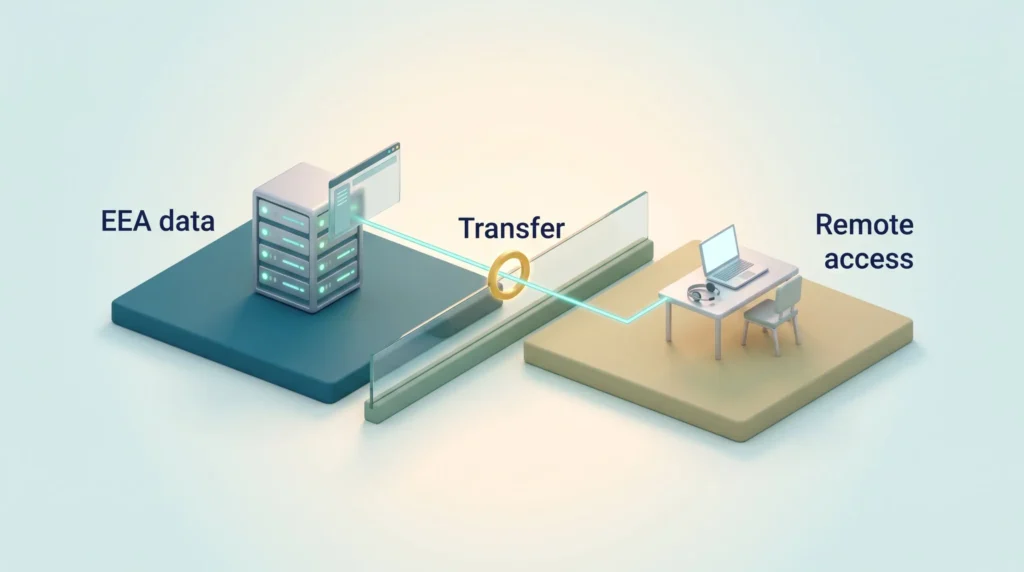
Storage in the EEA is not the test. The European Data Protection Board’s guidance on the interplay between Article 3 and Chapter V makes clear that letting someone outside the European Economic Area view or control EU personal data is a transfer in its own right. A remote admin session, an offshore support desk, a build pipeline that pulls production records, or a crash dump containing user identifiers all qualify.
That has practical consequences. If your night shift sits in a country without an adequacy decision, you need a lawful basis for that access, not just for the hosting.
The mechanisms you can actually use
Three routes cover most situations.
Adequacy decisions are European Commission findings that a country protects data well enough for transfers to flow freely. The EU-US Data Privacy Framework is the one most SaaS companies rely on. The EU General Court dismissed Philippe Latombe’s challenge to it on 3 September 2025 in case T-553/23, and an appeal to the Court of Justice was lodged in October 2025. The framework remains valid while that appeal runs, but the two earlier transatlantic arrangements were both struck down, so plan for the possibility that this one is too.
Standard contractual clauses (SCCs) are pre-approved contract terms between the exporter and the recipient. They are the fallback that keeps working if an adequacy decision falls away, which is why prudent teams keep them signed and ready even while relying on the framework.
Technical safeguards support both routes. Strong encryption, keys held inside the EEA, pseudonymised identifiers and tightly scoped admin roles are what a transfer impact assessment (a written analysis of the risk in the destination country) is meant to describe.
What the EU Data Act adds
Since 12 September 2025, the EU Data Act has applied to cloud and SaaS providers, and it is about portability rather than privacy. Contracts must let a customer switch provider after a two-month notice period, with a transition window of up to 30 days. Providers must list what data and digital assets are exportable, and must describe the measures they take to prevent certain non-EU government access to non-personal data. Switching charges may only cover direct costs today, and from 12 January 2027 they are generally banned.
If you sell into Europe, that last date belongs on your roadmap. Egress fees that quietly discourage customers from leaving stop being a commercial choice and become a legal problem. Our guide to managing cloud spend with FinOps covers how to model those costs before they surprise you.
Country rules that change your architecture
Russia: localization by default
Federal Law 152-FZ requires that the collection, recording, storage and updating of Russian citizens’ personal data happen in databases located in Russia. Later processing abroad is possible, but only if the Russian master database stays in-country and stays current.
In practice that means routing web forms, mobile SDKs and telemetry into Russian-hosted systems first, then replicating outward. Domestic payment records follow separate rules under the national payment system. Triggers that make you an operator under the law include a .ru domain, ruble billing and a Russian-language site.
Penalties rose sharply under Law 420-FZ, effective 30 May 2025. A first localization breach now draws 1 to 6 million rubles and a repeat breach 6 to 18 million. Repeat data breach offences can attract 1% to 3% of the previous year’s revenue, with a floor of 20 million rubles.
China: thresholds decide the route
The Personal Information Protection Law (PIPL) is China’s main privacy statute. Whether you may move personal information out of the country, and by which route, depends largely on volume.
A security assessment by the Cyberspace Administration of China is required for operators of critical information infrastructure, for anything classified as important data, for non-sensitive data on more than one million people, or for sensitive data on more than 10,000 people. Those approvals are valid for three years. Below those thresholds, the Chinese standard contract or a certification route applies, and certification measures took effect in January 2026. Transfers of non-sensitive data covering fewer than 100,000 people generally need no mechanism at all.
Provisions issued in March 2024 added exemptions for transfers necessary to perform a contract, such as bookings, shipping and payments, and for employee data handled under documented HR policies. Free trade zones in cities including Beijing, Shanghai and Tianjin publish negative lists that narrow the requirements further, so check the list for your zone before assuming the general rules apply.
India: a negative list, with a 2027 deadline
India took a different path from Europe. The Digital Personal Data Protection Act allows transfers to any country except those the central government restricts by notification. There are no standard contractual clauses and no formal adequacy process, which means less paperwork and more political risk.
The implementing rules were notified on 14 November 2025. Consent manager registration applies from roughly November 2026, and the core business obligations, including consent notices, retention limits, children’s data rules and security safeguards, apply around May 2027. Significant data fiduciaries, essentially the larger platforms, face an extra constraint: certain categories of personal data and related traffic data, to be specified by government, must not leave India at all.
If India is on your expansion map, the practical move is to build the routing capability now rather than in 2027. Our global expansion framework covers how to sequence that against sales commitments.
Vietnam: a new law, with revenue-linked fines
Vietnam’s Personal Data Protection Law (Law 91/2025/QH15) and Decree 356/2025 took effect on 1 January 2026, replacing Decree 13/2023 as the primary framework.
The law does not mandate localization. It does require valid consent for cross-border transfers, plus a transfer impact assessment filed with the Department of Cyber Security and High-Tech Crime Prevention within 60 days of starting transfers, refreshed every six months or whenever something material changes. Exceptions exist for personnel management, cross-border logistics and micro-enterprises.
The penalties are what make this a board-level item. Administrative fines reach 3 billion Vietnamese dong (roughly 115,000 US dollars), cross-border transfer violations can cost up to 5% of annual revenue, and illegal data trading up to ten times the unlawful proceeds.
Saudi Arabia: sensitive data stays put
The Personal Data Protection Law, supervised by the Saudi Data and Artificial Intelligence Authority (SDAIA), now governs personal data alongside the older CITC Cloud Computing Regulatory Framework, which sets registration, classification and breach notification duties for cloud providers.
Enforcement started in 2025. The US International Trade Administration reports that companies are expected to store sensitive and personally identifiable data inside Saudi Arabia unless a specific exemption is granted, with SDAIA and the National Cybersecurity Authority administering the mechanisms. For a SaaS vendor, that usually points toward a local region or a partner with in-country hosting, rather than a contractual fix.
UAE: the free zones are separate countries in practice
Three regimes overlap. The federal Personal Data Protection Law (Federal Decree-Law 45 of 2021) sets the mainland baseline, with full compliance expected by 1 January 2027, though the executive regulations were still unpublished in early 2026 and no adequacy list has been issued. The Dubai International Financial Centre (DIFC) and Abu Dhabi Global Market (ADGM) run their own frameworks with their own clauses and adequacy lists.
The trap is internal. The UAE mainland does not appear on the DIFC or ADGM adequacy lists, so moving records between your free zone entity and your mainland operation needs contractual protection like any other export.
Sector rules bite harder than the general law. Payment services must keep personal and payment data in the UAE under the Retail Payment Services Regulation, banking customer and transaction data must stay in-country with Central Bank approval needed to move it, and electronic health data may only leave for a short list of ministerially approved purposes.
Brazil: transfer rules, fully in force
Brazil’s LGPD follows the GDPR’s logic without a general storage mandate. Resolution CD/ANPD No. 19/2024 introduced Brazilian standard contractual clauses, and the grace period ended on 23 August 2025. Since then, an international transfer is lawful only with those clauses in place, or under another mechanism the national data protection authority has approved. The authority has not yet declared any country adequate, so the clauses are the working answer for most companies.
What localization costs, and what you get back
Be honest with your own finance team about both sides.
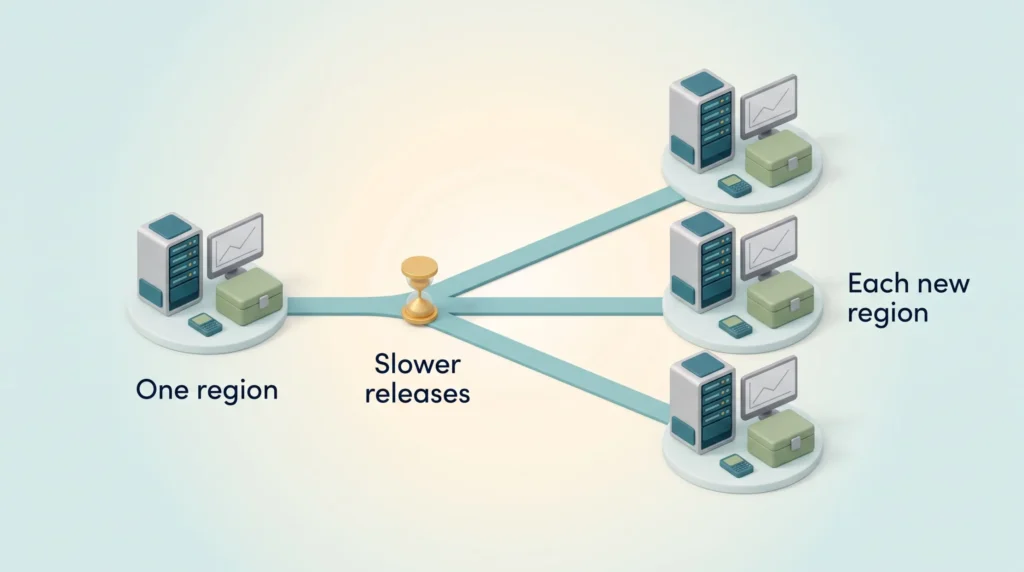
What it buys. Market access in regulated sectors, lower latency for local users, a cleaner story in enterprise security reviews, and shorter procurement cycles once you can answer the residency question with a diagram instead of a promise.
What it costs. Every additional region duplicates infrastructure, monitoring, backups and on-call coverage. Cross-region analytics get harder because you can no longer pool everything into one warehouse. Feature velocity drops, because each release now ships to several environments with different configurations. And you will hire regionally: support staff and site reliability engineers inside the boundary cost less in compliance risk than remote access from headquarters.
There is a middle path worth costing before you commit. Encrypting data and keeping the keys under local custody satisfies a good number of sovereignty concerns without full repatriation of every service. So does using a provider’s sovereign region rather than building your own. AWS launched its European Sovereign Cloud on 15 January 2026 with a first region in Brandenburg, Germany, operated by EU residents under a separate European governance structure, backed by more than 7.8 billion euros of investment in Germany. Comparable offerings exist from other major providers, and for many SaaS companies buying that capability is cheaper than recreating it. Our overview of industry cloud platforms and of hybrid cloud strategy covers how these options compare, and the wider cloud market outlook explains where sovereign regions fit.
A compliance playbook you can actually run
1. Map what you hold
Start with an inventory: what personal and regulated data you hold, which systems it passes through, and which countries touch it. Include logs, analytics events, backups, support tickets and anything in your customer relationship system. Most teams discover two or three flows nobody documented, usually a monitoring tool or an offshore support queue.
Classify by sensitivity and by regulatory scope, flagging payments, health and telecom metadata separately. Then tag those categories inside your storage and processing platforms so an engineer reviewing a pull request can see the scope without asking legal. A broader data governance strategy gives this structure, and a data literacy programme helps the rest of the company read the tags correctly.
2. Fix consent and contracts
Systematise consent capture, withdrawal and proof, and keep the log of consent events, because in Vietnam and several other markets the log is the evidence. Update vendor contracts so sub-processors are named, their locations are disclosed, and audit rights are explicit. Add the relevant clauses: EU SCCs, Brazilian SCCs, Chinese standard contracts, or local addenda where required.
Run an approval workflow for any new transfer that records the legal basis and the technical safeguards. It takes a day to build and saves weeks during due diligence.
3. Document, monitor, repeat
Keep records of processing activities, impact assessments, incident logs and evidence of your technical measures in one place. Non-compliance costs money, but an inability to demonstrate compliance costs deals, because enterprise buyers ask for this material long before a regulator does.
Add continuous monitoring for unexpected data movement, unusual admin behaviour and changes in vendor posture. Then review the whole picture annually, and again whenever you enter a market, switch providers or ship a feature that moves data somewhere new. Our privacy compliance framework sets out the control set in detail, and regtech tooling can automate much of the evidence collection.
Architecture that makes residency auditable
Treat each jurisdiction as an operational boundary rather than a configuration flag.
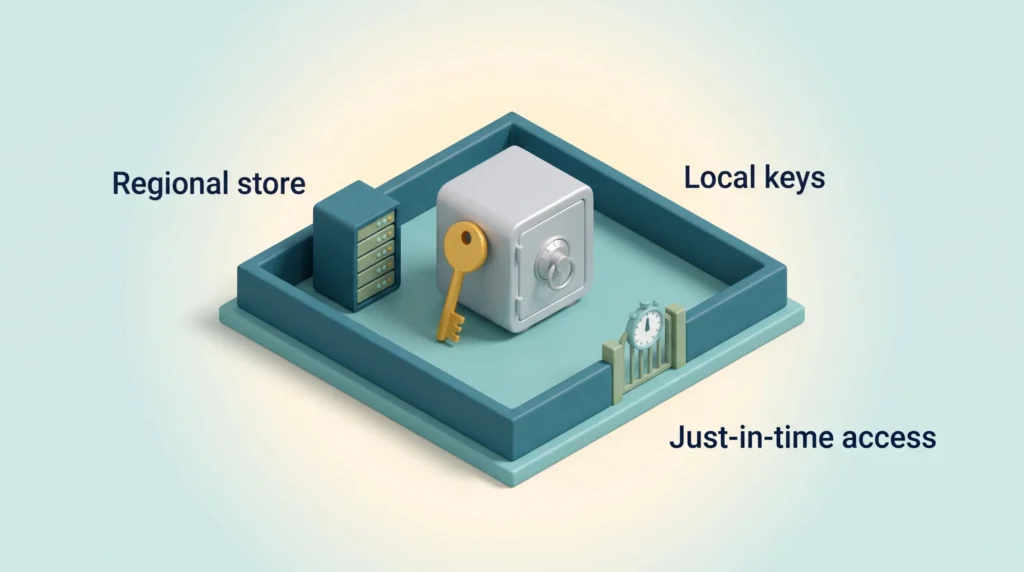
Regional stores and separate environments. Give regulated regions their own databases, queues and storage accounts. Logical separation inside a shared cluster is defensible in some markets and rejected in others, so check before you rely on it.
Local key custody. Keep encryption keys in a regional key management service, with separation of duties by jurisdiction. This is the single control that most often turns a hard residency question into a manageable one. For long-lived data, plan the move to quantum-safe encryption at the same time, since re-encrypting a fragmented estate twice is painful.
Logs as regulated content. Redact or tokenise identifiers before aggregating telemetry across regions. If your observability stack is centralised, that stack is a transfer.
Just-in-time admin access. Replace standing production access with short-lived, ticket-linked elevation and session recording. A distributed security architecture and a zero trust posture, meaning no implicit trust for any user or device, give you the enforcement points to do this without slowing engineers down.
Separate build pipelines. A continuous integration job that pulls production records into a shared runner exports data just as surely as a database replica does. Use masked or synthetic test data instead.
Policy as code. Encode residency rules in infrastructure templates and application checks so violations fail at deploy time rather than at audit time. Related patterns for regional processing are covered in our notes on regional edge and residency patterns, and templates for governance in our governance playbook.
Two adjacent areas deserve the same discipline. Generative AI tools move data in ways that bypass your normal controls, so set clear rules for what may go into a prompt and align them with your AI governance model. And where verification of identity is the bottleneck, decentralized identity approaches can reduce how much personal data you need to hold at all.
What happens if you get it wrong
Enforcement now comes in three flavours, and the financial one is not always the worst.
Fines. Several regimes moved to revenue-linked penalties for repeat or serious breaches, including Russia and Vietnam. Budget for remediation as well: rebuilding a pipeline under deadline pressure costs more than building it deliberately.
Service restrictions. Regulators can block access, order removal from local app stores, or suspend a service in-country. For a subscription business, losing a market for a quarter usually hurts more than the fine attached to it.
Trust. Enterprise customers write audit rights and breach notification into contracts. A public failure triggers those clauses across your whole base at once, not only with the affected customer.
The mitigations are unglamorous. Keep the evidence current, define who talks to regulators and customers before you need them, and prepare a remediation plan with dates. Regulators consistently treat prompt, documented correction more leniently than a good explanation. Internally, the same transparency is what keeps trust intact across a distributed team when something goes wrong at 3am.
What to watch next
Four dates are worth putting in the plan. From 12 January 2027, EU cloud switching charges are largely banned. Around May 2027, India’s core obligations take effect. By 1 January 2027, UAE mainland compliance is expected. And the appeal against the EU-US Data Privacy Framework continues at the Court of Justice with no hearing scheduled as of mid-2026.
Beyond the calendar, two structural shifts matter. Sovereign cloud regions are turning residency into a product you buy rather than a project you run, which lowers the cost of entering a strict market. And regulators increasingly ask about access and governance rather than geography, which rewards companies that can show who touched what, and when.
Build for that. A modular platform where residency is a deployment parameter, keys are regional, and access is logged will absorb the next rule change without an emergency rewrite. One that hard-codes a single global database will not.
Conclusion
Data localization is no longer a legal footnote to international sales. It shapes hosting, support rotas, logging, pipelines and hiring, and it decides which markets you can credibly sell into.
The work is sequential and unglamorous. Map what you hold. Separate regions properly. Keep keys local. Replace standing access with short-lived elevation. Write down what you did and keep it current. Choose vendors that publish their sub-processor locations and support local key custody, because their weaknesses become yours in an audit.
Done once, that foundation makes each new country a configuration exercise instead of a rebuild. That is the real return on compliance work: not avoiding a fine, but being able to say yes to a regulated customer without a six-month project behind the answer.
Found this useful?
Make SmartKeys a preferred source on Google, and our articles will surface more often in your Top Stories, AI Overviews, and AI Mode.
Add as Preferred Source