More than 70 countries now run a formal remote work visa, and the number keeps climbing. These programmes let you live in one country while you keep earning from employers or clients somewhere else, usually for a year at a time.
The idea is simple. A government gives you legal permission to stay longer than a tourist and to work online while you are there, in exchange for spending your foreign income in its economy. What varies enormously is the price of entry: the monthly income you must prove, the paperwork, the fees and the tax bill at the end of the year.
This guide covers what these programmes require in 2026, which countries have raised their thresholds, where the tax breaks are real, and how to pick a base that fits the way you actually work.
Key Takeaways
- Around 72 countries offered a digital nomad visa at the start of 2026, up from roughly 50 in 2023.
- Most programmes run 12 months, with renewal or conversion into a longer residence permit.
- Income thresholds moved up in 2026: Spain now asks about 2,849 euros a month, Portugal 3,680 euros.
- Croatia, Costa Rica, Malaysia and the UAE exempt qualifying foreign income from local tax.
- Pick a base on internet reliability, time zone overlap, healthcare and total cost, not the visa alone.
What a digital nomad visa is, and how it differs from a tourist visa
A digital nomad visa is a temporary residence permit for people whose income comes from outside the host country. You keep your existing job or clients. The host country lets you live there legally while you do that work online.
A tourist stamp does something different. It is shorter, usually 90 days or less in Europe, and it does not authorise work. Plenty of people have worked quietly on a tourist visa, but the risk is real: overstaying or working without permission can mean fines, a re-entry ban, or a rejected application the next time you try to do things properly.
The trade-off is paperwork. A nomad visa asks you to prove things a tourist never has to prove: a stable income, health cover, a clean criminal record, and somewhere to live.
One rule is near universal. You may work remotely for foreign employers and clients, but you may not take a local job or, in many programmes, earn more than a small share of your income from clients inside the host country. Portugal’s D8 is explicit about this.
Why the number of programmes keeps growing
Remote work did not fade after 2020, it settled. In the United States, roughly a quarter of paid full days are now worked from home, and employers kept flexible policies rather than reversing them. That left a permanent population of workers who can live almost anywhere.
Governments noticed. A remote worker earning 3,500 euros a month abroad pays rent, eats out, uses coworking space and books flights, all without competing for a local job. For a country with seasonal tourism or a shrinking working-age population, that is an attractive visitor to keep for a year rather than a fortnight.
The count reflects that. Roughly 50 countries had a formal programme by 2023. By 2026 the figure had passed 70, with Nepal joining at the start of the year at a notably low bar of 1,500 dollars a month.
If you want the wider picture of how this workforce is changing, our guide to digital nomads and the technology behind mobile work covers the infrastructure side, and our overview of the work from anywhere economy looks at what it means for employers.
What you need to qualify
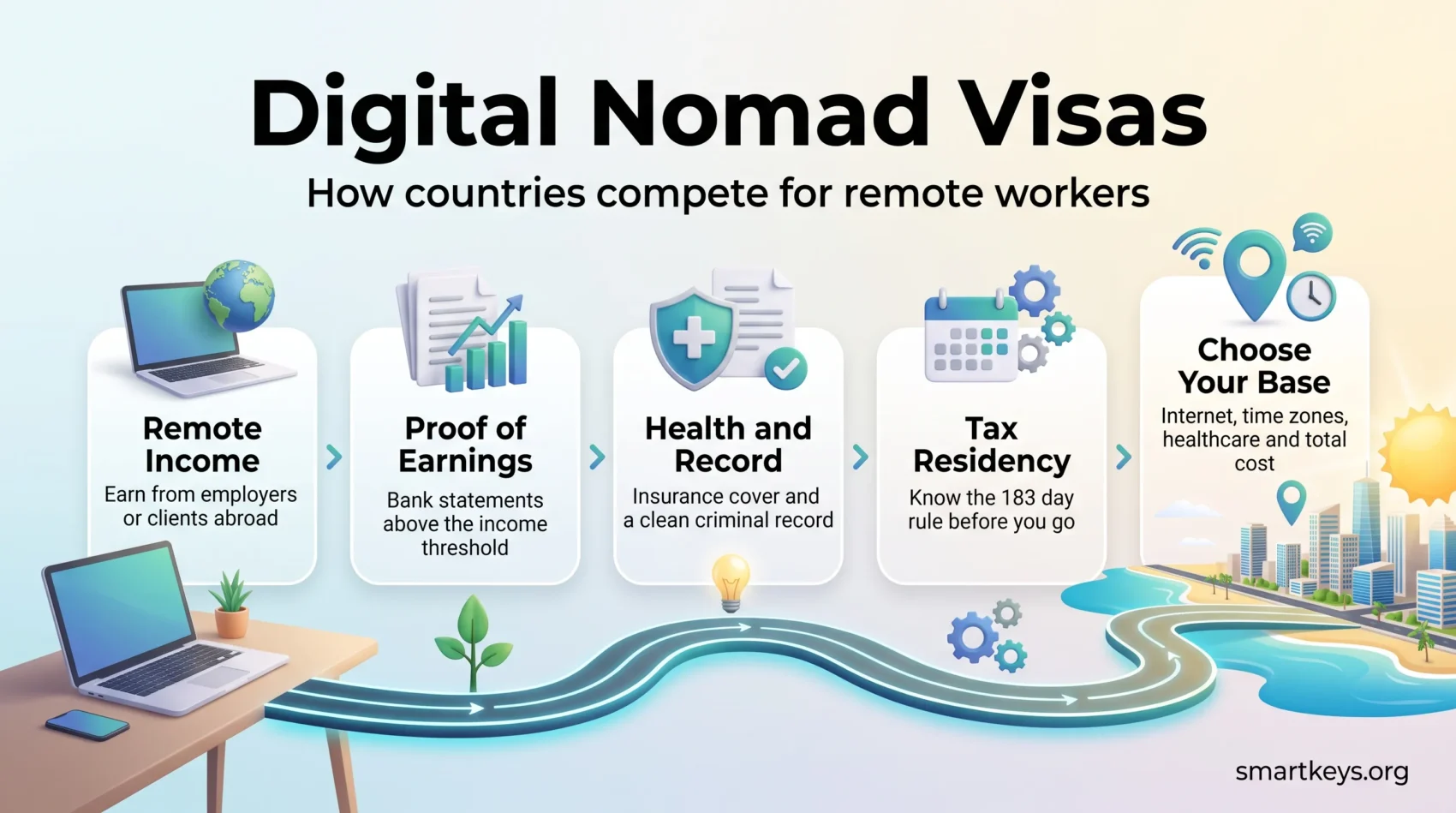
Programmes differ in detail but converge on the same five checks.
Proof that your work is foreign. An employment contract, a letter from your employer confirming you may work abroad, recent client invoices, or company registration documents. Consulates want to see that the money originates outside their borders.
Proof of income. This is where most applications fail. Countries set either a monthly floor or an annual total, and they want to see it sustained. Three to six months of bank statements is the usual evidence. The UAE moved to six months of statements in January 2026.
Health insurance. Nearly always mandatory, usually with a minimum coverage amount and a requirement that the policy is valid in the host country for the full permit period. Costa Rica, for example, asks for 50,000 dollars of cover.
A clean criminal record. Issued by your home country, often within the last three months, and frequently needing an apostille and a certified translation. Start this early: it is the single most common cause of delay.
Somewhere to live and a valid passport. A lease, a hotel booking or a host letter usually satisfies the accommodation requirement. Passports typically need six to twelve months of validity beyond your intended stay.
Income requirements in 2026
Thresholds rose across Europe in 2026, mostly because they are pegged to local wages rather than set as fixed numbers. If you researched a country in 2024, check again before you apply.
Europe:
- Spain: about 2,849 euros a month, up from 2,763 euros in 2025. The figure is 200% of the national minimum wage, so it moves whenever that does.
- Portugal (D8): 3,680 euros a month for 2026, roughly four times the minimum wage, plus savings equivalent to about twelve months of minimum wage.
- Croatia: about 3,622 euros a month, recalculated each year at 2.5 times the average net salary.
- Greece: 3,500 euros a month, with roughly 20% more for a spouse and 15% per child.
- Malta: about 3,500 euros a month, or 42,000 euros a year.
- Estonia: 4,500 euros net a month, the highest bar in the region.
- Italy: around 28,000 euros a year, one of the lowest thresholds in Western Europe.
Outside Europe:
- UAE (Dubai): 3,500 dollars a month.
- Costa Rica: 3,000 dollars a month for a single applicant.
- Malaysia (DE Rantau): 24,000 dollars a year.
- Japan: about 10 million yen a year, one of the steepest requirements anywhere.
- South Korea: roughly 105 million won a year, with a substantially lower bar for applicants aged 18 to 34.
- Thailand (DTV): no income floor, but 500,000 baht held in your account, at most consulates for at least three months before you apply.
Two practical notes. Dependents raise the requirement almost everywhere, commonly by 15% to 25% each. And aim comfortably above the posted minimum: exchange rate movements between your statements and the reviewing officer’s calculation have sunk borderline applications.
Europe: the main contenders
Spain
Spain has become the default choice for many US remote workers, partly for time zone reasons and partly for tax. Apply from a consulate and you get a one year visa; apply from inside Spain, if you can enter visa free, and you can receive a three year authorisation directly. Renewals run in two year blocks up to five years.
The tax draw is the special expat regime, a flat 24% on Spanish source employment income up to 600,000 euros a year, available for your arrival year plus five more. Foreign source income is generally left alone. Lower figures appear in older guides, so check the current rate before you plan around it.
Portugal
Portugal splits its routes. The D8 targets active income from remote work, while the older D7 suits people living on pensions, rental income or dividends.
The attraction is the destination rather than the visa itself. A D8 residence permit runs two years, renews for three more, and after five years of legal residence you can apply for permanent residency or citizenship. Very few nomad programmes lead anywhere permanent. This one does. The tax position is less generous than it was: the old non-habitual resident regime has been replaced, and eligibility for its successor depends on your profession and transitional rules.
Italy
Italy launched its route in 2024 and asks for around 28,000 euros a year, which is modest by regional standards. The permit runs one year and renews annually for up to five, after which EU long-term residence becomes possible.
Italy also offers two separate tax regimes new residents can elect: an impatriate scheme exempting half of qualifying income for five years, and a flat rate regime for self-employed people under an income cap. You choose one, not both, and the interaction with your home country’s rules is genuinely complicated.
Croatia
Croatia is the clearest tax story in Europe. Foreign source income earned by permit holders is exempt from Croatian income tax, and that holds even if you pass the 183 day residency line.
The catch is that it goes nowhere. The permit was extended to 18 months in 2025, but it cannot be renewed, it does not count towards permanent residency, and you must wait at least six months before reapplying. Treat it as a very good year and a half, not a first step.
Greece and Malta
Greece asks 3,500 euros a month and issues a twelve month visa that converts into a two year renewable residence permit. Since February 2026 you must apply from a consulate before travelling rather than switching status in-country. Its non-dom inbound worker regime can exempt half your income tax for up to seven years, provided you become a Greek tax resident and were not one for five of the previous six years.
Malta runs a Nomad Residence Permit that can extend to four years, taxes qualifying foreign income at 0% in the first year and 10% afterwards, and has the practical advantage of operating in English throughout.
Estonia
Estonia was first to market and remains the most digital-first process, with short stay and long stay options up to a year. The threshold has risen sharply to 4,500 euros net a month, which now prices out a large share of applicants who would have qualified two years ago.
Beyond Europe
UAE (Dubai). One year, renewable, 3,500 dollars a month, and no personal income tax. Budget realistically: government fees are small, but medical testing, the Emirates ID, mandatory health insurance and optional agent help push a typical first year into the high hundreds or low thousands of dollars. Connectivity and flight links are excellent, which matters if your clients are spread across time zones.
Thailand. The Destination Thailand Visa replaced the older patchwork for most remote workers. It is a five year multiple entry visa allowing 180 days per entry, extendable once for a continuous 360 days. There is no monthly income test, only 500,000 baht in savings. It permits online work for overseas clients but not for Thai companies.
Costa Rica. One year, extendable, 3,000 dollars a month solo or 4,000 with dependents, 50,000 dollars of insurance, and an exemption on foreign income.
Malaysia. DE Rantau runs three to twelve months with renewal, asks 24,000 dollars a year, and its foreign income exemption is currently legislated to run well into the next decade.
South Korea and Japan. Both sit at the expensive end. Korea’s permit can now reach three years and cuts the income bar sharply for applicants under 35. Japan’s six month workation visa has a high annual income requirement and no routine renewal, so plan your exit before you arrive.
Tax: where you pay, and where you might not
This is the part that turns a cheap year into an expensive one. Getting a visa and becoming a tax resident are two separate events, and the second one is usually triggered by days on the ground.
Most countries use a 183 day test. Cross it and you generally become tax resident, which can mean the host country wants to tax your worldwide income. Some programmes deliberately break that link. Croatia exempts foreign income for permit holders regardless of days. Costa Rica, Malaysia and the Philippines exempt qualifying foreign earnings. The UAE has no personal income tax at all.
Others offer a reduction rather than an exemption. Greece can halve taxable income for up to seven years. Spain’s flat 24% regime, Italy’s impatriate scheme and Malta’s 10% rate all work the same way: a favourable rate for a defined window, conditional on not having been resident recently.
Three things worth planning before you book a flight:
- Your home country still has a claim. US citizens are taxed on worldwide income wherever they live, though the foreign earned income exclusion and foreign tax credits usually prevent double taxation.
- Count days deliberately. Leases, family presence and where you keep your main home can all influence a residency determination, not just the calendar.
- Social security is separate from income tax. A tax exemption does not automatically mean an exemption from contributions.
If your income comes from several countries or you run a company, pay for an hour with a cross-border tax adviser. It is cheaper than a correction two years later. The same care applies to how your employer handles you abroad, which our guide to global payroll solutions and our look at employee mobility policies both cover.
Length, renewals and the path to something longer
Duration should shape your shortlist as much as income does.
Short and fixed. Japan’s six months has no routine extension. Croatia’s 18 months is generous but terminal.
One year, renewable. The most common shape. Malta, the UAE, Costa Rica, Greece and Italy all start here and renew if you still qualify.
Genuinely long. Thailand’s DTV runs five years. Korea reaches three. Spain can run to five years through renewals. Portugal is the outlier that leads to permanent residency and citizenship after five years.
Schengen access is a separate question. A residence permit issued by a Schengen country generally lets you travel within the area, but it does not grant the right to work in other member states. Confirm whether your permit is a short stay or long stay type before you plan a multi-country year.
If you are coordinating with colleagues across several countries, our guides to managing cross-border remote teams and follow-the-sun scheduling are useful companions.
Applying: process, documents and timelines
You will either file online or through a consulate, and that choice usually determines your timeline. Online systems accept PDF uploads and tend to be faster. Consulates often want originals, sometimes an interview, and always an appointment slot that may be weeks out.
Processing runs from about ten days in the quickest programmes to several months in the slowest. Holidays, backlogs and any request for additional documents extend it.
Assemble one universal document pack and reuse it:
- Passport with sufficient remaining validity and blank pages
- Employment contract, employer letter or client contracts
- Three to six months of bank statements, matching the currency the country expects
- Health insurance certificate meeting the stated coverage minimum
- Criminal record certificate, apostilled and translated
- Lease, booking confirmation or proof of address
- For dependents: marriage and birth certificates, plus their own insurance
Consistency matters more than most applicants expect. Names, dates and figures should match across every document. A middle name on your passport that is missing from your bank statements is enough to trigger a resubmission.
What it actually costs
The headline fee is rarely the real number. Budget in three layers.
Government charges. These range from nothing in a few programmes to several hundred euros. They often come in two parts: a consular visa fee, then a separate residence permit or ID card fee once you arrive. Dubai’s roughly 611 dollar package bundles processing, a medical check and the Emirates ID.
Document costs. Apostilles, certified translations and notarisations regularly add a few hundred dollars, more if you are applying with a family.
Setting up. Health insurance for a year, a rental deposit, agency fees, a local SIM, coworking membership and the flights themselves. These dwarf the visa fee in most cases. If you would rather not sign a lease before you know a city, coliving spaces for digital nomads bundle a furnished room, a desk and a community into one monthly price, and that guide shows what the main programmes cost by region.
Hold a cushion of one to two months of expenses. Applications slip, and a delayed permit while you are already paying rent is the scenario that catches people out.
How countries compete beyond the stamp
The competition has moved past simply having a programme. Countries now differentiate on the things that decide where people actually go.
Tax certainty is the strongest lever, and the clearest offers win: Croatia’s exemption and Dubai’s zero rate need no explanation.
Speed and simplicity matter more than they should have to. Romania built a reputation on fast approvals. Georgia charges nothing to apply. A programme that answers in two weeks beats a marginally cheaper one that answers in four months.
Family terms decide it for anyone not travelling alone: whether spouses can work, whether children can enrol in school, and how much the income requirement rises.
Everything after arrival. English-language services, reliable internet, healthcare you would actually use, and a coworking scene dense enough to meet people. Lisbon, Barcelona, Tallinn, Split and Budapest all built that layer deliberately, and it is why they keep appearing on shortlists. Our guide to coworking spaces and what a desk costs is a useful reference when you compare cities.
Choosing your first base as a US remote worker
Start with the constraint you cannot negotiate: your meeting hours.
Time zones. Portugal and Spain give East Coast workers a civilised afternoon overlap. Central Europe adds an hour of friction. Asia flips your day entirely, which works if your role is asynchronous and fails if it is not. Map a normal week of calls onto local time before you fall in love with a city. Teams that manage this well tend to lean on asynchronous communication tools rather than more meetings.
Connectivity. Do not rely on national averages. Check the specific neighbourhood, read recent accommodation reviews, and have a mobile data fallback. Your income depends on this more than on any other local factor.
Healthcare. Look at private hospital quality and whether English-speaking clinics exist near where you will live, not just whether insurance is accepted.
Total cost against the threshold. Rent, transport, groceries, coworking and insurance. If meeting the income requirement leaves nothing over, the base is wrong even if the visa is approved.
A backup. Keep a second country researched and your documents current. Applications get refused for fixable reasons, and being able to pivot in a fortnight is worth the extra afternoon of preparation. Working from a different country also raises questions about device security and company data, which our guide to cybersecurity for remote work addresses, and about staying visible to your team, covered in our piece on proximity bias.
Conclusion
The choice is no longer whether a programme exists. With more than 70 to pick from, it is which combination of income threshold, permit length, tax treatment and daily life fits your situation.
Three questions settle most decisions. Can you comfortably clear the income bar with documentation to prove it? Does the tax treatment leave you better or worse off once your home country’s rules are applied? And does the permit length match your actual plan, whether that is one exploratory year or a route to permanent residency?
Get those three right, prepare the criminal record certificate and translations early, and budget for the costs that sit behind the headline fee. The application itself is mostly administration once the strategy is settled.
For the wider context on how this shift is reshaping work, see our guides to how remote work changed the workplace, where hybrid work has settled, how companies write a digital nomad policy, current freelancing trends, the future of work travel and building a career from a distance.
Found this useful?
Make SmartKeys a preferred source on Google, and our articles will surface more often in your Top Stories, AI Overviews, and AI Mode.
Add as Preferred Source