Proximity bias is the habit of rewarding the people you see most. In a hybrid team, the colleague at the next desk gets the quick word of praise, the interesting last-minute project, and the news before it is announced. The colleague on the video call gets a summary later, if at all. Almost nobody decides to be unfair. The pattern shows up anyway, in who gets promoted.
The exposure to proximity bias in remote work is large. About 25% of paid full days in the United States were worked from home in May 2026. Among full-time employees, 26% work hybrid and 12% fully remote, according to the Survey of Working Arrangements and Attitudes. More than a third are out of sight for part of the week. How those schedules and policies are set up in the first place is covered in our guide to structuring hybrid work.
The cost lands on real careers. Job-tracking firm Live Data Technologies found that fully remote workers were promoted roughly 31% less often than their in-office peers. That gap is not a law of nature. The evidence points to a management problem rather than a distance problem, so it responds to changes you can make.
Key Takeaways
- Proximity bias means treating visibility as if it were performance.
- SHRM found that 42% of supervisors sometimes forget remote workers when assigning tasks.
- Fully remote staff are promoted less often, yet a controlled trial found no such penalty for hybrid staff.
- The fix is structural: outcome-based reviews, written records, and remote-first meeting rules.
- Track promotions, ratings and project assignments by work location to see whether anything changed.
What proximity bias is and why it matters
Proximity bias is the tendency to give better treatment to people you see in person, simply because you see them. It is a mental shortcut, not a policy. When a manager judges effort without full information, physical presence fills the gap: the person at the desk looks busy, so they must be contributing.
The shortcut is understandable and still expensive. SHRM surveyed 817 supervisors in July 2021 and found that 67% considered remote workers more easily replaceable, and 62% believed full-time remote work damages a person’s career prospects. Those beliefs shape decisions long before anyone opens a performance review.
The practical effect is an access problem. People near the office hear about a project first, get feedback in thirty seconds instead of a day, and are in the room when a decision is made. Each advantage is small. Over a year they compound into a stronger track record, which then justifies the next opportunity.
- It costs you people. Staff who feel overlooked start looking elsewhere, and retaining good performers is cheaper than replacing them.
- It narrows your talent pool. Caregivers, people who cannot commute easily, and staff hired outside your city are the ones most often working remotely.
- It misallocates work. If the best person for a project is not in the building, the project gets the second-best person.
The good news: proximity bias responds to structure. Once contributions are written down and reviews are tied to outcomes, presence stops being the tiebreaker, and accessible remote practices help the same people twice.
What the evidence actually shows
Two findings are often quoted against each other. Read together, they tell a more useful story.
Finding one: the remote promotion gap is real. Live Data Technologies tracks job changes across millions of professional profiles. It reported that fully remote employees were promoted about 31% less often than comparable in-office colleagues, and were more likely to be laid off.
Finding two: working from home is not the cause. Economists including Stanford’s Nicholas Bloom ran a randomized controlled trial at the travel company Trip.com, published in Nature in 2024. Randomized means people were assigned to each arrangement by chance, so the two groups were comparable from the start. Employees with odd-numbered birthdays worked two days a week from home; the rest stayed in the office five days. Across 1,612 employees there was no difference in performance reviews or promotions, tracked for up to two years afterwards, and resignations in the hybrid group fell by 33%.
So why the gap in the wider data? The trial ran with clear rules, equal information and managers who knew they were being measured. In an average company none of that is guaranteed, and full-time remote workers sit furthest from the informal channels. The penalty comes from how teams are run.
How proximity bias shows up at work
You usually see the pattern before you can prove it. Watch who gets the quick wins and the interesting problems.
Recognition and promotions follow visibility
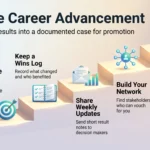
Look for the pattern, not the single case. If the last four stretch assignments went to people who sit near the leadership team, that is worth checking. In the SHRM survey, 42% of supervisors admitted they sometimes forget about remote workers when assigning tasks. Forgetting is not malice, but the career effect is the same. Our guide to remote career advancement covers the employee side.
Information reaches the office first
A decision taken over lunch reaches remote colleagues as a done deal, days later. They then look slow when they raise objections everyone else worked through last week. Open, written communication is the cheapest fix here.
Reviews praise presence instead of results
Watch the language in written evaluations. Phrases like “always around” and “great presence in the office” describe attendance, not output. If a review cannot name a result, it is measuring the wrong thing. Continuous performance management makes this easier to catch, because feedback is recorded as it happens.
Meetings and time zones quietly exclude people
A meeting fixed to headquarters hours, a room microphone that picks up half the table, chat questions nobody reads out: each one shaves a little off remote participation. Hybrid meeting etiquette and, for spread-out teams, follow-the-sun scheduling fix the mechanics.
“Document specific examples: who was invited, who presented, who closed the loop. Patterns are persuasive; anecdotes are not.”
Takeaway: collect three months of calendar invitations, project assignments and review language before you conclude anything. For the wider context, see our overview of diversity and inclusion strategies.
How to prevent proximity bias in your hybrid teams
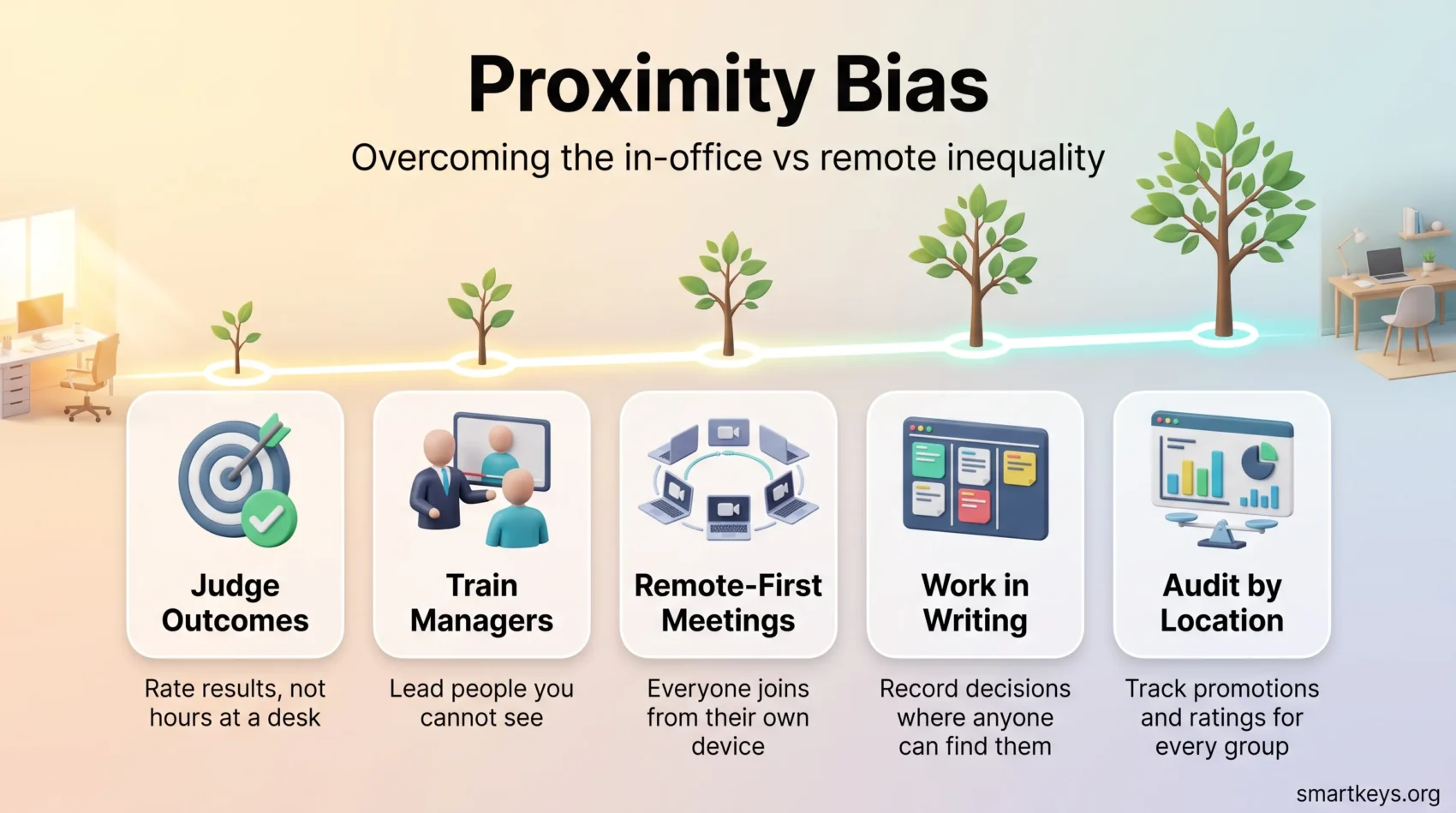
The aim is to make contribution visible without requiring physical presence. Five practices do most of the work.
Judge outcomes, not hours
Write down what success looks like before the work starts. Agree a few KPIs, meaning the measures you will judge the work by: tickets resolved, revenue booked, a feature shipped by a date. A framework like objectives and key results keeps individual goals tied to team goals. Then require managers to cite a result for every rating.
Train managers to lead people they cannot see
Managing remotely is a distinct skill that most managers were never taught. Cover structured agendas, written feedback and coaching by video. Our guide to remote leadership skills sets out what to practise, and these future-ready leadership skills show where the role is heading.
Run every meeting as if everyone were remote
One person on a screen means everyone joins from their own device, with their own camera and microphone. Publish an agenda, take notes in a shared document, and post decisions in a channel afterwards. Whoever missed the call is then a scroll behind, not a week behind.
Make the work visible in writing
Project boards, status channels and recorded updates create a record that does not depend on who walked past your desk. Asynchronous communication tools let people contribute across time zones, and hybrid workforce tools keep office and remote staff on the same information. The record also protects the remote employee at review time.
Have leaders model the behaviour
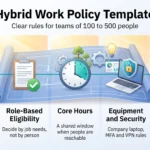
Norms follow the senior people. Synchrony Financial made this explicit early in its remote-first shift. Every employee, senior leadership included, had to work from home at least one day a week, so being off site was normal rather than suspect. The company has since moved to a flexible model with no mandated office days and, in 2026, topped Fortune’s Best Companies to Work For list. Back the example with structure. Use an internal talent marketplace so open projects reach everyone, and mentorship matching so remote staff find sponsors by design. A hybrid work policy writes the rules down.
How to measure whether anything changed
Good intentions are hard to audit. Numbers are not. Two measurements are enough.
Ask, and split the answers by work location
Run short pulse surveys, meaning brief check-ins of a few questions sent every few weeks rather than one long annual survey. Include items such as “I have equal access to growth opportunities, regardless of where I work”, then compare remote, hybrid and on-site staff. A gap between those groups is the finding. AI-powered engagement surveys make frequent checks manageable, and our summary of the 2026 engagement evidence gives you a benchmark.
Audit promotions, ratings and assignments
Pull twelve months of promotions, performance ratings, high-impact assignments and training budget by work location. You are looking for a group consistently underrepresented in the good outcomes. Repeat the audit twice a year, publish what you found, and say what you changed. Closing the loop convinces people the exercise was real.
Conclusion
Proximity bias is not a character flaw in your managers. It is what happens when presence is the easiest signal available. The fix is to make better signals easier to reach: outcomes written down before the work starts, meetings that treat the screen as the default, decisions recorded where anyone can find them, and reviews that cite a result.
The evidence should encourage you. When hybrid work runs on clear rules, the career penalty disappears. The gap in the wider data reflects how teams are managed, which you can change this quarter.
Start small. Pick one meeting, one review cycle and one audit. Check the numbers again in six months, and see whether the people doing the best work are the ones getting the next opportunity, wherever they sit.
Found this useful?
Make SmartKeys a preferred source on Google, and our articles will surface more often in your Top Stories, AI Overviews, and AI Mode.
Add as Preferred Source