A global holiday calendar is one shared list of the days your colleagues and customers are likely to be off work, in every country where you operate. It sounds trivial until a launch lands on the first day of Golden Week in Japan. Or until an approval sits unsigned because the only person who can sign it is observing Eid.
This guide shows you how to build that list, keep it accurate, and turn it into a few simple rules your team can actually follow. No special software is required. A spreadsheet and a shared calendar will do.
You will learn which dates are fixed and which move every year, and where to get reliable sources instead of guessing. You will also see how to set meeting-free windows that people respect, and how to time campaigns so they do not land on a day of mourning in one of your markets.
Key Takeaways
- One shared list beats a dozen private ones. Everyone plans against the same dates.
- Some holidays move each year because they follow the moon, not the Gregorian calendar. Treat those as estimates until confirmed locally.
- Clock changes in March and October quietly break recurring meetings for several weeks.
- Name an owner per region and review the list quarterly, or it goes stale within months.
- Blackout days protect both your people and your brand: no big launches, no promotional sends.
Why a shared holiday calendar is worth the effort
Without one, every team guesses. Sales books a customer call on a national holiday. Engineering schedules a release the week half of the India office is traveling for Diwali. Marketing sends a discount campaign on a remembrance day.
None of these are malicious. They happen because the information lives in people’s heads, and the people who hold it are not in the room when the date is picked.
A shared list fixes that in a mundane but effective way. When someone opens the calendar to book a workshop, the conflict is visible before the invite goes out. That is the whole mechanism. Most of the value comes from making the information available at the moment of the decision, not from the sophistication of the tool.
There is a second benefit that shows up later. Teams notice when their own observances are treated as real. Treating a colleague’s national holiday as a genuine day off, rather than a scheduling inconvenience, is one of the cheapest trust-building moves available to a distributed team. It is also a basic part of managing a global team across borders. It sits alongside the other habits that hold remote company culture together.
Step 1: Decide what belongs on the list
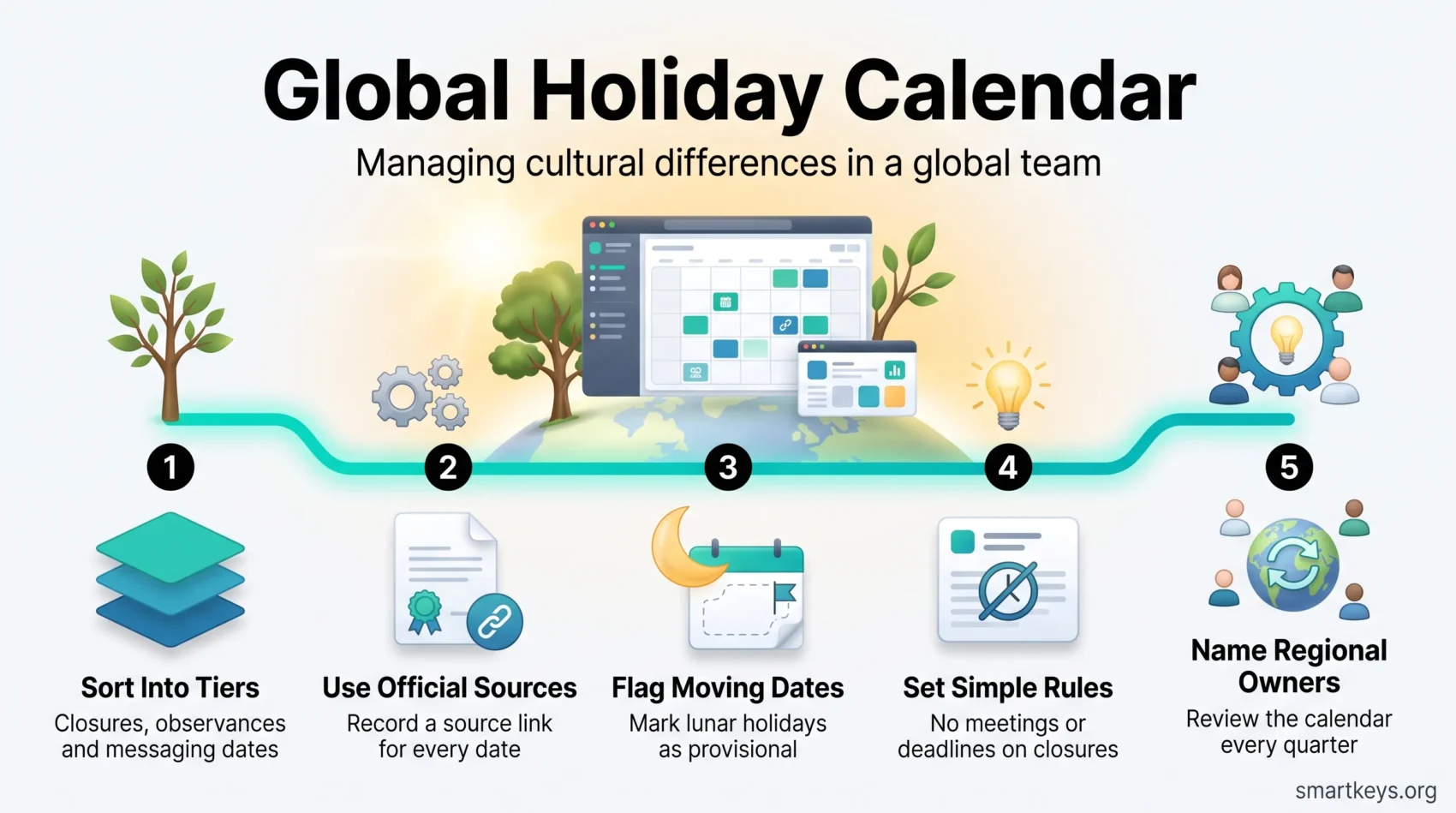
Not every observance needs an entry. A calendar that lists every national day in every country becomes noise that nobody reads. Sort entries into three tiers.
Tier 1: statutory closures. Public holidays where offices, banks and schools close. These directly affect who is available, and they are the backbone of the calendar.
Tier 2: widely observed days that are not closures. Ramadan, Lent, Yom Kippur, regional school breaks. People are working, but energy, hours and availability shift. A fasting colleague may prefer morning meetings. A parent during school holidays may need a different pattern.
Tier 3: dates that affect messaging only. Remembrance days, international awareness days, major shopping events. Nobody is off, but the tone of what you publish matters.
Tag each entry with its tier. Then your rules can be simple: Tier 1 blocks meetings and deadlines, Tier 2 triggers flexibility, Tier 3 triggers a content review.
Step 2: Get the dates from sources that will still be right next year
The most common failure is copying dates from a blog post and never checking them again. Holiday dates change. Governments add one-off days, move a holiday to create a long weekend, or announce substitute days when a fixed date falls on a weekend.
Use primary sources where you can. For each country, that usually means the government labor ministry or the central bank, both of which publish an official list for the coming year. Your payroll provider or employer of record will also publish a country holiday schedule, and it is contractually bound to get it right.
For religious dates, use a source tied to the community that observes them rather than a generic calendar site. Islamic dates in particular depend on local moon sighting, so the same holiday can start a day apart in two countries.
Record a source link next to every entry. A year from now, the link is what lets you check the date in thirty seconds instead of researching it again from scratch.
Step 3: Understand which dates move, and why
This is the part most calendars get wrong. Three different systems are in play, and they behave differently.
Fixed Gregorian dates land on the same day every year. Christmas Day on 25 December, Juneteenth on 19 June, Singles’ Day on 11 November. Easy to plan, though the weekday changes, and some countries shift the observed day when the date falls on a weekend.
Rule-based dates are fixed by a formula rather than a number. US Thanksgiving is the fourth Thursday in November. Memorial Day is the last Monday in May. These are predictable years ahead, but you cannot copy last year’s date.
Lunar and lunisolar dates move against the Gregorian calendar. The Islamic calendar is purely lunar, so its dates fall roughly 10 to 12 days earlier each year. The start of Ramadan is confirmed only when the new moon is sighted locally. Chinese New Year, Diwali, Passover, Easter and Vesak follow lunisolar rules and shift within a window each year.
Mark every lunar entry as provisional in your calendar and add a note saying when it will be confirmed. That single label prevents the most damaging kind of mistake: treating an estimate as a certainty and booking a launch on top of it.
Anchor dates to plan around
A handful of dates cause most of the scheduling pain. Here are the ones worth knowing well ahead, with 2027 as the reference year, since planning for the year ahead is where the calendar earns its keep.
United States. There are eleven federal holidays. In 2027: New Year’s Day (1 January), Martin Luther King Jr. Day (18 January), Washington’s Birthday (15 February), Memorial Day (31 May), Juneteenth (observed 18 June), Independence Day (observed 5 July), Labor Day (6 September), Columbus Day (11 October), Veterans Day (11 November), Thanksgiving (25 November) and Christmas Day (observed 24 December). When a fixed date falls on a weekend, federal employees observe it on the nearest weekday, which is why three of these shift (source: FederalPay federal holiday schedule).
Japan. Golden Week runs from 29 April to around 5 May, a cluster of public holidays that produces the heaviest domestic travel week of the year. Avoid launches and expect slow responses.
China. Chinese New Year falls on 6 February 2027, the start of the Year of the Goat, and the associated holiday period extends around it. Factories and offices close for several days, and the exact public holiday span is announced by the State Council each autumn.
India. Diwali falls on 29 October 2027. Travel and gifting peak around it, and many teams take extended leave.
Muslim-majority markets. Ramadan is expected to begin around 8 February 2027, with Eid al-Fitr expected around 9 to 12 March, depending on whether Ramadan runs 29 or 30 days. These are projections: Hijri dates are confirmed only after the moon is sighted, so treat them as a planning window rather than a schedule.
Christian observances. Western Easter falls on 11 April 2027; Orthodox Easter falls on 2 May 2027. In 2027 the two are three weeks apart, which matters if you operate in both Western Europe and Greece, Romania or Serbia.
Shopping peaks. Singles’ Day is 11 November, Black Friday is 26 November 2027 (the day after US Thanksgiving), Cyber Monday follows on 29 November, and Boxing Day is 26 December. These are not days off, but they are days when your support and logistics load spikes and your engineering team should not be deploying.
If you sell into new countries, the local holiday pattern is one of the first things to research, alongside the other groundwork in a global expansion strategy.
Clock changes: the quiet disruption
Twice a year, recurring meetings move for some participants and not others. A call that has worked for months suddenly lands at 6am for one region.
The United States switches to daylight saving time on the second Sunday in March and back on the first Sunday in November. The European Union switches on the last Sunday in March and back on the last Sunday in October. Those are different weekends, so for two to three weeks each spring and autumn the gap between US and European time zones is an hour off its usual size.
The EU has been debating whether to abolish the switch since 2018. The European Parliament backed ending it. The Council of the EU has not reached agreement, and its official position is that no decision has been taken and no timeline exists. In practice: plan for the clocks to keep changing.
Large parts of the world, including most of Africa, India, China and Japan, do not observe daylight saving at all. So every switch changes your overlap with some regions and leaves others untouched. Two weeks before each switch, check your recurring invites and fix the ones that break. If your team relies on protected focus time blocks, check those too.
Turn the calendar into rules people follow
A calendar nobody acts on is a wiki page. Convert it into three or four rules that are short enough to remember.
No meetings on Tier 1 days. If a country has a public holiday, nobody schedules a meeting that includes people from that country. Not “try to avoid”: no.
No deadlines on the day before or after. The day before a holiday is when people are clearing their desks. The day after is when they are catching up. Deadlines placed there are missed or met badly.
Default to written updates during long observances. Multi-day periods like Golden Week or Eid are exactly when a status meeting should become a written post. Teams that already use asynchronous communication tools find this easy; teams that do not can start here, since a holiday week is a low-risk trial of working asynchronously.
No promotional sends on solemn days. Remembrance days, national days of mourning and religious days of atonement are not campaign slots.
Rules are easier to enforce when the calendar is visible in the tool where meetings are booked. Subscribe the shared holiday calendar into everyone’s Google Calendar or Outlook so the conflict shows up during scheduling, not afterwards. The wider discipline here is the same one covered in calendar management, and it pairs well with a periodic meeting audit that removes the recurring calls nobody needs. For the calls that remain, hybrid meeting etiquette decides whether the people dialing in from a different time zone get a real say.
Coverage: who does the work while people are away
Blocking the day is the easy part. Covering the work is the real problem.
Start by listing the tasks that cannot wait: incident response, payroll runs, customer escalations, anything with a contractual response time. For each one, name a primary and a backup who are in a different country. If both people observe the same holiday, you do not have coverage, you have a single point of failure with two names on it.
That backup only works if the second person can actually do the job. Building a shallow second layer of skills across the team is the quiet prerequisite, and it is what a cross-training strategy is for. The same logic belongs in your workforce contingency planning, since a holiday cluster is a predictable version of the absence you would otherwise be planning for blindly.
Handoffs need a written format, not a verbal one. A short note covering current status, what is blocked, who to contact and where the files are turns a handoff into something the next person can act on. If your team runs a follow-the-sun rotation, you already have this habit; a holiday week is just a longer handoff.
Leave policy, and why the calendar is not enough
A holiday calendar tells you when offices close. It does not tell you when your people want time off. Those are different things.
An employee in the United States may want the days around Rosh Hashanah, which is not a public holiday there. A colleague in India may want the days around Diwali, which may be a holiday in one state and not another. The usual fix is a floating holiday allowance. Each person gets a set number of days to choose, so people take the days that matter to them rather than the days their government picked.
The other half is protecting the time once it is granted. If people answer messages through their national holiday because everyone else is working, the day off was cosmetic. France, Belgium, Portugal, Spain and a growing list of other countries now put a legal version of this into law through right to disconnect rules. The practical point applies everywhere.
Worth reviewing alongside this: whether your flexible PTO policy actually results in people taking leave, and whether longer breaks have a place through a sabbatical policy. Both interact with the holiday calendar more than most companies expect. Teams with people working abroad should also check how local public holidays interact with their digital nomad policy and the conditions attached to the relevant digital nomad visas.
Content and campaign timing
The same date can be a sales peak in one market and a solemn occasion in another. Your calendar is what stops those from colliding.
Mark two content states for each Tier 3 entry. Blackout means no promotional messaging at all. Soft-touch means you may publish, but the tone is respectful and the offer language comes out.
For campaign planning, work backwards from the local date rather than your own. A Diwali campaign approved in your head office in late October is already too late. Creative for a major seasonal peak needs six to eight weeks, because localization, legal review and media buying all sit in that window.
Two things break localization repeatedly. First, translating keywords word for word. Search intent differs by country, and the phrase that converts in one language is often not the literal translation of the one that converts in another. Research local queries before you build the page. Second, assuming the season matches. December is midsummer in Australia and Brazil, so winter imagery in a southern-hemisphere campaign reads as an import rather than a message.
Timing paid and organic activity around local demand is easier when you know how each platform’s seasonal patterns differ by market. That is the practical use of watching social media trends.
Inclusion without tokenism
The point of the calendar is fewer avoidable frictions, not a stream of corporate greetings.
A useful test: does the entry change what we do, or only what we say? If a date changes behaviour, such as no meetings, flexible hours or extra coverage, it belongs in the operating rules. If it only produces a post, ask whether anyone in the affected group asked for it.
Where you do want to mark a date internally, let the people who observe it lead. A short, voluntary session run by colleagues who celebrate the festival beats a centrally written announcement. The same principle applies to the generational assumptions that creep into scheduling, covered in more depth in managing multigenerational teams.
Optional and genuinely voluntary matters here. Attendance at a cultural session should never be tracked, and it should never be the only form of remote team building on offer.
Governance: keeping it accurate
Treat the calendar like a product with an owner, not a document that someone created once.
Name one owner per region. Their job is small but specific: confirm next year’s dates when the local government publishes them, usually in the autumn, and flag any mid-year changes.
Set a quarterly review. Four short checks a year catch nearly everything: newly announced holidays, moved dates, and lunar dates that have now been confirmed.
Keep a change log with who changed what and why. When someone asks why the calendar says one thing and a colleague says another, the log settles it in a minute.
Where to keep it depends on where your team already works. A shared calendar plus a source spreadsheet is enough for most companies. If you run a digital headquarters, the calendar belongs there with everything else. Put the rules themselves in the same place as your hybrid work policy so people find them without asking.
Build your own version this week
You can have a workable first version in a few hours.
- List every country where you have employees, contractors or significant customers.
- For each one, pull the official public holiday list for the next 12 months and record the source link.
- Add the Tier 2 and Tier 3 entries that matter for your markets, and mark the lunar ones as provisional.
- Create a shared calendar, add the entries, and have everyone subscribe to it.
- Write the three or four rules on one page and put them where policies live.
- Name a regional owner and put a quarterly review in the calendar.
Then stop. Resist the urge to add every observance in every country in the first pass. A short, accurate calendar people actually use beats a comprehensive one they ignore. Keep a running list of improvements using the same to-do list habits that work elsewhere. Blocking the maintenance itself is a natural fit for time blocking.
A short glossary
- Public holiday: a day when businesses, banks and schools legally close. The one tier that reliably removes people from work.
- Observed day: the weekday a holiday is taken when the actual date falls on a weekend. Common in the US and the UK.
- Floating holiday: a paid day an employee chooses, so people can take the observances their own calendar has rather than their employer’s.
- Lunar date: a date set by the moon rather than the Gregorian calendar, so it moves each year. Islamic holidays are the clearest example.
- Lunisolar date: a date set by a calendar that tracks both moon and sun, so it moves within a window. Chinese New Year, Passover and Diwali work this way.
- Blackout day: a date on which you publish no promotional messaging in a given market.
Conclusion
A global holiday calendar is not a cultural gesture. It is an operations tool that happens to also signal respect.
The version that works is small: the days that genuinely change availability, sorted into tiers, sourced from somewhere authoritative, owned by named people, and reviewed four times a year. The rules that hang off it should fit on one page.
Build the first version this week with the countries you already operate in. Add markets as you enter them. What you get back is fewer launches landing on holidays and fewer approvals stuck waiting for someone who is away. You also get colleagues who notice that their time off was treated as real. In a cross-border team, that last one is worth more than the scheduling it saves. It shows up in the engagement of remote employees long after the calendar itself has become invisible.
Found this useful?
Make SmartKeys a preferred source on Google, and our articles will surface more often in your Top Stories, AI Overviews, and AI Mode.
Add as Preferred Source