Paying people in another country is mostly a paperwork problem, not a banking problem. The money transfer is the easy part. The hard part is doing it in a way that satisfies the local tax office, the local labour law and your own auditors, every single month.
That is what a global payroll solution is for. It is a platform, or a service provider, that runs payroll in several countries at once: it calculates gross to net pay under local rules, withholds and files the right taxes, pays social contributions, and sends the money in the local currency.
This guide covers the ten providers most small and mid-sized companies actually shortlist, what each one charges according to its own published pricing in September 2026, and the two new European rules that will shape payroll data work over the next year.
Key Takeaways
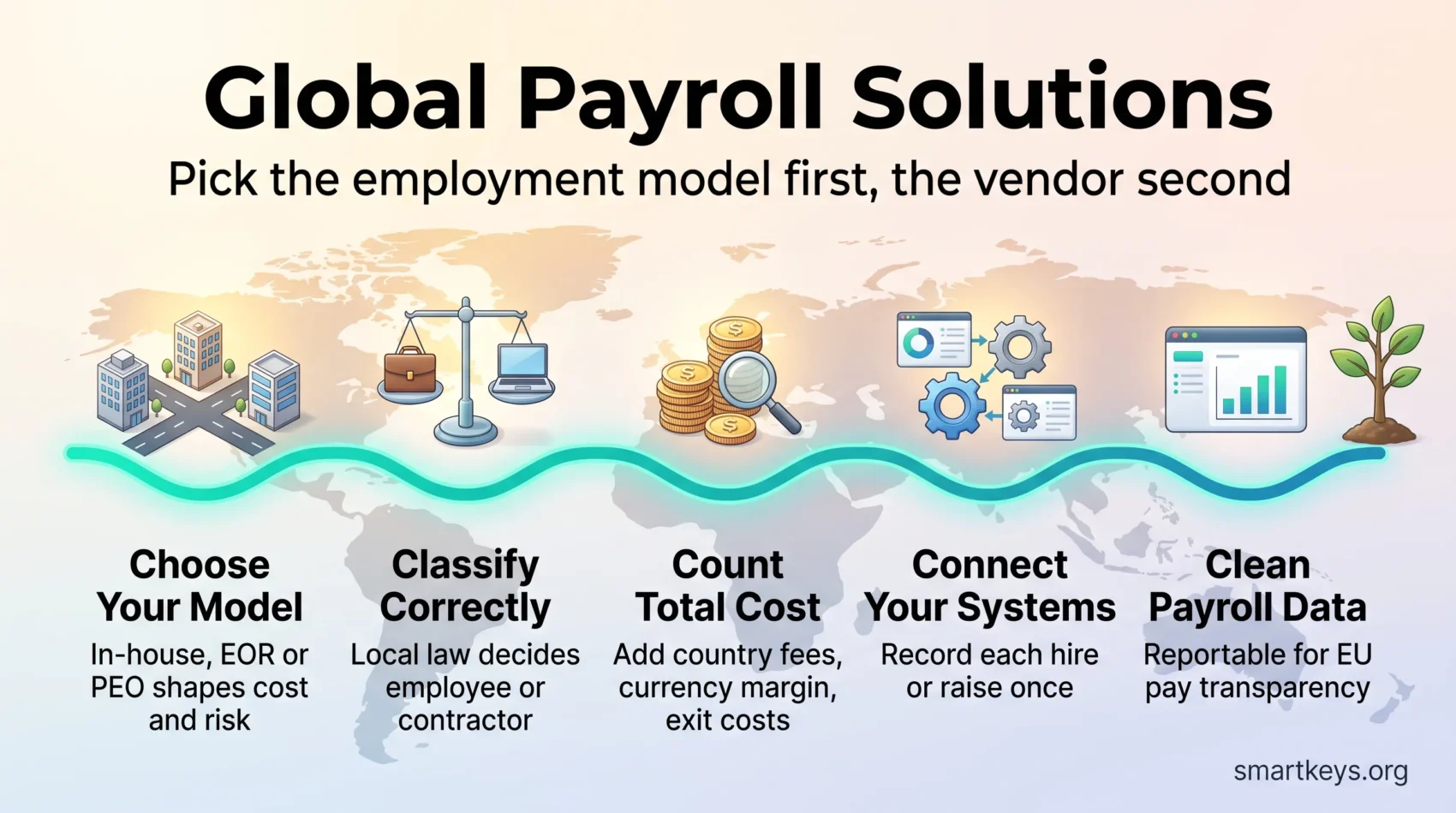
- Pick the model first, the vendor second: in-house, EOR or PEO decides most of your cost and risk.
- Published prices vary enormously: employer of record service runs from about $599 to $699 per employee per month, while pure payroll can be under $30.
- Contractor pricing has moved: some vendors now charge per payment rather than a flat monthly fee per contractor.
- Classification is the expensive mistake: calling an employee a contractor is what triggers back taxes and penalties.
- New EU pay rules land in 2026 and 2027: your payroll data has to be reportable, not just correct.
What This Roundup Covers, and How to Read It
This is a comparison of published capabilities and published prices, not a lab test. Every price below comes from the vendor’s own pricing page or product page, checked in September 2026. Where a vendor does not publish a price, this guide says so instead of guessing.
That matters more than it sounds. Global payroll is one of the least transparent categories in business software. Several large platforms quote only through sales, and list prices are often the floor rather than the real bill once local entity fees, deposits and currency conversion are added.
So use the numbers here to build a shortlist and to sanity-check the quotes you receive. Ask every vendor the same three questions: what is the per-person monthly fee, what is charged on top per country, and what does it cost to offboard someone.
Your Three Commercial Options
Before comparing tools, decide how you want to employ people abroad. There are three routes, and they differ in control, speed and liability.
In-house processing means you set up a legal entity in each country and run payroll yourself, usually with software plus a local accountant. You keep full control of data and cost. You also own every filing deadline. Registering an entity typically takes months, so this suits countries where you already have a real presence.
An EOR, or employer of record, is a company that legally employs your worker on your behalf in a country where you have no entity. The worker does your job day to day, but their formal employer is the EOR, which handles the contract, payroll, taxes and statutory benefits. You get speed. You pay a premium and you give up some control over contract terms.
A PEO, or professional employer organisation, is a co-employment arrangement. You keep the legal employment relationship, and the PEO administers payroll, benefits and parts of compliance alongside you. It sits between the other two on both cost and risk, and in the US it also buys benefits at a scale a small company cannot reach alone.
Employees versus contractors
The line between an employee and an independent contractor is drawn by local law, not by the wording of your agreement. Regulators look at how much control you have over the work, whether the person can send a substitute, whether they work for others, and how integrated they are in your team.
Get it wrong and the bill is retrospective: unpaid employer contributions, income tax, interest and fines, usually going back years. If you rely heavily on freelancers, our guide to managing freelancers without creating employment risk covers the practical controls.
- Choose an EOR when: you need one or two hires in a country fast, or the market is legally complex.
- Stay in-house when: you already have an entity, local finance support and enough headcount to justify the overhead.
- Go hybrid when: you run core markets yourself and hand the long tail of small countries to a provider.
Map this against your wider expansion plan before you take demos, because the right model narrows the vendor list by half.
Quick-Glance Picks by Use Case
Prices below are the vendors’ published list prices in September 2026.
- Rippling: best for automation. Products start at $8 per user per month, and global payroll pricing is quoted rather than published.
- Justworks: best for occasional international contractors, at $39 per month per contractor you actually pay, across 60+ countries.
- Gusto: best for US companies adding their first overseas contractors. The Simple plan is $49 per month plus $6 per person, and global contractor payments cost $5 per payment rather than a monthly fee.
- Remote: best for compliance-led buyers. Global payroll and contractor management are $29 per person per month; full EOR is $699 per employee per month.
- Deel: best for scale and breadth, at $599 per EOR employee per month and $49 per contractor per month.
- TriNet: best for US PEO customers who need international hiring bolted on, delivered through its partner Multiplier across 150 countries.
- Paylocity: best for finance teams wanting global payroll data inside their existing HR system, covering 100+ countries.
- Workday: best for enterprises that need payroll wired into an existing HR and finance core.
- UKG One View: best for consolidating payroll you already run through many local providers, across 160+ countries and 120+ currencies.
- Paychex: best for small US firms that want HR, benefits and payroll from one vendor.
Rippling: Best for Payroll Automation
Rippling’s pitch is that payroll should be a consequence of your HR data, not a separate monthly project. When someone changes role, location or salary in the system, the payroll run, the device policy and the app access all update from that one change.
That design removes the step where most payroll errors are born: rekeying the same information into a second system. Automated checks then flag unusual results, such as a net pay that jumps without a corresponding salary change, before you approve the run.
Pricing starts at $8 per user per month for the core platform, and you buy the modules you need on top. Rippling does not publish separate rates for global payroll or EOR, so treat any figure you see elsewhere as an estimate until you have a quote.
Justworks: Best for International Contractor Payments
Justworks charges $39 per month for each international contractor you pay, in the months you actually pay them. If a contractor sits idle for two months, you pay nothing for those months. The service covers more than 60 countries.
That billing model suits agencies and project-based teams whose contractor list changes constantly. Onboarding is self-service, so the contractor supplies their own tax and identity documents rather than emailing them to your operations team.
Justworks also sells a full EOR product at $599 per employee per month, plus US payroll from $50 per month with $8 per employee, and PEO plans at $79 and $124 per employee per month. The contractor product is the standout; the country list is narrower than Deel’s or Remote’s.
Gusto: Best for a First Step Abroad
Gusto is the low-friction option if you already run US payroll on it and now have one designer in Portugal. You add international contractor payments to the plan you already have rather than adopting a second platform.
The pricing changed in a way that helps small users. Gusto’s Simple plan is $49 per month plus $6 per person, and global contractor payments are billed at $5 per payment to a bank account, with foreign exchange costs applied per transfer. There is no monthly fee per contractor, so occasional payments stay cheap.
The trade-off is scope. Gusto pays contractors abroad; it does not employ people for you. Once you need a real employment relationship in a country where you have no entity, you need an EOR, and that means a second vendor. Our comparison of Gusto with rival HR platforms covers the domestic feature gaps.
Remote: Best for Compliance-Led Buyers
Remote separates its products cleanly, which makes it easy to buy only what you need. Global payroll is $29 per employee per month. Contractor management is $29 per contractor per month, or $99 for the Plus tier that adds contractor misclassification protection. Full EOR employment is $699 per employee per month.
The compliance story is the reason to pay the EOR premium. Remote owns its local entities in most markets rather than subcontracting, and its in-country teams translate rule changes into the payroll configuration itself, so a new statutory contribution shows up in the next run without you filing a ticket.
Two features earn their keep for cautious buyers. Watchtower tracks regulatory changes and tells you which ones need action from you. IP Guard handles the transfer of intellectual property created by workers abroad, which is easy to overlook and painful to fix later.
TriNet: Best for US PEO Customers Going Global
TriNet’s global offering is delivered through its partner Multiplier and covers 150 countries with payroll in 120 currencies. That matters when you read the contract: the international service sits under separate terms and fees from your US PEO agreement.
For a company already on TriNet for US employees, the appeal is one workforce view. You onboard an engineer in Poland through a process that resembles onboarding one in Ohio, and both appear in the same headcount reporting.
The caution is the same one that applies to any partner-delivered model. Ask who holds the local entity, who answers a tax authority letter, and what the escalation path looks like when the answer is not in a help centre article.
Paylocity: Best for Global Payroll Data Inside Your HR System
Paylocity acquired Blue Marble Payroll in 2021 and now sells global payroll as part of its own platform rather than as a partnership. It gives real-time access to aggregated payroll data across more than 100 countries.
The value here is for finance rather than HR. When payroll data from a dozen countries lands in one place in a consistent format, month-end close stops being a spreadsheet exercise and cost reporting by country stops being a project.
That fit is strongest if Paylocity already runs your domestic payroll. If it does not, you are buying a full HR platform to get a global payroll module, which rarely makes sense on cost alone.
Deel: Best for Breadth and Speed
Deel publishes its prices, which is rare in this category. EOR employment is $599 per employee per month. Contractor management is $49 per contractor per month. Contractor of record, where Deel takes on the classification risk, is $325 per contractor per month. US PEO is $125 per employee per month.
Coverage is the other argument. Deel says it owns entities and its own payroll engine in more than 130 countries and operates across 150+ countries in total, which means fewer markets where your hire has to wait for a partner to be appointed.
The practical benefit of that scale is time to first payslip. Where a provider already holds the entity and the bank account, onboarding an employee is a matter of days rather than the months an entity setup would take. Weigh that against the monthly premium: at $599 per person, an EOR stops being the cheap option once you have a real team in one country.
Workday: Best for Enterprise Integration
Workday is the choice when payroll is one process inside a much larger system of record. Its value is not the payroll engine itself but the fact that HR, finance and planning read from the same employee data.
In practice that means a promotion approved in HR flows into payroll, cost centre accounting and headcount forecasting without anyone exporting a file. For companies with strict audit requirements, that single chain of custody for employee data is often the deciding factor.
Workday also connects to third-party payroll providers in countries it does not run itself, so a global employer can keep local specialists while reporting centrally. Expect enterprise implementation timelines and pricing through sales rather than a public rate card.
UKG One View: Best for Consolidating Providers You Already Use
One View solves a specific problem: you already run payroll in fifteen countries through fifteen different local providers, and nobody can see the whole picture. UKG says the product covers more than 160 countries and 120 currencies.
Rather than forcing you to replace those local relationships, One View sits above them. It pulls the data together, gives one view of global payments and funding, and surfaces problems early enough to fix before pay day.
That makes it a poor fit for a twenty-person company and a strong one for a mid-sized or large employer with an inherited patchwork of vendors from past acquisitions.
Paychex: Best All-in-One for Small US Firms
Paychex bundles payroll, HR support, recruiting and benefits administration, which suits a small company hiring its first person abroad. The attraction is having one vendor and one support number rather than assembling a stack.
Paychex quotes its payroll plans through sales rather than a public price list, so budget on the basis of a written quote. Ask specifically which countries the international service covers and whether overseas workers are employed or paid as contractors, because the two carry very different obligations.
For a business testing whether an overseas hire works at all, the bundled approach limits the number of new systems your team has to learn while you find out.
The Features That Actually Change Your Month
Most feature lists in this category describe the same things. These are the ones that change how much work your team does.
Automated tax filing and remittance. Calculating the right deduction is table stakes. Filing it and paying it on time in each country is where providers differ, and where penalties come from.
Pre-run validation. The system should compare this run against the last one and flag anything unusual before you approve, not after the money has left.
Reporting you can hand to finance. Payroll cost by country, by entity and by cost centre, in both local currency and your reporting currency. This is also what makes newer pay reporting duties survivable, and it pairs directly with workforce analytics.
Self-service portals. Payslips, tax documents and personal details that employees can reach themselves, with role-based access so a manager in one country cannot see salaries in another.
Real currency and payment rail coverage. Ask which local rails are supported in your key countries, not just how many currencies appear on the marketing page. Settlement speed for a bank transfer in Brazil is not the same as one in Germany. Some employers now ask about alternative payment methods as well, which brings its own tax treatment.
Implementation, Timelines and Total Cost
A payroll migration fails in the data, not in the software. Plan it as a project with named owners for employee data, bank setup and approvals.
A realistic sequence: discovery and country requirements, data collection and cleaning, configuration, at least one parallel run where you process payroll in both the old and new system and compare the results, then cutover. Vendors quote timelines from a few weeks for a single simple country to several months for multi-country enterprise rollouts. Ask for the plan in writing with milestones, and treat any timeline that skips a parallel run as optimistic.
Building the real cost: the per-person fee is the headline, not the total. Add setup or implementation fees, per-country charges, currency conversion spread, off-cycle run charges, and the cost of offboarding. For EOR arrangements, also check severance funding and notice period rules, which vary enormously and are the most common budget surprise.
- Model both scenarios: EOR fees for three years against the cost of setting up your own entity.
- Ask about the exchange rate: the margin on conversion is a real cost that rarely appears on a price page.
- Check the exit: data export format, notice period and whether employees can be transferred to your entity later.
Cross-border pay also raises fairness questions inside the team, which is why a documented approach to global pay parity is worth settling before the first offer letter, alongside your internal cost planning. If you are comparing finance tooling at the same time, our look at expense and accounting workflows covers the neighbouring decision.
Integrations and Data: Where Errors Disappear
Every manual re-entry of the same fact is a chance to get it wrong. The point of integration is that a hire, a raise or a leaver is recorded once.
Start with the HR system. Whether you run BambooHR, HiBob, SAP SuccessFactors, UKG or Workday, employee records should flow into payroll automatically. Most global payroll vendors ship prebuilt connectors for the major HR platforms; confirm yours by name during the demo rather than trusting a logo wall.
Then connect finance. Payroll needs to post to your general ledger with the right cost centre mapping, in your accounting system of choice. If you use Xero or QuickBooks Online, check that the mapping supports multiple currencies and entities before you commit.
Then time and expenses. Hourly workers, overtime and reimbursements are the inputs most often typed in by hand, and therefore the ones most often wrong.
Ask about the API. An open, documented API matters less for your first ten hires and a great deal by your hundredth, when someone will want payroll data in a dashboard. This is the same discipline that underpins broader finance automation work.
Compliance in 2026: What Changed
Two European rules are reshaping payroll work right now, and both reach employers outside the EU that have staff inside it.
The EU Pay Transparency Directive had a transposition deadline of 7 June 2026, meaning member states were supposed to have it in national law by then. Most did not: only Italy, Slovakia, Lithuania and Malta met the date, while the Netherlands, Sweden, the Czech Republic and Denmark have signalled implementation from 1 January 2027. The delay does not remove the duties. Employers with 250 or more workers must report gender pay gap data by 7 June 2027 and then annually; those with 150 to 249 workers report by the same date and then every three years; those with 100 to 149 workers start in 2031. Where a gap of 5% or more in a category of workers cannot be justified on objective, gender-neutral grounds, a joint pay assessment with worker representatives is required. The directive also bans asking candidates about their pay history and requires pay information for advertised roles.
The practical consequence for payroll is data quality. You cannot report median pay by worker category if job architecture and pay components are recorded differently in every country. Our guide to pay transparency in practice covers the preparation.
The EU Platform Work Directive must be transposed by 2 December 2026. It introduces a legal presumption of employment for people working through digital labour platforms when facts point to control and direction, shifting the burden of proof to the platform. It is aimed at platform work rather than all freelancing, but it is part of a wider tightening around classification that also shows up in gig economy regulation more broadly.
Alongside these, the ordinary duties still apply: payroll data is personal data under the GDPR, so retention periods, access controls and cross-border transfers all need a documented basis. That overlaps with your general approach to employee data and with data localisation rules in some markets.
Who Should Choose What
Start from your next twelve months of hiring, not your five-year plan.
Under 50 people, occasional overseas hires. Keep it simple. Gusto or Paychex for the domestic base, contractor payments through Gusto or Justworks, and a single EOR contract if you need a real employee somewhere.
50 to 500 people, hiring in several countries. This is where Deel and Remote fit. You want published pricing, wide country coverage and the option to move from contractor to employee without changing vendor. Also the point at which your first entity may become cheaper than EOR fees.
Above 500 people, or acquisitive. Workday and UKG One View are built for consolidation and control. If you have inherited local providers you do not want to replace, One View is designed for exactly that situation.
Contractor-heavy teams of any size. Pay attention to the billing model. A per-payment charge beats a monthly per-contractor fee when activity is irregular, and the reverse is true for steady long-term freelancers. Platforms that source and manage that talent are covered in our review of freelance talent platforms, and the coordination side in our guide to managing cross-border teams.
Conclusion
Choosing a global payroll solution is mostly an exercise in honesty about scale. An EOR at $599 or $699 per employee per month is excellent value for two hires in a country you are testing, and poor value for twenty people you intend to keep.
Decide the employment model first, then shortlist on published pricing and real country coverage, then check the two things vendors rarely lead with: what it costs to leave, and how clean the data comes out.
Do that, and payroll becomes a monthly routine rather than a monthly risk. For the wider context of hiring across borders, our overview of current HR trends and of digital nomad visas covers the questions that usually arrive next.
Found this useful?
Make SmartKeys a preferred source on Google, and our articles will surface more often in your Top Stories, AI Overviews, and AI Mode.
Add as Preferred Source