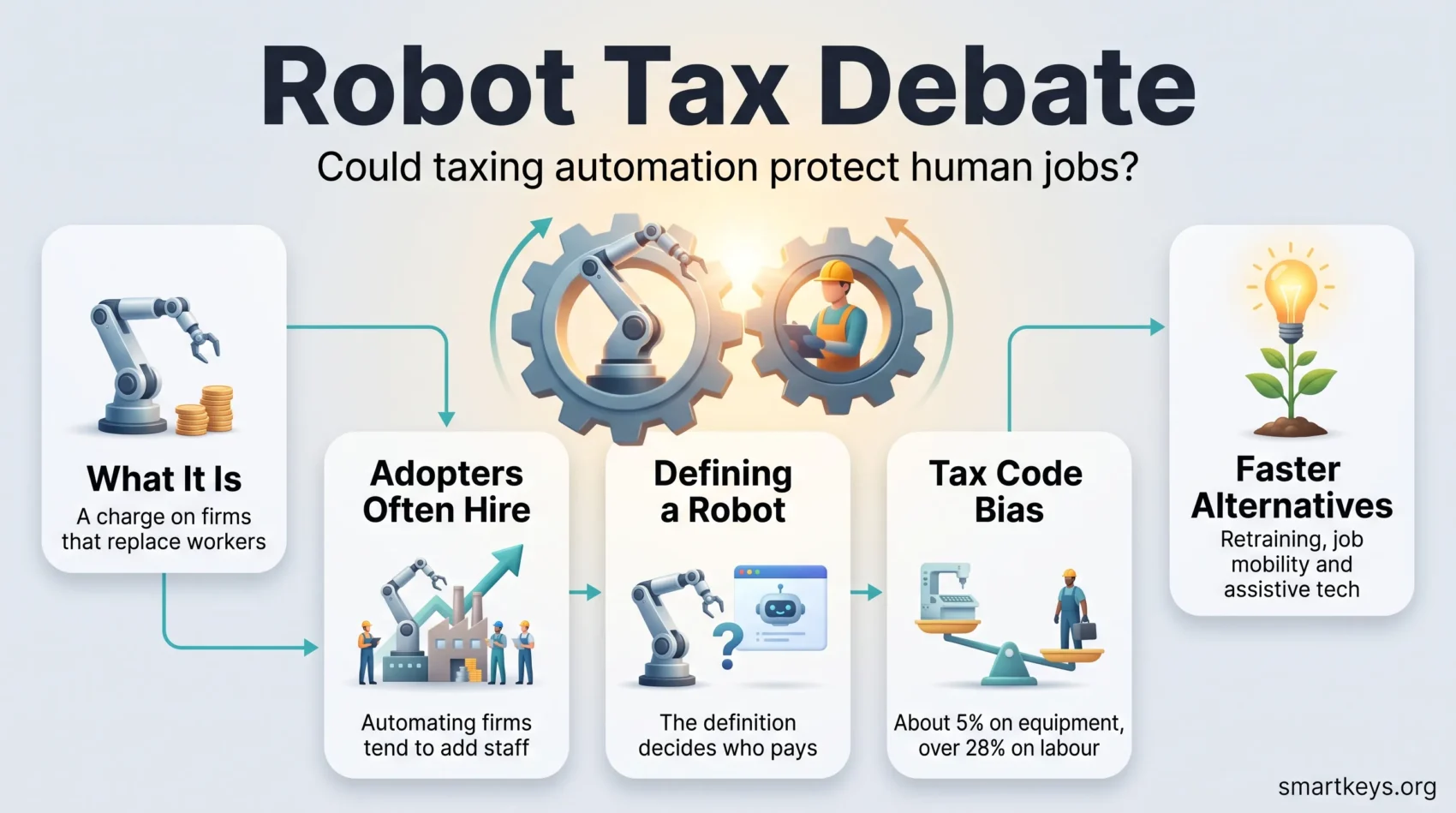
A robot tax is a charge on companies that replace human work with machines or software. The idea is simple: if a firm stops paying wages, and therefore stops paying payroll taxes, the state collects something else instead and uses it to support the people who lost the job.
Bill Gates put the phrase into circulation in a 2017 interview, and politicians have returned to it every time automation makes headlines. In September 2026, three members of the US Congress introduced a bill that would tax AI usage and revenue, with the rate rising automatically if unemployment climbs.
This article explains what the proposal would actually do, what the research on automation and employment shows, and why many economists think the more useful fix is the way the tax code already treats machines compared with people.
Key Takeaways
- A robot tax charges firms for automating work, and the revenue is usually earmarked for retraining and income support.
- Studies from Canada, France and Spain find that companies which adopt robots often hire more people, while their slower competitors shed jobs.
- Defining what counts as a robot is the hardest part of the design, and a vague definition decides which industries pay.
- The US tax code taxes equipment and software far more lightly than labour, and that gap grew again in 2025.
- Faster reskilling, easier job switching and targeted subsidies reach displaced workers sooner than a new levy would.
What a robot tax is meant to do
Payroll taxes fund a large share of social insurance in most rich countries. When a job disappears, that contribution disappears with it, even though the work still gets done and the output still gets sold. Supporters of a robot tax want to close that hole.
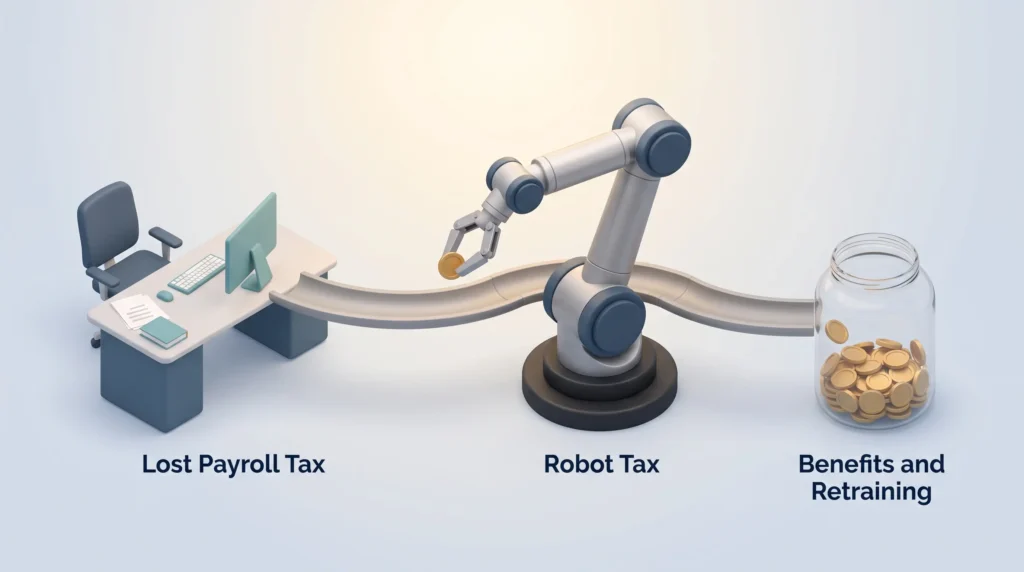
The levy is supposed to do three things at once. It raises money for unemployment benefits and retraining. It slows the pace of displacement by making automation slightly more expensive. And it signals that employment is a policy goal, not just a by-product of growth.
Critics answer that all three goals can be met without singling out machines, and that a badly drawn levy would do more harm than the problem it targets. The rest of this article works through both sides.
Where the idea came from and where it stands in 2026
The debate has a short, well-documented history.
2017, Bill Gates. In an interview with Quartz, Gates suggested that a robot doing a human job should be taxed at a similar level, with the proceeds funding care work and education.
February 2017, European Parliament. Parliament adopted a resolution on civil law rules for robotics, but voted down the robot tax element. Competitiveness was the stated reason.
August 2017, South Korea. Often called the world’s first robot tax, the measure did not create a new levy at all. It trimmed the existing tax deduction for investment in automation, which raises the cost of a robot indirectly.
2019, Bill de Blasio. During his presidential campaign, the then New York mayor proposed making large companies pay five years of the income tax that an automated-away job would have generated.
2026, United States. A robot tax bill has been sitting in the New York State Assembly, and Maryland withdrew an AI displacement tax bill. In September 2026, Representatives Sara Jacobs, Greg Casar and Valerie Foushee introduced a federal bill that would tax either the value of AI tokens (the units of text a model processes) or revenue from AI services, whichever raises more. The proposed starting rates are 2% on token value and 3% on revenue while unemployment sits at or below 5%, rising automatically above that threshold. Revenue would fund jobs in housing, infrastructure, childcare and elder care.
That last proposal is worth noting because it shifts the target. It is not a tax on physical robots at all. It is a tax on AI usage, triggered by a labour market indicator. Whether it advances is a separate question, but it shows where the argument has moved. For the wider regulatory picture, see our overview of AI regulation and what it means for business and our guide to future of work legislation.
Defining a robot before you tax it
Any levy needs a legal definition of what triggers it. This is where most robot tax proposals run into trouble.
ISO 8373, the international standard for robotics vocabulary, gives a usable starting point for industrial machines: an automatically controlled, reprogrammable, multipurpose manipulator with three or more axes. That covers a welding arm on a car line.
Physical robots and software bots are not the same thing
Robotic process automation (RPA) is software that repeats routine screen and data tasks, such as copying invoice numbers between two systems. It has no axes and no physical form, so the ISO definition misses it entirely. Yet RPA displaces clerical work at scale. Include it and you sweep in ordinary accounting software. Exclude it and the levy misses much of the automation that actually affects office jobs.
The edge cases decide who pays
Warehouse technology sits awkwardly in the middle. Driverless forklifts, automated storage and retrieval systems and computer-controlled machine tools have been excluded from some official robot counts, including US Census Bureau surveys of automation use. If a levy copies those boundaries, a distribution centre full of automated shuttles pays nothing while a factory with welding arms pays in full.
The practical consequences are easy to predict. Firms relabel equipment. Trade associations lobby for carve-outs. Lawyers argue about axes. That is one reason many economists prefer to adjust how all capital is taxed rather than draw a line around one category of machine. Our piece on robotics and automation in business covers how blurred that line has become.
What the evidence says about robots, jobs and productivity
This is the part of the debate where the data is strongest, and where it cuts against the simplest version of the proposal.
Companies that automate tend to hire
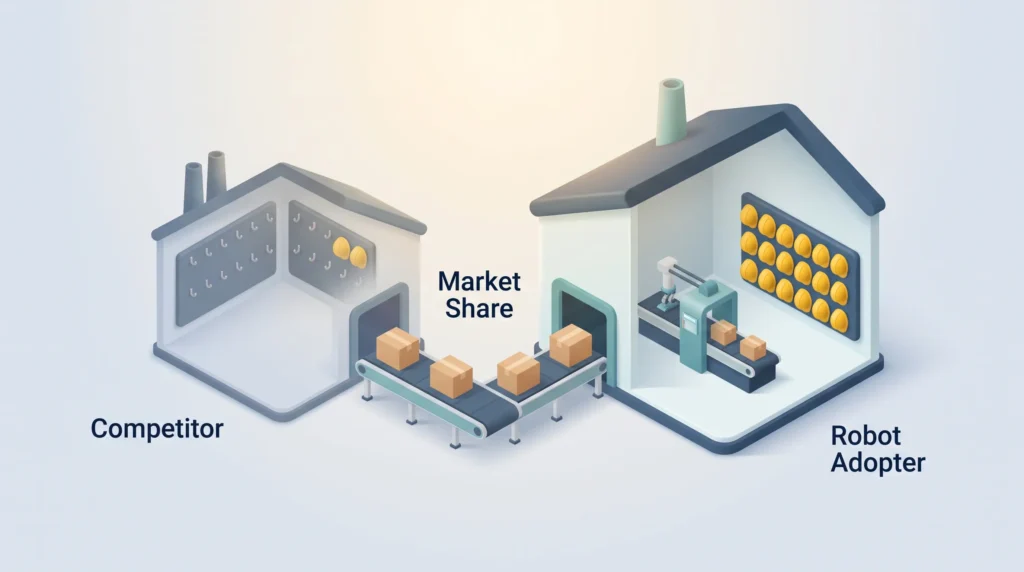
Firm-level studies in three countries point the same way. Dixon, Hong and Wu found that Canadian firms investing in robots increased employment. Acemoglu and co-authors found the same pattern in French manufacturing, and Koch, Manuylov and Smolka found it in Spain. Adopters cut unit costs, win market share, and take on more staff, often in lower-skilled roles.
The mechanism is not mysterious. A machine that makes each unit cheaper lets a firm sell more. Selling more requires more people in the parts of the process that are not automated.
The job losses land somewhere else
The same studies find that competitors who do not automate lose share and shed workers. Economists call this reallocation. National output and employment can rise while a specific town, plant or occupation is hollowed out.
That distinction matters for policy. The pain is real, but it is concentrated in firms and regions that fell behind, not in the ones buying the machines. A tax on buying machines does not reach the people actually being displaced. It just makes the purchase more expensive.
Automation sometimes fills gaps rather than cutting jobs
Eggleston, Lee and Iizuka studied Japanese nursing homes that received subsidies for care robots. Staff turnover fell and the devices complemented workers instead of replacing them, in a sector that could not find enough people to hire. Where labour is scarce, automation looks less like displacement and more like coverage. The same argument runs through the debate about demographic shifts and the shrinking workforce.
How much work is actually automatable
The widely cited McKinsey Global Institute analysis found that fewer than 5% of occupations could be fully automated with the technology demonstrated at the time, while about 60% of occupations had at least 30% of their activities in scope. In other words, most jobs change shape rather than disappear. That is the pattern our article on how workers are adapting to job automation traces in more recent data, and it is also why redeploying staff after automation has become a standard workforce planning task.
Tax the machine, or tax the profit?
Strip away the politics and one design question remains: do you tax the input or the outcome?
The International Federation of Robotics argues for taxing profits rather than the means of making them. The logic is that a profit tax is neutral. It does not care whether the money came from a robot, a better process or a smarter product, so it does not push firms towards one method over another.
A tax on the machine itself does the opposite. It changes the relative price of one production method, which means firms respond by delaying purchases, buying equipment that falls just outside the definition, or investing in a different country. None of those responses helps a displaced worker.
There is also a revenue argument. If automation raises productivity, it raises output, wages and corporate earnings, which broadens the tax base without any new levy. The IFR points to the US automotive sector, which installed roughly 60,000 robots between 2010 and 2015 while adding about 230,000 jobs. That is an industry-association figure rather than an independent study, and the two trends are not proof that one caused the other, but it does undercut the assumption that robots and headcount move in opposite directions.
For more on how automation affects employment and firm choices, see automation and jobs.
The bias already in the US tax code
Here is the point most economists consider more important than the robot tax itself: the United States already taxes machines and people at very different rates, and it does so by accident rather than by design.
Roughly 5% on equipment, far more on labour
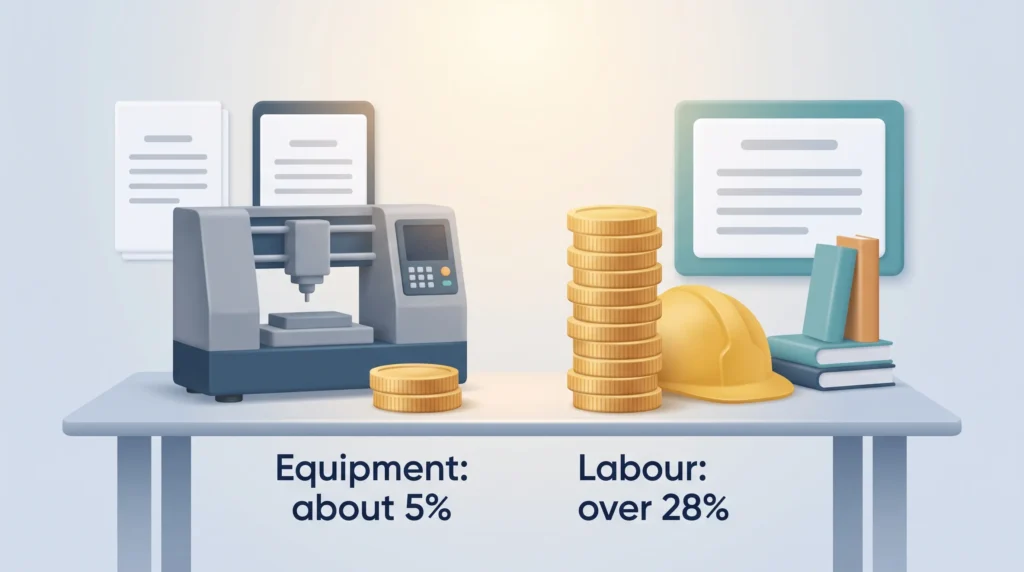
Daron Acemoglu, Andrea Manera and Pascual Restrepo examined effective tax rates in a 2020 study for the Brookings Papers on Economic Activity. They estimate the effective rate on capital invested in equipment and software has fallen to around 5%, while the effective rate on labour sits above 28% once payroll taxes are counted. A series of accelerated depreciation provisions enacted between 2002 and 2017 drove most of that gap.
Firms respond to after-tax returns. When a machine is taxed at a fraction of the rate applied to an employee doing similar work, automation gets subsidised even when it is not the more productive choice. The authors estimate that removing the bias would raise employment by about 4% in their working paper, and by 6.5% in the published version.
The gap widened again in 2025
The One Big Beautiful Bill Act made 100% bonus depreciation permanent for most qualifying property acquired after 19 January 2025, restoring immediate full expensing of equipment purchases. Whatever else the provision does, it lowers the effective tax cost of buying a machine, so the capital and labour rates moved further apart rather than closer together.
That is the awkward position the debate sits in. Congress is being asked to consider a new tax on automation while an existing set of rules quietly encourages it.
Three ways to level the field
- One rate for all investment. Simple to administer and technology-neutral, so it does not require anyone to define a robot.
- Rates that vary by how easily each input substitutes for labour. Better targeted in theory, but complex, contestable and slow to legislate.
- Adjusting depreciation schedules. The most practical option, because it uses machinery the tax system already runs, and it applies to all capital rather than one category.
Do robots need legal personality to be taxed?
A recurring proposal is to give advanced systems a limited legal status so they can hold insurance, be assigned liability and be billed directly. Supporters argue this would simplify claims when several parties contributed to a failure and no single human is clearly at fault.
The counterargument is short. Governments already tax machinery, software and property without granting any of it legal personhood, and the vehicle registration system manages liability for cars without making cars into persons. Creating a new class of legal entity mainly creates a new place to park assets.
The practical alternatives are less dramatic and better tested: auditable logs of what a system did, mandatory insurance for the operator, and safety certification against standards such as those developed by ISO technical committee 299. Liability stays with the owner or operator. Our guide to setting up an automation ethics board and our piece on automation risk assessment cover how companies handle this internally.
Alternatives that reach workers faster
Even people who accept the case for helping displaced workers often prefer measures that do not depend on defining a robot.
Fund retraining that leads to a specific job
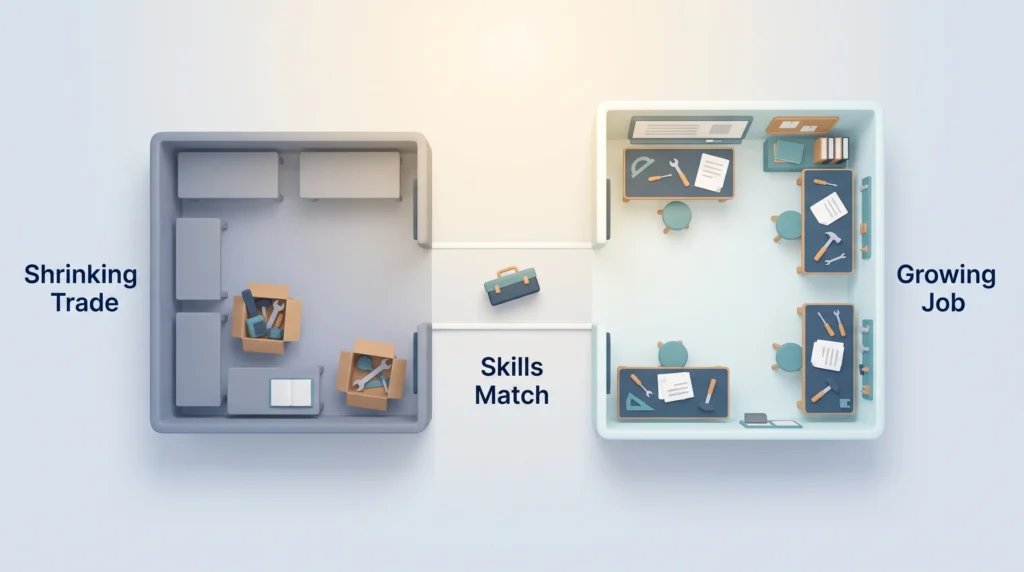
Generic training programmes have a poor record. Matching does better. Tools such as the US Department of Labor’s O*NET database measure how close two occupations are in skills, which makes it possible to move someone from a shrinking trade into a nearby growing one rather than starting from scratch. Tie the funding to actual vacancies and the gap between jobs shrinks. See our overview of mid-career retraining and upskilling and reskilling for what works in practice.
Make it easier to change jobs
Non-compete clauses, licensing rules that do not transfer across state lines and slow credential recognition all lengthen the time between one job and the next. Every extra month out of work deepens the wage loss that follows. Reducing those frictions costs the state very little and helps immediately, which a new levy would not. Building an internal talent marketplace does the same job inside a single company.
Subsidise machines that assist rather than replace
The Japanese nursing home example points to a targeted option: support the technology that raises what a worker can do instead of removing the worker. Assistive equipment, including exoskeletons in physically demanding roles, fits that description. So does most of what is currently sold as AI job augmentation.
Why coordination between countries matters
Capital moves. A levy imposed by one country and not its neighbours changes where equipment is bought and, over time, where production happens.
That is not a hypothetical risk. It is the same dynamic that shaped the long argument over corporate tax rates, and it is why the OECD spent years negotiating a minimum. A robot tax introduced alone would face the same pressure, with the added difficulty that the tax base is easier to move than a factory.
Standards offer a partial answer. Shared definitions for safety, reporting and certification reduce duplication and make cross-border rules comparable. They also give regulators a common vocabulary, which is a precondition for any coordinated tax. The EU AI Act is the closest current example of a rulebook other jurisdictions are measuring themselves against.
If a levy did happen: the design questions
Suppose the political argument is settled and a levy goes ahead. Several choices still decide whether it works.
Who pays. A charge at the point of sale falls on the manufacturer and shows up in the price. A charge when a machine enters service falls on the employer and can be tied to actual headcount changes. The second is harder to administer and easier to target.
What triggers it. A flat levy on every purchase hits firms that are adding jobs alongside machines. A trigger tied to measured displacement, such as the unemployment threshold in the 2026 congressional bill, is narrower but depends on data that arrives with a lag.
Where the money goes. Revenue earmarked for retraining, wage insurance and hiring subsidies reaches displaced workers. Revenue that flows into the general budget does not, and the political case for the levy weakens the moment that happens.
Who lobbies successfully. Definitions create winners. Exclude driverless forklifts and warehouses escape while factories pay. Expect every affected sector to argue that its equipment is different, and build transparent reporting into the rules so the effects can actually be measured. Our article on automation and inequality looks at who bears the cost when those decisions go badly.
Conclusion
The robot tax is a reasonable response to a real problem, aimed at the wrong point in the system. Displacement is genuine, concentrated and worth addressing. But the firms buying machines are usually the ones hiring, and a tax on the purchase lands on them rather than on the competitors shedding jobs.
The stronger case is for fixing what already exists. The US taxes equipment at roughly 5% and labour at more than 28%, and the 2025 expensing changes widened that gap. Closing it is technology-neutral, needs no definition of a robot and, on the authors’ own estimates, would raise employment more than a narrow levy plausibly could.
Alongside that, the measures that reach displaced workers quickest are unglamorous: retraining tied to real vacancies, fewer barriers to switching jobs, and support for equipment that makes people more capable rather than redundant. If a levy is introduced anyway, its design decides everything. Define the base precisely, tie it to measured displacement, earmark the revenue, and publish the results.
Found this useful?
Make SmartKeys a preferred source on Google, and our articles will surface more often in your Top Stories, AI Overviews, and AI Mode.
Add as Preferred Source