You are not starting over. You are building on what you already know. If you are in your 40s or 50s and wondering whether a career change is still realistic, that question is normal. It is also answerable with evidence rather than dread.
Automation is changing what jobs contain, not only how many of them exist. The World Economic Forum’s Future of Jobs Report 2025 estimates that 39% of workers’ core skills will change by 2030. The same report projects 170 million new roles and 92 million displaced roles over that period, a net gain of 78 million.
One finding matters in particular for people in the middle of a career. Stanford’s Digital Economy Lab tracks payroll records for millions of US workers. Its August 2026 update reported employment for workers aged 22 to 25 in highly AI-exposed occupations sitting about 19% below comparable peers in less exposed occupations. Experienced workers in the same occupations showed no comparable gap.
That is not a guarantee of safety. It does suggest your experience is still an asset, and that you have room to move deliberately instead of in a panic.
Key Takeaways
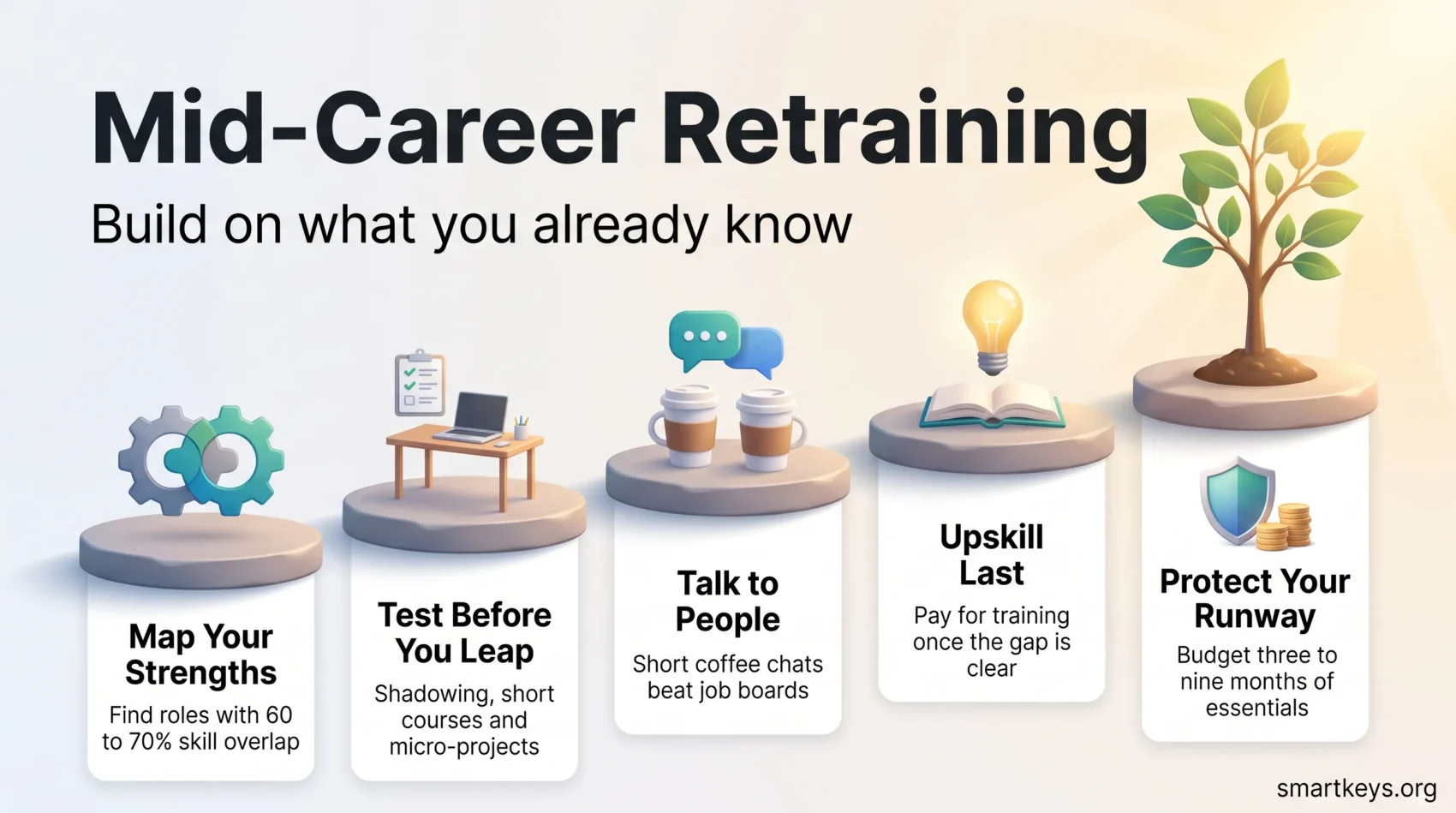
- Your experience transfers. Judgment, stakeholder handling and process knowledge travel between industries.
- Act before you feel certain. Small experiments create clarity faster than more thinking does.
- Conversations beat job boards. Most mid-career moves start with someone who already knows your work.
- Buy training last. Pay for a course once you have confirmed a real gap, not before.
- Protect the runway. A budget and a timeline keep the change steady instead of desperate.
Why Mid-Career Retraining Matters Now
Industry shifts become opportunities when you see them early. AI tools, new business models and changing customer expectations are already rewriting job descriptions. The pace is not slowing.
Start with your own role rather than with headlines. An automation risk assessment breaks a job into tasks and asks which of them software can now do well. That is far more useful than asking whether “your job” is at risk, because jobs rarely disappear in one piece.
What actually changes in the next ten years
Routine, rule-based tasks shrink first: data entry, first-draft copy, standard reporting, basic scheduling. Work that depends on judgment, negotiation and accountability tends to grow. The pattern is usually augmentation rather than replacement, where software handles part of a task and a person still owns the decision.
This has a direct consequence for your plan. The skills you build now decide which roles you can reach in three years. For a current view of where demand is heading, see our overview of the skills most in demand in 2026.
From fear to opportunity
Some warning signs are easy to recognise. You avoid talking about your job. You dread your manager’s calendar invitations. You cannot name a single thing you learned at work this quarter.
Those signals are uncomfortable, not fatal. Three habits turn them into movement:
- Plan ahead: connect broad industry trends to your own tasks, so you act early rather than react late.
- Start with people: conversations surface real openings faster than job boards do.
- Run small experiments: low-risk tests tell you whether a role actually suits you.
If it helps to see how others are already responding, our report on workers adapting to job automation across industries covers what has worked so far and what has not.
Mindset Roadblocks That Stall Career Change
Doubt is normal. What stalls people is how they answer it.
The worries tend to arrive as short, sharp questions. “I should have figured this out by now.” “Who hires someone my age?” “What else could I even do?” They feel enormous and are, in practice, solvable.
Naming the worry so it stops steering
Write down the three questions that keep circling in your head. Next to each one, put a single action you can take this week. A question paired with an action stops being a verdict and becomes a task.
Three patterns worth knowing
- You are both the driver and the obstacle. Fear of losing status or salary is what usually stops action, not a lack of options. A peer group or a coach keeps you moving.
- You cannot think your way to clarity. Clarity follows action. A two-week trial teaches you more than two months of research.
- Scanning job boards is not searching. Many mid-career roles are filled through referrals before they are advertised.
“Treat rejection as feedback. Small experiments build real confidence.”
Mid-Career Retraining: Your Step-by-Step Plan
Start with a short, repeatable plan that pulls other people into your work. Progress speeds up when someone else expects an update from you.
Do it with others, not alone
Recruit peers and at least one mentor. A small group brings perspectives you would not reach by thinking harder on your own.
- Build a peer group of three to five people and meet weekly for 30 minutes.
- Pair with one mentor for a monthly conversation. Company mentorship matching platforms are one route if your employer runs one.
- Keep a simple tracker: who you spoke to, what you learned, what happens next.
Act it out, do not figure it out
Run low-risk pilots: shadowing someone for a day, a short course, a volunteer task. Doing the work shrinks uncertainty in a way that reading about it never does.
Look for people, not for jobs
Aim for one outreach conversation and one experiment per week. Measure how fast you are learning, not how many applications you sent. Small, visible wins are what keep the process alive over several months.
Clarify Your Strengths, Values, and Energy
Begin with the moments when your work felt effortless and still mattered. Those moments are evidence, not nostalgia. They show where your strengths and real results overlap.
Mining your experience for transferable skills
Review your last year of projects. Note the tasks that felt easy and produced strong results. Describe the skills you used in plain language, without company jargon.
Many of them will be soft skills such as judgment, communication and adaptability. These travel particularly well across industries, because they are not tied to one company’s tools.
Turn two or three examples into a short value proposition: one sentence on what you do well, one on the result it produced. Hiring managers can then see the fit without decoding your job titles.
Designing work around your energy and life stage
Audit your week honestly. When are you sharp? What drains you by Thursday afternoon? Design options that match those rhythms, because a role that fights your energy pattern rarely lasts.
It also helps to zoom out. If you expect to work another 15 or 20 years, a multi-stage working life is a more useful model than a single straight run to retirement.
- Name one micro-commitment to test fit: two hours, a small project, or one call.
- Write down moments of flow and confidence. They guide later choices.
- Delay certifications until the direction is confirmed. That saves both time and money.
Map Transferable Skills to New Roles and Industries
Look for roles where your proven strengths already cover most of the requirements. Aim for positions matching roughly 60% to 70% of your current skills. You gain traction quickly without starting from zero.
Finding adjacent roles that value your experience
List three industries. Inside each, name three roles where your daily work would still be relevant. A career lattice, where moves go sideways as well as up, makes these options easier to spot than a ladder does.
- Pick roles with 60% to 70% overlap: less to learn, faster contribution.
- Swap the jargon: translate internal terms into language a recruiter outside your company will recognise.
- Choose plausible stretches: roles you could grow into within months, not years.
Do not overlook your current employer. An internal talent marketplace matches existing staff to open projects and roles, and an internal move usually carries far less financial risk than an external one.
Writing impact statements
Turn tasks into outcomes. A hiring manager reads results faster than responsibilities.
- Write one line that quantifies an achievement: revenue, hours saved, error rate, growth.
- Add one sentence linking that result to a need in the new field.
- Keep a short version ready, so someone inside a company can repeat it on your behalf.
“A brief pro bono project, meaning unpaid work done to prove the fit, often opens doors faster than another application.”
Track which versions of your story create interest fastest, then concentrate there.
Test Before You Leap: Low-Risk Experiments
Design quick tests that show you what a role actually feels like. Clarity follows action, so gather real data before committing.
Shadowing, short courses, and micro-projects
Shadowing someone for a day shows you the rhythm of a job: the meetings, the interruptions, the parts nobody mentions in a job ad. A two-week micro-project, meaning a small, self-contained piece of real work, tests whether you enjoy the task itself.
A single short course can teach one concrete skill and signal momentum without a large investment.
A formal version of this exists too. Contract-to-hire arrangements let both sides test the match before anyone commits to a permanent contract.
The parallel paths approach
Do not bet everything on one idea. Test several roles at once, so a stall in one direction does not stop your progress.
- Design low-risk trials: shadowing, one course module, or a short project.
- Run five to ten options: rotate through them and compare what energises you.
- Agree success criteria first: decide what counts as a win before you start.
Why small bets work
Experiments protect your income, because you keep your current job while you test. They also leave artefacts: a sample, a slide deck, a short report. Those become proof for the next conversation.
Review every few weeks. Drop the paths that produce nothing and put more time into those that do.
If you are restarting after a longer gap rather than moving sideways, returnship programs offer a structured way back in.
People First: Build a Strategic Network
Conversations are the shortest route from uncertainty to a concrete opportunity. Treat networking as a small weekly habit rather than a campaign.
The coffee chat playbook
An informational interview is a short conversation where you ask about someone’s work instead of asking for a job. The “500 coffees” idea simply means running many of these, steadily, rather than a handful when you are desperate.
- Choose people who can explain the real problems in a field, not just its job titles.
- Keep it to 20 or 30 minutes and say so when you ask.
- Log every conversation, so the effort compounds instead of evaporating.
Former colleagues are the easiest place to start. Many large employers now run corporate alumni networks precisely because rehires and referrals work.
What to ask and how to follow up
Ask questions that surface real needs. “What keeps your team stuck?” and “Where would an extra pair of hands make the biggest difference?” both work.
Follow up with something small and useful: a relevant article, a one-page outline, a short observation. Small deliverables turn goodwill into paid work more reliably than enthusiasm does.
- Offer brief unpaid help when it genuinely tests the fit.
- Ask for introductions to specific companies, not for “any leads”.
- Judge progress by introductions and small collaborations, not instant offers.
If your current role is remote, the same visibility problem applies internally. Our guide to remote career advancement covers how to stay visible without performing busyness.
Smart Upskilling: Certifications, Courses, and On-the-Job Learning
Choose learning that closes a gap you actually found during your tests and conversations. That keeps your money tied to roles that exist rather than to courses that sound impressive.
Confirm the gap before you pay
Clarity first, purchase second. Use interviews, shadowing and micro-projects to identify one specific missing skill. Then buy the shortest credible thing that closes it.
A structured skills gap analysis is worth borrowing here, even as an individual. It forces you to compare what a target role requires against what you can already evidence.
Short, stackable credentials
Prefer certificates you can finish in weeks and stack over time. Micro-credentials, meaning short certifications tied to one skill, are increasingly accepted as proof in hiring, particularly in technical fields.
Apply anything new within a fortnight. A skill you used once at work is far more convincing than a certificate you never applied.
- Match each programme to a gap you can name in one sentence.
- Prioritise tools that are common across your target industry, not one vendor’s platform.
- Record before and after numbers, so you can talk about outcomes rather than courses.
Short, spaced sessions also fit an already full week better than evening marathons. Our microlearning guide covers how to space practice so it sticks, and upskilling and reskilling trends shows which paths employers currently value.
Establish Your Personal Brand and Story
Your story is what helps a hiring team see how your past maps to their problem. Without it, they fall back on job titles, which is exactly where a career changer loses.
Owning your narrative
Pick three moments from your work that produced results. Write each in the same shape: context, action, outcome.
- State the problem you solved.
- Describe what you did and which skill you used.
- Give a measurable result or a clear outcome.
That format works in an email, an interview and a two-minute conversation, without rewriting.
Updating your resume and LinkedIn
Refresh both twice a year, while the details are still fresh. Waiting until you need them is how achievements turn into vague summaries.
- Align your headline, summary and featured items so they tell one story.
- Practise a 30-second positioning line you can say without notes.
- Collect short testimonials from colleagues who saw the work.
“A clear, consistent story turns scattered experience into fast trust.”
Self-Employment and Consulting as Viable Paths
Turning your experience into a service is a realistic route, and you do not need to quit first. Start small, gather evidence, and keep your options open while you learn what sells.
If you want the wider picture before committing, see our assessment of whether freelance work is sustainable.
Consulting, service work, and low-cost trials
Package one repeatable offer that solves a problem companies already pay to fix. Vague “advisory” services are hard to buy; a specific deliverable is not.
- Validate demand: run a two-week sprint or one unpaid pilot to get feedback and a testimonial.
- Protect your runway: fractional roles, meaning part-time senior positions held alongside other work, can smooth income during the transition.
- Use your history: turn past wins into a service description you can explain in one conversation.
Operations and simple business development
Build the minimum: a scope template, a basic contract, an invoice process. Anything more elaborate is procrastination in disguise.
- Design short trials with clear success criteria.
- Collect case studies from early clients, with permission, to win larger work.
- Keep a light routine of a few outreach actions each week.
Set a realistic first-year timeline. Define success by income, learning and workload together, not by revenue alone.
Plan Around Real Life: Time, Family, Health, and Finances
A realistic runway is what lets you test new roles without risking household stability. Start by naming the non-negotiables: monthly costs, caring responsibilities, and the hours when your energy is lowest.
Design a transition budget and runway
Build a simple budget covering three to nine months of essentials. Model a temporary drop in pay, then list ways to backfill it: freelance hours, a part-time role, or one short consulting engagement.
Set financial triggers in advance. Decide now what would make you accelerate, pause, or stop. That prevents decisions driven by a bad week.
Balancing responsibilities while you retrain
Block recurring weekly time for exploration and defend it like a meeting with your employer. Tell your family what you are doing and ask for specific help, such as two protected evenings rather than general support.
- Treat sleep, exercise and medical appointments as fixed, not flexible.
- Pick a path that matches your stage: an internal move, a side project, or consulting.
- Fix the small logistics that eat hours: batch cooking, shared school runs, a standing childcare swap.
Review monthly. Decide each time whether to continue, adjust, or stop, and write the reason down.
Your 30-60-90 Day Career Transition Action Plan
Start by naming one outcome for the next three months. A 30-60-90 plan simply splits that outcome into three stages, so progress stays visible.
First 30 days: clarity and conversations
Focus on listening and on telling a tight story. Aim for roughly ten to fifteen short conversations across the whole period.
- Define your strengths: write three impact statements you can send in an email.
- Book conversations: five chats plus one shadowing day or micro-project.
- Log wins: save details now for the resume refresh later.
Days 31 to 60: experiments and portfolio work
Run structured tests and produce something you can show.
- Complete two short trials or volunteer tasks that resemble real work in the target role.
- Add one skill you can apply immediately, then measure what changed.
- Set weekly outreach targets and track second-hand introductions inside target companies.
Days 61 to 90: targeted outreach
Turn warm conversations into live opportunities. Offer one small, concrete piece of help, then scope paid work if interest appears.
- Refresh your resume and LinkedIn so they match the story you are now telling.
- Keep applying to a few well-matched roles while referrals do the heavier lifting.
- Block time for outreach, learning and rest in roughly equal measure.
Review at each milestone. Put more time into the channels producing warm conversations. By day 90 you should have a pipeline, a clearer direction, and concrete next steps.
Conclusion
Mid-career change works best as a series of small experiments, not one dramatic leap.
The evidence is reassuring on one point. The AI-related employment squeeze measured so far sits mainly at the start of careers, not in the middle. Your experience still counts, and the pressure on entry-level roles is a different problem from the one you are solving.
What it does not do is make the change happen by itself. Build a plan around your strengths rather than your last job title. Test cheaply, talk to people, buy training only once you know what is missing, and protect your finances and health while you do it.
Change is iterative. Keep acting with intention, and the direction usually becomes clear well before the destination does.
Found this useful?
Make SmartKeys a preferred source on Google, and our articles will surface more often in your Top Stories, AI Overviews, and AI Mode.
Add as Preferred Source