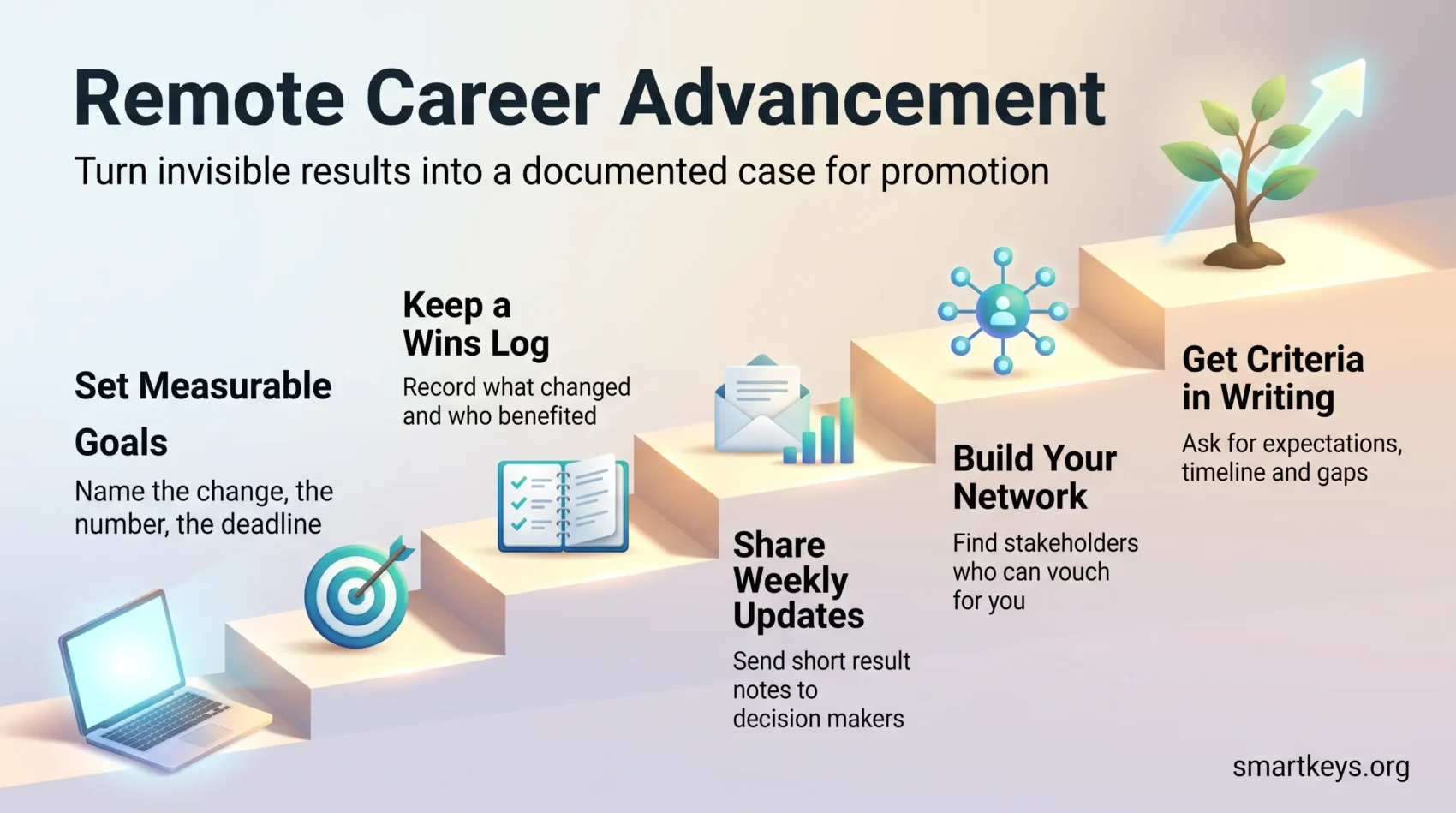
You can move up without sitting in an office. The obstacle is rarely your output. Promotion decisions still lean on informal signals: who the decision-makers happened to see, who spoke up in the room, who felt present. Work remotely and those signals go quiet, even when your results do not.
The fix is to replace informal signals with documented ones. Write down what you delivered, connect it to a number the business cares about, and put it where the decision-makers actually read.
This guide covers the evidence on the gap, a weekly system for making your impact visible, and what to ask so the criteria stop being guesswork.
Key Takeaways
- Remote workers are promoted less often than office peers, even at equal output.
- Document outcomes with numbers, not hours or activity.
- Ask for written criteria, timelines and current gaps.
- Volunteer for work that touches revenue or a company priority.
- Build a network of stakeholders who can speak to your impact.
The visibility gap is real, and it is not about your output
The evidence points one way: remote workers get promoted less, and not because they produce less. The clearest test was a controlled experiment. Nicholas Bloom and colleagues randomly assigned call-centre staff at the Chinese travel firm Ctrip to work from home for nine months. Output rose 13% and attrition halved. Promotions for the home workers were still almost 50% rarer.
Later workforce data points the same way. Live Data Technologies tracked roughly two million employees and found remote workers were promoted 31% less often than office-based colleagues: a 3.9% promotion rate against 5.6%. The Wall Street Journal reported the finding in 2023.
Part of this is proximity bias, the habit of rating people higher because you see them more often. Part of it is policy. In KPMG’s 2024 CEO Outlook, 87% of chief executives said they were likely to reward employees who come in with favourable assignments, raises or promotions.
That pressure has not emptied the home offices. Gallup’s May 2026 figures show 52% of remote-capable US employees working hybrid, 26% fully remote and 22% on site, and six in ten fully remote employees say they would job-hunt if the flexibility disappeared. Remote work settled rather than vanished, so the visibility problem is not going away either.
What you can actually control
- The record. What you delivered, in numbers, written down.
- The distribution. Who sees that record, and how often.
- The relationships. Who can describe your work without you in the room.
None of that requires a commute. It requires treating visibility as a system you run on purpose, the way engaged remote teams treat communication.
A weekly system for getting promoted from anywhere
Promotions go to people whose impact is obvious and documented. The three habits below take about 30 minutes a week.
Set goals your manager can check without asking
Vague goals (“improve onboarding”) give nobody anything to promote. Outcome-based goals name the change and the measure: cut new-customer setup time from 12 days to 7 this quarter. If your company uses personal OKRs or another goal-setting framework, map yours to a department number so the link is made for you.
Keep a wins log and send one-line updates
A wins log is one running document: date, what you did, what changed, who benefited. Two minutes per entry. It saves you reconstructing eight months of work the week before a promotion cycle.
Then distribute it. One short weekly note in the channel your manager reads beats a quarterly summary nobody opens. Pair each metric with one sentence of story: the problem, your move, the result. “Billing tickets fell 40% after I rewrote the invoice email” travels further than a dashboard link.
Use meetings to show work, not to attend
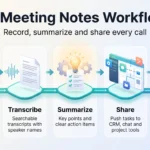
Ask for two minutes on the agenda rather than speaking only when asked. Present the result, not the process, and follow up in writing so people who missed the call still see it. A shared meeting notes template and tighter meeting practices keep your contribution searchable later.
Asynchronous work, where people contribute in writing on their own schedule instead of in a live call, helps you more than it helps office colleagues. A written decision log or a silent meeting puts your reasoning on the record, where proximity cannot outrank it.
“Here is the work I led, the measurable impact, and what I would do next.”
Volunteer for cross-functional projects that touch revenue or customers. They put you in front of leaders outside your reporting line, where promotion decisions get discussed. For the culture side, see our guide to building remote company culture.
Build a visibility network beyond your manager
If only one person can vouch for you, a single reorganisation can stall your career. Aim for three or four people outside your team who could describe your impact accurately, and schedule short recurring conversations with each. A focused one-on-one meeting with an agenda of wins, risks and one clear ask respects everyone’s time and gives them something to remember.
Show leadership when nobody can see you
In distributed teams, leadership shows up as behaviour on the record: giving specific feedback, defusing a disagreement calmly, writing down a decision so nobody reopens it later. These are the habits that define good remote leadership, and you can practise them before you manage anyone. Share small artefacts instead of asking for meetings: a two-minute screen recording, a single slide with the result.
Create the encounters that will not happen by accident
Office careers benefit from chance conversations. Remote careers need them scheduled. Offer a 15 minute virtual coffee to a peer in another function, present at an internal briefing, and join whatever passes for informal contact in your company, whether that is structured team-building or an open office-hours slot.
Time bigger updates close to planning and budget cycles, when leaders decide where headcount and opportunity go. If your company runs an internal career lattice, those cycles are also when new roles surface.
For how distributed organisations design access on purpose, see decentralized teams and the future.
Make the system fairer, not just louder
Personal tactics only go so far if the process rewards presence. Some of this you can push on; some is your employer’s job.
Ask for the criteria in writing
Request three things from your manager: the behaviours expected at the next level, the timeline for the next promotion round, and the gaps they see in your case today. Written answers give you something to work against and to hold them to. Where a company publishes leveling guides, the documents describing what work looks like at each level, map your wins to their wording.
Ask for feedback from more than one direction
An annual review is a poor instrument for a remote career, because it leans on one person’s impressions. Continuous performance management spreads the input across peers and partner teams, which dilutes any single manager’s proximity bias.
What employers should change
Companies that want fair outcomes evaluate on results rather than attendance, publish criteria openly, and run calibration meetings (where managers compare ratings across a team before they are final) with location set aside. A culture of open communication makes those decisions defensible, and accessible remote practices make sure the fix reaches everyone.
“Transparent criteria plus ongoing feedback turn work into a case anyone can verify.”
Conclusion
Treat visibility as a habit, not a personality trait. One weekly update, a wins log you actually keep, and a few stakeholders who can speak to your work will do more for your promotion odds than time spent in a chair.
Ask about criteria and timelines rather than inferring them. Volunteer for the projects leaders are watching. When the answer is no, ask in writing what would change it. The promotion gap is real, but it is a communication problem, and those are solvable from anywhere.
Found this useful?
Make SmartKeys a preferred source on Google, and our articles will surface more often in your Top Stories, AI Overviews, and AI Mode.
Add as Preferred Source