Remote teams do not lose morale in a single dramatic moment. It drains away quietly, through weeks of calls that are all agenda and no small talk, and through afternoons where nobody speaks to you at all. Remote team building is the deliberate work of putting that lost contact back in on purpose, because a distributed team will not generate it by accident.
This guide covers what the evidence actually supports, which virtual team building activities are worth your team’s time, and how to tell whether any of it is working. It is written for team leads and managers running distributed or hybrid teams, not for HR departments with an events budget.
Key Takeaways
- Remote work is now normal, not temporary: about 25% of paid US workdays happen at home.
- Fully remote workers report daily loneliness at a noticeably higher rate than on-site colleagues.
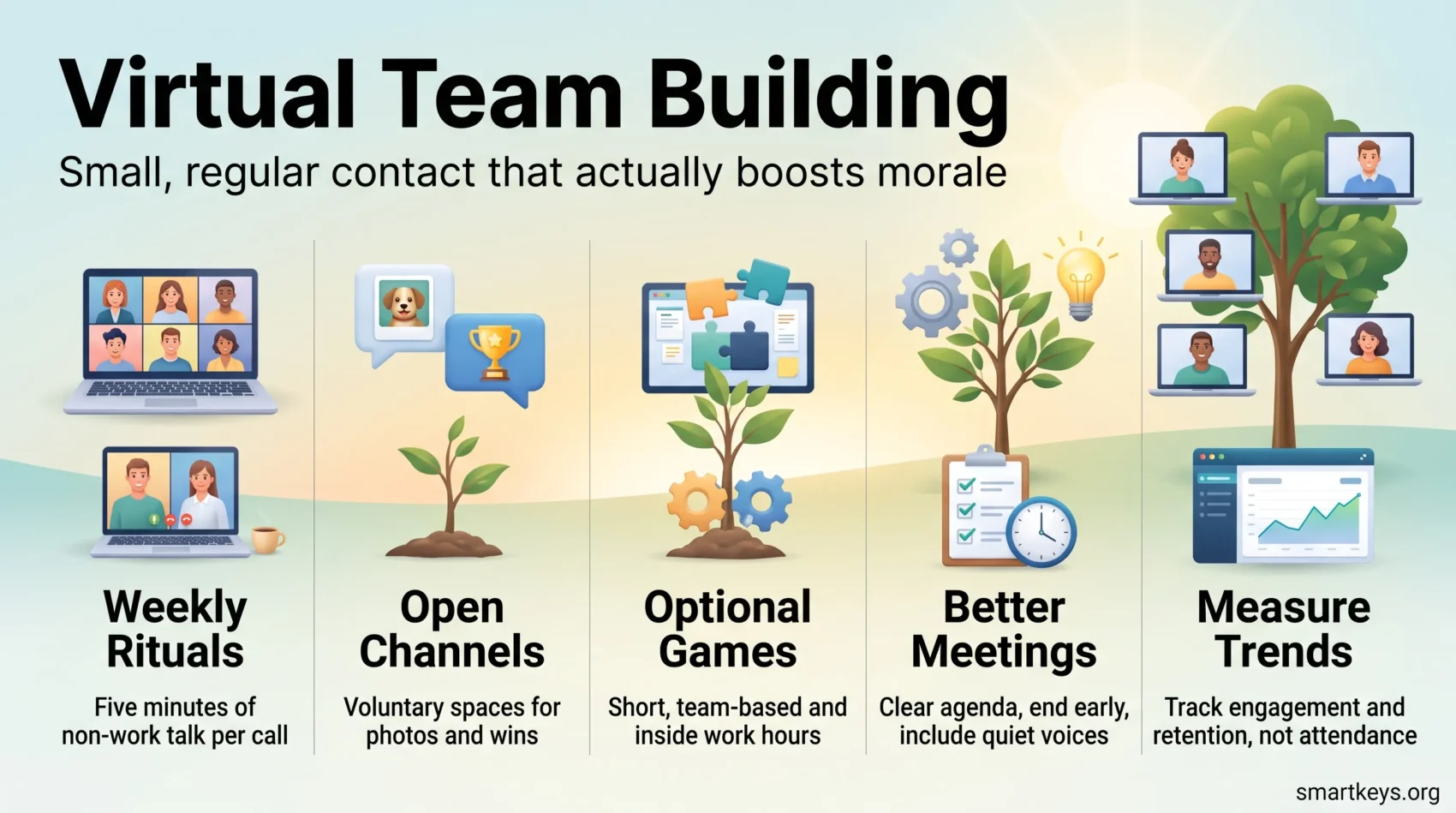
- Small, regular contact beats occasional big events. Frequency matters more than production value.
- Team building supports good management. It cannot compensate for bad management.
- Measure the effect with engagement and retention data, not with attendance numbers.
Why Morale Matters in Remote Teams
Before choosing activities, it helps to be clear about what you are trying to change and why it is worth your attention. In today’s evolving work environment, morale is not a soft extra. It shows up in how quickly people ask for help, how much they volunteer, and whether they stay.
What Employee Morale Actually Means
Employee morale is the general attitude people hold toward their work, their colleagues and their employer. It is not the same as happiness. Someone can enjoy a job and still have low morale, if they feel unheard or disconnected from the people around them.
In an office, morale is partly maintained by accident. You overhear a colleague solve a problem, you catch someone’s expression in a meeting, you walk to lunch together. Remote work removes all of that background contact. What is left is whatever gets scheduled. That is the gap remote team building is meant to fill.
What the 2026 Numbers Show
Remote work has settled rather than disappeared. Stanford’s Survey of Working Arrangements and Attitudes found that about 25% of paid days in the US in May 2026 were worked from home. Distributed teams are a permanent management problem, not a temporary one, and the wider future work trends point the same way.
The connection data is less comfortable. Gallup’s global survey found that one in five employees felt lonely a lot during the previous day. Split by work location, 25% of fully remote employees reported that feeling, against 21% of hybrid workers and 16% of those fully on site. Gallup also found that only about two in ten US employees say they have a best friend at work, which is a reasonable proxy for whether real relationships exist at all.
Meanwhile engagement is weak. Gallup’s State of the Global Workplace 2026 report put global employee engagement at 20% for 2025, with manager engagement down to 22% from 31% in 2022. That last figure matters here: the person expected to hold a remote team together is often the one most worn down by the job.
The upside is measurable. Gallup’s ongoing meta-analysis, covering more than 183,000 business units, found that units in the top quartile for engagement achieved 23% higher profit than those in the bottom quartile. Engagement is not the same thing as team building, and no activity list produces that gap on its own. But it does show that connection and attitude at work track real business outcomes rather than just mood.

What Team Building Fixes, and What It Does Not
Remote team building has a bad reputation, and often it has earned it. The compulsory Friday quiz nobody wanted is a real thing. The difference between an activity that helps and one that annoys people comes down to what problem it is solving.
The Problem It Actually Solves
The specific gap in distributed work is unstructured contact: knowing your colleagues as people rather than as names on tickets. That knowledge has practical value. When you know someone, you ask them a quick question instead of spending an hour searching. You interpret a blunt message as busyness rather than hostility. You notice when they go quiet.
Good remote team building creates low-stakes moments where that knowledge accumulates. It does not need to be fun in an organised way. A five minute conversation at the start of a call often does more than a scheduled event.
The Problems It Cannot Solve
Be honest about the limits. Team building will not fix unclear priorities, an overloaded team, a manager who takes credit, or pay that has fallen behind the market. If people are unhappy for those reasons, an optional social call reads as a distraction from the real issue, and resentment goes up rather than down.
There is also the participation problem. Activities that assume everyone is extroverted, available outside working hours, or comfortable on camera will systematically exclude some of your team. Anything that happens after hours, involves alcohol by default, or requires performing in front of colleagues should be optional in fact, not just in wording. Building a genuinely inclusive culture is covered in more depth in our guide to building a strong company culture remotely.
Build the Habit Before the Event
The most reliable morale work is not an event at all. It is the set of defaults your team operates under every week.
Make Connection Part of the Normal Week
Set a small number of rituals and keep them. A weekly team call where the first five minutes are deliberately not about work. A monthly one-to-one that is about the person rather than the project. A shared channel where finished work gets posted, so people can see what everyone else is doing.
The advantage of rituals over events is that they survive a busy month. A quarterly offsite gets cancelled when a deadline slips. A five minute opening on a call you were having anyway does not.
Communication Rules That Prevent Friction
Much of what feels like poor morale in remote teams is actually ambiguity. People do not know when a reply is expected, which channel matters, or whether silence means agreement.
Write the rules down. Which channel is for what, what a realistic response time looks like, and which hours people are genuinely expected to be reachable. Then follow them yourself, because a manager who messages at 22:00 has just set the real policy regardless of the document. Our overview of asynchronous communication tools covers how to run this without everyone sitting in the same time zone, and a hybrid work policy template is a practical starting point if you need something written.
Low-Effort Activities That Work Every Week
Start here rather than with anything elaborate. These cost minutes, not budget, and they are the ones that actually stick.
Opening Questions That Are Not Small Talk
A good opening question is specific, answerable in one sentence, and safe to answer honestly. Vague prompts like “how is everyone” produce nothing. Try questions with an actual answer:
- What is one thing you got done last week that nobody noticed?
- What is the most useful thing you have read or watched recently?
- What is something you are good at that has nothing to do with this job?
Rotate who asks. Keep it to a few minutes. If people start talking for longer on their own, that is the point, not a scheduling failure.
Channels That Give People a Reason to Talk
A handful of dedicated channels does more for connection than most organised events, because participation is voluntary and takes seconds. Useful ones include a channel for pets and photos, one for finished work worth celebrating, and one where people can post questions that feel too small to ask directly.
Two rules keep them alive. Someone has to post regularly at the start, usually you. And nothing in them should be mandatory. A channel people ignore for a week and come back to is healthy. A channel with a participation requirement is a chore. If you are choosing where to host this, our comparison of Slack and Microsoft Teams covers the practical differences. Some teams also run a scheduled virtual watercooler session for the same purpose.
Bigger Formats: Games, Challenges and Social Calls
Larger activities are worth running occasionally, as long as they are genuinely optional and reasonably short.
Games and Friendly Competition
Quizzes, collaborative puzzles and short online games work because they give people something to do together besides talk. That takes the pressure off anyone who finds unstructured social calls uncomfortable.
Keep sessions under an hour, run them inside working hours, and avoid formats where one confident person dominates. Team-based rather than individual scoring helps. So does anything with a shared visual surface: our comparison of Miro and Lucidspark covers the whiteboard tools most teams already have.
Gamification in Everyday Work
Applying game mechanics to actual work, such as progress tracking, streaks or team goals, can raise engagement, but it backfires when it turns into a leaderboard for output. Individual rankings on productivity metrics tend to increase stress and encourage gaming the numbers rather than doing better work. Team-level goals are safer. We cover the trade-offs in detail in our guide to gamification in the workplace.
Social Calls Done Properly
Optional social calls are fine if three conditions hold: they are inside working hours, they have a rough theme so nobody is staring at silence, and skipping one carries no cost. Themed sessions such as a shared lunch, a book or show discussion, or a show-and-tell of home workspaces give people an easy way in.
Meetings Are Your Real Team Building Surface
Most teams will spend far more hours in ordinary meetings than in any team building activity. That is where morale is actually made or lost.
Run Meetings People Do Not Resent
A few habits carry most of the weight. Send an agenda so people know why they are there. End early when you are done rather than filling the slot. Ask quiet participants directly rather than waiting for them to interrupt. Write decisions down afterwards so the people who missed it are not left guessing.
For hybrid teams, the specific failure mode is the in-room conversation that remote attendees cannot follow. Our guide to hybrid meeting etiquette covers the fixes, and silent meetings are a useful format when you need genuine input from everyone rather than from whoever speaks first.
Onboarding Is the Highest-Leverage Moment
A new remote hire has no accidental contact at all. Whatever relationships they form in the first month are the ones you deliberately arranged. Pair them with a colleague outside their immediate function, schedule short introduction calls across the team, and check in more often than feels necessary. Our guide to remote onboarding and training covers the full sequence.
Tools That Support Connection
Tools do not create morale, but the wrong setup makes connection harder than it needs to be. Aim for the smallest stack your team can work in.
You need somewhere to talk in real time, somewhere for scheduled calls, somewhere shared to think visually, and somewhere work is visible without asking. If your team already has all four, adding a dedicated engagement platform rarely helps. If you are evaluating options, our comparison of Zoom and Microsoft Teams covers the video side, and our look at AI collaboration tools for global teams covers what the newer features actually do.
One format deserves a mention because it scales well across time zones: a short recorded update replaces a status meeting nobody needed and lets people watch it when their day starts. Teams spread across many regions may also want our guide to building a digital headquarters for remote teams.
Measuring Whether Any of It Works
Attendance is not a result. Plenty of people join a call because declining feels awkward. Measure the things you actually care about.
What to Track
Three sources give you a usable picture. A short recurring pulse survey with the same few questions, so you can see direction rather than a single score. Retention and voluntary exit reasons, since morale problems show up there before they show up in a survey. And the qualitative signal from one-to-ones, which is usually the earliest warning you get.
Watch the trend, not the absolute number. A score that drops after a reorganisation tells you more than a flattering average. Our overview of remote employee engagement covers the wider benchmarks.
Act on What You Find
The fastest way to kill a survey is to run it and change nothing. If you ask, report back what you heard and name at least one thing you will change. If you are not going to act on an answer, do not ask the question.
Pay attention to wellbeing signals too. Isolation, always-on expectations and unclear boundaries are the recurring problems in distributed work, and no activity fixes them. Our guides to remote work and mental health and virtual employee wellness cover what helps.
Conclusion
In today’s remote work landscape, morale is a management output rather than a mood. The teams that hold together are not the ones with the most inventive activities. They are the ones where contact is regular, expectations are written down, and someone is paying attention.
Start small. Add five minutes of non-work conversation to a call you already have. Open one channel with no purpose beyond being human. Fix the meeting that everybody dreads. Then look at your engagement and retention data in three months and see whether anything moved.
If it did not, the problem is probably not the activities. It is more likely workload, clarity or management, and those are worth more of your attention than another quiz. Team building is the finishing layer on decent remote leadership, not a substitute for it.
Found this useful?
Make SmartKeys a preferred source on Google, and our articles will surface more often in your Top Stories, AI Overviews, and AI Mode.
Add as Preferred Source