Virtual employee wellness means the health support a company offers to people who work from home or spread across several locations. It covers physical health, mental health, and the working conditions that shape both. The topic is no longer a pandemic footnote. Remote work settled rather than disappeared: about 25% of paid full days in the US were worked from home in May 2026, according to the Survey of Working Arrangements and Attitudes run by WFH Research.
That settling created a problem most wellness programs were never designed for. When a team works apart, a company loses the informal signals that used to show when someone was struggling. Nobody notices the colleague who has quietly stopped speaking up in meetings. Nobody sees the person still answering messages at eleven at night.
This article looks at what the evidence actually supports. That turns out to be quite different from what the wellness industry sells, and the gap is worth understanding before you spend a budget on it.
Key Takeaways
- Fully remote employees are the most engaged group at work and also the loneliest.
- Large studies find little measurable effect from wellness apps, courses and resilience training.
- Changes to workload, schedule control and manager quality do more than any subscription.
- Technology helps most when it removes friction, and least when it adds surveillance.
- Without participation and outcome data, you cannot tell whether a program worked.
What Virtual Employee Wellness Actually Covers
It helps to split the term into three layers, because companies tend to buy only one of them.
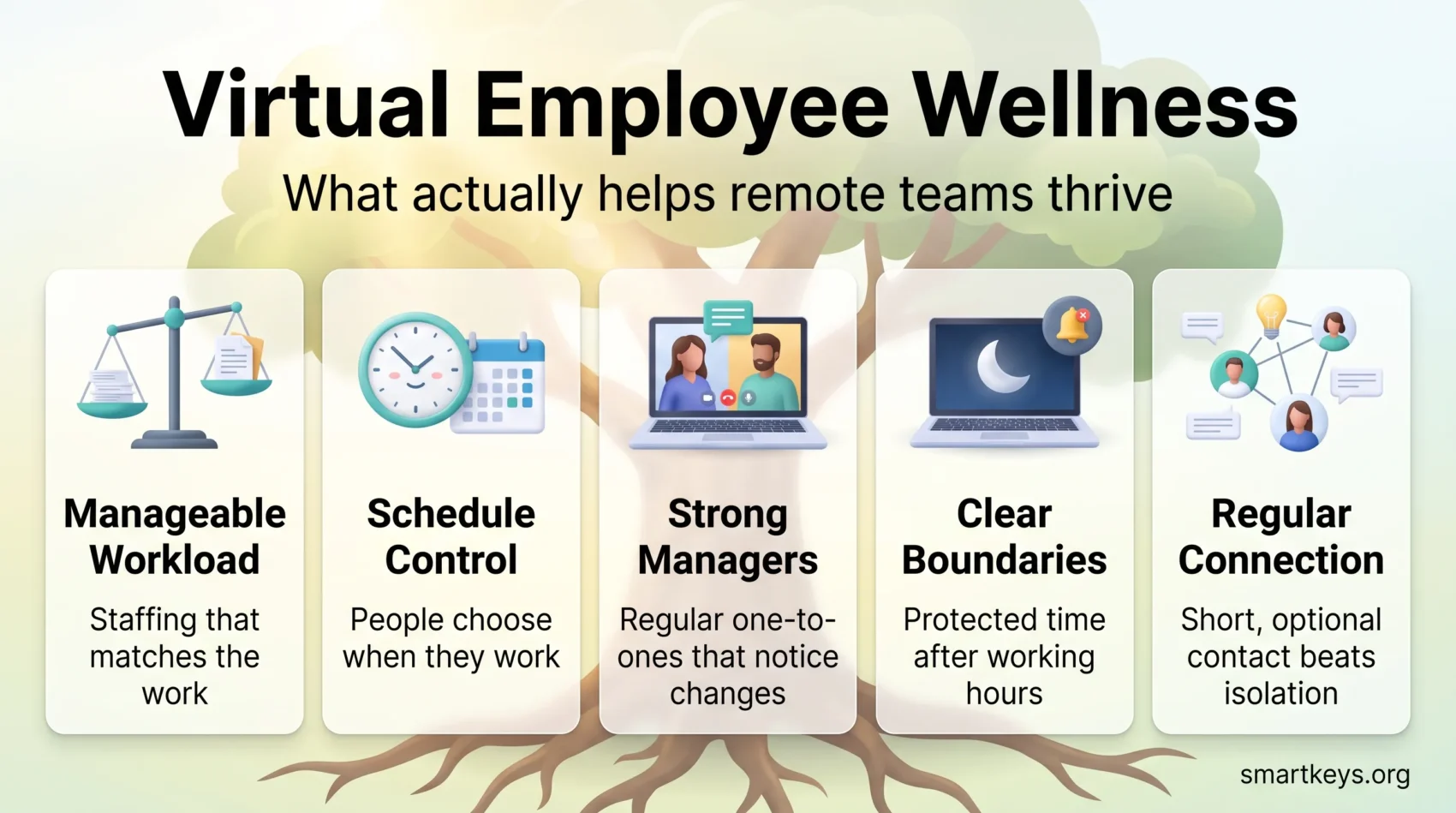
The first layer is individual services. This includes counseling, employee assistance programs, online fitness classes, meditation apps and telehealth appointments. The second layer is social connection: team rituals, informal contact, mentoring and anything that replaces the conversations an office used to supply by accident. The third layer is the working conditions themselves, meaning workload, autonomy, working hours and the quality of the person you report to.
Most budgets go to the first layer, because it is the easiest thing to buy. You sign a contract, announce the benefit, and the work is visibly done. The third layer requires managers to change how they run their teams, which is slower and less comfortable.
A concrete example shows why the order matters. Imagine a designer working from a spare bedroom, laptop on a kitchen chair, six hours of video calls a day, and a manager who sends questions at ten at night. A meditation subscription will not fix her week. A proper chair, two fewer meetings and a manager who stops messaging after hours will. That is the difference between the layers, and it runs through everything below.
The Remote Work Paradox: More Engaged, Less Well
Gallup’s State of the Global Workplace report, published in 2026 and covering 2025, measured engagement and wellbeing separately for each work arrangement. Engagement here means how involved and enthusiastic someone is about their work. It is not the same as being happy.
Fully remote employees scored highest on engagement at 31%. Hybrid employees and remote-capable employees working on site both sat at 23%. Employees whose jobs cannot be done remotely came last at 19%.
Wellbeing runs the other way. Only 36% of fully remote employees were thriving in their overall life evaluation, against 42% of hybrid employees and 42% of remote-capable on-site employees. Fully remote employees also reported the most loneliness the previous day, at 27%, compared with 23% of hybrid employees and 20% of remote-capable on-site employees. Sadness followed the same split, at 30% among fully remote employees against 21% among hybrid ones.
Read together, those numbers say something quite specific. Remote work is not making people worse at their jobs. It is removing the incidental human contact that used to come free with an office, and nothing has replaced it. The same pattern appears in the wider data on remote work loneliness and mental health, and it is the central design problem for any virtual wellness effort.
The backdrop is not encouraging either. Global engagement fell to 20% in 2025, down from a peak of 23% in 2022. Whatever companies have been doing, it is not working at scale. Our guide to remote employee engagement covers what the same dataset says about managers, and our look at how hybrid schedules and office design affect wellbeing explains why the hybrid middle keeps outperforming both extremes on wellbeing.
What the Evidence Says About Wellness Programs
This is the uncomfortable part, and it is worth stating plainly.
In 2024, William Fleming of the University of Oxford published a study in the Industrial Relations Journal covering 46,336 workers across 233 UK organizations. It tested 11 common individual-level interventions, including mindfulness courses, resilience and stress management training, wellbeing apps, coaching and volunteering opportunities. Fleming found no evidence that any of them improved employee wellbeing. A few showed small negative associations, most likely because the people who sign up are the ones already struggling.
The pattern is not new. In 2019, Zirui Song and Katherine Baicker published a randomized controlled trial in JAMA covering 160 worksites and 32,974 employees over roughly 18 months. A randomized trial means worksites were assigned to the program or a control group by chance, which makes the comparison far more reliable than a simple before-and-after survey.
The results were narrow. Self-reported regular exercise rose to 69.8% against 61.9% in the control group, and active weight management to 69.2% against 54.7%. Everything else stayed flat. There was no significant effect on clinical measures such as cholesterol and blood pressure, none on health care spending, and none on absence, job tenure or job performance.
Two qualifications matter here, because simplifying this finding too far turns it into something false. First, none of this means counseling is useless for the individual who needs it. An employee assistance program that gets one person to a therapist has done real good for that person. Second, both studies looked at whether these offers shift wellbeing across a whole workforce, and on that question the answer was no. If the work itself is the problem, buying an app to sit on top of it does not solve anything. That is also why burnout keeps reappearing in companies that have wellness benefits on paper, a pattern we unpack in our guide to employee burnout causes and prevention for employers.
The Changes That Actually Move Wellbeing
Fleming’s own conclusion pointed toward organization-level change, meaning the design of the job rather than the coping skills of the person doing it. Four levers do most of the work.
Workload and staffing. No amount of guided breathing offsets a role that needs two people. If the same team keeps absorbing extra scope every quarter, that is a resourcing decision, and it belongs on the leadership agenda rather than in a wellness newsletter. Our guide to managing stress for better productivity covers the individual side, but the structural side sits with whoever sets headcount.
Schedule control. Letting people decide when they work, within agreed limits, is one of the more reliable wellbeing levers available. It costs nothing and it removes a daily source of friction, particularly for parents and carers. The trade-offs are covered in our piece on flexible work schedules.
Manager quality. A remote employee’s direct manager is most of their experience of the company. Managers who hold regular one-to-one conversations, notice changes in behavior and can actually adjust workload will do more for wellbeing than any platform. Managers who default to checking activity dashboards will do the opposite, a habit we look at under productivity paranoia.
Clear boundaries on working hours. Some countries have stopped leaving this to company culture. Australia’s right to disconnect took effect on 26 August 2024 for employers with 15 or more staff, and on 26 August 2025 for smaller businesses. The law does not stop an employer from making contact after hours. It protects employees from being penalized for not responding, unless refusing would be unreasonable in the circumstances. Our overview of the right to disconnect explains how similar rules differ across countries.
Where Technology Genuinely Helps
Technology earns its place in a wellness program when it removes friction rather than adding a new thing to do.
Telehealth is the clearest example. An employee who can see a doctor or a therapist in a lunch break, without travel or a half day of leave, is far more likely to go. That is a genuine improvement in access, and access is often the actual barrier rather than motivation.
Asynchronous tools help for a different reason. Written updates, recorded walkthroughs and shared documents cut the number of calls that exist only because everyone had to be in the same room at the same time. Fewer calls means more uninterrupted work and shorter days, which is a wellbeing outcome even though it never appears in a wellness catalogue.
Equipment budgets belong in the same category. A stipend that pays for a decent chair, a second screen and a desk lamp addresses a real physical problem in home offices. See our guide to workplace ergonomics for what to prioritize, and our guide to wellness stipend amounts, taxes and eligible expenses for how companies structure the payment.
Two areas deserve more caution. The first is monitoring software marketed as a wellbeing tool, which promises to flag burnout risk from activity data. Employees usually read it as surveillance, and the trust cost tends to exceed the insight gained. We cover the legal and practical picture in AI in employee monitoring. The second is the growing category of AI wellness coach platforms for employers, which are useful for structure and reminders but are not a substitute for clinical care and should never be presented as one.
Virtual reality sits somewhere in the middle. It has clear value in training for hands-on practical tasks. As a relaxation tool it is pleasant, but there is no strong evidence that it does more for stress than a walk outside.
Rebuilding Connection Without Forcing Fun
The loneliness gap in the Gallup data is the most fixable part of this problem, provided the fix is not another mandatory video call.
Structured social time works best when it is short, regular and genuinely optional. A fifteen minute open call twice a week, which people can join or skip without explanation, tends to outlast a monthly ninety minute event. The point is frequency of contact rather than the quality of the activity. Our roundup of virtual watercooler approaches covers the tooling.
Design for the quiet half of the team as well. Competitive quizzes reward the same three extroverts every time. A rotating written round of what people are working on gives everyone equal airtime and takes five minutes. Practical formats are collected in our guide to remote team building activities.
Pairing is the other lever worth using. Assigning a buddy to every new starter, or running a rotating coffee pairing across teams, creates one-to-one relationships that group calls never produce. These connections are also what people cite when they stay, which is why they show up in most serious talent retention strategies.
Finally, protect recovery time properly. Regular short breaks and movement breaks are among the few individual habits with decent supporting evidence, and they cost nothing. They only work if the calendar leaves room for them, which brings the question back to workload.
Designing Challenges People Actually Join
Step challenges, hydration streaks and mindfulness bingo are the visible face of virtual wellness. They can work, but only under conditions that most programs ignore.
Make participation voluntary and unmeasured. The moment a challenge feels like an assessment, the employees who most need a break are the ones who opt out.
Design for different bodies and situations. A step challenge excludes wheelchair users and anyone with a mobility limitation. An activity-minutes challenge does not. This is basic inclusive design, and it costs nothing to get right at the planning stage.
Keep them short. Four weeks is long enough to build a small habit and short enough that people finish. Open-ended programs quietly die.
Let teams choose. A challenge picked by the people doing it beats one announced by head office, every time. It also tells you what your workforce actually wants, which is useful information in its own right.
How to Tell Whether Your Program Is Working
Most wellness programs are evaluated on the number of people who signed up. That is a measure of marketing, not of health.
Four questions give you a more honest picture. First, what share of eligible employees used the service more than once? Repeat use separates a real benefit from a launch-week spike. Second, did the outcomes you care about move, meaning absence, voluntary turnover, and the wellbeing questions in your engagement survey? Third, do the people using it differ from the people who need it? If the healthiest third of the company is doing all the yoga, the program is not reaching its target. Fourth, what did managers change? If the answer is nothing, the third layer has not been touched.
Run the same questions every six months and compare. Survey tools make the data collection cheap, so the real bottleneck is the willingness to act on an unflattering answer rather than the measurement itself.
What Is Changing in 2026
Three shifts are worth watching.
Regulation is moving from culture to law. Right to disconnect rules, working time rules and the growing body of law around workplace AI mean that some parts of wellbeing are becoming compliance questions rather than optional benefits.
Cost pressure is tightening. Employer health care costs have risen sharply, which is pushing benefits teams to justify each line. That scrutiny is uncomfortable for programs with no measurable effect, and welcome for anything that reduces the causes of ill health rather than treating the symptoms. Our overview of how employee benefits are changing covers the wider picture.
Attention is shifting toward job design. The research has been pointing this way for years, and budget scrutiny is finally forcing the question. Expect fewer app licences and more conversations about workload, meeting load and manager training. That is a slower kind of progress, and a more durable one. It also connects directly to everyday remote work productivity, since the same conditions that protect health protect output.
Conclusion
Virtual employee wellness is worth doing, but not in the shape most companies buy it. The strongest evidence says that individual apps, courses and resilience training move very little on their own. What does move wellbeing is the work itself: a manageable workload, real control over hours, a competent manager, clear boundaries at the end of the day, and enough regular contact that nobody disappears.
Technology belongs in that picture where it lowers barriers, through telehealth access, fewer unnecessary meetings and equipment that makes a home desk usable. It does not belong where it becomes another form of monitoring.
The practical starting point is not a vendor demo. It is asking your remote employees what actually makes their week hard, then fixing the two answers that come up most. That is less impressive than a platform launch, and considerably more likely to help. If you want a companion read on the individual habits that hold up, start with burnout prevention.
Found this useful?
Make SmartKeys a preferred source on Google, and our articles will surface more often in your Top Stories, AI Overviews, and AI Mode.
Add as Preferred Source