Five years after offices emptied, it is possible to separate what the pandemic changed for good from what quietly snapped back. The emergency phase is long over. What remains is a work model that no country and no employer planned, but almost everyone now operates inside.
Two numbers frame the story. In May 2026, about 25% of paid full days in the United States were worked from home, according to Stanford’s Survey of Working Arrangements and Attitudes (SWAA), against roughly 7% before 2020. And in the first quarter of 2026, the US office vacancy rate reached a record 21%, Moody’s Analytics reported, up from around 17% in 2020.
Neither figure describes a workforce that went fully remote. Both describe a workforce that stopped treating the office as the default container for work. That is the COVID-19 work transformation that stuck.
Key Takeaways
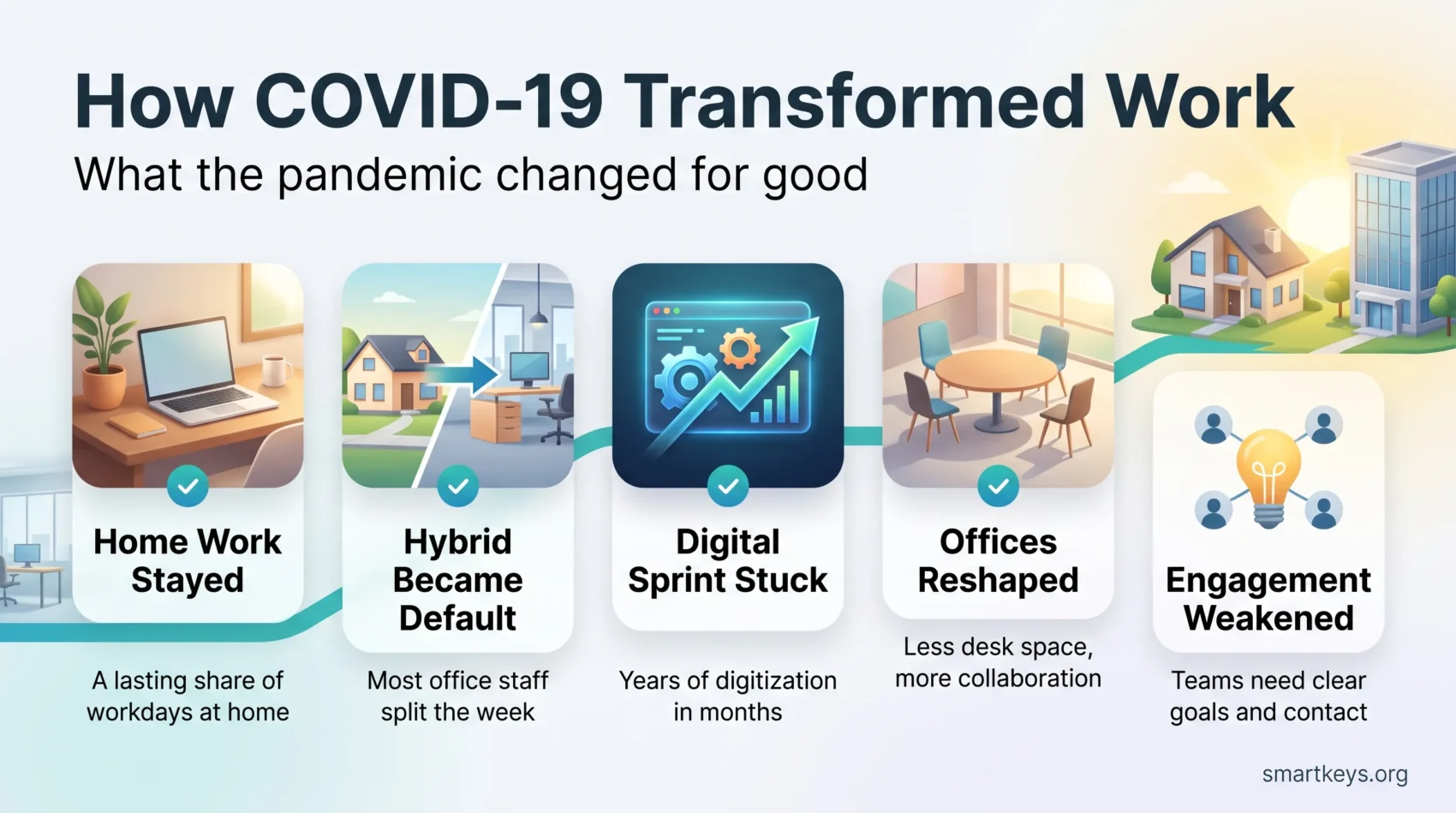
- Working from home settled at about a quarter of US paid days, roughly three to four times the pre-pandemic share.
- Hybrid, not full remote, became the dominant model for remote-capable staff.
- The digitization sprint of 2020 was real and measurable, and it never reversed.
- Record office vacancy shows the change reached buildings, not just calendars.
- Engagement and manager wellbeing came out of the period weaker, not stronger.
The Employment Shock and What Followed
The labour market moved faster in 2020 than in any recession on record, in both directions. Layoffs and discharges hit a series high of 13.0 million in March 2020, according to the US Bureau of Labor Statistics. Within two years the same survey was reporting the opposite extreme.
Job Losses and Furloughs Across Sectors
The damage was concentrated, not general. Hospitality, retail, travel and personal services absorbed the bulk of it, because their work could not be moved onto a laptop. Furlough schemes in Europe and the Paycheck Protection Program in the US kept many employment relationships formally alive while operations were suspended.
Office-based sectors saw something different: not mass unemployment, but a sudden, unplanned experiment in distributed work. That divide still explains most of who has flexibility today and who does not. It is also why remote work for blue-collar jobs remains a much narrower conversation than the headlines suggest.
Longer-Term Effects on the Job Market
The recovery produced its own record. Quits reached a series high of 4.5 million in a single month in November 2021, and job openings peaked at 11.4 million that December. For a period, workers held unusual leverage and used it to reprice flexibility, pay and conditions.
That window has closed. By mid-2026 the JOLTS quits rate had settled at 2.0% a month, with openings around 7.4 million. Mobility is back to something ordinary. What did not revert is the expectation set during those years: candidates now ask where and when work happens, and treat the answer as part of the offer. Employers that ignore it feel the effect in retention rather than in recruitment marketing.
Emergency Remote Work Became a Settled Pattern
The 2020 shift was not a strategy. It was an evacuation, executed with consumer hardware, home broadband and whatever collaboration licences a company already owned. The interesting part is what happened after the emergency justification disappeared.
From Improvisation to Infrastructure
Organizations that kept remote work rebuilt it properly: managed devices, single sign-on, documented processes, asynchronous updates instead of hallway context. The improvised version of 2020 could not have survived five years. The engineered version did.
Security was the clearest example. Once work left the corporate perimeter permanently, cybersecurity for remote work stopped being a special case and became the baseline design assumption. So did the question of what employers may collect about staff working at home, now governed in much of the world by the rules covering employee data privacy at work.
Challenges That Never Fully Went Away
Flexibility arrived with costs attached. Video calls replaced a large share of casual contact, and the fatigue that followed turned out to have identifiable causes. Stanford’s Jeremy Bailenson set out four in 2021: excessive close-up eye contact, constantly seeing your own face, reduced physical mobility, and the extra cognitive effort of producing and reading nonverbal cues through a screen.
Parents carried a second load, juggling childcare with professional responsibilities during months when schools were shut. Isolation, unclear boundaries and always-on availability hurt employee morale in ways that better software did not fix. Managing digital fatigue is now a standing task rather than a pandemic footnote. For the wider arc of how expectations shifted, see our overview of remote work trends.

COVID-19 Work Transformation and Employee Mindset
The most durable change may be attitudinal. A large group of people discovered that the commute, the open-plan floor and the meeting-heavy day were choices rather than laws of nature.
Reevaluating Work-Life Balance
Home working removed the commute and, with it, the ritual that separated the two halves of the day. Some people used the recovered time well. Others found the workday expanding into the evening because nothing marked its end.
The practical response has been to rebuild boundaries deliberately: fixed start and stop times, a workspace that can be walked away from, and explicit norms about after-hours contact. Several jurisdictions have gone further and legislated a right to disconnect.
Burnout and What Actually Drives It
Burnout is not caused by working from home. It is caused by workload without control, isolation without contact, and ambiguity about what good performance looks like. Remote arrangements can worsen all three if nothing else changes, and can improve them if managers adjust.
The evidence on the wellbeing side is mixed rather than triumphant, which is why the honest reading of remote work and mental health matters more than either the enthusiast or the sceptic version.
The Collapse of Work-Home Boundaries
When the office and the home occupy the same rooms, the boundary has to be created rather than inherited. That is the single biggest self-management change the period produced.
Managing Childcare and Professional Responsibilities
For working parents, 2020 and 2021 collapsed two full-time responsibilities into one space. The lasting effect was not the chaos itself but what it revealed: rigid hours were rarely a genuine operational requirement. Many employers now run explicit flexible work schedules rather than informal tolerance, which makes the arrangement survivable when a manager changes.
Virtual Meetings and Their Impact on Productivity
Meeting volume rose during the shift to remote work and, in many organizations, never came back down. A calendar full of calls crowds out the uninterrupted stretches that complex work needs.
The fix is structural, not individual willpower: fewer standing meetings, a written agenda or no meeting, and a default toward written updates. Teams that adopted asynchronous work reclaimed hours that no productivity app could have returned.
Adapting to Remote Work: Strategies for Success
The habits that separate people who work well at home from people who merely work at home are unglamorous and well documented.
Staying Focused and Productive at Home
- Establish a dedicated workspace: a defined area you can leave at the end of the day, which matters as much for stopping as for starting. Our guide to home office productivity covers the setup in detail.
- Create a structured schedule: fixed working hours and real breaks, so the day has edges.
- Limit distractions: switch off non-essential notifications rather than trying to resist them.
- Protect one long block: reserve a stretch for deep work before the calendar fills.
- Use a timing method: the Pomodoro Technique suits interruption-prone days.
The Technology Layer
- Video conferencing: Zoom, Microsoft Teams and Google Meet carry the synchronous load.
- Project management: Trello, Asana, Jira and ClickUp make status visible without a status meeting.
- Messaging: Slack and Teams replaced internal email for short exchanges, with the side effect of raising interruption frequency.
- AI assistance: summarization, drafting and scheduling are now built into most of these suites, which is where AI collaboration tools have made the clearest difference.
Tools distribute information; they do not create the clarity distributed teams run on.
Transformation in Workplace Culture
Culture was the hardest thing to move online and the slowest to recover.
Engagement Came Out Weaker
Gallup’s State of the Global Workplace 2026 report put global employee engagement at 20% in 2025, its lowest level since 2020. Manager engagement fell further, from 31% in 2022 to 22% in 2025, meaning managers no longer report higher engagement than the people they lead.
That is a management problem before it is a location problem. Distributed teams need more deliberate contact, clearer goals and more visible recognition than co-located ones, and the organizations that treated remote employee engagement as a design task rather than a morale campaign came through it better.
Respect, Proximity and Fair Treatment
The specific risk in mixed arrangements is that presence gets mistaken for contribution. Proximity bias shows up in assignments, promotions and informal influence long before it shows up in a survey. Evaluating output rather than visibility is the only reliable correction.
Hybrid Work: What Actually Settled
Hybrid is the answer the market converged on, and the data now describes a stable arrangement rather than a transition.
Combining Remote and In-Person Work
Among remote-capable US employees, Gallup found 52% working hybrid, 28% exclusively remote and 21% fully on-site, a distribution that has barely moved since 2022. Hybrid employees spend around 2.3 days a week in the office, roughly 46% of the workweek.
Return-to-office mandates made headlines but moved these shares far less than announcements implied. The office is now one venue among several, which is why coworking spaces found durable demand and why office design has shifted toward collaboration space rather than rows of desks.
What the Evidence Says About Flexibility
The strongest evidence available is a randomized controlled trial published in Nature in 2024. Nicholas Bloom and colleagues assigned 1,612 employees at Trip.com to hybrid or fully on-site work for six months. Quit rates fell by roughly a third, from 7.20% to 4.80%, with the largest reductions among non-managers, women and staff with long commutes. Performance grades showed no difference, and promotion rates were unchanged.
That is one company, not a universal law, but it is the cleanest test yet of the central claim: retention gains without a measurable performance cost. Flexibility has also broadened beyond location: phased retirement programs, compressed weeks and job sharing now sit in the same conversation, alongside the wider evolution of employee benefits.
The Digitization Sprint That Never Reversed
The technology change was faster and better documented than any other part of the transformation.
Accelerated Digitization of Operations
McKinsey surveyed 899 C-level executives and senior managers in July 2020 and found that companies had compressed roughly three to four years of digitization of customer interactions and internal operations into a few months. Digital product portfolios moved even faster, by about seven years.
Cloud collaboration, e-signature, remote IT management and self-service HR moved from optional to structural in that window. None of it was rolled back when offices reopened, which is why the pandemic period reads, in hindsight, as the point where digital transformation stopped being a programme and became the operating baseline.
Shift to Digital Customer Interactions
The same McKinsey survey measured the customer-facing side directly. The share of customer interactions that were digital rose globally from 36% in December 2019 to 58% by July 2020. In North America the figure went from 41% to 65%.
Those channels stayed. Buying, onboarding and support are now digital-first in most categories. The organizations that handled it best treated the channel change as permanent from the start and staffed accordingly.
Found this useful?
Make SmartKeys a preferred source on Google, and our articles will surface more often in your Top Stories, AI Overviews, and AI Mode.
Add as Preferred Source