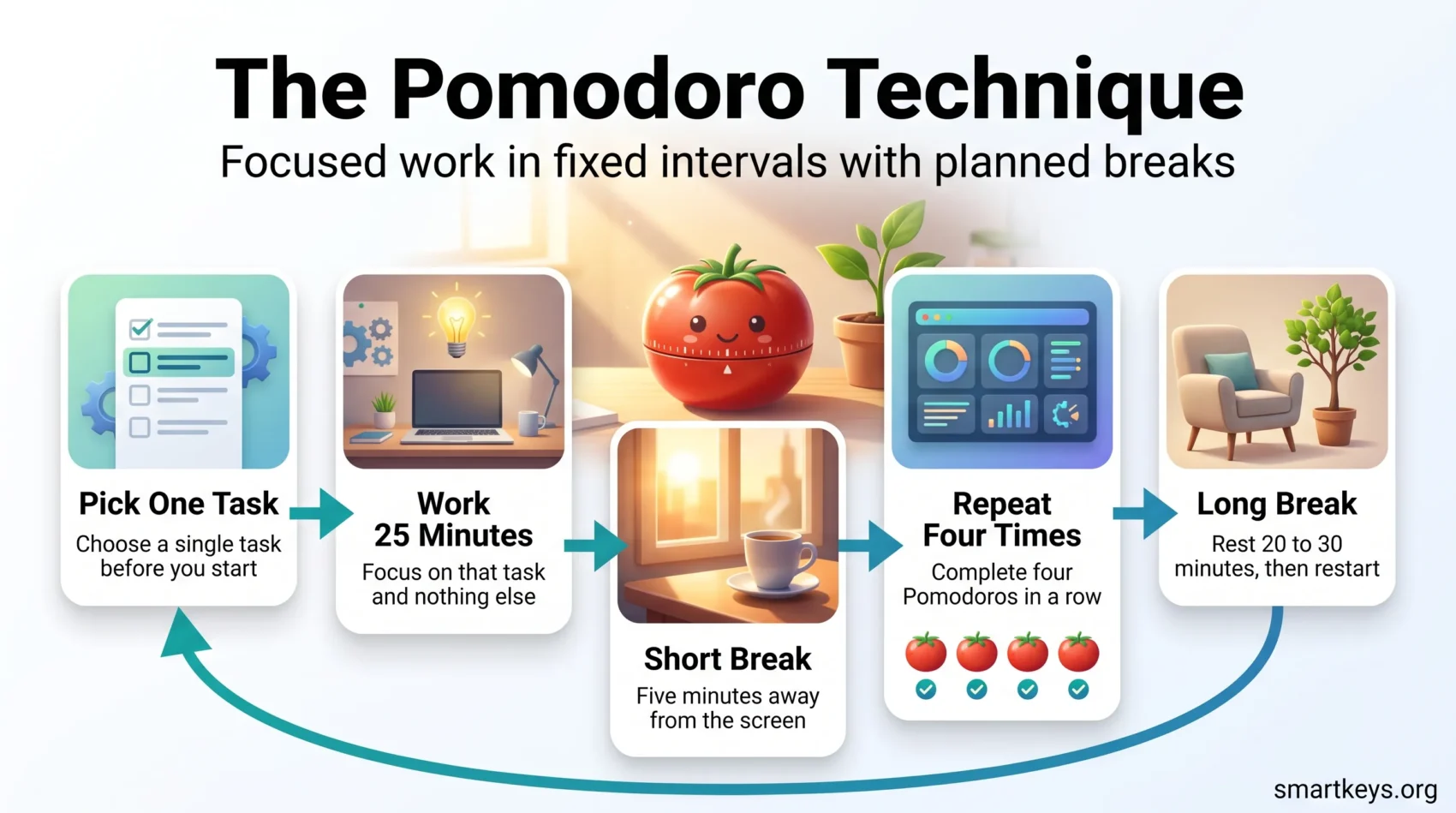
The Pomodoro Technique splits work into focused 25-minute blocks separated by short breaks. Francesco Cirillo built it around one idea: a timer you can see makes an open-ended task feel finite. You choose a single task, start the timer, and work until it rings. Nothing else gets touched in between. It suits studying, drafting, coding and clearing an inbox, and works as well with a paper list as with an app.
Key Insights
- One Pomodoro is 25 minutes of single-task work followed by a 5-minute break.
- After four Pomodoros, take a longer break of 20 to 30 minutes.
- Protecting the interval from interruptions matters more than the exact length you pick.
- The method fits work you can split into chunks. It fits deep creative flow and reactive support work far less well.
- It pairs well with time blocking: the calendar block decides when you work, the Pomodoro decides how.
- Evidence for the technique is mostly short-term and from students, so treat it as a useful structure rather than a guaranteed productivity multiplier.
What is the Pomodoro Technique?
The Pomodoro Technique is built on fixed work intervals of roughly 25 minutes, each followed by a short break. The interval is the unit of work: you measure a session in completed Pomodoros, not pages written or emails cleared. That shift makes the method easy to start and easy to keep.
The Six Steps of the Original Method
Cirillo’s method is deliberately small enough to memorise:
- Decide on the task to be done.
- Set the timer, traditionally to 25 minutes.
- Work on that task and nothing else.
- Stop when the timer rings and take a short break of 5 to 10 minutes.
- Repeat until you have completed four Pomodoros.
- Take a longer break of 20 to 30 minutes, then start the cycle again.
Everything else is a variation on those six steps. If you are choosing between structured approaches, the section on Pomodoro vs time blocking further down explains when each fits better and how to combine them.
Why a Visible Timer Changes How You Work
A running timer works as a commitment device. It turns a vague intention into a boundary you can see, and it removes the decision of when to stop, which is often what ends a stretch of concentration. Because a Pomodoro holds exactly one task, it also bans the flicking between windows that task switching creates, pushing you toward single-tasking without willpower. Both effects are structural rather than motivational, which is why the method still helps on low-energy days.
What the Evidence Says
A 2025 scoping review in BMC Medical Education pooled 32 studies covering 5,270 participants, mostly students, and found that structured Pomodoro intervals consistently outperformed self-paced breaks on self-reported focus and fatigue. The randomised trials reported roughly 20 percent lower fatigue, plus small improvements in distractibility and motivation.
The same authors flag the limits: the studies are heterogeneous, they measure short-term outcomes, and the rigid timing does not suit every working style. The reasonable reading is that a fixed break rhythm beats no rhythm, not that 25 minutes is a magic number.
History of the Pomodoro Technique
Origins and Evolution of the Productivity Technique
Francesco Cirillo developed the technique in the late 1980s, as a university student struggling to concentrate on his coursework. He bet himself he could study without interruption for a few minutes, grabbed a kitchen timer, and found that a hard boundary did more for his focus than willpower had. The interval grew to 25 minutes, the short break was formalised, and the method became a structured approach to downtime as much as to work. Longer variants, shorter variants and app-based versions have followed, but all keep the same skeleton: fixed work, fixed rest, a hard stop.
Francesco Cirillo’s Inspiration Behind the Tomato Timer
The name comes from pomodoro, the Italian word for tomato, after the tomato-shaped kitchen timer Cirillo used as a student. The choice matters more than it sounds: a mechanical timer sits outside your computer, so it cannot be dismissed with a click. The wider lesson is that a cheap tool used consistently beats an elaborate system used occasionally.
How to Implement the Pomodoro Technique
Setting up takes five minutes. The difficulty is holding the interval on the fourth repetition.
Step-by-Step Guide to Start Using the Technique
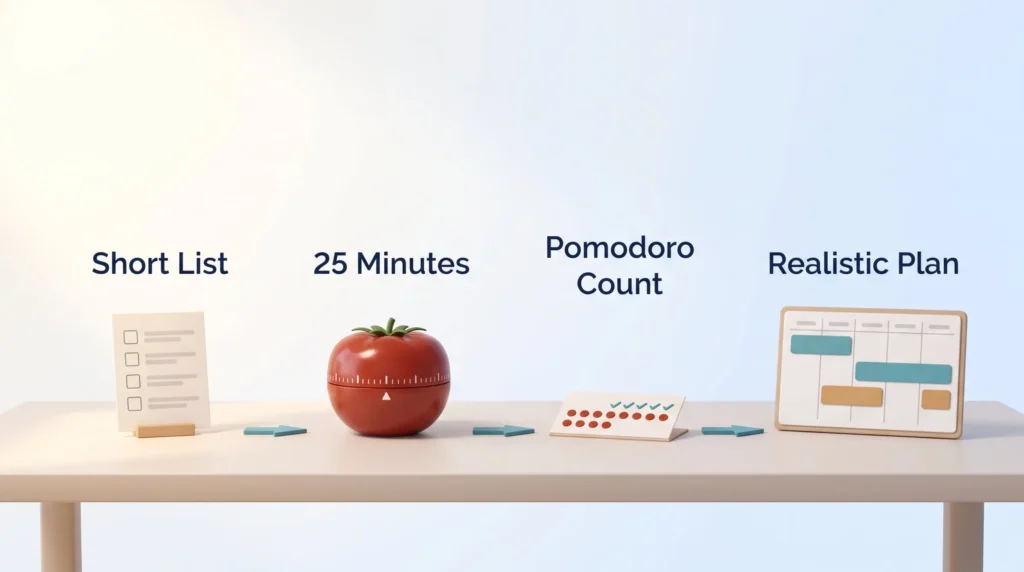
- Write down what you want to get through. A short, ordered list beats a long one, and our guide to building a workable to-do list covers how to keep it that way.
- Pick the first task deliberately rather than by whatever feels urgent. Simple prioritisation frameworks help here.
- Set the timer for 25 minutes and work on that one task.
- Stop when it rings and take a 5-minute break, away from the screen if you can.
- After four Pomodoros, take 20 to 30 minutes off.
- Mark each completed Pomodoro. The count is your record of what a task actually cost.
That last step is the one most people skip, and the one that turns the method into useful data. After a week you will know how long your recurring work really takes, which makes planning far less optimistic.
Tools You Need: Choosing Your Timer
Any timer works. A mechanical kitchen timer keeps the countdown off your devices. A dedicated app logs your session count automatically, and most task tools now include a focus timer. The stopwatch on your phone costs nothing and works today. A visual timer that shows remaining time as a shrinking block suits people who find digital countdowns easy to ignore. Whichever you choose, keep it for a few weeks: switching tools is procrastination in disguise.
Setting Up Your Work Environment
The method assumes an uninterrupted interval. If your environment cannot deliver 25 quiet minutes, it will keep breaking and you will blame yourself rather than the setup.
Creating a Distraction-Free Zone for Maximum Focus
- Work somewhere with predictable noise levels rather than somewhere merely quiet, and clear the desk down to what the current task needs.
- Silence notifications on every device, not just the one you are working on. Our guide to managing work notifications covers the settings worth changing.
- Use a website blocker if specific sites pull you away reliably.
- Tell people around you when a session starts, so an interruption becomes a decision rather than a reflex.
Minimizing Interruptions During Work Intervals
Cirillo’s own rule is that a Pomodoro is indivisible: an interrupted one does not count and is restarted from zero. That sounds harsh, but it gives the interval its weight.
For interruptions you create yourself, keep a notepad within reach and write the stray thought down instead of acting on it. For the ones other people create, agree on a response time rather than instant availability. In most roles a reply within the hour is sufficient, and saying so protects more focus than any app setting.
Breaking Down Your Tasks
Tasks have to fit inside an interval, so large projects must be cut down first. That cutting is where much of the benefit hides.
Strategies for Task Management with the Pomodoro Technique
- Estimate in Pomodoros. Guess how many intervals a task needs, then compare with the actual count.
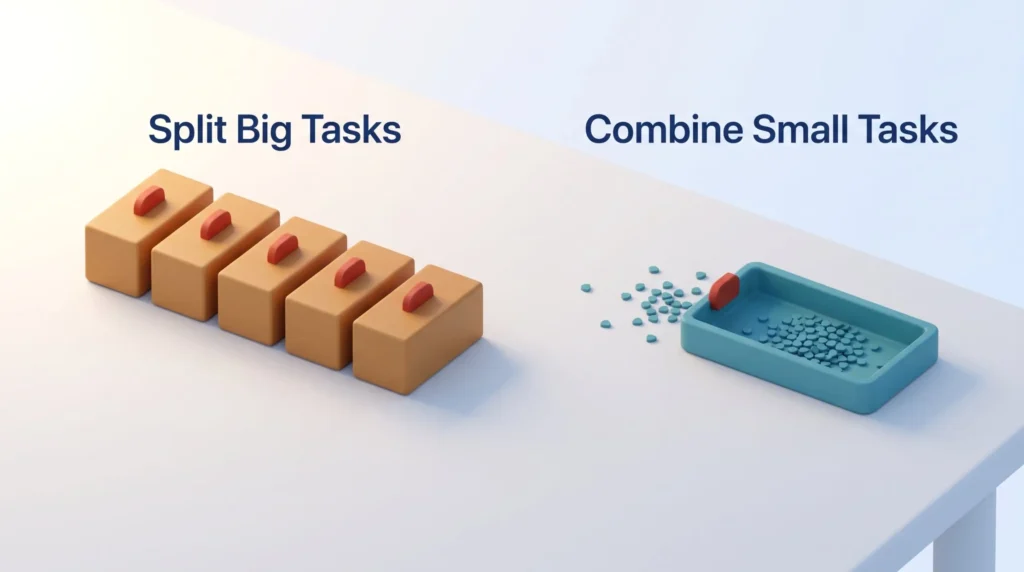
- Split anything over four Pomodoros. If a task will not fit in a morning, it is really several tasks.
- Combine anything under one. Tiny items belong together in a single session rather than scattered across the day.
- Start with the hardest item. The eat the frog approach pairs naturally with a fixed interval, because the timer caps how long the unpleasant task can last.
Combining Small Tasks into Effective Pomodoro Sessions
Grouping similar small jobs into one interval avoids paying the switching cost repeatedly. Answer the short emails in one Pomodoro, make the calls in another. Choose items that use the same kind of attention: mixing numbers work with writing inside one interval defeats the point. The 80/20 rule is a useful filter first, since some of those tasks do not need doing at all.
Rules to Follow for Maximum Productivity
Three Essential Guidelines to Enhance Your Efficiency
- Break complex work into pieces that fit an interval, so progress is visible after every session.
- Decide what a Pomodoro is for before you start it. Deciding afterwards costs you the first minutes.
- Finish the interval. If the task ends early, review or tidy it rather than start something new.
The Importance of Maintaining Break Intervals
The break is not a reward, it is part of the mechanism. Stopping on a fixed schedule prevents the drift into low-quality work that follows a long unbroken stretch, and it is the part of the method best supported by the research. Our piece on how short breaks affect focus covers the effect.
Use the five minutes for a genuine change of state: stand up, look out of a window, refill a glass. Movement breaks beat scrolling, which keeps you in the same posture and attention you just tried to release.
Benefits of Using the Pomodoro Technique
How the Technique Combats Procrastination
Procrastination usually attaches to tasks with no clear beginning. A Pomodoro supplies one. Committing to 25 minutes is a much smaller ask than committing to finishing, and starting is normally the hardest part; our guide to overcoming procrastination covers the pattern. The visible finish line helps too: you agree to a bounded amount of discomfort, not an open-ended one.
Improving Mental Stamina and Reducing Burnout
Working in intervals spreads effort across the day instead of front-loading it. The regular stops keep fatigue from accumulating unnoticed, which is what happens when a good stretch of concentration runs for three hours and leaves nothing for the afternoon. Pacing a day this way is closer to energy management than to time management.
Customizing Your Pomodoro Sessions
Adjusting Time Intervals to Fit Your Work Style
The 25/5 split is a starting point, not a rule. Common variants include 50 minutes of work with a 10-minute break, which suits writing and analysis, and a 15/5 cycle for low-energy days. Some people match the interval to their natural energy cycle instead; our explainer on ultradian rhythms covers that, and the focus sprints method extends the logic to longer blocks of 60 to 90 minutes. Change one variable at a time and give each version a week. If you are torn between short and long intervals, our Pomodoro vs focused sprints comparison shows which one suits deep work better.
Finding the Right Balance Between Work and Breaks
If you finish the day drained, the breaks are probably too short or too screen-based. If the timer keeps interrupting you mid-thought, the interval is too short for the work. Both are easy to fix once you notice the pattern, which is another argument for logging sessions.
Pomodoro vs Time Blocking: Choosing and Combining Them
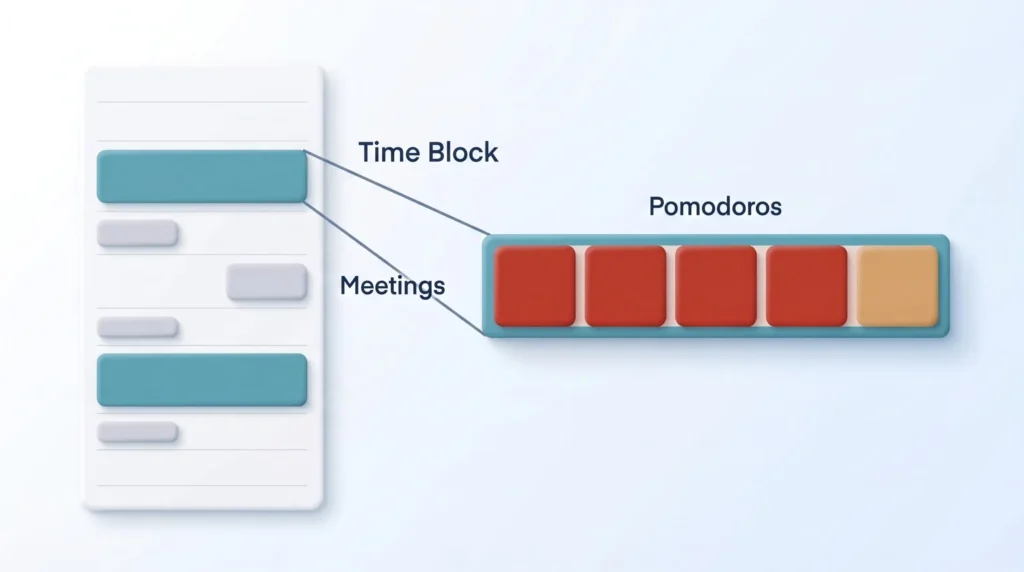
Time blocking is the closest alternative, and people often treat the two methods as rivals. In practice they work at different levels. Time blocking means assigning each part of your calendar to a specific task, so it decides what you work on and when. The Pomodoro Technique decides how you work inside that slot: one task, a fixed interval, a hard stop.
When Each Method Fits Better
- Pick Pomodoros when getting started is the problem, when tasks are small and clearly defined, or when you tend to work for hours without a pause.
- Pick time blocking when your day is full of meetings and deadlines and important work never gets a slot. Our step-by-step guide to time blocking shows how to build a first week.
- Expect neither to fit perfectly in roles where interruptions are the job. There, protecting one or two short blocks a day is a more realistic goal.
How to Combine the Two
The most practical setup uses both. Reserve two or three focus blocks in your calendar, then run Pomodoros inside them. A block of about two and a half hours holds one full cycle: four Pomodoros, the short breaks between them and the long break at the end. Meetings and messages go into the gaps between blocks, not into the intervals.
Your Pomodoro count also makes the calendar more honest. Most people underestimate how long tasks take, a bias psychologists call the planning fallacy. Comparing the time you blocked with the Pomodoros a task actually used shows where your estimates slip, so next week’s plan starts from real numbers.
Where the Pomodoro Technique Falls Short
It fights with deep work. If a task takes 20 minutes to get into, a 25-minute timer cuts you off just as concentration arrives, so writers and developers often do better with 50 or 90-minute blocks. It fights with reactive roles too: support, sales and management work is interrupt-driven by design, and a method that treats every interruption as a failure becomes a scoreboard of failures. It also assumes tasks can be isolated. Work that waits on other people fits time blocking better, as the comparison above shows. Use the Pomodoro Technique where it fits and drop it where it does not.
Found this useful?
Make SmartKeys a preferred source on Google, and our articles will surface more often in your Top Stories, AI Overviews, and AI Mode.
Add as Preferred Source