Most workdays no longer contain natural gaps. Microsoft’s 2025 Work Trend Index analysed Microsoft 365 activity and found employees are interrupted by a meeting, email or chat roughly every two minutes during core hours, about 275 times a day. Rest does not appear on its own in a day like that.
That is what structured downtime means: rest you schedule in advance, at a fixed time and for a fixed length, instead of waiting for a quiet moment that never arrives. It is the difference between “I will take a break when I get a chance” and “I stop at 11:00 for fifteen minutes and walk around the block.”
Key Takeaways
- Structured downtime is rest you plan, not rest you hope to find.
- A 2022 meta-analysis found micro-breaks reliably raise energy and cut fatigue, with smaller and less certain effects on performance.
- Longer breaks helped performance more than very short ones, especially after demanding work.
- Breaks work best when you mentally disconnect, not when you swap screens.
- Break rights differ by country, so check what your employer must provide.
Why Rest Has to Be Scheduled
Downtime is the part of your day when you are not working. Most people treat it as leftover time: whatever still stands after the meetings, messages and deadlines have taken their share. Leftover time disappears first. For the wider picture of what breaks, naps and idle minutes do for your work, see our overview of downtime and productivity; this guide focuses on how to schedule the rest itself.

Skipping rest rarely feels dramatic. It looks like eating at your desk, moving a walk to tomorrow, answering one more message before you stand up. Repeated across weeks, that pattern is a recognised contributor to chronic work stress and burnout, and it usually shows in your work before it shows in how you feel.
Scheduling the break removes the decision. You are no longer judging, mid-afternoon, whether you have earned fifteen minutes away from your desk. That was settled earlier, when you were calmer. Structured downtime works like wider stress management at work: both depend on choices made before the pressure arrives.
What Counts as Structured Downtime
Structured downtime is any deliberate pause from focused work, placed at a known point in the day. Length matters less than intent. A planned ten minutes counts. Twenty minutes of scrolling while telling yourself you are still working does not.

What tends to qualify:
- A short walk outdoors, ideally somewhere green.
- Mindfulness or breathing practice, the most studied way to shift attention off work. A few minutes of meditation counts.
- Deliberate movement breaks: stretching, stairs, anything out of the chair.
- A short nap where circumstances allow. The evidence on power naps and afternoon alertness is reasonably good, though timing and length decide whether you wake sharper or groggier.
- Letting your mind wander with no input at all, which sounds unproductive and is one of the better routes to associative thinking.
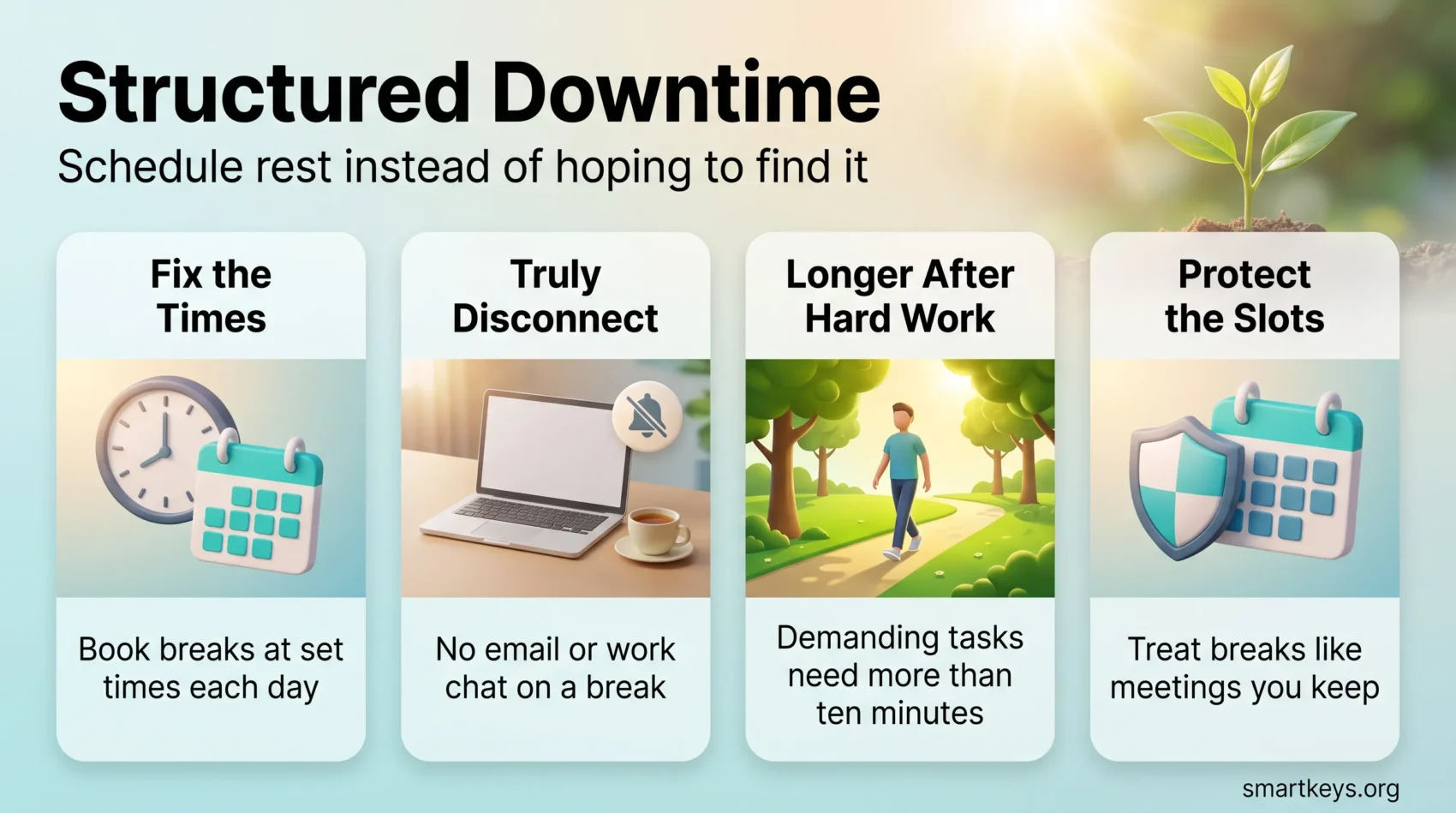
The common thread is psychological detachment: the point at which you stop mentally rehearsing the work. That is what separates a restorative break from a change of posture. Checking your inbox at lunch does not achieve it, which is why turning off work notifications during a break matters more than it looks like it should.
What the Evidence Actually Shows
The case for breaks is often oversold. It helps to separate what holds up from what does not.
Energy and Fatigue: The Strongest Finding
The most useful evidence is a 2022 systematic review and meta-analysis in PLOS ONE, pooling 22 samples covering 2,335 participants. Micro-breaks, meaning pauses of roughly ten minutes or less, produced a small but statistically reliable rise in vigor (d = 0.36) and a comparable drop in fatigue (d = 0.35).
In plain terms: short breaks make people measurably more energetic and less worn out. That is a modest effect, not a transformation, and it is the claim the research supports most clearly.
Performance and Creativity: Weaker and Conditional
The same meta-analysis found no statistically significant overall effect on task performance (d = 0.16, p = 0.116). Two qualifications matter. The longer the break, the larger the performance benefit, and the authors concluded that recovering from highly depleting work probably needs more than ten minutes. The effect also varied by task, helping with clerical and creative work but not with cognitively demanding ones.
So if your afternoon involves a genuinely hard problem, a five-minute pause will not rescue it. A proper lunch break, or protecting a full deep work block the next morning, is the realistic remedy. Short breaks reliably restore energy; restoring performance costs more time than people expect.

How Structured Downtime Lowers Burnout Risk
Burnout is not caused by a missing coffee break, and no schedule change fixes a workload that is simply too large. What structured downtime prevents is one failure: the week containing no recovery at all.
The best-known workplace experiment here is Leslie Perlow’s Predictable Time Off study with consulting teams at Boston Consulting Group. Teams were required to take scheduled time off, and compliance had to be enforced because people resisted it. What surprised the firm was that mandated time away improved satisfaction with work and working life without reducing the value delivered to clients. The lesson is about who owns the decision.
When rest depends on individual willpower inside a busy team, it loses. If your calendar is the only thing protecting your lunch break, one urgent meeting request will take it. Agreements about boundaries at work hold up better than good intentions, especially for distributed teams where colleagues cannot see you have stepped away. That visibility gap is a recurring theme in remote work and mental health.
Building Downtime Into the Working Week
Structured downtime is easier to sustain when it attaches to something already in your day.
Fixed Times and Small Rituals
Pick times rather than durations. A break at 11:00 and 15:00 is easier to keep than “two breaks a day”, because a specific time can be defended and a vague intention cannot. Putting those blocks in the calendar is the simplest form of time blocking; leaving slack around them is what time buffering is for.
A small ritual helps the break start on time: making tea, changing rooms, putting on shoes. If you prefer a countable rhythm, the Pomodoro Technique attaches a five-minute break to every 25 minutes of focus, while working with your ultradian rhythm uses cycles of roughly 90 minutes followed by real recovery. Keep whichever you actually follow.
Structured and Unstructured Downtime Are Not the Same
Unstructured downtime is the unplanned gap: a meeting ends early, a colleague is late. Those gaps have real value, and there is a good case that boredom is where loose ideas surface, which is the subject of our separate guide to making unplanned downtime productive. But they are unreliable. They arrive when you are already distracted and rarely last long enough to recover from anything. Treat them as a bonus and schedule the rest you are counting on.
What the Rules Actually Say About Breaks
Your legal position depends on where you work, and many people assume protections they do not have.
In the European Union, the Working Time Directive gives workers a rest break whenever the working day exceeds six hours, with details set by each member state. In the United States, federal law requires no meal or rest breaks at all; entitlement comes from state law or the employer, and several states including California do require paid rest periods.
A newer development concerns rest after hours rather than during them. Australia’s right to disconnect, which lets employees refuse to answer work contact outside working hours unless the refusal is unreasonable, was extended to small business employees on 26 August 2025. That matters for anyone whose downtime is regularly interrupted by evening messages. Our guide to the right to disconnect covers how these rules work in practice.
Putting Structured Downtime Into Your Own Routine
Start by finding where your day actually sags: usually mid-morning after a run of meetings, or the flat stretch after lunch. Put your breaks there rather than at neat intervals. A break placed where you were about to lose focus anyway costs almost nothing.

A workable starting pattern:
- Two scheduled breaks of 10 to 15 minutes at fixed times, plus a real lunch away from your desk.
- One longer recovery block each week for something with no output attached.
- A rule for what a break is not, for example no email and no work chat. This is where managing energy rather than hours becomes concrete.
- A check during your weekly review: which breaks survived, and what took the rest?
If fifteen minutes feels impossible, shrink it rather than skip it. Two minutes at a window is a smaller version of the same behaviour, and the logic of micro-productivity applies to rest as much as to work.
When breaks keep getting eaten, the cause is usually workload rather than routine. That is a prioritisation question, and frameworks such as the 4 Ds of time management beat another attempt at willpower.
Conclusion
Structured downtime is a modest intervention with a modest, well-documented payoff. Planned short breaks reliably restore energy and reduce fatigue. Their effect on performance is smaller, less certain, and depends on allowing enough time to recover from demanding work. Expect a steadier week rather than a dramatic one.
The practical shift is small. Decide in advance when you will stop, protect those slots the way you would protect a meeting, and genuinely step away. In a day interrupted every couple of minutes, that decision is the only thing standing between you and a week with no recovery in it.
Found this useful?
Make SmartKeys a preferred source on Google, and our articles will surface more often in your Top Stories, AI Overviews, and AI Mode.
Add as Preferred Source