Most advice about short breaks at work promises more than the evidence delivers. Breaks do reliably lift energy and reduce fatigue. What they do to raw output is smaller and more conditional than the usual productivity article suggests, and knowing the difference changes how you should schedule them.
That distinction matters more in 2026 than it did a few years ago. In a November 2025 Eagle Hill Consulting survey of more than 1,400 US employees, 55% reported burnout, and 72% of those said it was reducing their efficiency. Fatigue is not a niche problem, and a five minute pause is not a cure for it. It is, however, one of the few interventions an individual worker can apply without permission from anyone.
This guide covers what the research on micro-breaks actually found, how often and how long to pause, where the popular numbers come from, which break activities hold up, and how to build a break rhythm that survives a real workweek. For the bigger picture of rest at work, from naps to idle minutes, see our guide to why downtime boosts productivity. If exhaustion is the bigger issue rather than concentration, our guide to remote work and mental health covers the ground breaks alone cannot.
Key Takeaways
- Micro-breaks have a small but consistent effect on energy and fatigue; the effect on task performance is weaker and not statistically reliable.
- Longer breaks show bigger performance gains than very short ones, so a two minute pause is not interchangeable with fifteen.
- Non-work-related break activities beat work-related ones, and the benefit is largest on high workload days.
- Detaching properly matters more than the length of the pause.
- Break policies work when managers visibly take breaks themselves, not when they are written into a handbook.
Why Short Breaks Matter at Work
A short break is any deliberate pause from a task, usually somewhere between thirty seconds and twenty minutes. The problem is not that people disagree about their value. It is that many people skip them anyway.
A 2021 Tork survey found 39% of employees said they only occasionally, rarely or never take a break during the workday, while 94% said they felt happier when they were able to take one. More than nine in ten said they would be more likely to stay at a company that encourages breaks. Those figures are survey self-reports rather than measured behaviour, and they are now several years old, but the gap they describe has not obviously closed.
The practical case for breaks is less about a productivity number and more about the alternative. Working through fatigue produces slower, sloppier work that has to be redone, and it accumulates. The same logic applies to the physical side of desk work: uninterrupted sitting is a bigger risk than the few minutes an occasional walk costs you.

What the Research Actually Shows
The clearest evidence comes from a 2022 meta-analysis in PLOS ONE by Albulescu and colleagues, which pooled 22 independent samples covering 2,335 participants. Its headline findings are worth stating precisely, because they are usually reported loosely.
Micro-breaks produced a small but significant increase in vigour (d = .36, p < .001) and a comparable reduction in fatigue (d = .35, p < .001). The effect on task performance was smaller and did not reach statistical significance (d = .16, p = .116). In other words, breaks make you feel measurably better long before they make you measurably faster.
The moderator analysis is the more useful part. A meta-regression found that the longer the break, the greater the boost to performance (b = .07, p = .006). Duration did not moderate the wellbeing outcomes at all. The reading that follows: very short pauses are enough to restore energy, but tasks that demand sustained mental effort need something longer than a stretch at your desk before performance recovers.
A 2025 diary study by the same research group tracked 105 employees across 435 daily observations. Micro-breaks were associated with lower fatigue and higher vigour, and the pattern was strongest for non-work-related breaks. Checking a different inbox does not count. The buffering effect was most pronounced on high workload days, which is exactly when people are most likely to skip a break.
Separately, work from the US National Institutes of Health published in Cell Reports in June 2021 found that during ten second rest periods, the brains of people learning a typing sequence replayed that sequence roughly twenty times faster than real time, around 25 times per rest period. Participants whose brains replayed more showed larger performance jumps. It is a laboratory finding about early skill learning, not a general claim about office work, but it does suggest rest is doing something rather than nothing.

How Often Should You Take Breaks at Work?
The best known break schedule is the Pomodoro Technique: twenty five minutes of focused work, a five minute pause, and a longer break of fifteen to thirty minutes after four cycles. It is popular because it is simple, and it works well for tasks you can slice into short units. Our full Pomodoro guide covers the original method and where it fails.
The other number you will see everywhere is 52/17. It came from DeskTime, a time tracking company, which reported in 2014 that its most productive users worked about 52 minutes and then broke for about 17. DeskTime revisited its own data in 2021 and found the ratio had shifted to roughly 112 minutes of work followed by a 26 minute break, which it attributed largely to remote work removing office interruptions. Treat both as observations from one company’s user base, not as a law.
What this means in practice is that the exact interval matters less than three things: that the break happens, that it is long enough for the kind of work you are doing, and that you actually disengage. For work that requires deep concentration, longer blocks with fewer, longer breaks tend to fit better than short cycles. Our guides to deep work and time blocking cover how to build a day around that pattern.
One trap is worth naming. A break that consists of switching to another screen is not a break; it is a task switch, and it carries its own cost. Task switching fragments attention rather than restoring it.
How Short Breaks Reduce Stress
The stress case for breaks is stronger than the performance case, and it rests on the same meta-analytic finding: micro-breaks reliably reduce fatigue and lift vigour. Recovery research consistently points to psychological detachment as the mechanism. Physically leaving your desk while mentally staying in the problem gets you very little.

That is why the 2025 diary study’s distinction between work-related and non-work-related breaks is the most actionable result in this whole literature. Reading industry news, tidying your task list or “just answering one thing” all keep the work system loaded. Stepping outside, talking to someone about anything else, or doing a few minutes of breathing exercises unloads it.
Timing helps too. Taking breaks before you feel depleted works better than waiting until you cannot concentrate, because at that point a five minute pause is no longer enough. If the afternoon is where your day reliably falls apart, our guide to beating the afternoon slump and our overview of stress management at work go further than break scheduling alone.
Breaks are a maintenance practice, not a treatment. If you are already burned out, more micro-breaks will not fix it, and treating them as the remedy tends to delay the changes that would.
Micro-Breaks and Decision Fatigue
Decision fatigue describes the decline in decision quality that follows a long run of choices. The concept is intuitive, and it has been used to explain everything from bad afternoon judgement to impulse buying at the supermarket checkout. It is worth saying plainly that the strength of the underlying evidence is debated, and some of the best known ego-depletion experiments have not replicated well.
What survives that debate is the more modest claim, and it is the one the break research supports directly: sustained cognitive effort produces fatigue, fatigue is measurably reduced by breaks, and tired people make worse decisions. You do not need the strong version of the theory to justify pausing before a decision that matters.
Two practical implications follow. First, batch or defer trivial decisions so they do not consume the same attention as consequential ones; a set lunch order and a fixed getting-ready routine genuinely help. Second, schedule the decisions that matter into the part of the day when you are freshest, and put a real break in front of them rather than arriving straight from three hours of meetings.
Building Healthy Habits Into Your Breaks
What you do with a break changes what you get out of it. The meta-analysis did not identify one winning activity, so the sensible approach is to pick the one that actually detaches you and is repeatable on a normal Tuesday.

- Move. Standing up, stretching or walking breaks up sitting time and is the easiest option to build a habit around. Our guide to exercise and productivity covers the wider picture.
- Get outside. A short walk outdoors combines movement with a genuine change of environment, which makes detaching easier than staying at your desk.
- Breathe or meditate. A few minutes is enough to be worth doing. See meditation and productivity for how to start without a course.
- Eat and drink properly. A break spent on a real snack rather than a fourth coffee holds up better through the afternoon. Our guide to nutrition and productivity goes into detail.
- Talk to someone. A short non-work conversation is one of the most reliable ways to detach, and it is the one remote workers lose first.
- Nap, if you can. A ten to twenty minute nap restores alertness without leaving you groggy. See power naps at work for the timing.
Notice what is missing: scrolling. Phone breaks are the default, they are easy, and they are the least likely to leave you feeling recovered. If that is where your breaks go, a digital detox routine is a better starting point than a new timer.
Practical Tips for Effective Breaks at Work
Effective breaks need to be planned, or the busy days will eat them. A few rules that hold up:
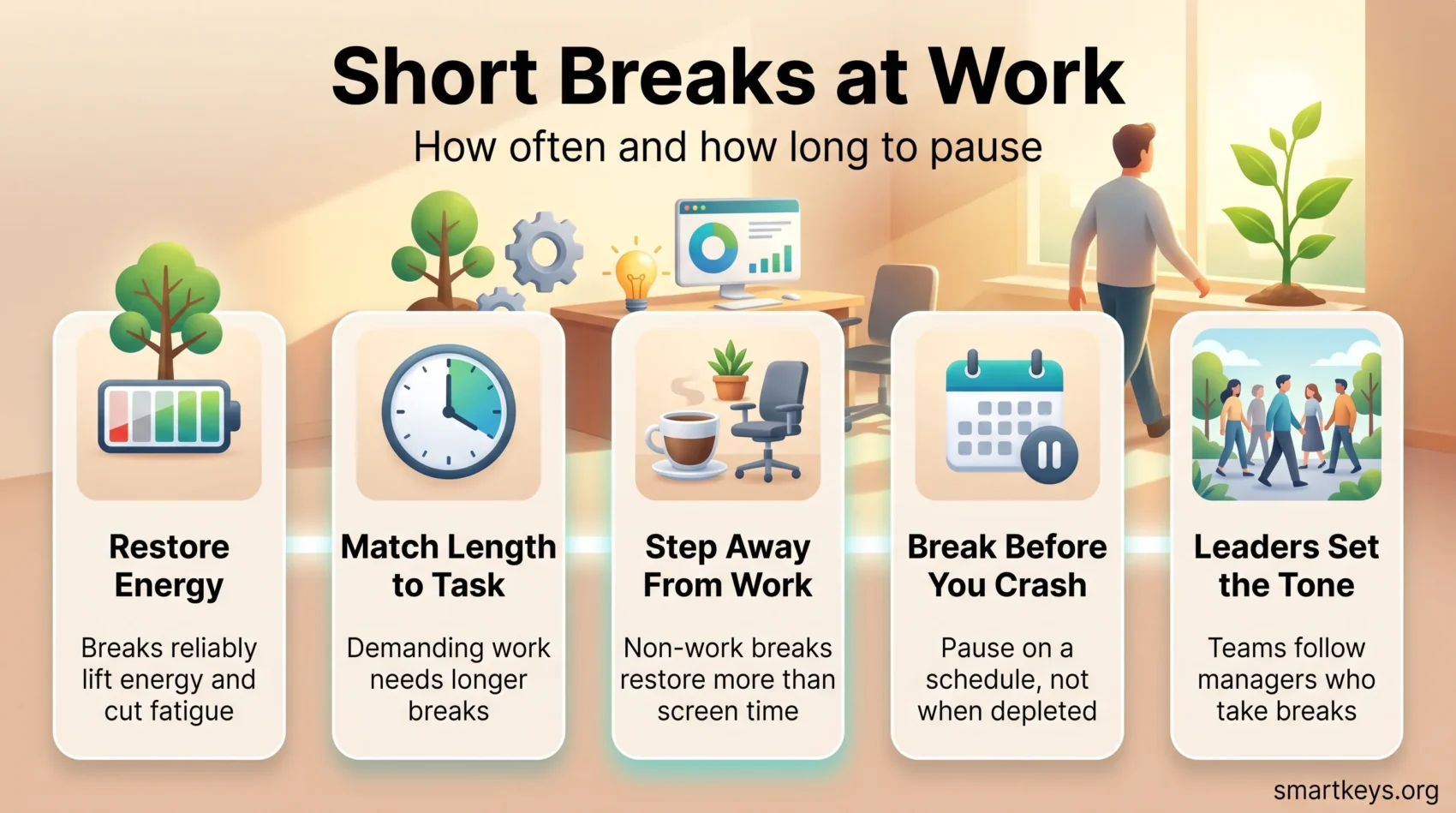
- Put them in the calendar. A break that exists only as an intention is the first thing to go when a day gets tight.
- Match length to task. Since the performance benefit grows with duration, demanding cognitive work deserves a longer break than routine admin does.
- Break before you crash. Pausing on a schedule beats pausing when you notice you have reread the same paragraph three times.
- Leave the desk. Changing location makes detachment far more likely than staying in the same chair.
- Protect the boundary. A lunch break spent on your inbox is not a break. Our guide to using focus modes covers keeping notifications out of it.
- Use a timer if you need one. The point is not the specific interval but removing the decision about when to stop.
For people working from home, the harder problem is usually that there is no natural interruption to signal a break at all. Our guide to a productive home office and our piece on structured downtime both address that directly.
Building a Culture of Breaks in the Workplace
Individual habits only go so far when the surrounding culture treats stepping away as slacking. Twenty two percent of respondents in the Tork survey said they felt guilty or judged when they took a break, which tells you most of what you need to know about why policies alone fail.
Management behaviour is the lever. When leaders visibly take breaks, others follow; when they eat at their desks and answer messages through lunch, no written policy overrides that signal. Robert Pozen, a senior lecturer at MIT Sloan, has long recommended a break of around fifteen minutes every 75 to 90 minutes, which is a reasonable default even though it is a recommendation rather than a research finding.
Flexibility beats prescription. Legal rest requirements set a floor, but rigid company-wide break times suit shift work better than knowledge work. Letting people place their own breaks around their own peak hours produces better compliance than mandating a schedule. Our guide to flexible work schedules covers how that works in practice.
How Organisations Put Break Policies Into Practice
The honest summary is that published, independently verified case studies on workplace break programmes are thin. Most of what circulates is vendor material. That does not mean nothing is known, but it does mean claims of specific percentage gains from a break policy should be read sceptically.
What organisations do report consistently is easier to believe because it is less dramatic. Structured break rhythms, whether Pomodoro cycles in software teams or scheduled pauses in call centres, tend to reduce end-of-shift fatigue complaints. Making breaks physically possible, with somewhere to actually go, changes uptake more than an email announcing a new policy. And where breaks are combined with movement rather than a change of screen, teams report better morale.
The pattern across these is not a productivity multiplier. It is a reduction in the accumulated cost of pushing through, which shows up as fewer errors and lower turnover rather than as a visible speed increase. Broader employee wellness programmes and work on preventing burnout face the same measurement problem.
Conclusion
Short breaks earn their place on solid but modest evidence. They reliably restore energy and reduce fatigue. They do not, on current evidence, reliably make you faster, and longer breaks do more for performance than very short ones. That is a less exciting claim than most productivity writing makes, and it is more useful, because it tells you what to actually change.
Take breaks before you need them. Make them long enough for the work you are doing. Spend them on something that is not work, and leave the desk if you can. Then stop expecting a five minute pause to solve a workload problem, because that is the part no break schedule can fix.
Found this useful?
Make SmartKeys a preferred source on Google, and our articles will surface more often in your Top Stories, AI Overviews, and AI Mode.
Add as Preferred Source