What you eat during the workday shapes how much of it you actually get done. Food supplies the glucose your brain runs on, the amino acids behind your neurotransmitters, and the micronutrients that keep energy production steady. The effect shows up in your output, not just in a health screening.
The link is measurable. A study of 19,803 employees at three large companies, led by Ray Merrill at Brigham Young University and published in Population Health Management, found that workers with unhealthy diets were 66% more likely to report a loss in productivity than colleagues who ate well. Those who rarely ate fruit or vegetables at work were 93% more likely to report a higher loss.
This guide covers what the evidence supports, what the 2025–2030 Dietary Guidelines changed in January 2026, and how to turn both into habits that survive a real workday.
Key Takeaways
- In a study of nearly 20,000 employees, those with unhealthy diets were 66% more likely to report productivity losses.
- The 2025–2030 Dietary Guidelines, released in January 2026, push whole foods, high-quality protein at every meal and far less added sugar.
- Complex carbohydrates paired with protein and fat give steadier energy levels than sugar-heavy snacks.
- Losing more than 2% of body mass in water measurably impairs attention and executive function.
- Nutrition works alongside sleep, movement and focus habits — not instead of them.
The Importance of Nutrition in the Workplace
Most people eat a meal and several snacks during working hours, so the workplace decides much of daily diet quality. What the canteen, vending machine or desk drawer offers is the default — and most people follow defaults.
A 2025 review in Frontiers in Public Health by Quak, Ebata and Barnett examined the business case for workforce nutrition initiatives across 24 studies. It identified two routes from food to results: better intake supports concentration and energy, which reduces absenteeism, and it can lift motivation and work quality. The authors are candid about the limits — 20 of the 24 studies came from high-income countries.
Employers who want a return change the default, not the poster:
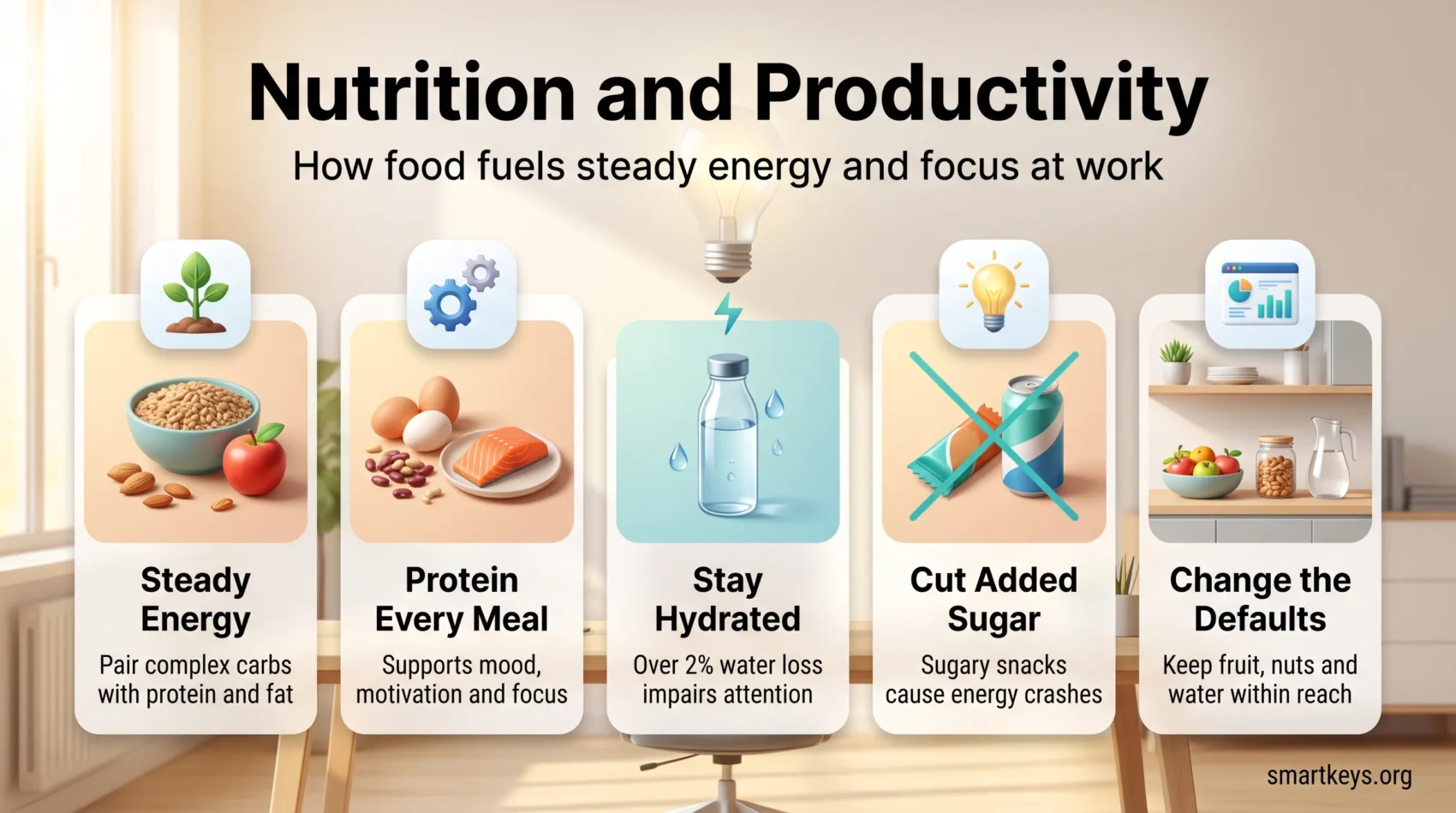
- Stock fruit, nuts and whole-grain options where the snacks already are.
- Serve real food at meetings instead of pastries and sugary drinks.
- Make water visible and free at every desk cluster.
- Give people time to eat away from the screen — a keyboard lunch helps neither digestion nor the dip that follows it.
Nutrition is one input among several, working alongside regular physical activity and workable stress management. None compensates for the absence of the others.
Nutrition and Productivity
The mechanism is unglamorous. Your brain is metabolically expensive and runs on a steady glucose supply. A sugar-heavy snack gives a fast rise and an equally fast fall; complex carbohydrates with protein and fat alongside deliver the same energy slowly enough to last a work block.

That matters most where attention is scarce. If you are trying to hold a 90-minute block and work with your energy peaks rather than against them, a mid-morning crash is not a health problem — it is a lost block. A good diet does not create focus, but a bad one reliably removes it.
Mood follows the same path. Steady energy makes it easier to begin difficult work, and beginning is usually the hard part — which is why food and tackling your hardest task first belong together.
What the 2025–2030 Dietary Guidelines Changed
On 7 January 2026, the US Department of Health and Human Services and the USDA released the 2025–2030 Dietary Guidelines for Americans. Several shifts matter for how you eat at work:
- Protein at every meal — eggs, poultry, seafood, meat, beans, nuts and legumes.
- Added sugars: no amount of added sugars or non-nutritive sweeteners is recommended in a healthy diet.
- Ultra-processed foods: for the first time, the guidelines advise avoiding highly processed packaged, prepared and ready-to-eat foods and sugar-sweetened drinks.
- Fats from whole foods such as nuts, eggs, seafood, full-fat dairy and olive oil belong in a healthy pattern.
- Whole grains over refined breads, cereals and crackers.
Read against a normal workday, that argues against the vending machine and for anything you unpacked yourself.
Understanding Nutritional Balance
Nutritional balance means getting both macronutrients and micronutrients in usable proportions. It is what keeps energy and concentration stable across eight hours instead of peaking once and collapsing.
Macronutrients and Their Impact
Carbohydrates, proteins and fats each do a distinct job. Carbohydrates are your main energy source, and complex ones release it gradually. Protein repairs tissue and supplies the building blocks for neurotransmitters. Fats provide dense energy and support brain structure.
- Carbohydrates: favour complex sources such as whole grains, legumes and vegetables.
- Proteins: lean meats, fish, eggs, beans and legumes.
- Fats: avocados, nuts, seeds, olive oil and oily fish for brain health.
The Role of Micronutrients
Vitamins and minerals supply no energy, but metabolism does not run without them. B vitamins help convert food into usable energy, iron carries oxygen to the brain, and magnesium supports nerve and muscle function. Deficiencies usually show up as fatigue and poor concentration long before anything more dramatic.
- Vitamins: the B group for energy metabolism, vitamin C for immune function.
- Minerals: iron for oxygen transport, calcium and magnesium for bone and muscle function.
- Antioxidants: abundant in fruit and vegetables, they help counter oxidative stress.
Healthy Eating Habits for Better Focus
Healthy eating habits are a logistics problem, not a knowledge problem. Almost everyone knows lentils beat crisps. The difficulty is having them ready at 12:30 on a day that went sideways at 09:00.
How to Create a Balanced Meal Plan
A balanced meal plan only works if it reduces decisions rather than adding them:
- Build each meal around a protein, a fibre-rich carbohydrate and a vegetable — that template covers most of the guidance without a spreadsheet.
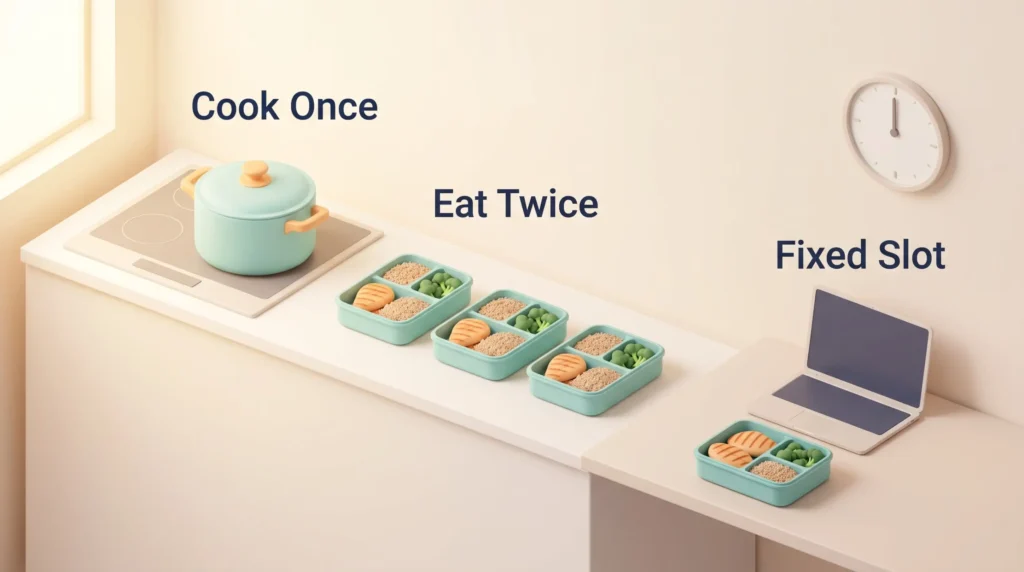
- Cook once, eat twice. Batch-cooking removes the weekday decision entirely.
- Eat slowly enough to notice fullness; rushed meals tend to be larger ones.
- Keep one default lunch you can assemble without thinking, for when planning fails.
Attaching meals to a fixed slot in your daily routine beats relying on hunger to remind you; by then the decision is usually made for you.
Incorporating Nutrient-Rich Foods
Small substitutions beat reinvention:
- Eat the vegetables or protein on your plate before the starch; it blunts the blood-sugar rise.
- Choose protein-dense snacks such as Greek yoghurt, eggs or nuts over biscuits.
- Swap sugary drinks for water, sparkling water or unsweetened coffee and tea.
Boosting Energy Levels Through Diet
Boosting energy levels through food is less about adding a superfood than removing the crashes. Meals combining slow carbohydrates, protein and fat produce a flatter, longer energy curve than anything eaten alone.
Foods that Provide Sustained Energy
- Whole grains such as oats, brown rice and quinoa
- Legumes including beans, lentils and chickpeas
- Nuts and seeds such as almonds, walnuts and chia
- Fruit including berries, apples and bananas
- Vegetables such as sweet potato, spinach and broccoli
- Lean protein including chicken, fish, eggs and dairy
These release glucose gradually, preventing the spikes and dips that break concentration.
The Longest-Lasting Fuel for Your Body
Pairing extends the curve. Fat and protein slow digestion, so the carbohydrate alongside them arrives over hours rather than minutes. An apple alone is a short snack; an apple with a handful of almonds carries you to the next meal.
If your energy still collapses at the same hour every day regardless of what you ate, the cause is more likely circadian than nutritional, and food only amplifies or softens it.
Hydration: The Cheapest Lever You Have
Water gets ignored because it costs nothing, yet the evidence for it beats most supplements. A meta-analysis of 33 studies by Wittbrodt and Millard-Stafford, published in Medicine & Science in Sports & Exercise in 2018, found that dehydration of more than 2% of body mass was associated with impairments in attention, executive function and motor coordination.

Two per cent is not a desert march. It is a warm office, a few coffees and no water bottle. There is no single correct intake, so keep water within arm’s reach and drink before you feel thirsty — thirst is a lagging indicator. If your attention frays in short bursts through the afternoon, rule out dehydration before reaching for another focus tool or blaming your attention span.
Cognitive Performance and Nutrition
Diet has a measurable relationship with cognitive performance. Omega-3 fatty acids, concentrated in oily fish such as salmon and mackerel, are structural components of brain cell membranes, and fruit and vegetables supply antioxidants that help the brain manage oxidative stress. Neither is a nootropic; both are maintenance.
The realistic framing is downside protection: a varied whole-food diet will not turn an average day into a brilliant one, but a run of poor eating reliably produces foggy afternoons and work that has to be redone.
Food also interacts with everything else competing for your attention: steady energy makes it easier to resist the pull of notifications, which is where digital fatigue and diet reinforce each other.
The Influence of Carbohydrates on Work Productivity
Carbohydrates are your main energy source, and the type you choose changes how the next two hours feel.
Simple vs. Complex Carbohydrates
Simple carbohydrates in sugary snacks and drinks deliver a quick lift followed by a sharp drop. Complex carbohydrates in whole grains, legumes and vegetables release energy slowly, which is what sustained concentration requires. The 2025–2030 guidelines say the same in policy language: prioritise fibre-rich whole grains, cut the refined versions.
Recommendations for Optimal Carbohydrate Intake
- Make complex carbohydrates the default and treat simple ones as occasional.
- Build meals around whole grains such as brown rice, oats and quinoa.
- Keep the meal before demanding work moderate in size; a heavy plate costs alertness.
- Avoid large late-night meals, which disturb sleep and cost you the next morning.
For more on building these choices into the first hours of the day, see our guide to building an effective morning routine.
The Role of Protein in Enhancing Employee Efficiency
Protein does more than repair muscle. Amino acids are the raw material for dopamine and serotonin, which shape motivation and mood, and protein-rich meals produce a steadier glucose response than carbohydrate alone. That is why a protein-forward lunch tends to leave you functional at 15:00 while a pasta-only one does not. The 2025–2030 Dietary Guidelines make protein at every meal an explicit recommendation — the easiest single change to make at work is to add a protein source to whatever you were already going to eat.
For teams, the lever is availability. Making protein-rich options the easy choice does more than any amount of nutrition messaging — a pattern that holds for remote work habits too, where the fridge, not the canteen, sets the default. Pair food with practical home-office guidance, recovery practices such as meditation and realistic expectations about productive remote work.
Found this useful?
Make SmartKeys a preferred source on Google, and our articles will surface more often in your Top Stories, AI Overviews, and AI Mode.
Add as Preferred Source