Meditation has moved from the fringes into ordinary working life. In 2022, 18.3% of US adults said they had meditated in the past 12 months, according to an analysis of National Health Interview Survey data published in Scientific Reports. That is roughly one adult in five.
The reason most people give is practical rather than spiritual: they want to feel less wound up and think more clearly. This guide covers what meditation is, what the research supports, how to build a habit that survives a normal working week, and the parts the marketing usually leaves out.
Key Takeaways
- Meditation means training attention, usually by returning focus to your breath whenever your mind wanders.
- The strongest evidence is for reduced anxiety, low mood and pain. The case for sharper attention is much weaker.
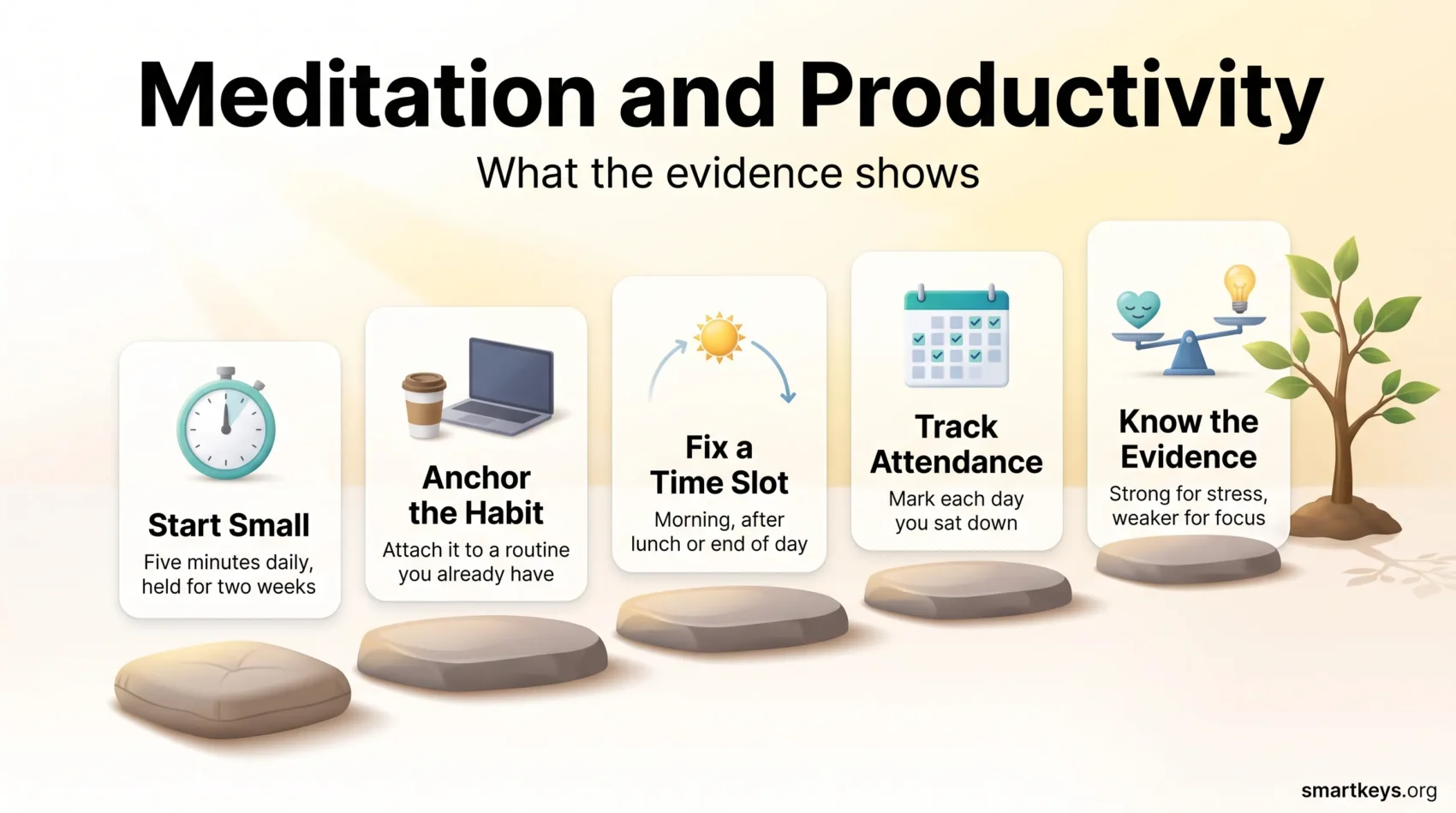
- Five minutes a day, done consistently, beats a 40-minute session you abandon after a week.
- Anchoring the session to something you already do daily makes the habit far likelier to stick.
- Workplace programmes reliably lower reported stress, but the effect on measured productivity is not established.
- A small minority find meditation distressing, which is worth knowing before you start.
Understanding the Basics of Meditation
Meditation is attention training. You pick something to focus on, usually the feeling of your own breathing, and each time your mind wanders you notice it and come back. The wandering is not a failure. Noticing it and returning is the exercise, the way a repetition is the exercise in the gym.
The most common form in workplaces and research is mindfulness meditation: paying attention to what is happening right now, including thoughts and feelings, without arguing with any of it. If a worry about tomorrow’s deadline shows up, you register it as a thought and return to the breath rather than following it for ten minutes.
A useful reference point is Mindfulness-Based Stress Reduction, the eight-week course Jon Kabat-Zinn developed at the University of Massachusetts Medical School in 1979. Participants attend a weekly class of roughly two and a half hours and practise at home most days. Most clinical research on meditation studies this format or something close to it. That matters when you read a headline: the results come from eight weeks of structured, near-daily practice, not an occasional five minutes. You do not need the full course to benefit, but it is worth knowing what the studied dose looks like.

The Importance of Daily Meditation
Frequency beats duration. A short session most days builds the skill; a long session once a fortnight builds only the intention to meditate. That is why micro-habits taking a minute or two tend to outlast ambitious routines.
Building Consistency for Long-term Benefits
Start at five minutes and stay there for two weeks before adding time. The temptation is to begin with twenty because that sounds serious. Twenty minutes on day one usually means nothing at all by day nine.
Once five minutes feels automatic, add two or three more. Ten to fifteen minutes a day is a reasonable long-term target. Beyond that suits committed practitioners rather than someone fitting this around a job.
Creating a Habit That Fits Your Lifestyle
The most useful trick is attaching the session to something you already do without thinking. After you switch the kettle on. After you close your laptop. Before you open your inbox. This is habit stacking, and it works because the existing routine supplies the reminder. Choose the anchor first, then the length. A habit tied to “sometime in the morning” competes with everything else and usually loses.
Meditation and Productivity: Unlocking Focus and Efficiency
Here is the honest version of the productivity case, because it is more mixed than most articles admit.
What holds up: meditation lowers how stressed people report feeling. A 2020 meta-analysis in the journal Mindfulness pooled 56 randomised controlled trials of workplace mindfulness programmes and found a moderate to large drop in perceived stress (g = 0.66), plus improvements in job satisfaction (g = 0.48) and work engagement (g = 0.53), and a smaller reduction in burnout (g = 0.37).
What does not: the same review found the work-productivity result unstable. A single outlier study drove the effect, and removing it left the finding statistically insignificant. The authors also detected publication bias for stress outcomes, which usually means the published picture is rosier than reality.
So the defensible claim is this: meditation has good evidence behind how you feel at work and weak evidence behind how much you produce.
If your actual problem is a day chopped into fragments, meditation is not the fix. Fewer interruptions is. That means turning off the notifications that pull you out of a task and protecting blocks for concentrated work. Meditation helps you notice you have been pulled away. It does not stop the pulling.
Starting Small: Gradual Steps into Meditation
The first two weeks decide whether this becomes a habit or another good intention. Keep the barrier low.
Five-Minute Meditation Sessions
Set a timer for five minutes. Sit down. Breathe normally and attend to the physical sensation of the breath, wherever you feel it most clearly: nostrils, chest or belly. When you notice you are planning your afternoon instead, note that and go back to the breath.
Expect to get lost repeatedly. Twenty round trips in five minutes is a normal session, not a bad one. Nothing dramatic happens for the first week or two, which is exactly why most people quit.
Finding Your Comfort Zone
There is no required posture. Sit on a chair with your feet on the floor, sit cross-legged on a cushion, or lie down if sitting hurts. The only real requirement is a position you can hold for a few minutes without fidgeting or falling asleep. Lying down makes the second problem more likely, so most people sit upright with a supported back.
Walking meditation suits people who find stillness restless. You walk slowly and attend to your feet meeting the ground, returning to it each time your mind drifts. It fits anyone who schedules short movement breaks more easily than quiet sitting.

Finding the Right Time to Meditate
The best time is the one you will keep. That usually means the point in your day with the fewest competing demands: early morning or the end of the working day.
Morning Meditations for a Productive Day
Meditating early gets it done before the day interferes. It also sets a deliberate tone: you start by doing something on purpose rather than reacting to whatever arrived overnight.
To make a morning session realistic:
- Set your alarm ten minutes earlier rather than squeezing it into the existing rush.
- Meditate before you look at your phone. Once the inbox is open, the session rarely happens.
- Attach it to a step you already take, such as sitting down with your first coffee.
If you are rebuilding the whole start of your day, it fits naturally into a wider morning routine.
Evening Meditations to Wind Down
An evening session marks the boundary between work and the rest of your life, which matters most if you work from home and no commute marks the change.
For an evening practice:
- Do it at the same point each night, such as right after you close your laptop.
- Keep it short. A tired mind wanders more, and a long session at 11pm turns into frustration.
- Focus on slow breathing with a longer exhale than inhale, which many find settling.
A wind-down session sits comfortably inside a broader evening routine.
A midday session is the third option and the most underrated. Five minutes after lunch competes with almost nothing and lands where attention typically sags. If you cannot sit quietly at work, a short nap or a walk outside serves a similar purpose.
Creating a Comfortable Meditation Space
You do not need a dedicated room, just a spot where sitting down signals that this is what happens here. A specific chair in a specific corner is enough.
Essential Elements of a Meditation Space
A few things genuinely help:
- Somewhere to sit properly: a firm cushion or a chair that lets you sit upright without slumping.
- Low visual clutter: fewer objects in your eyeline means fewer reminders of unfinished tasks.
- Natural light: a spot near a window is more inviting, which matters for a habit you choose daily.
- Consistency: the same spot every day does more work than any single feature of it.
Candles, plants and altars are optional. They make the ritual feel deliberate for some people and are pure decoration for others.
Using Light and Sound to Enhance Your Experience
Your surroundings shape how easily you settle:
- Sound: silence works, and so do soft instrumental tracks. Avoid lyrics, which compete for the attention you are steadying.
- Light: dim or indirect light suits evening sessions; daylight suits morning ones.
- Interruptions: put the phone in another room. This is the highest-value change most people can make.
Exploring Different Meditation Techniques
Techniques differ mainly in what you point attention at. Trying two or three for a week each tells you more than reading about all of them.
Mindfulness Meditation
This is the default and the most studied. You anchor on the breath, notice when you drift, and return. Some versions widen the focus over time to include sounds, body sensations and passing thoughts.
Two close relatives are worth knowing. The body scan moves attention slowly through the body from feet to head, noticing sensation without trying to change it; people who find breath-focus boring often prefer it. Loving-kindness meditation involves silently repeating well-wishing phrases towards yourself and then others, and targets mood rather than concentration. For the workplace angle, see this piece on mindfulness at work.
Guided Meditations through Apps and Podcasts
Guided sessions are the easiest entry point. A voice tells you what to do, removing the “am I doing this right” question that stops many beginners.
Headspace and Calm are the two best-known paid apps, both structured as beginner courses that unlock progressively. Both offer a free trial and then charge a subscription; prices change often enough that it is worth checking current rates before you commit. If you would rather not pay, Insight Timer has a large free library, and UCLA Health publishes free guided meditations in several languages.
Two warnings. An app is a teacher, not the practice: plenty of people build a long streak of tapping “start” while barely paying attention. And if your phone already pulls you around, opening it to meditate has an obvious flaw. A plain kitchen timer avoids it, as does a broader reset of your relationship with the phone.
Mindfulness Practices in Everyday Activities
Formal sitting is the training. Applying the same attention to ordinary moments is where most of the day-to-day value shows up, and it costs no extra time.
Incorporating Mindfulness while Eating
Mindful eating means giving the meal your attention instead of eating it over a keyboard. Take a few slow breaths first, then notice the food itself: temperature, texture, taste, the point at which you stop being hungry.
- Eat away from your screen, even if only for the first five minutes.
- Put the fork down between bites. It slows the meal without any effort.
- Notice when you have had enough rather than when the plate is empty.
Lunch is often the only genuine pause in a working day. Spending it half-attending to a spreadsheet turns the one break into more low-grade work, which is a reliable route towards burnout.
Practicing Mindful Breathing during Commutes
A commute, a lift ride, or the two minutes between video calls all work. Breathe in through the nose, out slowly through the mouth, and follow the sensation. Three or four cycles is enough to interrupt a stress spiral.
- Take three slow breaths before joining a meeting rather than arriving mid-thought.
- Use a red light or a train stop as a cue for one deliberate breath cycle.
- Reset for thirty seconds between tasks instead of switching instantly.
There is a whole family of structured patterns here, covered in this guide to breathing techniques. They work on a bad afternoon even if you never formally meditate.
Time Management Strategies for Meditation
Meditation fails on scheduling more often than on motivation. If it lives in the gaps, it lives nowhere.
Scheduling Meditation into Your Daily Routine
Give the session a named slot, not a vague window. Options that work in practice:
- First thing, before email, as a fixed part of starting work.
- Directly after lunch, when concentration is usually lowest.
- At the end of the day, as the switch out of work mode.
If your calendar is your real to-do list, put it there. This is the same logic as time blocking, applied to a five-minute commitment.
Using Reminders to Stay Committed
Reminders bridge the gap until the habit runs itself:
- One calendar entry at a fixed time, not a notification that arrives whenever.
- A physical cue in the right place: the cushion left out, the timer on the desk.
- A tick on a paper tracker, which gives you a visible streak worth protecting.
Reminders decay as you learn to ignore them, so change the format every few weeks. If you follow through more when someone else expects it, an accountability partner raises the odds considerably.
What the Evidence Actually Shows
It is worth separating the claims that survive scrutiny from those that come mostly from marketing.
Stress, Anxiety and Mood
The most careful review remains the 2014 meta-analysis by Goyal and colleagues in JAMA Internal Medicine, covering 47 trials with active control groups. It found moderate-strength evidence that eight-week mindfulness programmes improve anxiety (effect size 0.38 at eight weeks, 0.22 at three to six months), depression (0.30 and 0.23) and pain (0.33).
Those numbers are small to moderate: real, noticeable, not transformative. The same review found no evidence that meditation outperformed other active treatments such as exercise, medication or behavioural therapy. It is one reasonable option among several, not a superior one.
If persistent stress rather than everyday tension is the issue, read more broadly on managing stress and, for distributed teams, on remote work and mental health.
Focus and Attention: A Weaker Case
This is where popular claims outrun the evidence. The same JAMA review found low evidence of no effect, or insufficient evidence of any effect, for attention, positive mood, sleep, eating habits and substance use. “Meditation makes you focus better” is a hypothesis with thin support, not an established finding.
The brain-structure claims deserve the same caution. Early studies reported grey-matter increases after eight weeks, and those results were widely repeated. In 2022, Kral and colleagues published two combined randomised controlled trials in Science Advances and found no structural brain changes from an eight-week MBSR course. That failure to replicate should temper any claim that a two-month habit visibly rebuilds your brain.
If your goal is specifically longer focus, direct interventions have better support: working in defined sprints and taking proper short breaks.
Keeping the Momentum: Staying Consistent with Meditation
Most people who quit do so in the first month, usually because nothing obvious has happened yet.
Overcoming Challenges in Your Practice
The common obstacles have straightforward answers:
- “My mind will not stop.” It is not supposed to. Noticing the wandering is the practice, not a sign of failure.
- “I do not have time.” Cut the session to two minutes rather than skipping it. A short session keeps the habit alive.
- “I keep forgetting.” The anchor is wrong. Tie it to something you never skip, such as shutting the laptop.
- “I get bored.” Change technique. Body scan, walking meditation and guided sessions all feel different.
Missing a day is not a relapse. Missing three in a row means the slot is wrong, so move it rather than trying harder.
Tracking Your Progress and Benefits
Track attendance, not quality. Whether a session felt good is a poor measure and a discouraging one.
- Mark each day you sat down at all, regardless of how it went.
- Once a month, note what you have observed: sleep, temper, recovery after a difficult meeting.
- Set a target such as five sessions a week, which survives a bad Tuesday better than a daily streak. A realistic goal beats an ambitious one you abandon.

When Meditation Is Not the Right Tool
Meditation is usually presented as harmless, and for most people it is. But a systematic review by Farias and colleagues, published in Acta Psychiatrica Scandinavica in 2020, examined 83 studies covering 6,703 participants and found an overall adverse-event prevalence of 8.3%. The most commonly reported problems were anxiety, low mood and cognitive difficulties such as feeling detached or disoriented. The authors noted that these effects can occur in people with no history of mental health problems.
That is a minority, not a reason to avoid meditation. It does mean two things. If sitting with your own thoughts consistently makes you feel worse rather than steadier, stop and try walking, exercise or talking to someone. And if you have a history of trauma or a current mental health condition, start with a qualified teacher or clinician rather than an app.
Meditation is also the wrong tool for a structural problem. An unmanageable workload, a hostile manager or chronic understaffing are not attention problems, and treating them as such shifts responsibility onto the person least able to fix it. That is a fair criticism of wellbeing programmes that offer a mindfulness app while leaving the causes untouched.
Conclusion
Meditation is a modest, well-supported tool with an oversized reputation. The evidence for lower anxiety and better mood is solid; the evidence for sharper focus and rebuilt brain structure is not. It is worth doing, without expecting it to reorganise your working life.
The practical version is short. Five minutes, at a fixed point in the day, attached to something you already do. Keep it small for a fortnight before making it bigger. Track whether you showed up, not whether it felt profound.
If after a month you feel calmer and recover faster from difficult moments, you have got what meditation reliably offers. If your real problem turns out to be an impossible calendar, the fix is on the calendar, not the cushion.
Found this useful?
Make SmartKeys a preferred source on Google, and our articles will surface more often in your Top Stories, AI Overviews, and AI Mode.
Add as Preferred Source