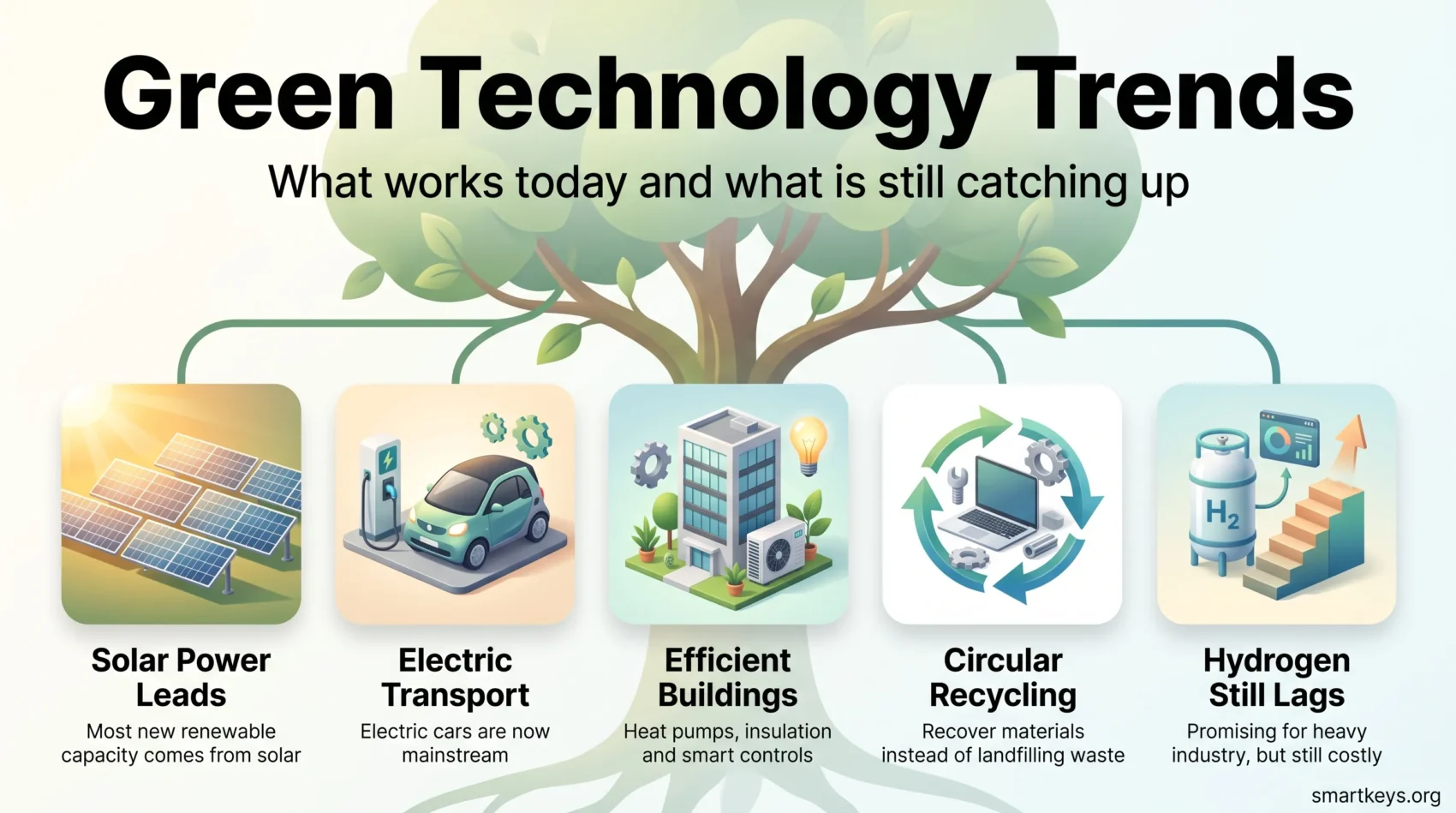
Green technology is any tool, material or process built to cut environmental damage: clean electricity, lower-emission transport, better recycling, buildings that need less energy. The label sounds vague. The money behind it is not. Global investment in the energy transition reached a record $2.3 trillion in 2025, about 8% more than the year before, according to BloombergNEF.
Two things changed the picture by 2026. Deployment kept breaking records while the technologies that were supposed to arrive next, green hydrogen above all, slipped. And regulation caught up. EU member states had until 29 May 2026 to write the revised Energy Performance of Buildings Directive into national law, and from 27 September 2026 loose claims such as “eco-friendly” or “green” are banned in EU advertising unless you can back them up.
This guide covers where Green Technology Trends actually stand in 2026: what renewables deliver, why hydrogen fell behind, what carbon capture really captures, how waste and recycling are shifting, and which rules now carry fines. For the wider commercial picture, see our overview of sustainable business innovation.
Key Takeaways
- Energy transition investment hit a record $2.3 trillion in 2025 (BloombergNEF).
- Solar photovoltaics account for roughly 80% of new renewable capacity expected to 2030, so grid flexibility, not generation, is the bottleneck.
- Green hydrogen slipped: the announced 2030 pipeline shrank for the first time, and low-emission hydrogen is still under 1% of supply.
- Electric cars passed a quarter of global new car sales in 2025.
- Buildings and construction cause about 37% of global CO2 emissions, which is why building rules are the first place regulation bites.
- From 27 September 2026, generic green claims are banned in the EU unless proven.
What Green Technology Actually Means
Green technology, also called clean tech, covers two different jobs. The first is cutting emissions at the source: generating electricity without burning fuel, electrifying vehicles and heating, using less energy for the same output. The second is cutting material waste: recovering metals from old electronics, designing products to be repaired, keeping materials in use instead of sending them to landfill. That second idea is the circular economy, which means treating waste as a supply of materials rather than a disposal problem.
Both matter. A factory running on wind power still carries the emissions of the steel and concrete it was built from.
The sector is also a real employer. Renewable energy supported 16.6 million jobs worldwide in 2024, according to the IRENA and ILO annual review published in January 2026. Growth slowed sharply that year, to 2.3%, even though installations hit records. Automation and manufacturing consolidation, especially in solar, mean more capacity no longer translates into proportionally more jobs.
Renewable Energy: Solar Does Most of the Work
The headline number from the IEA’s Renewables 2025 report is straightforward. Global renewable power capacity is expected to double by 2030, adding around 4,600 gigawatts. Solar photovoltaics alone account for roughly 80% of that addition. Wind is second, with hydropower, bioenergy and geothermal filling in behind.
Two details matter more than the headline for anyone making decisions.
First, the growth is uneven. The IEA cut its United States forecast by close to half in the 2025 edition after policy changes, while raising its outlook for India, the EU and the Middle East. Where you operate changes what is available and what it costs.
Second, the constraint has moved. Variable renewables are on track to supply close to 30% of global electricity by 2030. Sun and wind do not follow demand, so the harder problem is now storage, grid capacity and flexible demand rather than building more panels. If you are planning a site, a warehouse or a data centre, grid connection queues will shape your timeline more than panel prices will.
There is a commercial oddity worth knowing. Major solar and wind manufacturers reported large losses even as installations surged, because oversupply crushed margins. Cheap equipment is good news for buyers and bad news for the companies making it, which is why some suppliers may not be around for the full life of your warranty. That risk belongs in your supply chain resilience planning.
For most businesses the practical options are narrower than the headlines suggest: a power purchase agreement that fixes your electricity price against a specific clean project, rooftop solar where you own the roof, or a green tariff from your utility. Each needs its own check on what is actually being bought.
Green Hydrogen: The Part That Slipped
Green hydrogen is hydrogen made by splitting water with renewable electricity, so burning or using it releases no CO2. It was widely promoted as the answer for steel, shipping and heavy industry, where batteries are impractical.
The 2025 numbers are sobering. Global hydrogen demand was close to 100 million tonnes in 2024, but low-emission hydrogen was under 1% of that, according to the IEA’s Global Hydrogen Review 2025. For the first time, the announced project pipeline for 2030 shrank, from 49 million tonnes a year to 37 million. Electrolysis projects made up more than 80% of the cancellations and delays.
The reason is cost. Cheaper natural gas widened the gap between conventional and low-emission hydrogen, and many projects never found a buyer willing to pay the difference. Projects that are operating or have taken a final investment decision could still reach 4.2 million tonnes a year by 2030, five times the 2024 level, which would be roughly 4% of hydrogen supply.
One more fact shapes the market: China holds around 65% of global electrolyser capacity and close to 60% of manufacturing, while Western manufacturers face financial pressure and likely consolidation.
The practical read for 2026 is simple. Do not build a plan that depends on cheap green hydrogen before 2030. Treat it as a serious option for specific industrial processes, not a general fuel.
Carbon Capture: Growing Fast From a Small Base
Carbon capture and storage means trapping CO2 at a chimney or directly from air, then piping it into permanent underground storage. It grew quickly in 2025. The Global CCS Institute counted 77 operating facilities in October 2025, up 54% in a year, with 47 projects in construction representing 44 million tonnes a year of capture capacity. Across everything operating and in development, capacity reaches 513 million tonnes a year.
Keep the scale honest. Global CO2 emissions run into the tens of billions of tonnes a year, so even the full development pipeline is a small fraction of the problem. Carbon capture is credible for specific hard cases such as cement and chemicals, where the chemistry itself releases CO2 and no amount of clean electricity removes it. It is not a substitute for cutting emissions elsewhere, and buying capture-based offsets is not the same as reducing your own footprint. Our guide to carbon neutrality claims covers that distinction in more detail.
Waste, Recycling and the Circular Economy
Waste is the least glamorous part of green technology and one of the most measurable. The UN Environment Programme’s Global Waste Management Outlook 2024 put municipal solid waste at 2.1 billion tonnes in 2023, heading for 3.8 billion tonnes by 2050 on current trends. The cost side is starker than the tonnage: waste management cost the world about $361 billion in 2020 once hidden environmental costs are counted, and could reach $640 billion a year by 2050. A circular route, where waste is avoided rather than processed, would instead produce a net gain of around $108.5 billion a year.
Electronic waste shows the gap between intention and practice. A record 62 million tonnes were generated in 2022, on track for 82 million tonnes by 2030, while only 22.3% was documented as properly collected and recycled. Roughly $62 billion of recoverable materials went unaccounted for in a single year.
For a business the useful moves are unglamorous and near-term:
- Set up a documented route for old IT equipment, with a certified recycler rather than a skip.
- Buy refurbished where specification allows. The recommerce market now covers business hardware, not just consumer goods.
- Write reuse and take-back requirements into supplier contracts. Digital procurement tools make those conditions easier to track.
- Measure waste by weight and destination before setting a target, otherwise you cannot tell whether anything improved.
Manufacturers face a bigger version of the same task, covered in our piece on the circular economy in manufacturing and in the wider circular economy business models guide.
Transport: Electric Cars Cross a Quarter of Sales
Electric cars stopped being a niche in 2025. Global sales grew 20% to pass 20 million, which was one quarter of all new cars sold, according to the IEA’s Global EV Outlook 2026. The IEA expects around 23 million in 2026, close to 28% of sales.
The regional split is wide. China reached nearly 55% electric share of new car sales. Europe grew over 30% to a 28% share. The United States stayed just under 10%. Southeast Asia more than doubled to about 20%, and Latin America grew 75% from a small base. Chinese manufacturers accounted for 60% of global EV sales, with European and North American producers at roughly 15% each.
The fleet on the road avoided about 1.7 million barrels of oil demand a day in 2025, rising towards 5 million by 2030 on IEA projections.
For a company running vehicles, the decision now turns on duty cycle and charging rather than on whether electric works. Depots with predictable overnight routes convert easily. Long, unpredictable routes are harder. Freight and last-mile delivery are moving on their own track, which we cover in autonomous delivery trends, and the logistics data layer behind it in blockchain in logistics.
Buildings: Where the Rules Bite First
Buildings and construction account for around 37% of global CO2 emissions, according to UNEP’s 2025/2026 Global Status Report, and nearly half of global material extraction. That share explains why buildings are where regulators moved first.
In the EU, the revised Energy Performance of Buildings Directive had to be in national law by 29 May 2026. New buildings must be zero-emission and solar-ready, meaning designed so panels can be added. Minimum standards require renovating the worst-performing 16% of non-residential buildings by 2030 and 26% by 2033. Residential targets are set nationally, cutting average primary energy use by 16% by 2030.
In New York City, Local Law 97 caps emissions for buildings over 25,000 square feet, which produce close to 70% of the city’s greenhouse gas emissions. Owners over the cap face fines of up to $268 per tonne of CO2 equivalent. The limits tighten in 2030, and estimates suggest most covered buildings would exceed them without upgrades.
The technology that meets these rules is mostly ordinary: heat pumps instead of gas boilers, better insulation and glazing, LED lighting, and building management systems that actually get tuned. Building Information Modelling helps at design stage by testing energy performance before anything is built. Newer approaches such as biophilic design, which brings daylight and planting inside, are usually justified on comfort and retention rather than on emissions. The office side of that trade-off runs through our article on climate change and workspaces.
One tension is growing. Data centres are pushing electricity demand up quickly, which complicates emissions targets for anyone whose footprint includes cloud services. We cover that in AI and data centre energy use.
Industry, Agriculture and the Boring Wins
Outside energy and buildings, the gains in 2026 come from measurement rather than invention.
Sensors and analytics let factories catch equipment failures before they waste energy or materials, the approach behind predictive maintenance. Connected equipment gives the same visibility across sites, which is one of the more grounded uses of IoT in business.
In agriculture, soil moisture sensors and controlled irrigation reduce water use while holding yields. In logistics, route and load optimisation cuts fuel per delivery. None of it is a breakthrough. All of it is measurable, which is why it survives budget review when a flashier project does not. The supplier side of this sits in green supply chains.
What This Means for Your Business in 2026
Four practical points follow from the 2026 picture.
Measure before you commit. A target set without a baseline cannot be checked. Energy bills, fuel cards and waste invoices give you a usable starting figure in a week. Carbon accounting software helps once the basics are in place, and an ESG framework gives the numbers structure.
Be careful what you say. From 27 September 2026, EU rules ban generic environmental claims such as “green”, “eco-friendly” or “climate neutral” unless you can demonstrate excellent environmental performance, and ban sustainability labels not based on a recognised certification scheme. Implied claims through colours, imagery or product names count too. Vague marketing is now a legal risk, not just a credibility one. Our corporate social responsibility guide covers how reporting expectations shifted alongside this.
Prioritise the reliable over the promised. Efficiency upgrades, electrification of vehicles and heating, and better waste routing all work today at known cost. Hydrogen and large-scale carbon capture are worth watching, not planning around.
Expect finance to ask. Lenders and insurers increasingly price climate exposure into terms, a shift covered in green finance trends. That is often what moves a project internally when the environmental case alone does not.
Employees notice the same gap. Policies that show up in daily work, from commuting to equipment choices, land better than published pledges, as our article on sustainable work practices and the broader sustainability strategy guide both show.
Conclusion
Green technology in 2026 is less exciting and more useful than the version sold five years ago. Solar and batteries are cheap and being installed at record pace. Electric cars are mainstream in China and Europe and lagging in the United States. Hydrogen missed its own timetable. Carbon capture is real but small. Waste and recycling remain the least funded part of the picture and one of the easiest places for an individual business to make a measurable difference.
The choice has also narrowed. Building rules, disclosure requirements and advertising law now set a floor, and the technologies that meet it are proven and priced. The question is no longer whether to act, but which reliable option fits your operation first.
Found this useful?
Make SmartKeys a preferred source on Google, and our articles will surface more often in your Top Stories, AI Overviews, and AI Mode.
Add as Preferred Source