Climate change has stopped being a topic for the sustainability report and started showing up in operating decisions: where offices are built, how they are cooled, when people are told to stay home, and which roles get funded. Rising temperatures and more frequent extreme weather are turning climate resilient office design from a talking point into a planning problem. This guide covers what the evidence actually supports in 2026 about sustainable office design, heat at work, commuting disruption and the jobs the transition is creating. The focus here is adaptation: how offices and working patterns cope with a changing climate. For the broader picture of green careers and everyday environmental practice, see our guide to sustainable work and the green job market.
Two things have changed since this topic first entered corporate strategy decks. The regulatory picture has moved, in both directions: the EU narrowed its sustainability reporting rules in 2026, while occupational heat protection tightened in several US states. And the data on remote work and emissions got considerably more precise, which makes the trade-offs easier to judge.
Key Takeaways
- The ILO estimates 71% of the global workforce is exposed to excessive heat, and heat causes roughly 22.85 million occupational injuries a year.
- A federal US heat standard is still pending; several states already enforce their own rules.
- Fully remote work cuts an individual’s carbon footprint by about 54%, but one hybrid day a week cuts it by only 2%.
- Renewable energy employed 16.6 million people worldwide in 2024, though growth has slowed sharply.
- Extreme weather now disrupts commuting and operations often enough to belong in continuity planning, not just insurance.
- Workers weigh sustainable practices when they evaluate employers, particularly in early-career hiring.
- The EU’s Omnibus I package cut CSRD scope to companies above 1,000 employees and 450 million euros in turnover.
The Impact of Climate Change on Daily Work Life
The most visible effect of a warming climate on work is not strategic, it is logistical. Heat and storms interrupt the commute, close buildings and push companies toward policies they did not previously need, from heat days to standing remote-work fallbacks.
How climate change affects your daily routine
Commuting is the first thing to break. Heatwaves buckle rails and degrade signalling; heavy rain floods road and transit tunnels. Employees absorb the delay, and employers absorb the lost hours. Companies operating in exposed regions increasingly write weather triggers into their flexible work schedule policies so that nobody has to improvise on the morning it happens.
Remote work is the obvious release valve, and its climate benefit is real but sensitive to how it is done. In a study published in the Proceedings of the National Academy of Sciences in September 2023, researchers from Cornell and Microsoft found that fully remote workers had a carbon footprint about 54% lower than onsite workers. Hybrid arrangements delivered far less: two to four days at home cut footprints by 11% to 29%, and a single remote day produced only a 2% reduction, because commuting patterns and home energy use absorb most of the gain.
That gap matters when companies claim environmental credit for hybrid policies. If you want the emissions benefit, the number of remote days has to be high enough to change behaviour, and the carbon impact of remote work has to be measured rather than assumed.

Aligning working patterns with climate reality is not only an emissions question. It also reduces the number of days when work simply does not happen, which is why weather resilience increasingly sits alongside productivity in hybrid work planning.
Understanding Climate Change and Its Relevance to Workspaces
Understanding the workplace consequences of climate change means separating slow structural shifts from acute events. Both matter, but they call for different responses: one is a design and investment question, the other a continuity question.
What you need to know about climate change
The structural shift is the easier one to plan for, because it is directional. Research by the Crowther Lab at ETH Zurich, published in PLOS ONE in 2019, modelled how the climate of major cities would feel by 2050 and found London’s climate converging on something closer to present-day Barcelona. Buildings designed for a cooler baseline will spend more of the year working against it, which changes cooling loads, ventilation specifications and glazing choices.
The acute side is harder. In the United States, the reference dataset for costly weather events moved: NOAA retired its billion-dollar disaster database in May 2025, and Climate Central relaunched it on 22 October 2025 with the same peer-reviewed methodology and the project’s former NOAA lead scientist. On that basis there were 28 billion-dollar events in 2023 and 27 in 2024, against a long-term annual average of nine. The first half of 2025 alone recorded 14 events costing 101.4 billion dollars, with the January Los Angeles wildfires exceeding 60 billion dollars on their own.
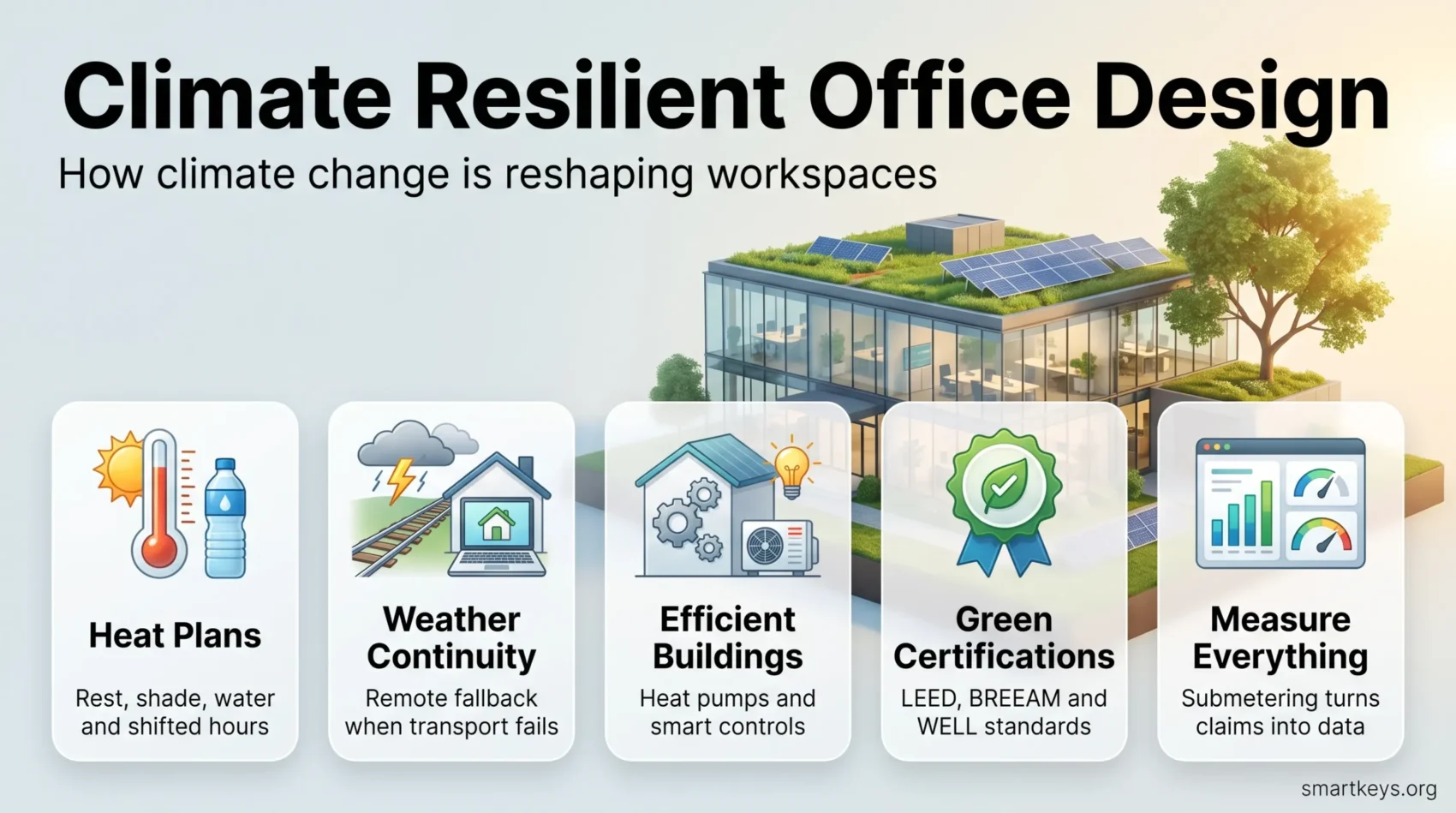
For most employers the practical takeaway is unglamorous. Facilities need a heat plan and a closure plan, IT needs to assume people will work from wherever they are, and both belong in workforce contingency planning rather than in a sustainability appendix.

Everyday operational choices still count, and they are cheap: cutting printing, switching to LED lighting, tightening building management schedules and retiring idle equipment. None of them is transformative alone, but they lower both emissions and running costs, which is what keeps them funded.
Climate Resilient Office Design: Redefining Office Environments
Office design is where climate policy becomes physical. Because most companies now occupy less space than they did before hybrid work settled, refits are frequent, and each one is a chance to lower running costs for the next decade.
Sustainable office design principles
A workspace built for a warmer, less predictable climate tends to share a few features:
- Green building certifications such as LEED, BREEAM or WELL, which impose measurable standards on energy, water and indoor environmental quality.
- Cooling and ventilation sized for the temperatures the building will see in twenty years, not the ones it was designed around.
- Flexible layouts that work at variable occupancy, so half-empty floors do not cost full-floor energy.
- Building management and sensor systems that cut lighting and HVAC use in unoccupied zones.
- Daylight and glare control that reduces artificial lighting without turning the floor into a greenhouse, a balance covered in more detail in this guide to workspace lighting and focus.
Indoor air quality deserves a note of caution, because it is frequently oversold. Elevated indoor carbon dioxide is often described as a direct drag on decision-making, citing chamber studies from the 2010s. A 2023 systematic review of short-term CO2 exposure and cognitive performance found the evidence far less consistent than those headlines suggest, particularly at the concentrations typical of real offices. Good ventilation remains worth paying for, on comfort, health and airborne-transmission grounds. Framing it as a proven productivity multiplier goes beyond what the research supports.
The rest of the design conversation has less to do with climate than with how people now use offices, a shift traced in this analysis of future workspaces and the changing purpose of the office floor.

Extreme Weather Events and Their Implications for Commuting
Extreme weather has moved from an annual inconvenience to a recurring operational cost. Floods, storms and heat all degrade the transport networks that most workplaces quietly depend on, and the disruption rarely stops at the commute.
Changes in transportation due to climate impact
The pattern is consistent across affected regions. Public transit becomes unreliable first, because rail and bus networks have little slack; road journeys lengthen as traffic redistributes; and the effects concentrate on employees with the fewest alternatives, typically those on lower incomes and in shift roles.
Employers have a limited set of levers, and they are all easier to use if agreed in advance:
- Standing permission to work remotely when transport authorities issue disruption warnings, rather than case-by-case approval.
- Shifted start times during heat events, so travel avoids the hottest part of the day.
- Clear closure criteria and a single communication channel, so nobody sets out to an office that is shut.
- Regional distribution of critical work, so one city’s weather cannot stop a whole function.
Distributed teams handle this better than concentrated ones, which is one of the less-discussed advantages of the shift toward remote and distributed work. It also explains growing interest in corporate coworking partnerships, which give employees a nearby alternative when the commute into a central office fails.
The Rise of Remote Work Due to Climate Challenges
Remote work did not start as a climate measure, but it has become one of the more effective ones available to office employers, mostly because it removes the commute rather than because it makes the office greener.
Adapting work structures to climate flux
The operational case is straightforward. Distributed teams keep working when a building or a transport network does not. They also widen the hiring pool, which matters when specialist climate and energy skills are scarce.
The emissions case is real but conditional, as the Cornell and Microsoft figures above make clear. Home energy use, non-commute travel and household size all shift the result, and a company that cuts office days without reducing office floor space may end up heating and cooling the same building for fewer people.
The costs are familiar. Boundaries blur, connection weakens, and home internet quality varies more than most IT departments assume. Security exposure grows as work moves onto home networks, which is why remote-first employers treat cybersecurity for remote work as a baseline rather than an add-on. A well-set-up home office handles most of the comfort and ergonomics problems; it does not fix the isolation ones.

Shifts in Industry Roles and Employment Due to Climate Change
The energy transition is a labour story as much as a technology one, and the 2026 numbers are more sober than the projections that circulated a few years ago.
Emerging job opportunities in climate-related sectors
According to the IRENA and ILO Renewable Energy and Jobs Annual Review 2025, published in January 2026, renewable energy employed 16.6 million people worldwide in 2024. Solar photovoltaics accounted for 7.3 million of those jobs, followed by liquid biofuels at 2.6 million, hydropower at 2.3 million and wind at 1.9 million. Growth was 2.3% year on year, the sector’s first clear slowdown, which the report attributes partly to automation across supply chains and partly to geopolitical friction, even as installation volumes hit records.
Slower growth is not the same as decline, and demand is uneven rather than absent. The World Economic Forum’s Future of Jobs Report 2025 found that 47% of employers expect climate mitigation and adaptation to transform their business, and identified renewable energy engineers and environmental specialists among the fastest-growing roles this decade.
Inside conventional companies, the growth is quieter: sustainability reporting, energy procurement, building performance and supply chain emissions work. Much of this is reskilling rather than hiring, which puts it squarely in the territory covered by upskilling and reskilling programmes and by longer-term education and career planning.
Green Building Certifications: A Step Toward Sustainability
Certification is how sustainability claims about a building become checkable. For tenants it is a shortcut to comparable information about energy performance and indoor environmental quality; for owners it is increasingly a condition of leasing to large corporates.
Importance of achieving green standards
The schemes differ in emphasis. LEED and BREEAM focus on building performance across energy, water, materials and site. WELL concentrates on occupant health, covering air, water, light, movement and thermal comfort. Many owners pursue more than one, because tenants and lenders ask different questions.
The benefits that hold up in practice are:
- Lower energy and water consumption, which shows up directly in operating costs.
- Documented indoor air and thermal performance, which is easier to defend to occupants than assurances.
- Stronger leasing position with corporate tenants who have their own reporting obligations.
- Reduced transition risk as building performance standards tighten in major markets.

Costs vary widely by scheme, building size and how much remediation the building needs, so published headline fees are a poor guide to what a specific project will pay. The more useful question is whether the certification is being pursued for measured performance or for the plaque. A building that certifies once and is never recommissioned tends to drift back toward its old consumption, which is why recurring schemes and ongoing measurement matter more than the initial award. Shared workspaces have been unusually active here, and this guide to coworking spaces covers how operators use green credentials commercially.
Innovations in Energy-Efficient Workspace Design
Most of the meaningful gains in workplace energy use come from unglamorous engineering rather than visible features. The building systems matter more than the plants.
Future technologies for sustainable workspaces
The measures with the clearest track record include:
- Retrofitting existing buildings instead of building new, which avoids the embodied carbon of new construction entirely.
- Heat pumps and improved building envelopes, which cut both heating and cooling demand rather than shifting it.
- Occupancy-responsive lighting and HVAC, which stop conditioning space that nobody is using.
- On-site solar generation where roof area and grid rules allow, most effective in buildings with high daytime load.
- Lower-carbon materials in fit-outs, including reused furniture, an approach connected to broader circular economy practices at work.
Biophilic design, the deliberate use of plants, daylight and natural materials, is popular and generally well received by occupants. Treat it as a comfort and satisfaction measure rather than an energy one, because that is where the support is strongest.
Measurement is the part most organisations skip. Without submetering and a baseline, efficiency claims are guesses, which is why carbon accounting tools have moved from ESG teams into facilities management.
Health Implications for Workers in a Changing Climate
Heat is the workplace health risk that has changed most, and it is no longer confined to outdoor sectors. Warehouses, kitchens, factories and poorly cooled offices all produce heat exposure well before an official heatwave is declared.
Addressing health risks associated with climate change
The ILO’s 2024 report on occupational safety in a changing climate put numbers to it. About 71% of the global workforce, some 2.4 billion workers, is exposed to excessive heat at some point. Excessive heat is associated with roughly 22.85 million occupational injuries and 18,970 deaths each year. Exposure during heatwaves specifically rose by 66% between 2000 and 2020. Regionally, the burden is heaviest in Africa, the Arab states and Asia-Pacific.
Regulation is catching up unevenly. In the United States, OSHA published a proposed federal Heat Injury and Illness Prevention standard in August 2024 and held public hearings in mid-2025, with the post-hearing comment period closing in October 2025. No final federal rule is in force. Several states, including California, Oregon, Washington, Colorado, Minnesota and Maryland, run their own heat standards, so multi-state employers face a patchwork rather than a single obligation.
The practical measures are established occupational health practice: acclimatisation for new and returning workers, mandatory rest and shade, accessible water, adjusted schedules during peak heat, and training so that supervisors and colleagues recognise heat illness early. Older workers, those on certain medications and anyone doing sustained physical work carry higher risk. Air quality is the second front, as wildfire smoke now affects indoor environments hundreds of miles from any fire, which puts filtration on the facilities agenda in regions that never previously needed it.
Adapting Corporate Structures to Support Climate Resilience
Climate resilience is drifting out of the sustainability function and into risk, finance and operations, largely because that is where the consequences land.
Corporate responsibility in facing climate challenges
Disclosure rules set much of the pace, and they moved in 2026. The EU’s Omnibus I package, adopted by the European Parliament on 16 December 2025 and entering into force on 18 March 2026, sharply narrowed the Corporate Sustainability Reporting Directive. Reporting now applies to large undertakings with more than 1,000 employees and net turnover above 450 million euros, and listed SMEs are fully exempt. Many companies that had built reporting programmes are now out of scope, though those supplying in-scope customers still face the same data requests through the value chain. The wider shift from pledges to filings is covered in this look at corporate social responsibility trends.
Beyond compliance, the structural work is fairly consistent across companies that take it seriously: physical risk assessment of key sites and suppliers, weather triggers written into continuity plans, energy and emissions data collected at a useful frequency, and clear ownership so that resilience is somebody’s job rather than everyone’s concern. Frameworks help order this work, and the practical steps are set out in this guide to building an ESG framework and this overview of sustainability strategy.
Supply chains deserve separate attention, because that is where most companies’ emissions and most of their physical exposure sit, a problem examined in this guide to green supply chains.

Conclusion
Climate change affects workplaces through a small number of concrete channels: heat exposure, weather disruption, building energy costs, reporting obligations and the skills companies need. Each has evidence behind it, and each responds to fairly ordinary management attention.
The parts worth acting on first are the ones with the clearest data. Heat plans have well-established public health guidance behind them. Building efficiency pays back in operating costs whether or not the certification follows. Remote work delivers real emissions reductions, but only in proportion to how much of the commute it actually removes.
What does not help is treating the topic as a communications exercise. The organisations handling this well are measuring their own consumption, writing weather into continuity plans and training supervisors to recognise heat illness. That work is less visible than a green building award, and considerably more useful. For the wider picture of how these forces reshape work, this overview of future work trends is a useful next read.
Found this useful?
Make SmartKeys a preferred source on Google, and our articles will surface more often in your Top Stories, AI Overviews, and AI Mode.
Add as Preferred Source