A circular economy is a way of running an economy that keeps products and materials in use for as long as possible, instead of making them, using them once and throwing them away. That sounds abstract until you look at what it changes on the ground: who repairs a laptop instead of replacing it, who is paid to sort and resell office furniture, and who has to prove to a regulator what a product is made of.
For most people at work, the circular economy arrives as concrete tasks rather than a philosophy. New roles appear in repair, refurbishment and materials handling. Procurement teams get new questions. Designers get new constraints. And from 2026, European rules on repair and product data reach ordinary companies, not just heavy industry. This guide covers what has changed, what the evidence supports, and what it means for the way you work.
Key Takeaways
- Only about 7% of the materials entering the global economy are recycled or reused, and that share has been falling.
- Circular economy employment in the EU grew roughly 10% between 2014 and 2023, to about 4.4 million jobs.
- Job quality is the weak point: many circular roles are low-paid or insecure, and the better ones tend to go to already advantaged workers.
- Repair, refurbishment, materials handling and product data are the skill areas employers are hiring for.
- EU repair and ecodesign rules now create compliance work inside normal companies, not just in factories.
What a Circular Economy Actually Means
The model most companies still run on is linear: extract raw materials, make a product, sell it, and let the buyer dispose of it. A circular model tries to close that loop. Products are designed to last, to be repaired, and to be taken apart at the end of their life so the materials go back into something new.
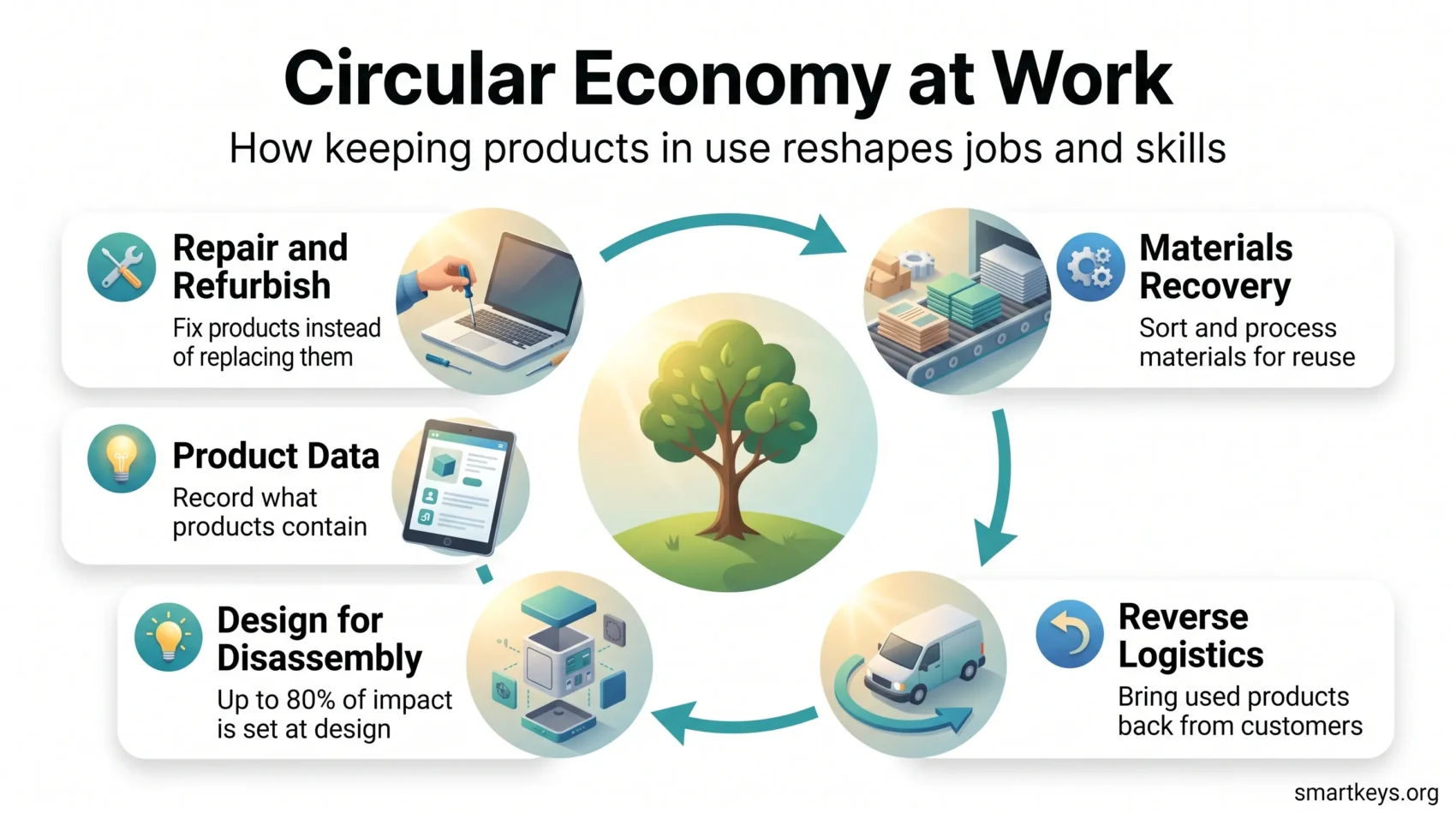
The important part is that most of this is decided before anything is manufactured. The European Commission’s Circular Economy Action Plan estimates that up to 80% of a product’s environmental impact is locked in at the design stage. If a phone is glued shut, no amount of good intent at the recycling plant will make it repairable. That is why circularity turns into a design and procurement question long before it becomes a waste question.
This is a different lens from the business-model question of how a company earns money from circularity, which is covered in more depth in our guide to the circular economy as a business opportunity. Here the focus is narrower: what changes for the people doing the work. It is one strand of a wider shift toward sustainable work and green jobs.
Where the Transition Actually Stands in 2026
It helps to be honest about the starting point. The Circularity Gap Report 2026 puts the global circularity rate at 6.9%, meaning roughly 93% of the materials entering the economy each year come from virgin sources. That figure has fallen in recent editions rather than risen, because material demand keeps growing faster than recycling capacity. Global resource use has tripled since 1970.
The same report estimates about €25.4 trillion in avoidable economic value lost every year through waste, resource degradation, pollution and underused assets, close to a third of global GDP. Whether or not you accept that specific number, the losses are large enough that governments have started legislating rather than encouraging.
Europe is further along than the global average but still short of its own targets. The EU circularity rate sits around 12%, and the Clean Industrial Deal sets the goal of doubling it to 24% by 2030. A Circular Economy Act, consulted on in 2025 and due in 2026, is meant to build a single market for recycled materials so that secondary raw materials are as easy to buy and sell as virgin ones. For a wider view of what customers reward in this space, see our overview of what consumers actually pay for in sustainability.
What the Circular Economy Means for Jobs
Circular work is labour-intensive in a way that extraction and disposal are not. Sorting, testing, repairing, refurbishing and reselling all take people. That is the mechanism behind the job numbers, and it is worth understanding before looking at the figures.
The most reliable European data comes from the European Environment Agency. Its 2026 briefing on a just transition to a circular economy reports that circular economy jobs across the EU-27 grew by about 10% between 2014 and 2023, reaching roughly 4.4 million positions. Eurostat counts these as employment in recycling, repair and reuse activities, measured in full-time equivalents. On top of that, the EU’s Clean Industrial Deal estimates that European remanufacturing alone could add around half a million jobs by 2030.
Two caveats matter. These are gross figures: they do not subtract jobs lost in the linear activities being replaced. And a 10% rise over nine years is steady growth, not a boom. Circularity reshapes employment gradually, much as automation reshapes tasks rather than eliminating whole occupations.
Which Roles Are Actually Growing
The demand is concentrated in a handful of areas:
- Repair and refurbishment technicians. Electronics, appliances, furniture and industrial equipment all need people who can diagnose and fix rather than replace.
- Materials and recycling operators. Sorting and processing recovered materials to a quality that manufacturers will actually buy.
- Reverse logistics planners. Getting used products back from customers is a supply chain problem in its own right, and it is closely tied to how green supply chains are organised.
- Product designers with materials knowledge. Designing for disassembly, repairability and recycled content.
- Compliance and product data roles. Someone has to assemble, verify and publish the product information the new EU rules require.
Job Quality Is the Open Question

More circular jobs is not the same as more good jobs. The EEA is unusually direct on this point: some circular economy jobs are low-paid or insecure, and the higher-skilled roles often go to workers who were already advantaged. Sorting waste by hand and designing a modular product are both circular jobs, and they sit at opposite ends of the pay scale.
This is an argument for treating job design as part of the transition rather than an afterthought. For an employer that means three things: pay circular roles at the rate the skill requires, build progression from entry-level sorting or repair work into technical roles, and fund the training that makes that progression possible. Ignore it and you get high turnover in exactly the roles that take months to train, which is the retention trap described in our review of current HR trends.
Access matters too. Repair and refurbishment work can be a genuine route into skilled employment for people without a degree, but only if hiring is designed to let them in. The same logic that supports neurodiversity-friendly hiring applies here: widen the entry point, then train.
The Skills and Training This Requires
The skills gap in circular work is practical rather than exotic. Employers report shortages in repair and refurbishment trades, in digital and data handling, and in the technical knowledge needed to judge whether a recovered material is fit to reuse. Those are teachable skills, and most of the teaching has to happen inside companies because the formal education pipeline has not caught up.
Training the People Already in the Job
Start with the roles that already exist. A procurement officer needs to know how to write a tender that asks for repairability and recycled content, not just the lowest unit price. A facilities manager needs to know what happens to office equipment at the end of a lease. A product manager needs to know which materials will become a compliance problem in three years. None of that requires a new hire; it requires a few days of specific training and a mandate to act on it.
Short, role-specific training works better here than generic sustainability awareness sessions. The delivery patterns that hold up for distributed teams are covered in our guide to remote learning and corporate training.
Moving People Out of Linear Roles
Some jobs will shrink. Roles tied to single-use production and disposal are the obvious cases. Reskilling works best when it starts before the role disappears and when it builds on skills the person already has: a machine operator often has most of what a refurbishment technician needs. Our overview of upskilling and reskilling covers how to size and sequence that kind of programme, and our look at the skills employers are paying for shows where green skills sit relative to everything else.
The Rules That Now Reach Ordinary Employers
Until recently, circular economy regulation mostly landed on manufacturers and waste handlers. That changed in 2026.
The Right to Repair Directive. Directive (EU) 2024/1799 had to be transposed into national law by 31 July 2026. For products already covered by EU repairability requirements, including washing machines, dishwashers, fridges, phones, tablets, electronic displays, tumble dryers, servers and welding equipment, manufacturers must offer repair at a reasonable price and supply spare parts and tools. Consumers who choose repair over replacement under warranty get an extra year of legal guarantee. A European Repair Platform is due to be fully operational on 1 January 2028. National implementations vary, so the practical text a company answers to is its own country’s law rather than the directive itself.
Ecodesign and the Digital Product Passport. The Ecodesign for Sustainable Products Regulation (EU) 2024/1781 introduces the Digital Product Passport, a digital record of what a product contains and how it can be repaired or recycled. The DPP registry went live on 20 July 2026. Batteries are first, with the passport mandatory for certain types from 18 February 2027, followed by iron and steel, then textiles, aluminium and tyres, then furniture, mattresses and ICT products later in the decade. Companies get at least 18 months after each sector’s rules are adopted.
The Circular Economy Act. Due in 2026, it is intended to create a functioning single market for secondary raw materials so that recycled content is a reliable input rather than a procurement gamble.
The workplace consequence is straightforward: product data becomes someone’s job. Assembling material composition, repair instructions and supplier declarations into a passport is a recurring administrative task, and companies that treat it as a one-off project tend to discover the gap at audit. It sits close to the reporting discipline described in our guide to building an ESG framework and to the wider shift from pledges to evidence covered in corporate social responsibility trends.
What Companies Can Actually Change

Design and Buying Decisions
The highest-leverage changes happen where products and contracts are specified.
- Design for disassembly. Fairphone builds modular phones whose parts a user can swap out. The principle transfers to furniture, machinery and packaging.
- Sell the outcome, not the object. Signify, formerly Philips Lighting, sells lighting as a service and keeps ownership of the hardware, which gives it a direct reason to make fixtures last. This shift is examined in detail in our piece on the servitization trend.
- Take products back. IKEA’s buy-back and resell scheme and Patagonia’s Worn Wear repair and resale programme both create a second life for goods the company already made.
- Write circularity into tenders. Ask suppliers for repairability, spare part availability and recycled content, and score them on it.
Manufacturing offers the clearest examples of what this looks like at scale, which we cover separately in how the circular economy is changing manufacturing. On-demand production methods play a part too, as discussed in our piece on 3D printing and supply chains.
Everyday Workplace Practice
The office-level version is less dramatic but not pointless:
- Repair and redeploy IT equipment before buying new, and track how long devices actually last.
- Set up genuine separation for paper, electronics and packaging, and check that the waste contractor really recycles what you sort.
- Move furniture and equipment between sites instead of disposing of it at the end of a lease.
- Give one named person responsibility for it. Shared responsibility for circularity usually means nobody does it.
The mistake to avoid is treating awareness campaigns as the programme. Posters above the recycling bin do not change procurement contracts, and procurement contracts are where the material decisions are made. A workable approach is described in our guide to building a sustainability strategy.
Who Gets the Good Circular Jobs
The benefits of circular work are not evenly spread, and this is where the transition can go wrong.
Geographically, the growth data is strongest for Europe, where the regulation and the measurement both exist. Much of the world’s actual material recovery happens through informal waste collection and sorting, often in unsafe conditions and without contracts, healthcare or bargaining power. Formalising that work is one of the clearest ways to turn circular activity into decent jobs, but it requires labour policy rather than product design.
Within organisations, the risk is subtler. If repair and sorting roles are treated as low-status and the design and analytics roles as career jobs, the circular economy reproduces the inequality it was supposed to reduce. The EEA’s finding that higher-skilled circular roles tend to benefit already advantaged groups is a warning worth taking literally. Building a visible path from the workshop floor into technical and design work is the practical answer.
Cities, Buildings and the Bigger Picture

Circularity shows up at work through buildings. They account for a large share of material use and emissions, so reusing structures and materials rather than demolishing them changes where and how people work. Heat, energy costs and building standards are already reshaping office design, as we cover in how climate change is reshaping workspaces.
There is also a reporting link. Material use and waste are increasingly part of the emissions and disclosure work companies already do, which we cover in our roadmap to carbon neutrality goals. And the technologies that make circular systems workable, from materials tracking to energy efficiency, are surveyed in our overview of green technology trends. For the individual career angle, our guide to sustainable work practices and green jobs is the closest companion piece, and the broader innovation context sits in sustainable business innovation.
What to Do Next
The circular economy is no longer a forecast. It is a slow, measurable shift in what companies buy, how they design and which roles they hire for, now backed by rules that carry deadlines.
For an actionable starting point, pick one of three: find out what happens to your organisation’s used equipment today, check whether any of your products fall under the EU repair or ecodesign rules, or ask whether the people doing repair and materials work for you have a route into better-paid roles. Each surfaces something concrete within a week.
Circularity creates real work, some of it good and some of it not yet good enough. Which kind your organisation creates is a decision, not an outcome.
Found this useful?
Make SmartKeys a preferred source on Google, and our articles will surface more often in your Top Stories, AI Overviews, and AI Mode.
Add as Preferred Source