Sustainable work means doing your job in a way that reduces environmental harm instead of adding to it. The term covers two different things: the green practices any workplace can adopt, and the growing group of jobs whose entire purpose is environmental. The second is where the career leverage sits right now.
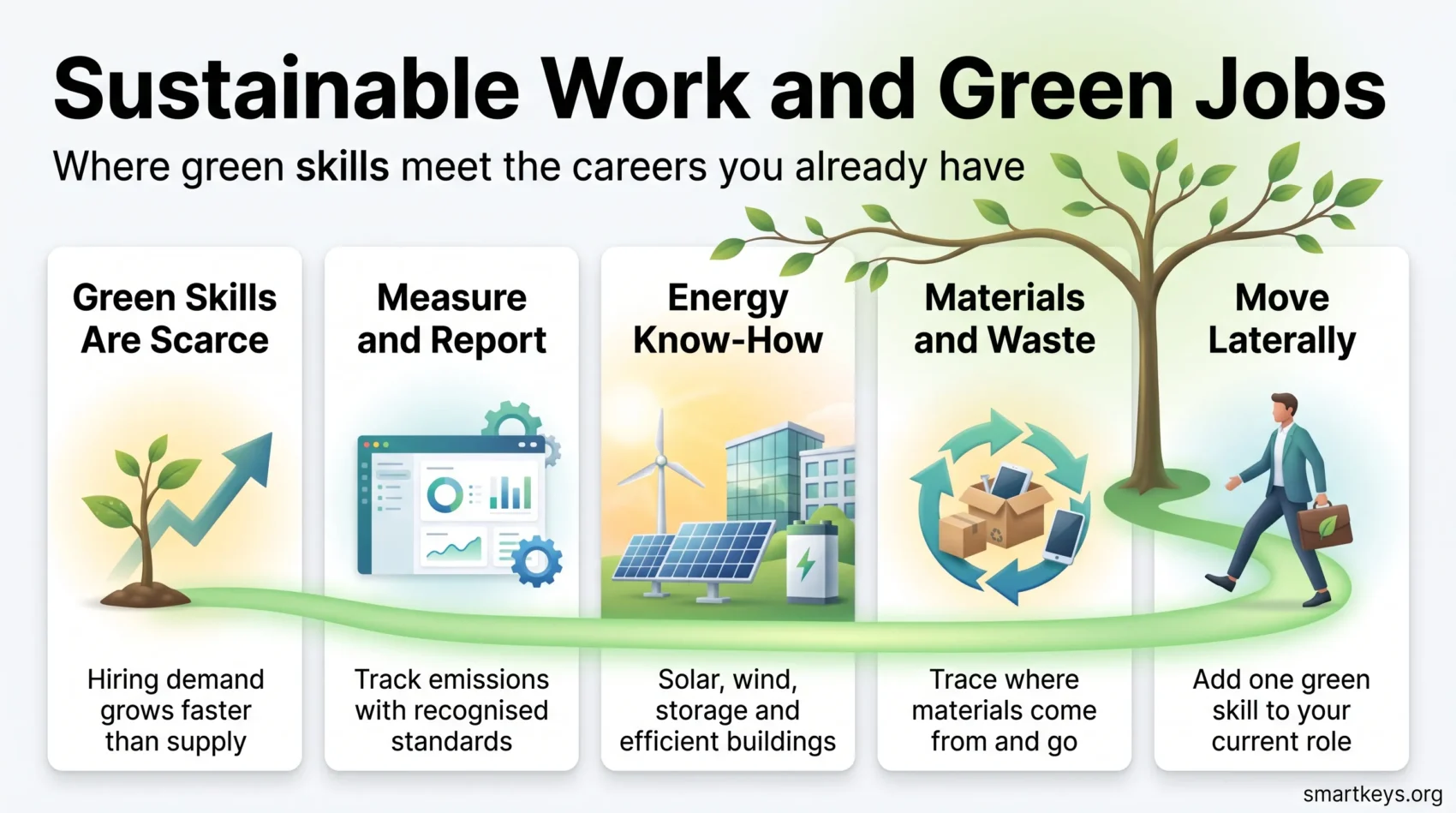
The hiring data makes the point. LinkedIn’s 2025 Global Green Skills Report found that 17.6% of workers on the platform list at least one green skill, up from 15.2% in 2021. Over the same year, hiring of green-skilled workers grew 7.7% while the supply of those skills grew only 4.3%. Employers want these skills faster than people are learning them.
This guide covers what sustainable work looks like day to day, which green roles pay well in 2026, and which skills employers screen for. It also explains how to move into the field without discarding the career you already have.
Key Takeaways
- Green skills are scarce: hiring grew 7.7% last year against 4.3% growth in supply (LinkedIn, 2025).
- Renewable energy employed 16.6 million people worldwide in 2024, led by solar (IRENA and ILO).
- US clean energy jobs reached 3.6 million and grew three times faster than the wider job market (US Department of Energy, 2025).
- The best paid green-adjacent roles are managerial and technical, with natural sciences managers on a median $167,220 (BLS, May 2025).
- Most green hires happen in ordinary job titles, so adding skills usually beats switching careers.
What Sustainable Work Actually Means
The two meanings lead to very different decisions, so it is worth separating them.
The first is operational. It is how an organisation runs: the electricity it buys, the equipment it replaces, the waste it produces, the commutes it requires. These changes rarely alter anyone’s job title. Switching an office to LED lighting is a good example. The US Department of Energy states that LEDs use at least 75% less energy than incandescent bulbs and last up to 25 times longer. That saves cost and emissions at once.
The second meaning is occupational. It covers roles that exist because of the environmental transition: solar installers, energy auditors, sustainability reporting analysts, grid engineers, circular design specialists. These are jobs, not policies.
Practical steps in the first category tend to look like this:
- Replacing lighting and old equipment with efficient models, which cuts both bills and emissions.
- Reducing required commuting days, since travel is often the largest single source of office-related emissions.
- Moving processes off paper, which lowers printing, storage and shipping costs at the same time.
- Setting purchasing rules that favour repairable and recyclable equipment, an idea explored in our guide to the circular economy at work.
None of this is dramatic on its own. Together it is what most companies mean by a sustainability strategy, and it is now the baseline customers and regulators expect.
Understanding Green Jobs and Why They Are Growing
A green job is one whose main output protects or restores the environment, or one that makes an existing activity measurably cleaner. That second half matters, because it is where most of the growth is.
The global picture is clearer than it used to be. The IRENA and ILO annual review counted 16.6 million renewable energy jobs worldwide in 2024, up 2.3% on the previous year. Solar photovoltaics alone accounted for 7.3 million. China holds roughly 44% of the global total, followed by the EU, Brazil, India and the United States. That 2.3% was the slowest growth the series has recorded, even in a record year for installations, because much new capacity is built with more automated supply chains.
In the United States, the Department of Energy’s 2025 Energy and Employment Report counted 3.6 million clean energy workers at the end of 2024. That workforce grew 3% over the year against 1% for total US employment. Roughly 22 of every 1,000 American workers now hold a clean energy job.
Green work spreads across sectors that have little to do with each other:
- Solar, wind, geothermal and storage, from manufacturing through installation and maintenance.
- Building efficiency, including retrofits, insulation, heat pumps and energy auditing.
- Measurement and reporting, where carbon accounting software has created a whole category of analyst roles.
- Waste, recycling and materials recovery, increasingly tied to circular manufacturing models.
- Transport and logistics, including fleet electrification and greener supply chains.
The Green Job Market in 2026
Three shifts define the market this year.
Green Skills Now Sit Inside Ordinary Jobs
For the first time, LinkedIn reports that workers with green skills in non-green job titles account for 53% of all green hires. Buyers, project managers, finance analysts and software engineers are all being asked to handle sustainability work as part of the role.
That is good news if you already have a career. You do not need to become an environmental scientist, only to add the specific green competence your existing function now requires. Our overview of future job skills shows how the pattern repeats across other transitions.
Demand Is Concentrated, Supply Is Not
Utilities and renewable energy have the highest green talent density at 29.6%, and over a third of their 2025 hires were green roles. Financial services raised green hiring 16.3% year on year, yet only about one in ten of its workers has a green skill. That gap is the opportunity: sectors hiring hard from a low base tend to pay more and screen less rigidly on background.
Regulation Sets the Floor, and It Moved
Sustainability reporting rules create a large share of corporate green jobs, so it is worth knowing where they stand. The EU’s Omnibus I directive entered into force in March 2026 and narrowed the Corporate Sustainability Reporting Directive substantially. Reporting now applies to large undertakings with more than 1,000 employees and net turnover above 450 million euros, and listed small and medium-sized companies are exempt.
The effect is mixed. Fewer companies must report, which cooled hiring for pure reporting roles. Those still in scope face unchanged expectations and keep asking suppliers for data. Our article on corporate social responsibility reporting tracks how the rules developed, and the ESG framework guide explains what companies actually measure.
What Sustainable Practices Deliver Environmentally
Two claims about workplace sustainability hold up under scrutiny. Several others do not.
Remote work genuinely reduces individual emissions, but only at the extremes. Cornell University and Microsoft studied this in 2023, publishing in the Proceedings of the National Academy of Sciences. Fully remote workers can have a 54% lower carbon footprint than onsite workers. Hybrid workers who stay home two to four days a week see a reduction of only 11% to 29%. Partial remote work keeps the office running while adding household energy use, and some saved commuting is replaced by other travel. Our piece on the carbon impact of remote work examines that trade-off.
Efficiency upgrades also deliver reliably. Lighting, heating and old hardware are the three largest controllable loads in a typical office. Replacing them produces savings that show up on the meter, not just in a report.
Talent is the third effect, and it is well documented. Deloitte’s 2025 Gen Z and Millennial Survey, with more than 23,400 respondents, found that 70% consider a company’s environmental credentials important when evaluating an employer. About 23% had researched those credentials before accepting a job, and 15% of Gen Z respondents had already changed jobs over environmental concerns. Since these two groups are projected to make up around 74% of the global workforce by 2030, this is becoming a talent retention question rather than a communications one.
What does not hold up: broad claims that sustainable offices cut sick days or raise productivity by a fixed percentage. Those studies are small, poorly controlled, or actually measure daylight and air quality. Better ventilation is worth doing on its own merits, but it is not evidence that a green policy raises output.
The Skills Employers Actually Screen For
Green job listings ask for a narrower set of things than the phrase suggests. Three clusters cover most of what appears.
Measurement and Reporting
This is the most transferable skill in the field. It means being able to collect emissions or energy data, apply a recognised standard such as the Greenhouse Gas Protocol, and produce a number someone else can audit. If you already work with spreadsheets, data pipelines or financial controls, you are closer to this than you think. Demand comes from both regulation and customers who now ask suppliers for figures.
Technical Energy Knowledge
Employers hiring for solar, wind, storage or building efficiency want people who understand how the equipment behaves, not just why it matters. That includes system sizing, grid interconnection basics, maintenance realities and cost modelling. Certifications carry real weight here, and many are short.
Materials and Waste Flows
Roles in packaging, procurement, manufacturing and facilities increasingly need someone who can trace where material comes from and where it ends up. The practical skills are supplier assessment, waste segregation design, and knowing which recycling claims are real. This is the operational side of the circular economy.
Alongside these, ordinary skills still decide who gets hired: project management, clear writing, and explaining a technical finding to a finance director.
How to Move Into a Green Career
The realistic path is lateral, not vertical. Start from what you already do.
First, map your current function against green demand. A procurement specialist is one course away from being a supplier emissions specialist. An accountant is close to a carbon reporting analyst, a facilities manager close to an energy manager. Our guide to mid-career retraining covers how to assess that honestly.
Second, close one specific gap rather than several vague ones. Pick the single credential or skill that appears repeatedly in the job adverts you want, and finish it. Short, recognised certifications beat broad awareness courses, and our analysis of upskilling ROI explains why targeted training pays back faster.
Third, get evidence you can show. One completed project, audit or measurable result is worth more than a list of courses. If your current employer has any sustainability work underway, volunteering for it is the cheapest possible way to build that evidence.
Fourth, be realistic about pay in the transition. Entry-level environmental roles often pay less than the job you are leaving, while the technical and managerial roles further up pay considerably more. That is why the sequencing matters.
Building a Network That Helps
Networking works better here than in most fields, because the sector is small enough that people recognise each other.
Focus on three things. Follow the organisations that publish the data, since knowing what IRENA or your national energy agency just released gives you something specific to say. Join the professional bodies attached to your target function, because their job boards are usually better than the public ones. And contribute something visible: a short analysis of a report does more than a hundred connection requests.
Useful contacts come from months of consistent participation, not one outreach campaign. If you are doing this from a distance, our guide to advancing your career remotely applies here too.
Well-Paid Roles in and Around the Green Economy
The highest paying green work is usually senior technical or managerial, and the official wage data reflects that. All figures below are US median annual wages from the Bureau of Labor Statistics, May 2025.
Natural Sciences Manager
Median pay is $167,220 per year, with 8% projected growth from 2025 to 2035. These managers run scientific and technical teams, including environmental research, testing and remediation work. The role needs a science degree plus years of technical experience, so treat it as a destination rather than an entry point.
Marketing Manager in a Sustainability-Focused Business
Median pay is $166,790 per year, with 7% projected growth to 2035. The green element is subject matter knowledge, not a separate job. Marketing managers on sustainable products must understand what the claims mean, because regulators in both the EU and the US now police misleading environmental claims closely. Our overview of what consumers actually reward covers where those claims land.
Software Developer Working on Climate and Energy Products
Median pay is $135,980 per year, with 10% projected growth to 2035. Developers build the metering, forecasting, grid management and reporting systems the transition runs on. This is one of the easiest crossovers in the field, because the engineering skills transfer directly and only the domain knowledge is new. Most of these roles sit in the climate tech sector, and many of them are fully distributed, which fits the way remote work has settled in knowledge industries.
One caveat: these are medians for the whole occupation, not a green premium. A sustainability focus changes the work, not automatically the pay band.
Making a Workplace More Sustainable
If your goal is to improve your current employer rather than change jobs, a short list of measures does most of the work.
Start with energy, because it is measurable. Lighting, heating and cooling schedules and hardware replacement cycles have the clearest payback. Get the baseline first: you cannot show improvement without it.
Address travel next. In a service business, commuting and flights usually dwarf office electricity. Reducing required office days, tightening travel approval and shifting short-haul trips to rail produce real reductions rather than symbolic ones. Since these policies also shape work-life balance, they need to be designed with staff, not imposed on them.
Then look at purchasing, which determines most of your indirect emissions and locks in for years. Refurbished equipment, repairability and asking suppliers for their own figures are the practical moves.
Plan for the climate that is already changing, too. Hotter summers, heavier storms and new heat protection rules affect how offices are cooled, when people work and how teams cope with disruption. Our guide to climate resilient office design covers those adaptations in detail.
Finally, report honestly. Overstated claims now carry legal and reputational risk. Companies that fund this work properly treat it as an investment case, an approach our article on green finance examines, alongside broader sustainable business innovation and green technology decisions.
Conclusion
Sustainable work has stopped being a separate category and become a layer inside normal jobs. The global renewable workforce is still growing, though more slowly than deployment. Green skills remain in short supply, and most hiring now happens in ordinary job titles.
That combination favours anyone considering the move. The shortest route is to add one specific, verifiable green skill to the function you already know, then target a sector hiring hard from a low base. Less romantic than starting over, and far more likely to work.
Found this useful?
Make SmartKeys a preferred source on Google, and our articles will surface more often in your Top Stories, AI Overviews, and AI Mode.
Add as Preferred Source