You don’t have to choose between profit and purpose. A sustainability strategy is a company’s long-term plan for reducing its environmental and social harm in ways that also protect margins, customers and access to capital. Done well, it cuts energy and material costs, lowers risk and gives you credible answers when investors, buyers or regulators ask what you are doing.
This guide is for the people who have to make that plan work: founders, operations leads, finance managers and team leads. It covers what a strategy includes and which 2026 rules apply. It also shows how to build one and report on it without greenwashing, which means making environmental claims you cannot prove.
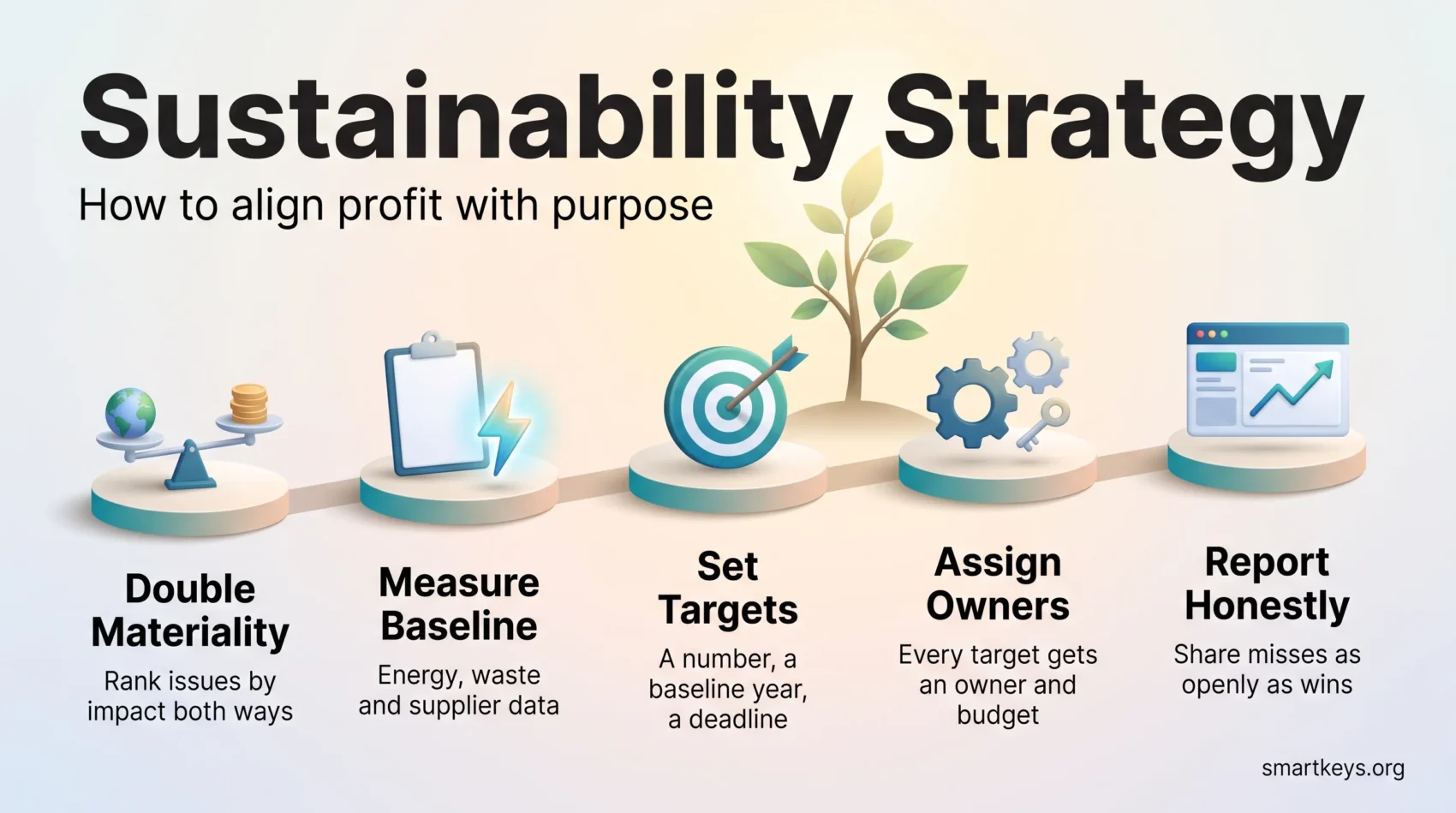
The short version: pick the few issues that matter most for your business, set measurable targets, give each target an owner and a budget, and report honestly on what changed.
Key Takeaways
- A sustainability strategy links daily business decisions to a short list of measurable environmental and social goals.
- The EU narrowed CSRD reporting in February 2026 to companies with more than 1,000 employees and €450 million turnover, but big customers still ask their suppliers for data.
- From 27 September 2026, EU rules ban vague green claims such as “eco-friendly” and product “carbon neutral” claims based on offsets.
- Start with a double materiality assessment, then set targets, owners, budgets and KPIs.
- Credible reporting beats ambitious pledges: companies such as Unilever have had to scale back targets they could not meet.
Why aligning profit with purpose matters in 2026
Sustainability used to sit in marketing. In 2026 it sits closer to finance and legal, because the questions now come from people who control money and market access.
Regulators, lenders and large customers increasingly expect numbers instead of promises. That includes emissions data, supplier information and evidence behind any green claim on a product or website.

A clear plan turns that pressure into an advantage. If you report progress consistently, you are ready when a customer sends a sustainability questionnaire or a bank asks about climate risk.
- Lower risk: you spot supply chain, energy and regulatory problems before they hit operations.
- Better market position: buyers, especially large B2B customers, favour suppliers who can document their performance.
- Stronger hiring: clear values help you attract people who want their work to mean something.
The wider context is covered in our overview of CSR trends and the shift from pledges to proof. This article focuses on the practical side: building the plan itself.
What a sustainability strategy is and what it includes
A sustainability strategy turns broad commitments into concrete actions across your business. It defines how your operations, products and services address environmental, social and economic priorities over the long term.
Definition and long-term value
Think of it as a blueprint that connects daily activities to measurable goals. You identify the issues that matter most, set targets and link each initiative to business value, such as lower costs, new revenue or reduced risk. That link is what keeps the plan alive when budgets get tight.
Core components
- Goals: time-bound targets tied to your most important issues. Many companies map them to the UN Sustainable Development Goals (SDGs), a set of 17 global goals adopted in 2015.
- Policies: rules for procurement, energy use, travel and labour practices.
- Actions: projects such as energy efficiency upgrades, waste reduction or supplier improvement programmes.
- Accountability: a named owner, a KPI (key performance indicator) and a reporting rhythm for each goal.
- Measurement: a reporting framework that makes your data comparable year on year (more on frameworks below).
Tangible benefits
The most reliable benefits are operational: less energy, material and packaging means lower costs. A documented track record also eases access to green financing options such as sustainability-linked loans.
The forces shaping your sustainability strategy in 2026
Regulation gets the most attention, but customer demands and costs often matter more for small and mid-sized businesses.
Reporting rules: narrower scope
The EU’s Corporate Sustainability Reporting Directive (CSRD) requires detailed environmental, social and governance (ESG) reporting. Companies use the European Sustainability Reporting Standards (ESRS) to do it. The EU’s “Omnibus I” simplification package, published in the Official Journal on 26 February 2026, cut the scope sharply. Mandatory reporting now applies to EU companies with more than 1,000 employees and more than €450 million in net turnover.
For smaller firms, two details matter. A “value chain cap” limits what large reporting companies may demand from partners with fewer than 1,000 employees. But those companies still need supplier data, so expect questionnaires even if you are out of scope.
The same package raised the threshold for the Corporate Sustainability Due Diligence Directive (CSDDD), which requires companies to find and address human rights and environmental harm in their supply chains. It now covers companies with more than 5,000 employees and €1.5 billion turnover, from July 2029.
In the US, California’s SB 253 applies to companies with more than $1 billion in annual revenue that do business in the state. They must report their Scope 1 and Scope 2 emissions. Scope 1 covers emissions from your own operations; Scope 2 covers the electricity and heat you buy. The state regulator moved the first deadline to 10 November 2026. Its sister law SB 261, on climate risk reports, has been on hold since a November 2025 court injunction.
Green claims rules
From 27 September 2026, the EU’s Empowering Consumers for the Green Transition Directive (often called EmpCo) applies. It bans generic claims such as “eco-friendly” without recognised proof, as well as self-made sustainability labels. Product claims of being “climate neutral” based on carbon offsets are banned too. If you sell to EU consumers, audit your packaging, website and ads now, and see what consumers actually reward.
Investors and access to capital
Lenders and investors price climate and governance risk into their decisions. Outside Europe, the ISSB standards (IFRS S1 and S2, a global baseline for sustainability and climate disclosure) are spreading. According to S&P Global, 28 jurisdictions had adopted them on a voluntary or mandatory basis as of April 2026, with 12 more planning to.
Cost, risk and resource efficiency
Carbon pricing and raw material swings raise costs. The EU’s Carbon Border Adjustment Mechanism (CBAM), which puts a carbon price on imports such as steel, aluminium and cement, entered its definitive phase in January 2026. Energy efficiency and circular economy models, which keep products and materials in use longer, protect margins against these swings. Even digital businesses are affected, as AI data center energy demand feeds into cloud and power prices.
Employer brand and talent
A strategy people can see in daily decisions supports talent retention far better than a glossy report nobody reads.
How to develop a sustainability strategy step by step
Now to the plan itself. Work in phases, and keep the first version short enough to use.
1. Run a double materiality assessment
A double materiality assessment looks at two directions. How do environmental and social issues affect your business (for example, flood risk at a warehouse)? And how does your business affect people and the environment (for example, emissions from your delivery fleet)? Interview customers, employees, suppliers and finance, then rank issues by importance on both axes. The top five to eight become your focus.
2. Measure your baseline
Credible targets need a starting point. Collect energy bills, fuel use, waste volumes and key supplier data for the last full year. Carbon accounting software helps once the data gets messy, especially for Scope 3, the emissions from your suppliers and the use of your products.
3. Set a vision, goals and time-bound targets
Write a one-paragraph vision, then pick measurable goals for your material issues. A good target names a number, a baseline year and a deadline, such as “cut Scope 1 and 2 emissions by a set percentage against 2025 by 2030”. If climate is central, our roadmap to carbon neutrality explains how current net-zero standards treat offsets.
4. Define governance and stakeholder engagement
A board member or executive sponsors the strategy; each target gets an operational owner. Test the draft with employees, key customers and suppliers.
5. Integrate with your core business
Link initiatives to product design, procurement rules and the annual budget. A strategy with a separate budget line gets cut first; one built into purchasing and capital planning survives.
Putting your strategy into action across the business
A plan on paper changes nothing until leaders back it with time, people and money.
Secure leadership sponsorship and resources
Senior backing unblocks decisions and signals that the work is funded. Leaders who model the behaviour they ask for matter here; our piece on ethical leadership covers why.
Build a cross-functional team
Sustainability touches operations, finance, procurement, product and HR, so no single department can deliver it.
- Define roles, decision rights and a monthly or quarterly review.
- Run small pilots, such as one site or one product line, before scaling.
- Tie milestones to capital planning and supplier selection. Our guide to greener supply chains shows how procurement criteria can do much of the work.
Give employees the tools and routines
Short checklists beat long policies. Procurement needs a supplier scorecard; facilities needs energy data by site; product teams need material and repairability criteria.
Measuring performance, reporting progress and staying credible
Measurement turns intentions into results people can check and trust.
Choose KPIs and targets
Pick KPIs that match your material issues, such as emissions, energy, waste, safety incidents or staff turnover, and track them yearly against the same baseline.
Use frameworks and tools
Frameworks make your data comparable. The most common options:
- GRI: the most widely used standard for reporting a company’s impact on people and the environment.
- ISSB (IFRS S1 and S2): investor-focused standards; they absorbed the industry-specific SASB standards.
- ESRS: mandatory for companies in CSRD scope and a useful template for everyone else.
- GRESB: a benchmark specifically for real estate and infrastructure portfolios.
Our guide to choosing an ESG framework compares these in more detail.
Monitor, adjust and stay honest
Build simple controls: who collects each number, who checks it and where the evidence is stored. Treat sustainability data like financial data, as part of your wider risk management framework.
- Publish your methods and boundaries so readers can verify claims.
- Report misses as openly as successes. Readers trust a company that explains a missed target more than one that quietly drops it.
Embedding a culture of sustainability and employee well-being
The social side of a strategy starts inside the company. Put clear criteria into purchasing rules and performance reviews, so that “what does this do to our targets?” becomes a normal meeting question. Then look after your own people: safety, fair pay and manageable workloads affect engagement and turnover as much as any environmental project.
- Train managers to spot overload and support their teams.
- Use flexible work and travel policies that cut commuting and flights where the job allows. Our analysis of the carbon impact of remote work shows where the savings are real.
- Build succession for key sustainability roles so the strategy does not depend on one champion.
Sustainability strategy examples and practical actions
Examples make abstract goals concrete, and they show that strategies need adjusting when reality gets in the way.
Business model shifts: dematerialization, circularity and product-as-a-service
Dematerialization means delivering the same value with fewer physical goods. Netflix’s move from mailed DVDs to streaming removed discs, packaging and postal logistics, although streaming has its own energy footprint in data centers and networks.
Product-as-a-service means customers pay for use rather than ownership, through leasing, take-back or repair contracts. The supplier keeps an incentive to build durable products. Our articles on servitization and circular manufacturing cover the economics, and the EU’s digital product passport will soon require product data that supports these models.
Company snapshots: Netflix, Unilever, Holcim
- Netflix: a business model shift that cut physical material flows.
- Unilever: a cautionary example. In April 2024 it replaced its target of halving virgin plastic by 2025 with a 30% cut by 2026. The lesson: set targets you can fund and deliver.
- Holcim: the building materials group sells lower-carbon concrete and uses recycled construction waste as a raw material, turning a regulatory pressure into a product line.
For more ideas on turning sustainability into new products and services, see our practical guide to sustainable business innovation.
Quick wins and a manufacturing scenario
Start with quick-payback projects: energy audits, LED lighting, heating tune-ups and waste separation. A mid-sized furniture manufacturer, for example, could work through these steps:
- Measure a baseline: energy per site, wood and foam waste, transport emissions.
- Rank projects by cost and impact: compressed-air leaks and lighting first, rooftop solar later.
- Engage suppliers on certified wood and recycled packaging, redesign one product for easier repair, and track results each quarter.
Using your sustainability strategy for competitive advantage
Once the basics work, the strategy can become a growth engine rather than a compliance cost. Rising transparency rewards early movers: products that are durable, repairable and have a verified lower footprint win customers who need those qualities for their own reporting.
To make the business case, tie each initiative to a financial effect: cost saved, revenue gained or risk reduced. Use scenario planning to test how higher carbon prices or a supplier failure would hit your margins, and present the portfolio the way finance presents any investment case.
Conclusion
A sustainability strategy is not a report or a slogan. It is a short list of priorities, backed by owners, budgets and honest data. To develop yours, start with a double materiality assessment, measure a baseline, set targets and build reviews into your planning cycle.
The 2026 rules reward this approach. Fewer companies must file CSRD reports, but customers, lenders and consumer rules all expect evidence. Start small, measure carefully and scale what proves both profitable and credible.
Found this useful?
Make SmartKeys a preferred source on Google, and our articles will surface more often in your Top Stories, AI Overviews, and AI Mode.
Add as Preferred Source