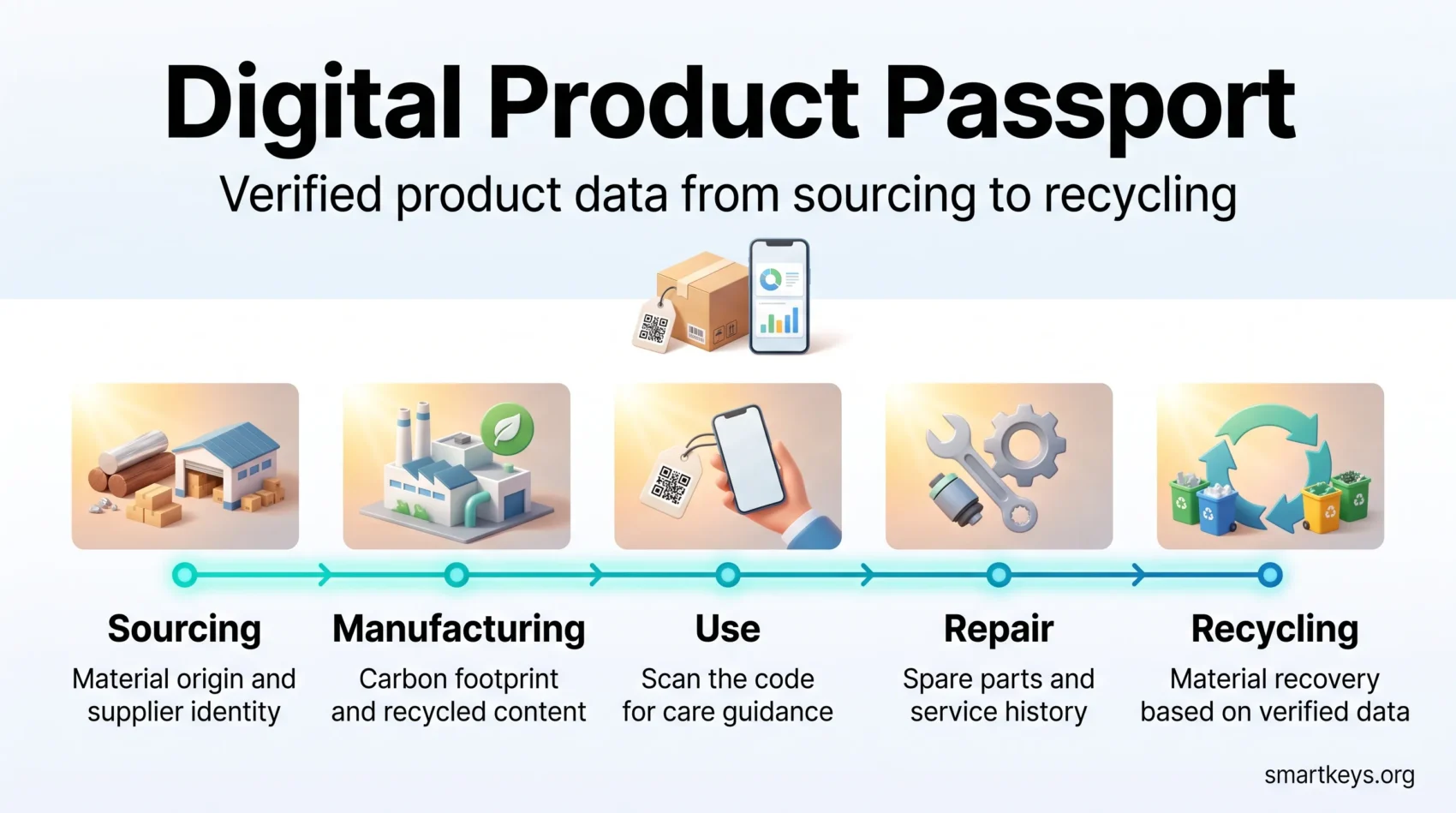
EU sustainability rules have moved from proposal to plumbing. A digital product passport is a structured lifecycle record that follows an item from sourcing through manufacturing, use, repair, and recycling.
The Ecodesign for Sustainable Products Regulation (EU) 2024/1781, or ESPR, entered into force on 18 July 2024. Two years later, Article 13 of that regulation required the European Commission to have a central registry for digital product passports (DPPs) in place by 19 July 2026. The registry opened to users on 20 July 2026, and Implementing Regulation (EU) 2026/1778 sets out how it works. The first hard sector deadline follows on 18 February 2027, when battery passports become mandatory.
Reliable product data is no longer a policy topic for your sustainability team. It is a market-access requirement with dates attached.
This guide covers what a digital product passport must contain, which sectors are affected and when, and how to share verified data without exposing trade secrets.
Key Takeaways
- The ESPR is in force, and the EU central DPP registry opened to users on 20 July 2026.
- Battery passports are the first binding obligation, from 18 February 2027, and that date holds even though the implementing act on access rights is late.
- Six priority product groups have delegated acts scheduled between 2026 and 2029.
- Registration requires a verified identity under eIDAS, not just clean data, and that status lasts up to three years.
- Selective disclosure meets transparency duties without publishing trade secrets.
What Is a Digital Product Passport and Why Does It Matter?
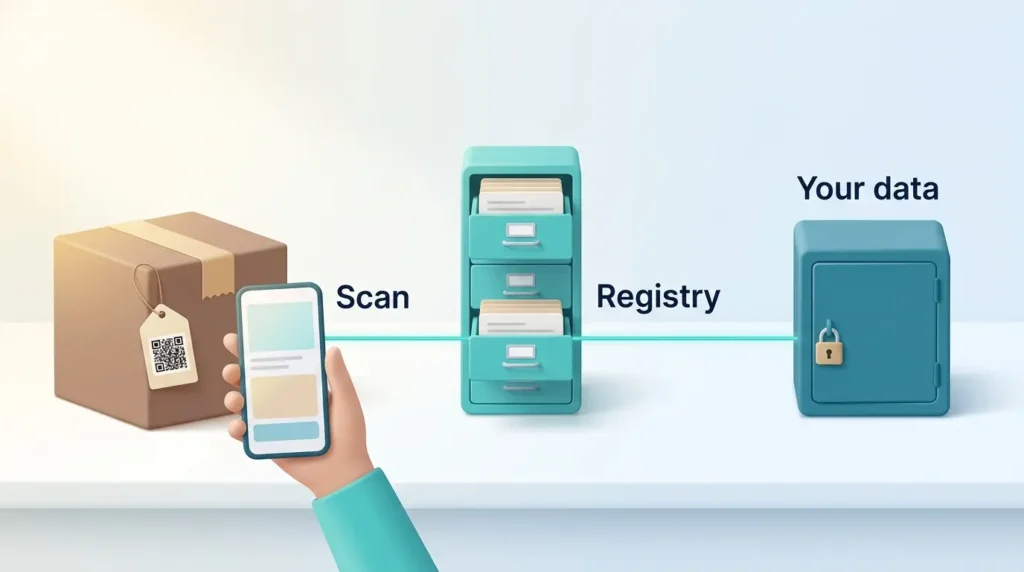
A digital product passport is a data record tied to a specific product, batch, or item. It links that physical thing to verified information about materials, origin, sustainability performance, repairability, and end-of-life handling, reached by scanning a QR code, barcode, or NFC tag.
How the Record Follows an Item
Scan the code on a jacket and your phone can show fibre composition, country of manufacture, care and repair guidance, and how to return the garment at end of life. Each audience sees only the fields relevant to it.
The European Commission describes it as a digital container for products, components, and materials.
Why the Registry Matters More Than the Label
One detail is widely misunderstood: the EU’s central registry is a directory, not a database of passport content. It stores identifiers and registration metadata, then points to wherever the manufacturer hosts the passport itself. Your data stays with you.
Implementing Regulation (EU) 2026/1778, in force since 6 August 2026, fills in the mechanics. Verified operators submit passports through the registry website or a direct system-to-system connection. The Commission checks structure and completeness automatically, though the regulation states that passing is not proof the product complies. Proof of registration is valid for 90 days and can be regenerated, and registration data is deleted 10 years later unless another law requires longer.
The practical result is shared value: consumers can compare durability before buying, businesses can substantiate sustainability claims, recyclers can identify materials reliably, and authorities can check compliance without a document request.
How EU Rules Are Driving Digital Product Passport Adoption
The European Union has turned product data into a condition of market access. Verified data now underpins trust, faster market checks, and tighter supply chain control.
The Ecodesign for Sustainable Products Regulation
The ESPR replaced Ecodesign Directive 2009/125/EC and widened the scope from energy-related products to almost all physical goods placed on the EU market, including goods made outside the region. Food, feed, and certain medical products stay outside it. The regulation sets the framework; delegated acts set the requirements.
The Circular Economy Action Plan and What Follows It
The Circular Economy Action Plan, adopted in March 2020, targeted high-waste sectors including batteries, plastics, construction, and textiles. It is the policy behind the shift toward a circular economy, where products are designed to be repaired, reused, and recovered rather than thrown away. The Commission has signalled a Circular Economy Act as the next step and has listed it for 2026. Until that proposal is published, treat it as a direction of travel rather than a settled requirement.
Related EU Legislation That Also Mandates Passports
The ESPR is not the only route to a passport obligation. The Commission lists standalone legislation carrying its own DPP requirements: the Batteries Regulation, the Packaging and Packaging Waste Regulation, the Critical Raw Materials Act, the Toy Safety Regulation, the Construction Products Regulation, and the Detergents and Surfactants Regulation. Reporting duties push the same way. The Corporate Sustainability Reporting Directive (CSRD) governs what large companies publish about their environmental and social performance, and the Corporate Sustainability Due Diligence Directive (CSDDD) covers how they check their own supply chains. An evidence base built for corporate carbon-neutrality targets largely carries over.
What Happened to the Green Claims Directive
One correction is worth making, because the Green Claims Directive is still cited as though it were law. The European Parliament adopted its position on 12 March 2024, but the Commission announced withdrawal of the proposal in June 2025, and it is not proceeding in its original form.
Greenwashing rules did not disappear with it. The Empowering Consumers for the Green Transition Directive (EU) 2024/825 was published on 6 March 2024. Member States had to write it into national law by 27 March 2026, and those national rules apply from 27 September 2026. They ban generic environmental claims such as “eco-friendly” or “climate neutral” where a company cannot substantiate them, which raises the value of passport-grade evidence.
Who Needs to Implement a Digital Product Passport?
Market access depends on where you sell, not where you are registered. Manufacturers, importers, distributors, and retailers can all carry duties, and a company based in the United States or Asia is in scope the moment its regulated goods reach an EU buyer.
“Compliance follows the market, not the company address.”
The Verification Step Teams Underestimate
Under the registry rules, only verified economic operators can register passports. Verification runs on eIDAS, the EU framework for electronic identity and trust services. In practice that means a qualified electronic signature for a sole trader, or a qualified electronic seal for a company, issued by an approved trust service provider. Verified status then lasts up to three years. Getting them involves an identity check, so start early.
Responsibility then spreads across the chain: suppliers provide material data, manufacturers own the record, sales channels surface approved fields, and waste operators use it for recovery. Smaller businesses are not left alone with this, since ESPR Article 19 obliges Member States and the Commission to provide guidance, financial support, and training.
- Map each partner’s role and data ownership.
- Confirm who is the responsible economic operator for EU placement.
- Start eIDAS verification early.
What Information Must a Digital Product Passport Include?
Your record has to turn scattered supply data into structured, machine-readable information. A digital product passport needs a unique identifier linked to a data carrier, which is the QR code, barcode, or chip that a scan reads. Standards such as ISO/IEC 15459 exist so that identifier works across global systems. Most implementations build on GS1 identifiers and GS1 Digital Link, from the organisation behind retail barcodes, because that is what retail and logistics systems already read.
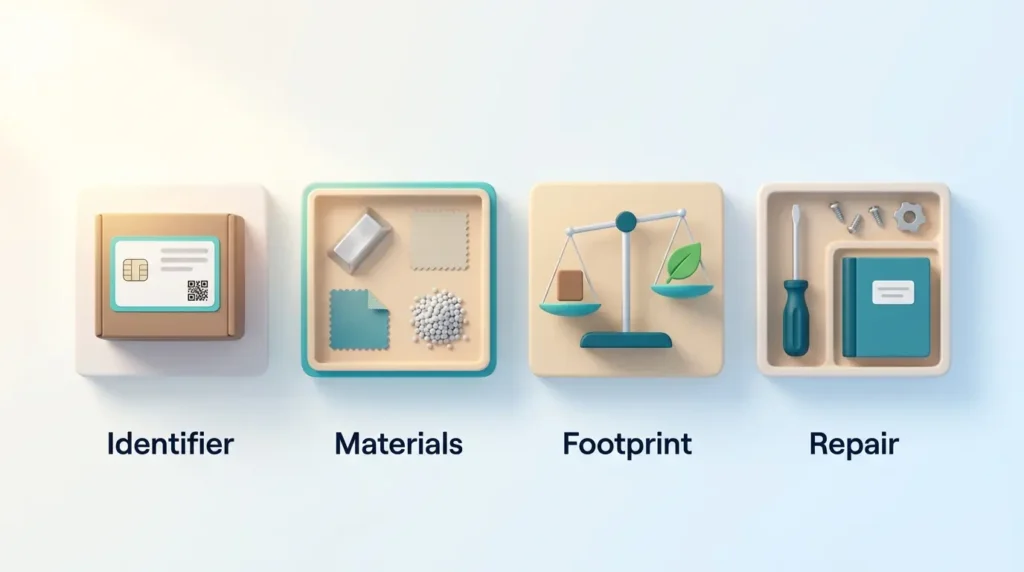
Product, Material, and Supply Chain Data
Include model, batch, and item detail, raw-material origin, supplier identity, substances of concern, and packaging, in structured fields rather than PDFs. Granularity is set per category: a passport may be issued at model, batch, or item level. Getting that wrong is expensive, because retrofitting item-level serialisation means changing how production lines mark goods.
Carbon Footprint and Environmental Impact Details
Record product carbon footprint, use-phase energy, recycled content, and the other impact measures defined for your category. These fields feed sustainability reporting and let you test claims before a regulator or competitor does. Teams already running carbon accounting software usually find them the least painful part.
Repair, Ownership, Warranty, and End-of-Life Information
Add repair events, spare-part references, disassembly instructions, warranty terms, and recycling guidance. This is the part with the clearest commercial upside, because it makes repair, refurbishment, and resale operationally possible rather than merely well-intentioned.
Digital Product Passport Requirements by Industry
Requirements vary by sector, so your plan should follow the product’s own life cycle, from sourcing through reuse and recycling.
Battery Passports: the First Binding Deadline
Batteries set the pace. Under Regulation (EU) 2023/1542, from 18 February 2027 a battery placed on the EU market needs a battery passport if it powers a light means of transport (an e-bike or e-scooter, for example), is an industrial battery above 2 kWh, or is an electric vehicle battery. Required data covers material sourcing, recycled content, carbon footprint, durability, repurposing, and recycling guidance. DIN DKE SPEC 99100 is a useful reference for core battery attributes. The same date is when Member States must have appointed their national registry administrators.
Which Battery Deadlines Moved, and Which Did Not
This distinction is the most common planning error in battery compliance, and it is worth stating plainly. Most dates in Regulation (EU) 2023/1542 apply only once an enabling act is in force. Article 77(1) is the exception: its wording is unconditional, so the passport obligation stands on its own. The Commission reconfirmed the date publicly on 20 July 2026 when it opened the registry, describing it as the first implementation deadline.
Other obligations under the same regulation have moved. Supply chain due diligence duties for cobalt, lithium, nickel, and natural graphite were postponed by two years to 18 August 2027 under Regulation (EU) 2025/1561, and a separate Omnibus IV proposal would exempt companies below EUR 150 million turnover from them entirely. That proposal is still under discussion, so companies between the thresholds should prepare regardless. None of this touches the passport date.
The Access-Rights Gap You Have to Design Around
There is one open problem worth planning for now. The Commission was legally required to adopt the implementing act defining who may access non-public battery passport data by 18 August 2026. It did not, and its published timetable places that act in the fourth quarter of 2026.
The passport obligation does not move to accommodate the delay. Manufacturers therefore have to build tiered access control against rules that have not been written, with under six months of runway. The practical answer is to design against the three-tier structure already set out in the regulation itself, separating public data, data for legitimate interested parties, and data for authorities, and to keep the boundaries between those tiers configurable rather than hard-coded. When the act lands, you want to be adjusting a policy table, not re-architecting.
Textiles, Steel, Furniture, and Construction Products
The ESPR working plan puts iron and steel first, with textiles, tyres, and aluminium behind it, then furniture and mattresses. Construction products, toys, and detergents carry obligations through their own regulations.
- Textiles: fibre content, origin, durability, and care.
- Iron and steel: embodied carbon and recycled content.
- Construction: material impact, reuse, and declaration of performance.
- Furniture: sourcing, replaceable parts, and recovery routes.
Manufacturers already investing in digital twins in manufacturing have a head start: the product model and the bill of materials, meaning the full parts list for an item, are already digital and versioned. Our look at how the circular economy is changing manufacturing covers the wider shift these rules sit inside.
Digital Product Passport Timelines and Delegated Acts
The Commission adopted the first ESPR Working Plan for 2025 to 2030 on 16 April 2025, setting the order in which priority sectors are addressed. Delegated acts carry the practical detail: required data fields, technical standards, granularity, application dates, and enforcement rules for each category.
The Order of Play
Iron and steel is targeted first, with a delegated act expected around 2026 and compliance roughly two years later. Textiles, tyres, and aluminium are targeted for 2027, furniture for 2028, and mattresses for 2029. None of those acts had been adopted by mid-2026, and a mid-term review is scheduled for 2028, so treat the dates as planning assumptions rather than fixed deadlines. Batteries are the exception, set by a separate law that is already final.
Why Early Preparation Matters
The ESPR generally leaves a lead time between a delegated act’s entry into force and the point its requirements apply, typically around 18 months. That window closes quickly when suppliers use incompatible systems or cannot evidence what they ship. The data problem is almost always harder than the technology problem.
- Track the delegated acts covering your categories.
- Test the identifier and carrier on a real run.
- Collect supplier evidence before it is demanded.
How a Digital Product Passport Benefits Your Value Chain
A shared record turns compliance data into operating value. Manufacturers gain visibility into upstream components and supplier performance. Retailers work from one trusted source instead of reconciling supplier PDFs, much as a customer data platform consolidates fragmented customer records.
- Repair partners can identify components and service history up front.
- Recyclers can sort materials on evidence rather than assumption.
- Resale teams can price on verified condition and provenance.
- Procurement can compare suppliers on documented recycled content.
The clearest payoff is in secondary markets. Verified provenance and service history are what resale marketplaces need to price used goods with confidence, and the same record supports take-back and refurbishment. Documented environmental performance also overlaps with the evidence base behind green finance.
How to Assess Your Digital Product Passport Readiness
Before implementation starts, run a readiness audit. It shows where your records, systems, and partners will fail under scrutiny.
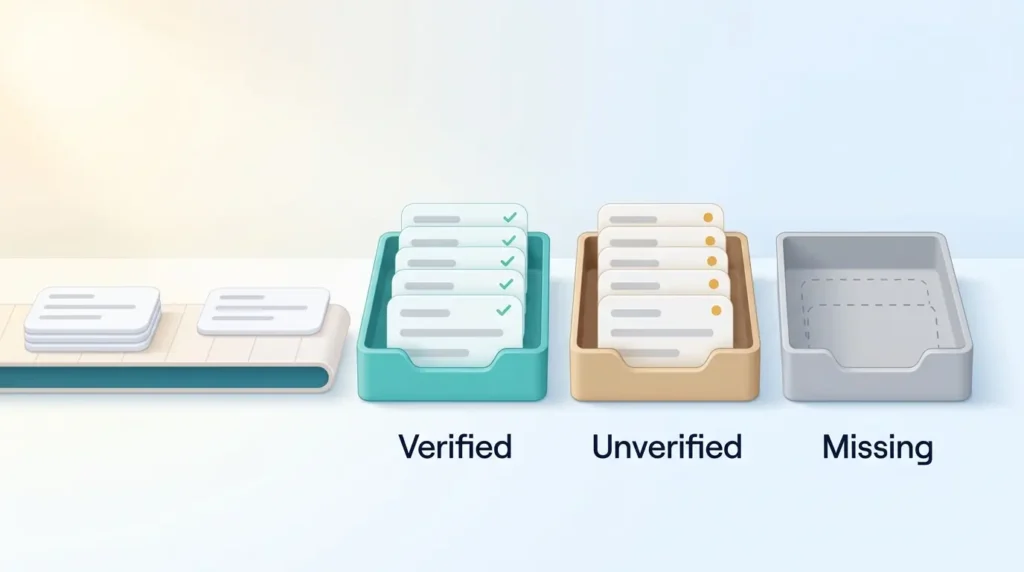
Finding Gaps in Product and Supplier Data
Start with identifiers, raw-material origins, components, supplier inputs, carbon figures, repair records, and end-of-life guidance. Score each field: present and verified, present but unverified, or missing.
Three failure patterns show up in nearly every audit. Fields exist under different names in different systems. Suppliers are known by purchase order but not by material declaration. Lifecycle events happen but nothing records them.
Run a small pilot before scaling. Pick one product family, a handful of suppliers, and the events that matter most. A narrow pilot exposes weak links and compliance gaps at a cost you can absorb. It is the same logic that makes predictive maintenance pilots work.
- Score field completeness against the requirement.
- Check whether supplier claims are evidenced or asserted.
- Test how a repair or recycling event updates the record.
- Assign a named owner for every field.
How to Implement a Digital Product Passport System
Decide the architecture before you choose a vendor. A passport is not a product you buy; it is an output your systems must produce reliably. Governance decides whether it holds up under audit.
Creating a Single Source of Truth for Product Information
Two systems usually carry this. Product information management (PIM) governs and enriches the product records your teams and sales channels use. Master data management (MDM) keeps identifiers and attributes consistent across every system that holds them. Together they create one trusted view of materials, design detail, repair events, and recycling guidance. Without it, every passport becomes a manual reconciliation exercise.
Connecting PIM, MDM, PLM, ERP, and Supply Chain Systems
Product lifecycle management (PLM), the system engineers design in, supplies engineering records. Enterprise resource planning (ERP), the system finance and operations run on, supplies transactions, serial numbers, and product codes. Supplier, factory, repair-centre, and recycler systems connect through machine-readable interfaces rather than emailed spreadsheets. Sector-specific platforms can shorten this work, which is part of the appeal of industry cloud platforms for regulated manufacturers. Teams using AI agent workflows for data enrichment should be deliberate about provenance: a passport field that cannot be traced to a source is a liability, not an efficiency.
Using QR Codes, NFC, RFID, and Other Data Carriers
QR codes suit packaging and retail scanning and are the default for consumer access. NFC, the near-field chip behind contactless payments, works for a quick phone tap on higher-value goods. RFID tags can be read at a distance and in bulk, which suits warehouse tracking. Choose on cost, durability, scan range, and who needs to read it. Where provenance across many independent parties is the core problem, some manufacturers pair the passport with distributed ledgers; our overview of blockchain in logistics covers where that helps and where it is overkill.
How to Protect Proprietary Data in Your Product Passport
Transparency does not mean publishing your bill of materials. A well-designed digital product passport gives each user only the fields their role requires: compliance evidence for an authority, care and repair guidance for a customer, material composition for a recycler. None of those roles needs your supplier contracts or formulations.
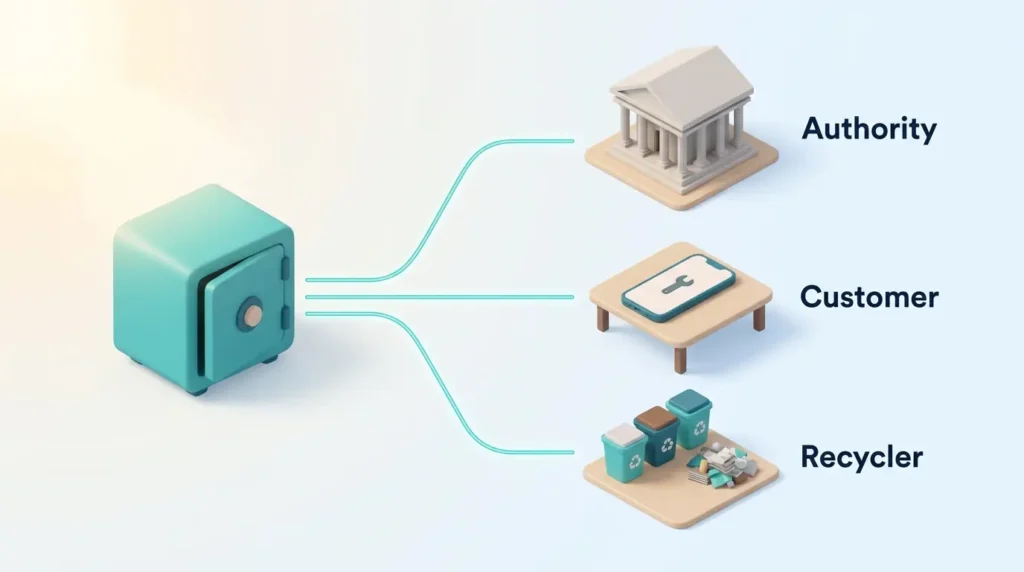
The architecture helps. Because the registry indexes passports rather than storing contents, sensitive records stay in your systems or your provider’s, and no single store holds every manufacturer’s data. Access control is yours to design, and yours to get wrong. For batteries that design work cannot wait for the implementing act on access rights, which is running behind schedule while the February 2027 obligation stays fixed.
Use several safeguards together:
- Encryption at rest and in transit for every exchange.
- Role-based access, so each audience sees a different view of the same passport.
- Zero-knowledge proofs, to confirm a claim without revealing the underlying data.
- Qualified electronic signatures and seals, which the registry requires in any case.
- Audit logging, so you can show who accessed what and when.
A zero-knowledge proof can show that a material meets a recycled-content threshold without revealing the supplier or the formulation. That is the balance the regime aims for: verifiable claims without forced disclosure. Where passport data is hosted matters too, because data localization laws can require certain records to stay inside a given country.
Turning Digital Product Passport Compliance Into Business Growth
Handled well, compliance work produces an asset: a trustworthy, queryable record of what you make and what it is made of.
Building Trust Through Verifiable Claims
A passport gives customers evidence of material origin, durability, repair options, and environmental impact. That evidence is what makes a claim defensible once the national rules under the Empowering Consumers Directive restrict generic green claims from 27 September 2026. The discipline behind explainable AI applies here too: if you cannot show the working, do not make the claim.
Enabling Repair, Resale, Recycling, and Circular Models
The Right to Repair Directive (EU) 2024/1799 applied from 31 July 2026, the deadline by which Member States had to transpose it. It obliges manufacturers of listed goods, including washing machines, refrigerators, electronic displays, phones and tablets, and servers, to offer timely and cost-effective repair and to make spare parts available at a reasonable price. Sellers who repair rather than replace under warranty owe an extra year of legal guarantee.
Repair history, parts information, and service instructions therefore carry direct commercial value. They support refurbishment programmes, resale and take-back services, material recovery, and product-as-a-service models where you keep ownership of the item.
These models also feed the 2030 benchmarks the Critical Raw Materials Act sets for strategic raw materials: 10% of annual EU consumption from EU extraction, 40% from EU processing, and 25% from EU recycling. Recovered material only counts if someone can identify it, which is what a passport enables, and it is one reason green supply chains now depend on data as much as on logistics. Advances in additive manufacturing for spare parts make repair viable in categories where it previously was not, and platform business models are emerging around exactly this kind of verified product data.
Conclusion
The infrastructure arrived before most companies did. The registry opened in July 2026, the first binding deadline is 18 February 2027, and the delegated acts that will bind everyone else are scheduled.
Start where the friction is highest: identifiers, supplier evidence, and named ownership of each field. Get eIDAS credentials in hand early, since verification is a prerequisite for registration rather than a closing formality. Then run one narrow pilot and let it show you what your systems cannot do yet.
Preparation is where the advantage sits. Treat the digital product passport as a data capability rather than a compliance filing and the record pays for itself in resale, repair, procurement, and customer trust.
Found this useful?
Make SmartKeys a preferred source on Google, and our articles will surface more often in your Top Stories, AI Overviews, and AI Mode.
Add as Preferred Source